THE SHORT ANSWER
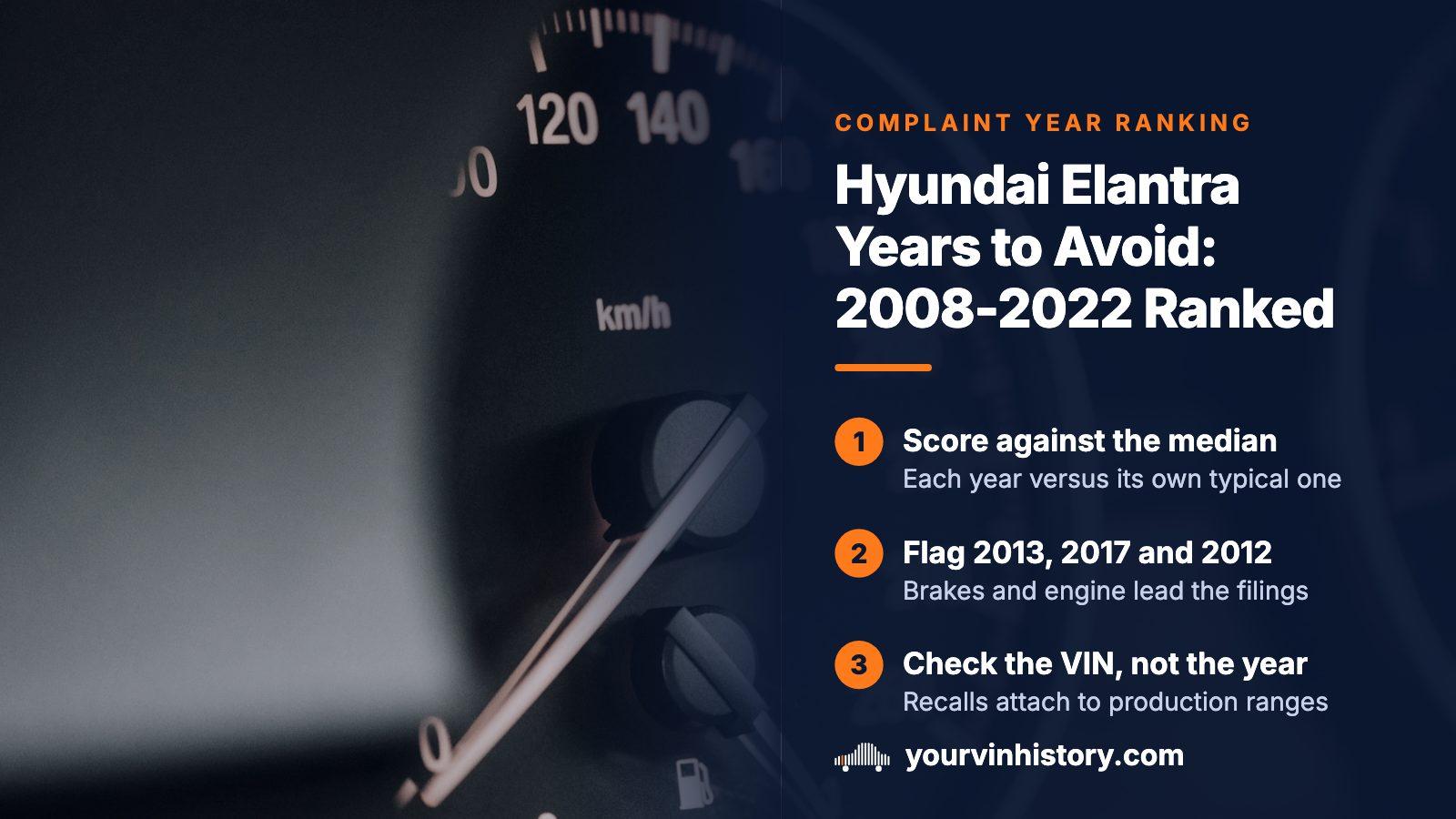
By NHTSA complaint volume, the 2013 Hyundai Elantra is the year to inspect hardest, with 1,331 complaints against the Elantra's own yearly median of 315. The 2017 and 2012 cars follow at 787 and 673. The lightest records belong to 2022 and 2021, at 152 and 158. Engine is the biggest complaint area, with 1,600 reports. Complaints are unverified owner accounts, not failure rates, so a flagged year is a reason to inspect harder and haggle, not to skip the car.
- Owner complaints on file
- 6,386 across 2008 to 2022
- Typical year
- 315 complaints
- Peak year
- 2013, with 1,331 complaints
- Largest area
- Engine, 1,600 reports
Scoring each year against the Elantra's own typical year
Raw complaint totals mostly track how many cars were sold. A model year that moved in huge numbers piles up filings even when the cars are sound, while a slow seller looks spotless for the opposite reason. To strip out most of that effect, this page ranks every Elantra year against the nameplate's own median year instead of against other models.
The pool is every NHTSA consumer complaint on the 2008 through 2022 cars, 6,386 in all, spread over 15 model years and deduplicated by NHTSA's ODI complaint number, pulled on 2026-08-15. The middle year of those fifteen draws 315 complaints. A year at 1× is therefore ordinary for this car, and a year near 4× has drawn about four times the usual volume of owner reports. A multiple tells you how many owners wrote in. It is not a failure rate and not a reliability score.
All 15 Elantra model years in one table
The Standing column is shorthand, not an official grade. Heavy means more than double the median, elevated means about one and a half times it, typical means within a quarter of it in either direction, and light means about half.
| Year | Complaints | Times median | Recalls | Standing |
|---|---|---|---|---|
| 2008 | 315 | 1× | 7 | Typical |
| 2009 | 282 | 0.9× | 4 | Typical |
| 2010 | 453 | 1.44× | 3 | Elevated |
| 2011 | 460 | 1.46× | 5 | Elevated |
| 2012 | 673 | 2.14× | 4 | Heavy |
| 2013 | 1,331 | 4.23× | 4 | Heavy |
| 2014 | 390 | 1.24× | 2 | Typical |
| 2015 | 261 | 0.83× | 3 | Typical |
| 2016 | 297 | 0.94× | 2 | Typical |
| 2017 | 787 | 2.5× | 4 | Heavy |
| 2018 | 329 | 1.04× | 0 | Typical |
| 2019 | 249 | 0.79× | 1 | Typical |
| 2020 | 249 | 0.79× | 3 | Typical |
| 2021 | 158 | 0.5× | 6 | Light |
| 2022 | 152 | 0.48× | 5 | Light |
| Median of the 15 | 315 | 1× | n/a | Benchmark |
The step from 673 to 1,331 between 2012 and 2013
The 2012 car, at 673 complaints, already sits 2.14× above the median. The 2013 car then nearly doubles that to 1,331, which is 4.23× and the largest count in the set. A jump this big between neighboring years often coincides with a redesign or a mechanical change, though complaint counts alone cannot say which happened here.
Service brakes is the most reported area on the 2013 car, and steering stands out there too. Engine leads on the 2012 car. The two years carry 4 recalls each. Read together they form a block of heavy filings, so a 2012 is not a safe-side alternative to a 2013 on complaint volume alone. This site also has a separate record page for the 2013 Elantra, covering its recall campaigns and how its complaints break down by component.
The 2010 to 2013 climb, and 2017 on its own
Counting 2013, five years are flagged as running well above the median. They fall into two groups with different shapes, and one neighbor deserves a mention as well.
- 2010 to 2013: complaints rise every year, from 453 to 460 to 673 to 1,331, so four consecutive model years sit above the median. Steering is the most reported area on the 2010 car, engine on 2011 and 2012, service brakes on 2013.
- 2017: 787 complaints, 2.5× the median, with engine as the leading area. The 2016 car (297) and the 2018 car (329) on either side are both ordinary, which makes 2017 a one-year spike rather than part of a trend.
- 2014: 390 complaints, 1.24×. It is the first year after the peak, just outside the flagged group and already back near the median.
Engine leads in three of the five flagged years, 2017, 2012 and 2011, which matches its place as the biggest category overall.
The quietest records, and why the newest cars are left out
Among model years old enough to have settled, 2022 and 2021 hold the lightest files: 152 complaints at 0.48× and 158 at 0.5×. They also show 5 and 6 recalls, more than most years in the table. Few complaints alongside many recalls can mean defects were found and handled under the maker's remedy program, though a count cannot confirm that.
Next quietest are 2019 and 2020 at 249 apiece (0.79×) and 2015 at 261 (0.83×). The 2018 car is the only year with no recalls at all, and its 329 complaints sit at 1.04×.
The data stops at 2022, and the newest three model years never qualify for a cleanest list. A young car has had little time to collect owner reports, so it looks tidy whether or not it deserves to.
Where owners point: engine first, then steering and electrical
Across all 15 years, NHTSA's component categories for the Elantra rank like this in the leading categories:
- Engine: 1,600 reports
- Steering: 964 reports
- Electrical system: 792 reports
- Service brakes: 650 reports
- Air bags: 545 reports
- Unknown or other: 446 reports
These are broad buckets, not parts. Engine takes in any engine fault an owner reports, and electrical system stretches from wiring and lighting to control modules. The counts tell a mechanic where to start looking on any Elantra, whichever year you buy, but they do not isolate one failing component. The list covers the leading categories only, so it will not add up to the full 6,386, and the smaller entries are still sizable: air bags alone drew 545 reports, which is why the air bag warning lamp shows up in the inspection steps below.
Recalls and complaints measure different things
A recall is a defect the manufacturer has acknowledged and must repair at no charge. That duty has an age limit: under 49 U.S.C. 30120(g) it lapses 15 years after a car's first sale, so the oldest Elantras in the table are the ones nearest that edge for any newly announced campaign. A complaint is the opposite kind of record, one owner's unverified account.
The two columns do not move together. The 2008 car carries the most recalls, 7, yet its complaints sit exactly at the median. The 2013 car has 4 recalls and the biggest complaint count. Campaigns also attach to production ranges, not whole model years, so the table shows how many campaigns touched a year and not whether a given car is affected. Only the VIN answers that.
Four ways a complaint count can mislead a buyer
- Sales volume: a bestseller collects more filings than a rare car of equal quality. The median method removes most of that distortion, not all of it.
- Age: older model years have had longer to gather reports, which is why the newest years are treated as provisional instead of being ranked as best.
- Unverified accounts: a complaint records what an owner believed happened. That is useful in bulk and shaky one at a time.
- No single car: the Elantra you are looking at has its own history, and no model-year statistic describes it.
A flagged year is a bargaining chip, not a verdict
A heavy complaint year justifies a closer look and a lower offer. It says nothing definite about the particular Elantra on the lot, which may be the best-kept car of its year.
What to check on a used Elantra from a heavy year
- Ask for service records and read the engine entries first. Engine is the largest category overall and the top area on the 2017, 2012 and 2011 cars.
- Enter the VIN in NHTSA's recall lookup, which costs nothing, and compare the result with the repair paperwork. Only the VIN shows which campaigns this car carries.
- On a 2013 or 2010 car, spend part of the test drive on the areas those owners reported most: how the brakes feel and how the steering responds.
- Watch the air bag warning lamp at start-up. Air bags drew 545 complaints across the run.
- Pay an independent shop for a pre-purchase inspection with the car on a lift, and ask it to start with the engine.
From the model year to the car on the lot
A model year describes a population, and a VIN describes one car. After you pick a year, the facts that decide the purchase belong to the vehicle itself. Those are the recall campaigns that cover its build and whether the repairs were done, any brand on the title, an odometer sequence that climbs in a believable order, and whatever a mechanic finds with the car in the air.
NICB's VINCheck screens a VIN for reported theft and total-loss status at no cost, and the Bureau of Justice Assistance explains the national title database, NMVTIS. A yourvinhistory report puts title brands, accidents, odometer readings and open recalls in one place, with NMVTIS title records supplied by ClearVin LLC, an approved NMVTIS data provider. The preview is free and the full report is a one-time purchase.
Where this information comes from
- NHTSA: Vehicle safety — The federal safety agency whose consumer complaint database supplies the owner reports counted for each Elantra model year.
- NHTSA: Recalls — Source of the yearly recall tallies, and the place to enter a VIN to see which campaigns apply to one specific car.
- Bureau of Justice Assistance: NMVTIS — Federal overview of the national title record, which holds the paperwork history of an individual car that a model-year ranking cannot show.
- NICB: VINCheck — A no-cost screen of one VIN for reported theft and total-loss status.
Sources and photos: Facts checked against the sources above in October 2026. Photo by Erik Mclean on Unsplash; diagrams by YourVINHistory.
Keep reading
- 2013 Hyundai Elantra recalls and complaints: the NHTSA recordThe record page for the heaviest year here, with its recall campaigns and complaint areas.
- Hyundai recallsHow to run a Hyundai VIN through the recall lookup and read what comes back.
- Hyundai Elantra timing chain replacement cost: what to settle before you payCost context for an engine job on this car, the complaint area that leads the table.
- Pre-purchase inspectionWhat an independent shop covers on a lift, where complaint areas turn into findings.
Frequently asked questions
Which Hyundai Elantra years should I avoid?
By complaint volume, the 2013 model stands out with 1,331 filings, followed by 2017 at 787 and 2012 at 673. The 2010 to 2013 run also climbs each year. None of that proves a given car is bad, so treat a flagged year as a prompt for a harder inspection and a firmer price.
What is the most reliable Hyundai Elantra year?
No public complaint count measures reliability. What the data does show is that 2022 and 2021 hold the lightest files, 2019 and 2020 sit at 249 each, and 2018 has no recalls. The newest years are left out of that comparison, since young cars have had little time to collect reports.
What goes wrong most often on a Hyundai Elantra?
Engine, with 1,600 reports, then steering at 964 and electrical system at 792. Those are broad NHTSA categories, so a count does not point to one failed part. It does suggest that an inspector should begin under the hood on any Elantra, whichever model year it is.
Are Hyundai Elantra recalls repaired for free?
Dealers perform recall repairs at no charge, but within federal limits. The duty under 49 U.S.C. 30120(g) lapses 15 years after a car's first sale, so an older Elantra may fall outside it for a new campaign. Check the VIN with NHTSA, then ask a dealer whether any open item is still covered.
How do I check a specific Elantra before buying?
Start with the VIN. Look it up in NHTSA's recall tool, screen it with NICB's VINCheck for theft and total loss, and review its title record through an NMVTIS provider. Then book an independent inspection. A model year describes thousands of cars, but only the VIN tells you about the one you are buying.
Now check the car itself
The guide explains what to look for. The report shows what this VIN has on record.