THE SHORT ANSWER
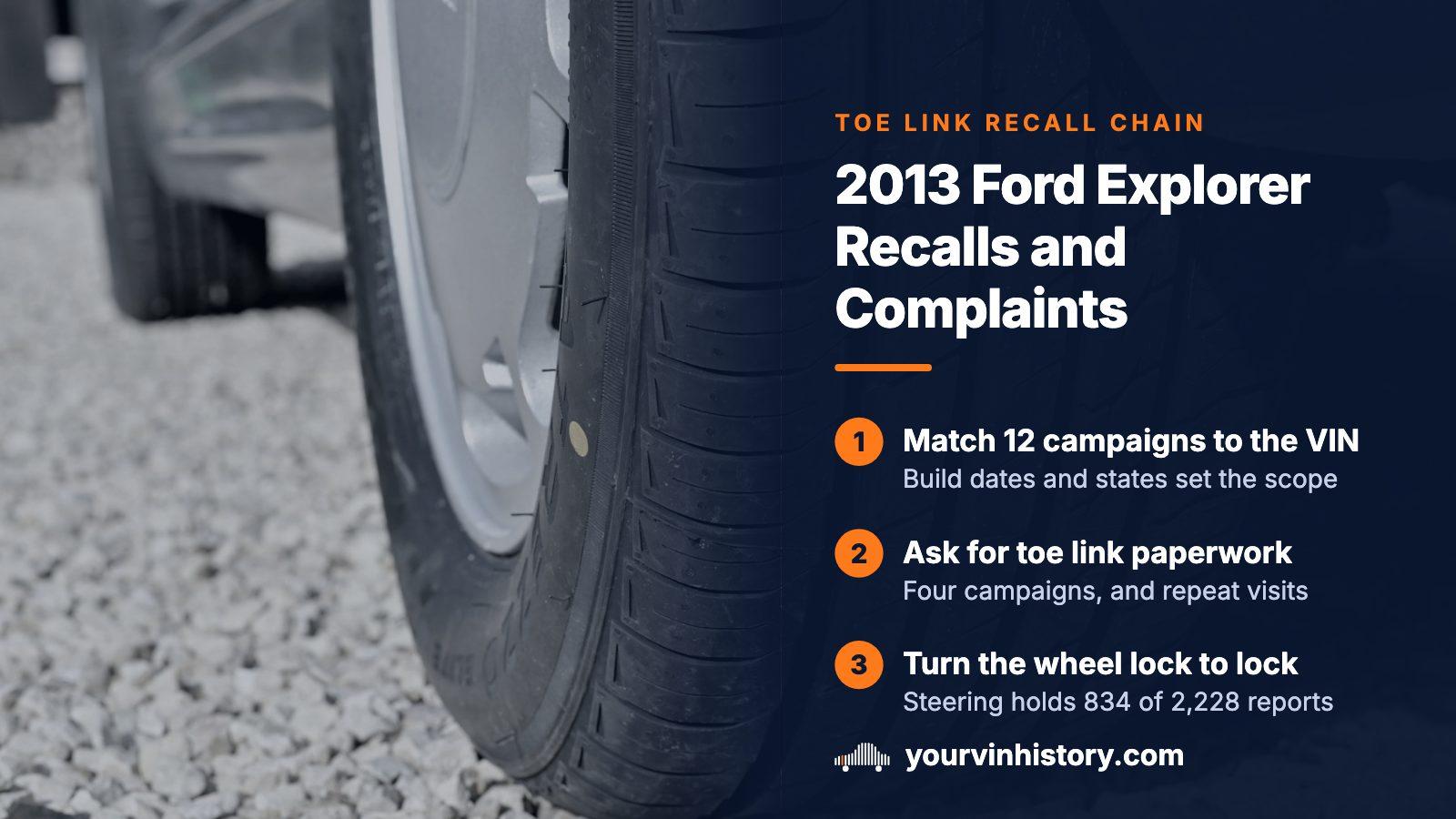
NHTSA lists 12 recall campaigns for the 2013 Ford Explorer, touching fuel leaks, rear toe links, power steering, door handles and roof-pillar trim. Owners filed 2,228 complaints, 834 of them about steering. Crash tests gave 5 of 5 stars overall and 4 of 5 for rollover. Each recall applies by VIN range, so check the exact car and ask for repair paperwork.
- Recall campaigns
- 12 on file with NHTSA
- Owner complaints
- 2,228, with 37% about steering
- Crash ratings
- 5 of 5 overall, 4 of 5 rollover
- Complaint volume
- 2nd heaviest of 15 Explorer years
What NHTSA has on file for this model year
Three kinds of federal record apply, each with different weight. A recall is a defect Ford has acknowledged and agreed to repair; the 2013 Explorer has 12. A complaint is one owner's unverified report; NHTSA held 2,228 in mid-August 2026, and the live count keeps creeping up. An investigation is the agency probing a possible pattern, and 6 touch this model year.
Among the 2,228 reports, 44 describe a crash, 11 a fire and 61 an injury. The flags rest on what the owner wrote when filing, and one event can produce several reports, so read them as leads, not findings.
All twelve campaigns on one page, oldest first
A campaign number begins with two digits that mark the year it was opened. Read the last column closely, since few campaigns reach every 2013 Explorer.
| Campaign | Part involved | Who is covered |
|---|---|---|
| 13V109000 | Fuel tank side seam | 2013 builds, July 2011 to March 2012 |
| 13V227000 | Fuel delivery module | 2013 Explorers and sister models |
| 13V270000 | Child safety locks | Late-2012 builds, about two weeks |
| 14V286000 | Electric power steering | 2011 to 2013, built May 2010 to February 2012 |
| 15V171000 | Interior door handles | 2011 to 2013 Explorers |
| 15V812000 | Fuel delivery module | 2013 Explorers and sister models |
| 17E048000 | Hub bearing parts | Parts listed for 2011 to 2017 rear axles |
| 19V435000 | Rear toe links | 2011 to 2017 Explorers |
| 20V675000 | Toe link knuckle | 2013 to 2017, listed states |
| 21V537000 | Toe link ball joint, road salt | 2013 to 2017, listed states |
| 21V746000 | Toe link ball joint, new part | 2011 to 2013, listed states |
| 24V031000 | A-pillar trim clips | 2011 to 2019 Explorers |
The rear toe link: four campaigns, one part, no single stamp
Ford's first campaign on this part, 19V435000, covers 2011-2017 Explorers whose rear toe links may fracture under stress, changing the handling suddenly. Dealers replace the links, check both ball joints and swap a wheel knuckle if needed. The remedy began June 26, 2019.
Three later campaigns concern a cross-axis ball joint at the link's outer end, each limited to cars sold or registered in listed states and Washington, D.C., mostly in the Northeast, Mid-Atlantic and Midwest. Campaign 20V675000 covers cars already repaired once. Campaign 21V537000 says road salt can corrode the original joint until it seizes, and because it widens earlier recalls, some fixed cars must return. Campaign 21V746000 targets a replacement joint that could seize. NHTSA names loss of steering control as the risk in all three.
Ask for work orders naming each campaign number, because a car repaired under the first may still owe a second visit.
Fuel: a cracking delivery module and a thin tank seam
All three fuel campaigns carry one warning: leaked fuel near an ignition source can start a fire. Campaigns 13V227000 and 15V812000 address a delivery module that may crack and leak. Both sit under Ford's base number 13S04, the later with an S1 tail, and the module is shared with other models.
Campaign 13V109000 is a different defect: a marginally sealed seam in the side of certain fuel tanks, which might weaken the tank in an impact and let it leak. It covers 2013 Explorers built from July 19, 2011 through March 15, 2012; dealers inspect the tank and replace it when needed.
The fuel and propulsion bin holds 120 complaints, about 5%, and is not a count of cracked modules.
Steering: the biggest complaint bucket and a 2014 software fix
Steering takes 834 of the 2,228 complaints, about 37%. Campaign 14V286000, the one recall in that area, covers 2011-2013 Explorers built from May 17, 2010 through February 28, 2012, where an intermittent connection in the electric steering gear can lose the motor position sensor signal. That shuts power assist off and leaves the wheel heavy at low speeds.
Dealers reprogram the power steering control module, and replace the rack when a car shows a history of lost signal. The remedy began July 23, 2014.
The build window closed in February 2012, so a given 2013 car may sit outside it, and the steering label covers every steering complaint, so 834 is not a tally of failed racks. Still, a third of the file in one category justifies a long test drive with the wheel turned lock to lock.
Door handles, child locks, hub bearings and pillar trim
- 15V171000, interior handles: on 2011-2013 Explorers a return spring can slip, leaving a handle short of its stowed position, and in a side impact the door could unlatch. Dealers inspect all four handles.
- 13V270000, child locks: after many door cycles a lock can flip from on to off unannounced, so a child could open the door from inside. Only cars built in a span of about two weeks at the end of 2012 qualify.
- 17E048000, hub bearings: a parts problem, not a factory one. Bearings lacking a self-retention feature were wrongly listed for the rear axles of 2011-2017 4X2 Explorers, and a wheel could separate. Ford told distributors to use them on drive axles only. If a rear bearing was replaced, ask which part number went in.
- 24V031000, A-pillar trim: retention clips may not be fully engaged, so trim can detach and land on the road. Dealers inspect and replace it as needed, phased by model year.
Where the 2,228 complaints land, and how this year ranks
NHTSA files each report under the system the owner blamed, so these are broad bins, not parts. Four smaller bins, none above 3%, hold the rest.
| Share | Reports | NHTSA category |
|---|---|---|
| 37% | 834 | Steering |
| 20% | 436 | Structure |
| 15% | 342 | Unknown or other |
| 10% | 224 | Engine |
| 7% | 163 | Electrical system |
| 5% | 120 | Fuel / propulsion system |
| 5% | 119 | Power train |
| 4% | 79 | Suspension |
Against the Explorer's own median year, a yardstick that cancels most of the effect of sales volume, 2013 ranks second of the 15 model years on record (2008 to 2022), at 2.71 times the median. Only 2016 is higher, at 2.99; the lightest settled year, 2009, sits at 0.05. Filings for 2013 peaked in 2019.
How old the car was when each problem was reported
Each report carries the date the owner says the trouble began, which gives the car's age then.
| System | Median age in years | Inside first three years |
|---|---|---|
| Steering | 7.1 | 6% |
| Structure | 10.1 | 12% |
| Unknown or other | 4.7 | 23% |
| Engine | 4.2 | 35% |
| Electrical system | 6.3 | 22% |
| Fuel / propulsion system | 4.1 | 31% |
| Power train | 6 | 19% |
| Suspension | 7.9 | 11% |
Nothing piles up early; engine and fuel come closest. Most reports came after the original warranty, and structure comes latest.
Medians describe the filers
Ages come from owners who chose to complain. They show when problems were reported, not how likely any one Explorer is to have one.
Crash-test stars, and what they leave out
NHTSA's New Car Assessment Program tested the four-door SUV in all-wheel and front-wheel drive. Both earned 5 of 5 stars overall, 5 in the frontal test, 5 in the side test and 4 for rollover; rollover probability for the all-wheel-drive version is 17.4%.
NHTSA lists electronic stability control as standard, but forward collision warning and lane departure warning as options, so a car may lack both, and the seller should say which this one has. The two versions scored the same on every star line. Stars describe a vehicle as tested, not one rebuilt poorly after a collision. Uneven panel gaps or mismatched paint can hint at an earlier repair.
The 15-year limit on no-charge recall repairs
Under 49 U.S.C. §30120(g), the duty to repair a recall without charge lapses when the first buyer purchased the vehicle more than 15 calendar years before the manufacturer's notice or NHTSA's order, whichever is earlier. Every campaign above dates from 2013 to 2024, inside the window for a car first sold near its model year.
The clock runs from the first sale, not the model year, so a car first sold in 2012 and one sold in 2013 sit a year apart from the cutoff. A campaign announced years from now may carry no such right, though some dealers repair the car anyway. Ask in writing before you buy.
An inspection list built from the file
- Steering: effort at parking speed, any assist warning, and proof of the 14V286000 update or a new rack.
- Rear suspension: invoices naming toe links, ball joints or knuckles, and rust near the rear knuckles on a car from a salt state.
- Fuel: a gasoline smell near the rear, and a record of any delivery module replacement.
- Doors: every interior handle springs back, child locks hold after repeated use, and pillar trim sits tight.
- Engine bay: heat-damaged wiring or amateur electrical work, since fire reports exist for this model year.
- SUV wear: all-wheel-drive engagement, tailgate seals, the spare well, third-row mechanisms and the floor under them, and roof-rail mounts.
Questions for the seller, then the VIN
- Which of the 12 campaigns has a dealer work order, and can I see each one?
- Has the car spent winters in a state that salts its roads?
- Did a crash ever lead to an insurance claim or a body-shop repair?
- Will you let my own mechanic inspect it before we talk price?
A recall list cannot show title brands or past damage. A yourvinhistory report covers NMVTIS title records, accidents with a damage map and odometer readings for the exact car; the preview is free and the full report is a one-time purchase. Run NHTSA's lookup on the VIN as well.
Where this information comes from
- NHTSA: recalls lookup — Where a VIN is entered to list open campaigns; the 12 campaign records summarized here come from the same data.
- NHTSA: vehicle safety and complaints — Entry point to the owner complaint filings behind the totals, category shares and investigation count.
- 49 U.S.C. §30120: remedy without charge — Statute text for the no-charge repair duty and where it stops applying, in subsection (g).
- NHTSA: 5-Star Safety Ratings — The crash-test program behind the star scores, the rollover figure and the optional driver-alert listings.
- NMVTIS: national title information — Federal source for title brands and history, which a safety record leaves out.
Sources and photos: Facts checked against the sources above in October 2026. Photo by Andres Siimon on Unsplash; diagrams by YourVINHistory.
Keep reading
- Ford Explorer years to avoid: 15,059 NHTSA complaints, ranked by yearRanks every Explorer year against its own median, so you can see where 2013 sits beside its neighbors.
- Ford recallsWalks through running any Ford VIN in NHTSA's lookup and reading what comes back.
- Buying a car with an open recallCovers your options when the lookup shows a repair that was never made.
- 2013 Ford Edge recalls, electrical complaints and what to inspectA same-year Ford SUV record to hold up against the Explorer's.
Frequently asked questions
How many recall campaigns cover the 2013 Ford Explorer?
NHTSA lists 12 campaigns, opened between 2013 and 2024. That is the model-year total, not the count on any one car, because campaigns follow build dates, state lists or model-year spans. A given Explorer can have none open, one or several. Enter the 17-character VIN in NHTSA's lookup, and ask for dealer paperwork on anything marked done.
What do 2013 Explorer owners complain about most?
Steering leads with 834 of 2,228 reports, about 37%. Structure follows at 436 and unknown or other at 342. These are NHTSA's broad bins, filed by owners and unverified, so they show where a mechanic should look rather than naming a failed part.
Is the 2013 Ford Explorer safe in a crash?
In NHTSA testing, both the all-wheel-drive and front-wheel-drive versions earned 5 of 5 stars overall and 4 of 5 for rollover. Those scores describe a tested vehicle as built. They say nothing about whether a particular used Explorer had its recall work done or was repaired well after a crash.
Are recall repairs still done at no charge on a car this old?
Within limits. The federal rule ends the no-charge duty for a vehicle first bought more than 15 calendar years before the notice or order, and tires have a shorter limit of 5 calendar years. Resale does not restart the clock, since it counts from the first purchase. Ask the dealer to confirm for the exact VIN, in writing.
Does a clean recall lookup mean the Explorer has a clean history?
No. Recall data covers manufacturer defects only. It leaves out title brands, accident history and odometer readings. NMVTIS holds the federal title record, and a yourvinhistory report pulls title, damage and mileage records for the exact VIN. Read both before agreeing on a price.
Now check the car itself
The guide explains what to look for. The report shows what this VIN has on record.