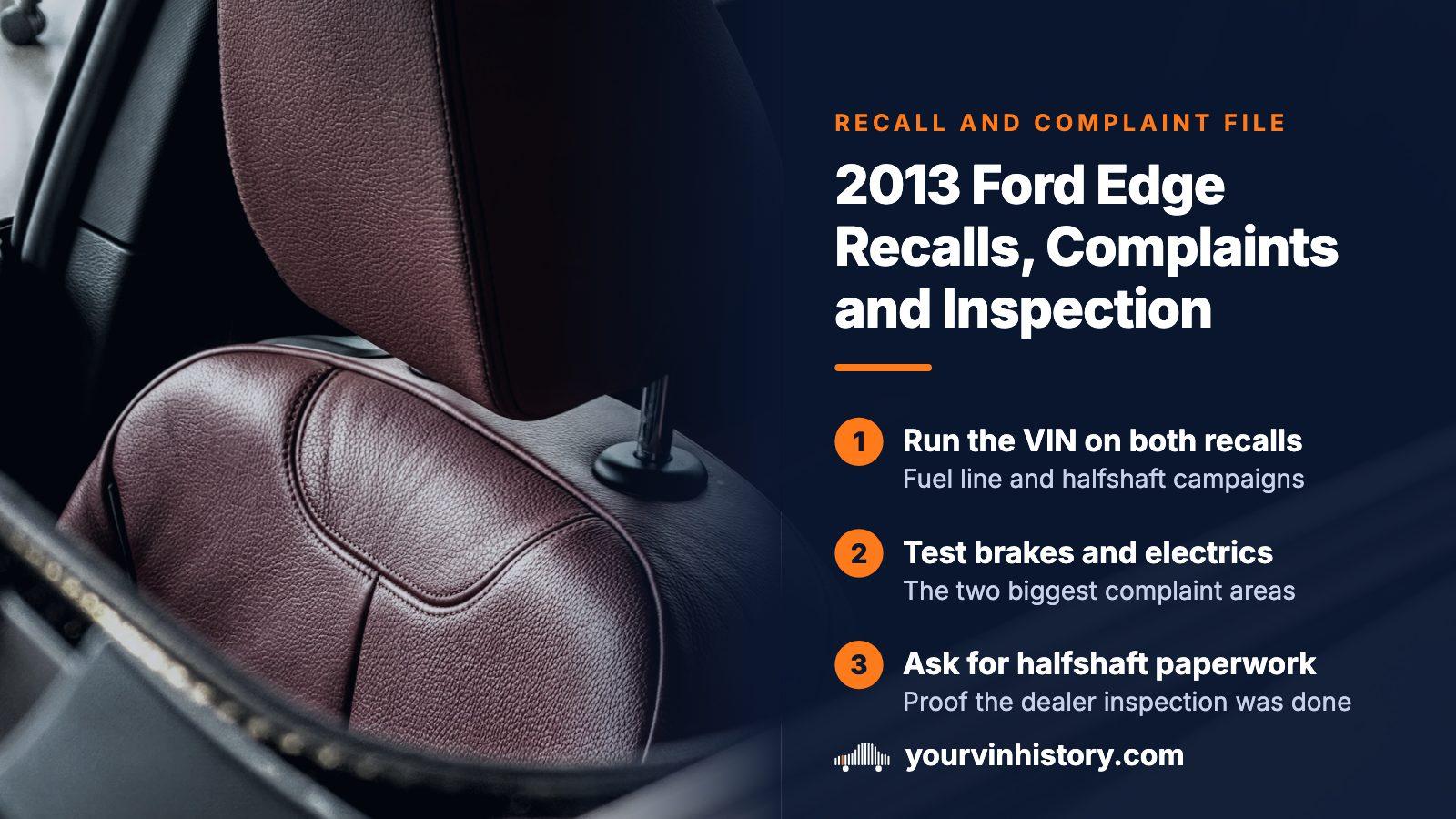
THE SHORT ANSWER
The 2013 Ford Edge has 2 recall campaigns on file with NHTSA: 14V002000, a fuel line part that can crack on 2.0L engines, and 14V393000, a halfshaft retaining clip. Owners filed 2,437 complaints, led by the electrical system at 852 and service brakes at 631. NHTSA gives 4 of 5 stars overall and 3 in the frontal test. Recalls follow VIN ranges, so look up the actual car.
- Recall campaigns
- 2 on file with NHTSA
- Owner complaints
- 2,437, with 35% about the electrical system
- Standing among Edge years
- Heaviest of 15, at 3.28 times the median year
- NHTSA overall rating
- 4 of 5 stars, 3 in the frontal test
Where 2013 stands among the Edge model years
Raw complaint totals say little when models sell in different volumes, so the useful yardstick is the Edge's own history. NHTSA's file spans 15 Edge model years, 2008 through 2022. Ranked by complaint volume, 2013 is the heaviest of them, at 3.28 times the median Edge year. The lightest settled year, 2021, comes in at 0.14 times that median.
| Measure | 2013 Ford Edge |
|---|---|
| Rank by complaint volume | 1st of 15 model years |
| Multiple of the Edge median year | 3.28 times |
| Year the filings peaked | 2016 |
| Lightest settled Edge year, for contrast | 2021, at 0.14 times the median |
Other SUVs from nearby years show why that yardstick helps. The 2013 Ford Escape has 18 recalls and 2,748 complaints, the 2013 Ford Explorer 12 and 2,228, and the 2014 Jeep Cherokee 13 and 2,639. The Edge has the fewest recalls of that group, yet its complaint count sits in the same range.
Recalls, complaints and an investigation: three different weights
A recall is a defect the manufacturer has acknowledged and owes a repair for; this model year has 2. A complaint is one owner's unverified account sent to NHTSA, and there are 2,437 of them in the August 2026 pull used here. The count creeps upward as late reports arrive. NHTSA also lists 1 investigation touching this model year, and an investigation can end in a recall or in nothing.
Filers can tick boxes for what happened. Among the 2,437, 33 describe a crash and 7 a fire, and the injury fields add up to 40 injuries. Those flags are the owner's own account, one incident can generate several reports, and none is a finding. Treat them as the entries worth opening in full before a purchase, not as a rate.
Campaign 14V002000: a fuel line damper that can crack
Ford recalled 2012 and 2013 Edges with the 2.0L engine that were built between September 2, 2010 and April 25, 2013. The fuel line includes a pulse damper, a part meant to calm pressure surges, and a flaw in how its metal housing was made lets it crack. A cracked housing can show up as a fuel smell, a damp spot or a steady leak whenever the system is under pressure.
NHTSA lists the danger as fire, if leaking fuel meets an ignition source. The remedy is a replacement fuel line with no damper at all. Ford's own number for the campaign is 13S13, the remedy began February 25, 2014, and the notice says it supersedes an earlier campaign, 12V-438. A car repaired under that earlier campaign still needs the newer fix, so an invoice from the old job does not settle the question.
An Edge with a different engine does not match the description, and the VIN lookup is what settles it. On a test drive, a fuel odor around the engine bay is the symptom to take seriously.
Campaign 14V393000: the halfshaft retaining clip
This campaign reaches further: 2012 to 2014 Edge and Lincoln MKX models built from September 2, 2010 through November 30, 2013, plus several sister Ford and Lincoln vehicles with build windows of their own. Ford found that a retention circlip on the halfshaft may not have been seated correctly. If so, the halfshaft can creep outward and separate from the linkshaft while the car is moving, with no warning beforehand.
Two outcomes are listed. Drive power stops reaching the wheels, which raises crash risk. And if the driver gets out without setting the parking brake, the car can roll away even with the transmission in Park. Dealers inspect the shaft; where it is not retained properly they replace the linkshaft, and the halfshaft too if the splines show damage. The remedy began August 4, 2014, and Ford's number is 14S10. A halfshaft inspection leaves a repair order behind, so a car this age with none on file is a question for the seller.
Where owners aimed their complaints
Owners pick the component category themselves when they file, so the table records what people believed had failed. NHTSA sorts the 2013 Edge reports into 26 categories; these are the eight largest.
| Reports | Category | Share of all filings |
|---|---|---|
| 852 | Electrical system | 35% |
| 631 | Service brakes | 26% |
| 423 | Unknown or other | 17% |
| 300 | Structure | 12% |
| 191 | Exterior lighting | 8% |
| 168 | Engine | 7% |
| 159 | Power train | 7% |
| 104 | Hydraulic | 4% |
Read the labels carefully. The electrical category takes in batteries, wiring, lighting and control modules along with alternators and starters, so 852 does not mean 852 of one part. Service brakes counts owners reporting brake defects, which is different from ordinary pad and rotor wear. A tight cluster still beats a count spread thin, and the electrical share is the clearest concentration here.
How old the car was when each system acted up
Owners also give the date a failure happened. Subtract the 2013 model year and you have the car's age at that moment; the table shows the median of those ages for each system.
| System | Median age at failure | Reports with a date | Inside the first three years |
|---|---|---|---|
| Electrical system | 3.3 years | 851 | 40% |
| Structure | 3.3 years | 299 | 38% |
| Exterior lighting | 3.3 years | 191 | 38% |
| Engine | 4.7 years | 168 | 24% |
| Power train | 5.8 years | 158 | 15% |
| Service brakes | 8.5 years | 631 | 3% |
| Hydraulic | 10.3 years | 104 | 0% |
Electrical reports arrive earliest, at a median of 3.3 years, so many of them were the first owner's problem. Service brakes and hydraulic reports come late, at 8.5 and 10.3 years, and those land on whoever holds the car by then. None of this is a failure rate. The figures describe when people who did complain say something broke, and a car with complete service records can outlast every row.
Crash-test ratings and driver-assist equipment
Star ratings come from tests of the model in new condition. They are handy for comparing model years, but they cannot tell you how a particular used Edge behaves after whatever has happened to it since.
| Test | NHTSA result |
|---|---|
| Overall | 4 of 5 stars |
| Frontal crash | 3 of 5 stars |
| Side crash | 5 of 5 stars |
| Rollover resistance | 4 of 5 stars |
| Rollover probability | 15.9%, front-wheel-drive version |
NHTSA rated two configurations, front-wheel drive and all-wheel drive, and both came out at 4 stars overall and 4 for rollover. Forward collision warning was optional equipment, so individual cars differ, and lane departure warning was not available at all. The window sticker or the dash will show what a given car has.
How long a recall repair stays at no charge
The rule sits in 49 U.S.C. 30120(g). The no-charge requirement does not apply when the first purchaser bought the vehicle more than 15 calendar years before the manufacturer gave notice of the recall. Both campaigns here began in 2014, comfortably inside that window for a car sold new around 2013.
The clock matters for the future. A campaign announced after a given Edge passes the 15-year mark can fall outside the rule, though dealers sometimes do the work anyway. Do not assume; have the dealer confirm in writing before money changes hands. If the lookup shows an open item today, ask the seller to get it done first, or negotiate it into the price.
What to check on a 2013 Edge in person
Each item below comes from an owner pattern or a recall description. Work through them before the general used-SUV checklist.
- Electrical: with the ignition on, cycle every window, light, display and warning lamp, and have a shop scan for stored fault codes. Ask what was repaired or replaced.
- Brakes: feel for long pedal travel, pulsing or pull under firm braking, and inspect pads and rotors. Ask for invoices, since brake reports skew toward older cars.
- Fuel system: on a 2.0L car, smell around the engine bay after a drive and look along the fuel line for dampness.
- Driveline: listen for clunks or vibration at low speed, and see whether the halfshaft inspection is on paper. On all-wheel-drive cars, transfer case and coupling trouble can hide on a short drive.
- Engine bay wiring: fire reports exist for this year, so look for heat damage, melted insulation and amateur splices.
- Body: check the tailgate seals and spare well for damp, the roof-rail mounts for leaks, and the underbody and suspension for corrosion.
Questions for the seller, and the VIN lookups to run first
Run the 17-character VIN through NHTSA's recall lookup before the first visit. It shows whether either campaign is open on that exact car. Then put these to the seller:
- Were both campaigns done, and is there dealer paperwork for each one?
- When was the electrical system last repaired, and what was replaced?
- Which shop has serviced the car, and are the records available?
- Has it ever been in a collision, and did an insurer pay for repairs?
- Will you let my own mechanic put it on a lift before we discuss price?
- Is the title in your name, with no lien on it?
What the safety file leaves out
NHTSA's records cover recalls, complaints and crash tests. They do not show title brands, accident history, odometer readings or liens. A yourvinhistory report adds those; the preview comes first and the full report is a one-time purchase.
Where this information comes from
- NHTSA: Recalls — The VIN-based lookup that shows which of the 2 campaigns are open on a particular Edge.
- NHTSA: Vehicle safety — Entry point for the consumer complaint database behind the owner report counts used here.
- NHTSA: 5-Star Safety Ratings — The federal crash-test program behind the overall, frontal, side and rollover scores.
- U.S. Code: 49 U.S.C. 30120 — Statute text for the no-charge remedy and its 15-calendar-year limit.
- NMVTIS: National Motor Vehicle Title Information System — Source of title brand records, which the safety file does not cover.
Sources and photos: Facts checked against the sources above in October 2026. Photo by Obi on Unsplash; diagrams by YourVINHistory.
Keep reading
- Ford Edge years to avoid: 2008 to 2022 ranked against its own medianRanks every Edge model year against the nameplate's own median, so 2013 can be set beside its neighbors.
- Ford recallsShows how to run Ford recall checks by VIN on any model.
- Buying a car with an open recallCovers what to do when the lookup shows an unrepaired campaign.
- 2013 Ford Escape recalls and complaints: what NHTSA has on fileA nearby Ford SUV with a very different recall and complaint record.
Frequently asked questions
How many recalls apply to the 2013 Ford Edge?
NHTSA lists 2: 14V002000 for the fuel line damper and 14V393000 for the halfshaft clip. Neither covers every 2013 Edge. The first describes only 2.0L engines built in a set window, while the second uses a build window of its own, so one Edge can fall in both campaigns, one of them or neither. The VIN lookup answers for a single car.
What problems are most common on a 2013 Ford Edge?
By owner complaints, the electrical system leads with 852 reports, about 35%, followed by service brakes with 631. Electrical reports cluster early, at a median age of 3.3 years, while brake and hydraulic reports come late. These are unverified filings, not failure rates, so they show where to look rather than what a given car will do.
Is the 2013 Ford Edge safe in a crash?
NHTSA scored it 4 of 5 stars overall, 5 for side crashes, 3 for frontal crashes and 4 for rollover resistance. Those scores come from standardized tests of the design as built. A used Edge that has been in a collision or had structural repairs may not protect occupants the same way, so ask about prior accidents.
Will a Ford dealer still fix my 2013 Edge recall at no charge?
Within the federal limit, yes. The no-charge duty lapses only if the notice went out more than 15 calendar years after the first purchaser bought the car, and both Edge campaigns began in 2014. If a dealer hesitates, quote the campaign number and ask for the answer in writing.
Is a 2013 Ford Edge a risky used car to buy?
Its complaint volume ranks first among 15 Edge model years, at 3.28 times the median, which justifies a careful inspection. It does not rule the car out. Maintenance records, finished recall work and a pre-purchase inspection tell you far more than the model-year rank.
Now check the car itself
The guide explains what to look for. The report shows what this VIN has on record.