THE SHORT ANSWER
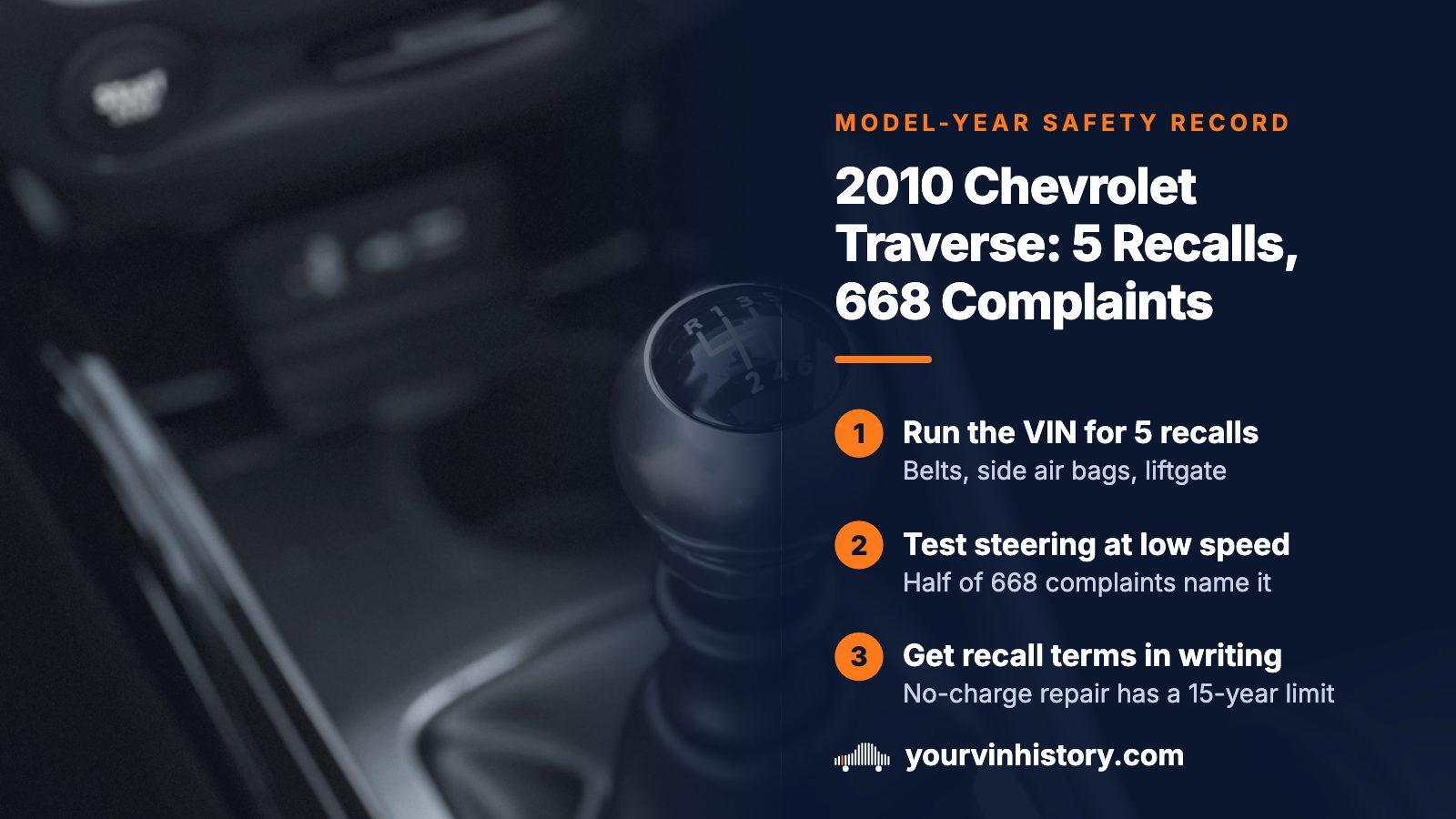
NHTSA lists 5 recall campaigns for the 2010 Chevrolet Traverse: two on seat belts, two on air bags and one on the power liftgate. Of 668 owner complaints, 331 name steering and 178 the engine. The agency shows no overall, frontal or side crash rating for the configuration it lists, only a rollover score of 4 of 5. Recalls follow VIN ranges, so the specific car needs its own lookup.
- Recall campaigns
- 5 on file with NHTSA
- Owner complaints
- 668, with 331 about steering
- Crash ratings
- Rollover 4 of 5; overall, frontal and side not rated
- Among Traverse years
- Heaviest of 14, at 1.87 times the median
The most complaint-heavy year in the Traverse's run
Raw complaint totals make a poor yardstick, because a model that sold well collects reports just by being on the road. A fairer test sets each year against the same nameplate's median year, which absorbs most of the sales-volume effect. On that test the 2010 is the heaviest of the 14 Traverse model years on record, 2009 through 2022, at 1.87 times the median year.
The lightest settled year is 2021, at 0.24 times the median. Newer years deserve a discount the other way, since a young car has had little time to attract reports. None of this is a failure rate; it is a reason to read this year's record closely.
Steering holds half of everything owners filed
NHTSA sorts each complaint under the component the owner names. One bucket holding half of the 668 is a pattern rather than noise: 331 reports name steering. Most narratives concern power steering, with assist dropping out at low speed, leaking pumps, lines and racks, and repairs that did not hold.
| Component | Share of 668 | Reports |
|---|---|---|
| Steering | 50% | 331 |
| Engine | 27% | 178 |
| Power train | 10% | 66 |
| Electrical system | 9% | 59 |
| Electronic stability control | 9% | 57 |
| Vehicle speed control | 6% | 42 |
| Air bags | 4% | 30 |
| Unknown or other | 4% | 28 |
| Seat belts | 4% | 25 |
| Service brakes | 3% | 18 |
| Fuel and propulsion | 2% | 12 |
| Suspension | 1% | 10 |
The counts add up to more than 668 because one report can name several components. Engine and power train are broad bins, not part names, though many engine narratives point to a stretched timing chain with a check-engine light, a stored code or a rattle.
Recalls, complaints and investigations carry different weight
The five campaigns are defects the manufacturer has accepted and owes a remedy for. The 668 complaints are unverified accounts, useful in bulk and shaky one at a time. NHTSA also lists 2 investigations touching this model year, early signals that some end in a recall and others in no action at all.
Filers can flag what happened. Among the 668 reports, 17 describe a crash, 6 a fire and 12 an injury. Those flags are the owner's description, not a finding, and one incident can produce several reports, but these are the narratives to read in full before handing over money.
The five campaigns side by side
A Traverse built outside a campaign's production range is untouched, and one inside it may still be waiting for the work. All five also reach sister models, including the Buick Enclave and GMC Acadia.
| Campaign | System | What can go wrong | Dealer remedy |
|---|---|---|---|
| 10V375000 | Second-row belts | Buckle cover can slide and press the release button | Modify the seat trim shield; replace a damaged buckle |
| 14V118000 | Front side air bags | Wiring resistance can stop the bag and pretensioner firing | Swap harness connections for soldered ones |
| 14V266000 | Front belts | Steel cable at the front outboard belts can fatigue and break | Inspect; repair or replace the lap pretensioner |
| 15V415000 | Power liftgate | Struts wear early and an open gate can fall | Software update to the motor control unit |
| 21V246000 | Side curtain air bags | Bags may be poorly secured | Check weld nuts; realign or replace |
The two belt campaigns, from 2010 and 2014
Campaign 10V375000 is about the second row. When a folded seat back is raised again, a trim shield on the seat's side can hold the belt buckle down. If the buckle meets the seat frame, the rider has to push harder, and enough force can slide the buckle cover down the strap and partly press the red release button, so the belt may not hold an occupant as intended. The repair began August 18, 2010.
Campaign 14V266000 reaches the front seats. The steel cable tying each outboard belt to the seat can fatigue and break apart, which could leave a crash occupant poorly restrained. Traverses built between June 6, 2008, and May 14, 2014 are in range. Parts were unavailable at launch, so ask for dealer paperwork showing the work was actually done.
Air bag wiring, curtain bags and the power liftgate
Campaign 14V118000 concerns the front side air bags. Added resistance in the seat wiring harnesses can keep the bags and belt pretensioners from deploying in a crash. Dealers replace the affected connections with soldered ones, a remedy that began June 16, 2014.
Campaign 21V246000, the newest, says the side curtain bags may not be attached as designed. Dealers check the weld nuts and realign or replace them, and GM mailed owner letters on May 24, 2021. An air bag lamp that stays lit on a test drive warrants a shop visit before any talk of price.
Campaign 15V415000 matters only when the car has the power liftgate. Its gas struts can wear early and let an open gate drop on someone beneath it. The fix, a software update that began November 15, 2016, leaves nothing to see, so ask for the dealer record, then watch whether the open gate holds its height.
Crash ratings: three blanks and one score
NHTSA's New Car Assessment Program crash-tests new examples and publishes star ratings. For the configuration it lists here, the 4-DR. w/SAB, the overall, frontal and side lines read not rated. Rollover earns 4 of 5, with a rollover probability of 15.5%.
Not rated means no published score, which is different from a poor one. Neither forward collision warning nor lane departure warning was offered on this model year. Stars also describe a laboratory car in new condition: structural repair, aftermarket parts and old collision damage change how a body takes an impact, and no rating records any of it, so ask the seller about collisions.
How old the car was when owners reported each problem
Each complaint carries the date the owner says the problem happened, so subtracting the 2010 model year gives the car's age then. The table shows medians.
| System | Reports | Median age in years | Reported within three years |
|---|---|---|---|
| Steering | 331 | 4.2 | 12% |
| Engine | 178 | 7 | 2% |
| Power train | 66 | 6.8 | 8% |
| Electrical system | 59 | 5.8 | 20% |
| Stability control | 57 | 5.9 | 4% |
| Vehicle speed control | 42 | 5.8 | 5% |
| Air bags | 30 | 5.5 | 23% |
| Unknown or other | 28 | 8.1 | 7% |
No system bunches up in the first three years. Air bags show the largest early share at 23%, then electrical at 20%, but most reports came after normal new-car coverage had run out, so the bill fell on the owner. Steering turns up earliest among the big groups, near 4.2 years, and engine later, near 7. Filings peaked in 2014, which suggests wear arriving with mileage, not a fault caught at launch.
Medians, not odds
The table records when people who complained say something broke, not how likely a given Traverse is to break. A car with full service records can outlast every age shown.
When the no-charge recall repair stops being owed
The duty to repair a recall without charge has a federal expiry, written into 49 U.S.C. §30120(g). A manufacturer is released from it when the first buyer's purchase predates the recall notice, or an order, by over 15 calendar years, whichever of the two came first.
The five campaigns here date from 2010 to 2021, inside that window for a Traverse first sold near its model year. A campaign announced today would differ, since a car first sold around 2010 is already past 15 calendar years. Some dealers do the work anyway, as goodwill rather than entitlement. Get the answer in writing before agreeing on a price.
What to look at on the car itself
- Steering: turn lock to lock at parking-lot speed, listen for whine, and look for wet spots at pump, hoses and rack.
- Engine: insist on a cold start, since a rattle in the first seconds fits the timing-chain narratives, and ask a shop to scan for stored codes.
- Power train: shift quality on a long drive, since that bucket covers more than the gearbox.
- Recall proof: dealer paperwork for all 5 campaigns, with belts, side air bags and liftgate worth a hands-on look.
- Wiring and engine bay: 6 reports describe fires, so check for heat damage and amateur electrical work.
- All-wheel drive, if fitted: transfer cases and couplings are costly and hide well on a short drive.
- Liftgate seals, spare-tire well and the carpet under folding seats, where water collects first.
- Rust and suspension wear, which at this age outweigh the federal record.
Questions for the seller, then the VIN
- Which of the 5 campaigns were done, and where are the dealer receipts?
- Has any steering part been repaired or replaced, and who did the work?
- Which shops have serviced the car, and may I read the records?
- Has it ever been in a collision, and did an insurer pay for the repair?
- May my own mechanic inspect it before we settle on a price?
- Whose name is on the title, and has any loan been paid off?
Then enter the VIN at NHTSA's recall lookup, a free government tool listing open campaigns for that exact car, and run it again the day you sign. A yourvinhistory report adds title brands, accidents with a damage map, odometer readings, salvage and auction records and liens, with title records from ClearVin LLC, an approved NMVTIS data provider. The preview is free; the report is a one-time purchase.
Where this information comes from
- NHTSA: Recalls — Where a VIN is checked for open campaigns; the five campaign summaries here were read from NHTSA's recall records.
- NHTSA: Vehicle safety and complaints — Entry point to the owner filings behind the 668 total, the component split and the investigations count.
- NHTSA: 5-Star Safety Ratings — The federal crash-test program behind the not-rated lines and the rollover result.
- 49 U.S.C. 30120 on govinfo.gov — Statute text for the remedy-without-charge rule and the 15-calendar-year limit in subsection (g).
- NMVTIS: national title information system — Federal source for title brands and history, which a safety record leaves out.
Sources and photos: Facts checked against the sources above in October 2026. Photo by Nils Keesmekers on Unsplash; diagrams by YourVINHistory.
Keep reading
- Chevrolet Traverse years to avoid, ranked from 5,003 NHTSA complaintsSets the 2010 against every other Traverse year on complaints and recalls.
- Chevy Traverse timing chain replacement cost, tested against GM's own hoursCovers the engine side, the second-largest group of 2010 complaints.
- Chevrolet recallsShows how to check any Chevrolet by VIN for open campaigns.
- Buying a car with an open recallExplains your options when the lookup shows a repair was never made.
Frequently asked questions
How many recall campaigns cover a 2010 Chevrolet Traverse?
NHTSA lists 5 campaigns: 10V375000 and 14V266000 for seat belts, 14V118000 and 21V246000 for air bags, and 15V415000 for the power liftgate. All five also reach sister models, and each is tied to production dates, so one Traverse can sit outside some. Only a VIN lookup shows which are still open.
Is there a steering recall on the 2010 Traverse?
None of the five campaigns concerns steering, even though 331 of the 668 complaints do. NHTSA also lists 2 investigations touching this model year, which are early signals rather than findings. Manufacturers sometimes run repair programs outside the federal campaigns, so ask a Chevrolet dealer whether anything covers the VIN.
Does the 2010 Chevrolet Traverse have a good crash test rating?
NHTSA shows no overall, frontal or side rating for the configuration it lists, which means unrated rather than poor. The one published result is rollover: 4 of 5, with a 15.5% rollover probability. Stars describe a new car in a laboratory, so a used one with repaired collision damage may behave differently.
Will Chevrolet still fix a 2010 Traverse recall at no charge?
It depends on dates. Federal law ends the no-charge duty once the first purchase is over 15 calendar years older than the recall notice or order, whichever came earlier. The known campaigns fall inside that window for a car first sold near 2010; one announced today would not. Some dealers still help as a courtesy, so get any promise in writing.
How do I check a specific 2010 Traverse for open recalls?
Enter the 17-character VIN at NHTSA's recall lookup. It lists campaigns still unrepaired on that exact vehicle, so a car inside a production range but already fixed will not show as open. Repeat the lookup the day you buy, and use a history report for title brands and accident records, which the recall database never holds.
Now check the car itself
The guide explains what to look for. The report shows what this VIN has on record.