THE SHORT ANSWER
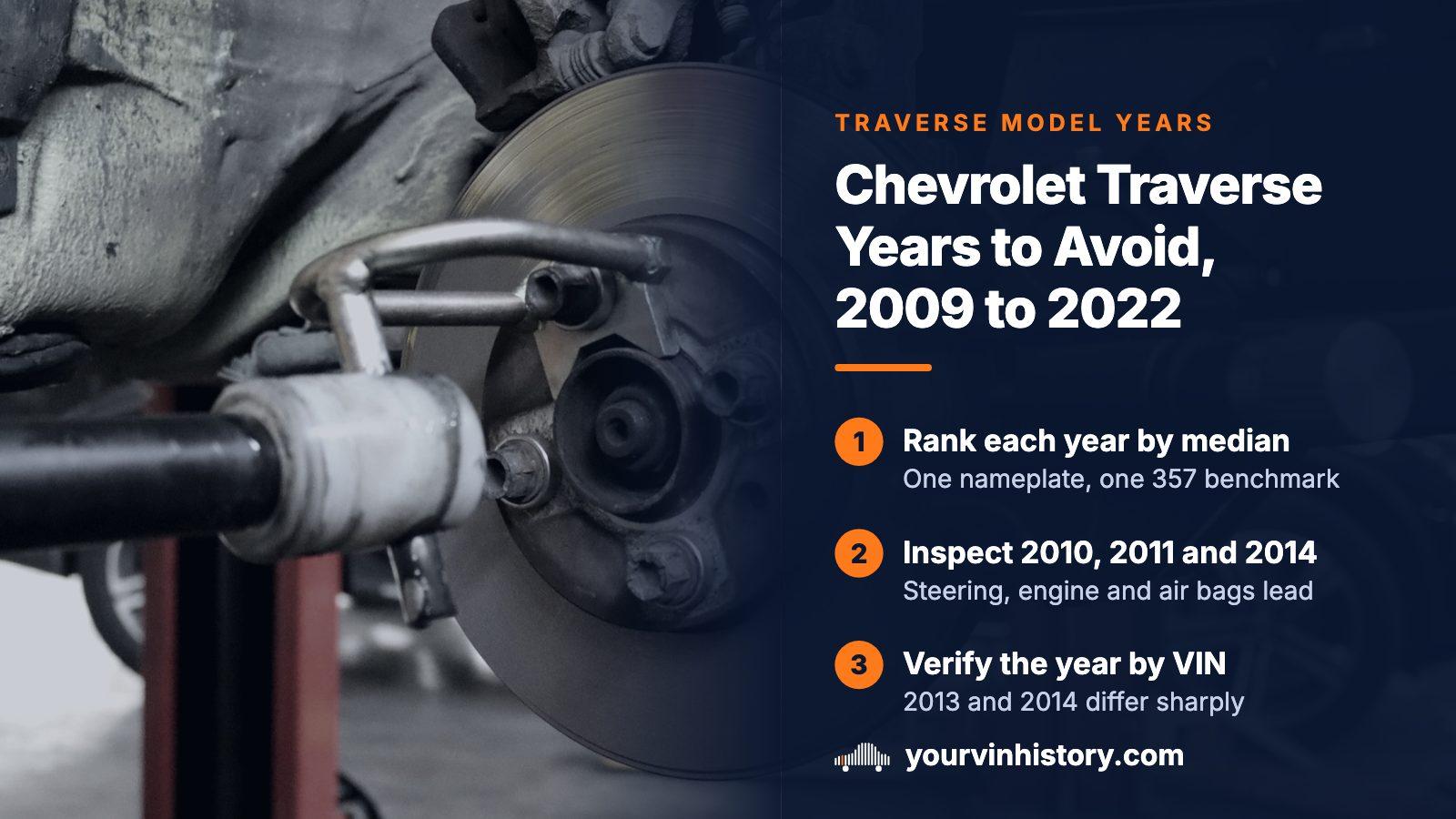
Of the 5,003 NHTSA complaints filed on the 2009 to 2022 Traverse, three model years sit well above the nameplate's own median of 357: 2010 (668), 2011 (608) and 2014 (547). The lightest records are 2021, 2022 and 2013, although the first two are the youngest rows. Engine is the biggest complaint area at 1,042 reports. Counts are not failure rates, so use them to plan an inspection.
- Total filed
- 5,003 complaints, 2009 to 2022
- Benchmark
- 357 complaints in the median year
- Peak
- 2010, with 668 reports
- Largest category
- Engine, 1,042 reports
How the ranking works: one nameplate, one median
Setting the Traverse beside other SUVs would mostly reveal how many each maker sold. So this ranking compares the Traverse with itself. The 14 yearly complaint totals from 2009 to 2022 have a middle value of 357, and every model year is expressed as a multiple of that number. A year at 1× is typical for this SUV, while a year at 1.87× has drawn close to twice the usual volume of owner reports.
The pool is 5,003 consumer complaints filed with NHTSA. Repeats were removed using the agency's complaint number, and the data was pulled in mid-August 2026, so anything filed later is missing. Recall counts for each year sit beside the complaints, though they record a different kind of evidence.
Every model year from 2009 to 2022 in one table
The standing column turns each multiple into a word. Elevated means well above the median and light means well below it. Ordinary covers the wide band in between, from 0.61× up to 1.27×.
| Model year | Standing | Times the median | Complaints | Recalls |
|---|---|---|---|---|
| 2009 | Ordinary | 1.25× | 448 | 8 |
| 2010 | Elevated | 1.87× | 668 | 5 |
| 2011 | Elevated | 1.7× | 608 | 5 |
| 2012 | Ordinary | 0.99× | 354 | 5 |
| 2013 | Light | 0.45× | 161 | 4 |
| 2014 | Elevated | 1.53× | 547 | 7 |
| 2015 | Ordinary | 0.88× | 313 | 5 |
| 2016 | Ordinary | 0.82× | 291 | 5 |
| 2017 | Ordinary | 1.01× | 360 | 3 |
| 2018 | Ordinary | 1.27× | 454 | 2 |
| 2019 | Ordinary | 1.12× | 400 | 3 |
| 2020 | Ordinary | 0.61× | 218 | 8 |
| 2021 | Light | 0.24× | 86 | 3 |
| 2022 | Light | 0.27× | 95 | 1 |
| Median year | Benchmark | 1× | 357 | n/a |
Two details are easy to miss. The 2012 and 2017 years sit almost exactly on the median, at 354 and 360. And 2020 carries 8 recalls, tied with 2009 for the most, beside one of the smaller complaint totals.
The jump between 2013 and 2014
Read down the complaint column and one move dominates: 161 for 2013, then 547 for 2014. No other year-to-year change in the table is as large. A swing of that size often lines up with a redesign or a major mechanical change, but a complaint table cannot say which one happened here.
The practical lesson is to settle which side of the line a car sits on before comparing prices. A 2013 and a 2014 can look alike in an online listing and still carry very different records. The tenth character of the VIN encodes the model year, so read it off the car or the listing and do not rely on the seller's description.
2010, 2011 and 2014: the flagged years
Three model years sit clearly above the median. Each has a different leading category, so no single defect story connects them.
- 2010 holds the peak: 668 complaints, 1.87 times the median, 5 recalls. Steering is its top category, with engine also prominent.
- 2011 is next with 608 complaints, 1.7 times the median and 5 recalls. Engine leads.
- 2014 logged 547 complaints, 1.53 times the median and 7 recalls, the most of the three. Air bags lead.
Recall counts do not move in step with complaint counts, which is normal: a recall is a maker's admission, and a complaint is an owner's report. An elevated year is a prompt to inspect harder and bargain, not proof that a given car is faulty. Good Traverses exist in all three.
The eight ordinary years and the range inside that label
Eight years carry the ordinary standing: 2009, 2012, and 2015 through 2020. The label hides a wide spread. At the high end, 2018 logged 454 complaints (1.27×) and 2009 logged 448 (1.25×). At the low end, 2020 logged 218 (0.61×). Put 2018 next to 2016, which logged 291 (0.82×), and the two share a label while carrying noticeably different records.
For most buyers this band is a sensible place to start looking, provided each car earns its place on its own history. The 2020 row deserves a footnote: it is a recent model year, so some of its low multiple is simply time that has not yet passed.
The lightest records, and a caveat on two of them
By raw count, the lightest records are 2021 with 86 complaints and 3 recalls, 2022 with 95 and 1 recall, and 2013 with 161 and 4 recalls. They are not equal evidence.
The 2021 and 2022 totals come from the youngest cars in the table. Owners of newer vehicles have had less time to file anything, so part of the low count is age, not quality. A fair cleanest-years list sets the newest model years aside for that reason, and 2021 and 2022 are best read as early, provisional numbers.
The 2013 result is the sturdier finding. Those cars have had many years to collect complaints, and they still show the smallest total among the older years. Its neighbor, 2014, is flagged, which is one more reason to verify the year before you buy.
Where the complaints cluster by component
NHTSA files every complaint under a component category. These six lead across the full run of 14 model years.
| NHTSA category | Reports, 2009 to 2022 | What the label can include |
|---|---|---|
| Engine | 1,042 | Any engine fault, not a single part |
| Air bags | 919 | Problems reported with the air bag system |
| Steering | 840 | Steering-related faults |
| Power train | 755 | The transmission and other drive components |
| Electrical system | 743 | Battery, wiring, lighting and control modules |
| Electronic stability control | 404 | The stability control system |
Engine leads overall and is also the top category in 2011. Steering leads in 2010 and air bags in 2014. Because the categories are wide, a count points a mechanic toward an area. It does not identify a failed part or say how many vehicles were affected.
What recall counts add, and the 15-year limit
A recall means the maker has acknowledged a defect and must repair it at no charge to the owner. That is a stronger statement than any single complaint. A year with many recalls and few complaints, such as 2020 with 8 recalls and 218 complaints, can mean problems were found and handled through the recall process.
The no-charge promise has a time limit. Under 49 U.S.C. §30120(g), it does not reach a vehicle first bought more than 15 calendar years before the recall notice. On the oldest Traverse years, call a dealer and confirm that a recall repair is still covered before you count on it.
Recalls attach to production ranges
A model year is not a recall status. Two Traverses from the same year can differ in which campaigns apply, so enter the full VIN into NHTSA's recall lookup for the car you are considering.
Four limits on what these counts can say
- Sales volume. A popular year collects more filings than a scarce one of equal quality. The median yardstick softens that effect without erasing it.
- Time in service. Older cars have had longer to attract reports, which flatters the youngest rows.
- Unverified accounts. A complaint records what an owner believed happened. In bulk it shows patterns, but alone it proves little.
- No denominator. A complaint count is not a failure rate or a reliability score. It cannot tell you how many Traverses of a given year ran without trouble.
None of these four describes the specific vehicle in front of you. That car has its own repair, ownership and title history.
What to inspect on a 2010, 2011 or 2014 Traverse
Because the leading complaint area differs by year, aim the first part of the inspection at that area, then cover the shared ground.
- 2010: test the steering at parking-lot speed and on the highway, feeling for looseness or odd resistance and noting any steering warning light.
- 2011: check around the engine for oil leaks, listen during a cold start, and ask for receipts that show regular oil changes.
- 2014: confirm the air bag warning light comes on at startup and then goes out, and ask whether any restraint-system work has been done.
- All three: have a mechanic scan for stored fault codes and check the transmission and electrical features, since power train and electrical system rank fourth and fifth.
- Any year: ask for paperwork on completed recall repairs.
None of these steps proves a defect either way. They turn a statistic into checks that fit in an afternoon, and an independent mechanic adds a trained eye that a seller's walkaround does not.
From a model year to the one car you are buying
A model year describes a population, while a VIN describes one vehicle. NHTSA's recall lookup is free to use and shows open campaigns by VIN. NICB's VINCheck is also free and screens a VIN for theft and total-loss records. The federal NMVTIS program holds national title records, which a ranking like this cannot reach.
For the history of one particular Traverse, the preview on this site is free for any VIN, and the one-time paid report adds accident records with a damage map, odometer readings, title brands and liens. Hold what it shows against what the seller has told you.
Where this information comes from
- NHTSA: Vehicle safety — Home of the federal consumer complaint database, where every owner-report count in this ranking was filed.
- NHTSA: Recalls — Where the recall counts by model year come from, and where a VIN is entered to see which campaigns remain open on one car.
- Bureau of Justice Assistance: NMVTIS — Federal overview of the national title information system, which holds the per-vehicle history this ranking cannot show.
- NICB: VINCheck — A no-cost lookup that screens one VIN for reported theft and total-loss status.
Sources and photos: Facts checked against the sources above in October 2026. Photo by Media Digital on Unsplash; diagrams by YourVINHistory.
Keep reading
- 2010 Chevrolet Traverse recalls, complaints and what to inspect before you buyThe peak year's own record page, with its recall campaigns and complaint components.
- Chevrolet recallsHow to find open Chevrolet recalls by VIN, the first check on any Traverse.
- Chevy Traverse timing chain replacement cost, tested against GM's own hoursEngine is the Traverse's largest complaint area, and this post prices one engine repair.
- Chevrolet Equinox years to avoid: 2010, 2011 and 2013 lead the complaintsThe same year-by-year median comparison for another Chevrolet crossover shoppers weigh against the Traverse.
Frequently asked questions
What is the worst year for the Chevrolet Traverse?
Judged by NHTSA complaint volume, 2010. It logged 668 reports, 1.87 times the Traverse's median of 357, and steering is its most reported area. The 2011 and 2014 years follow. Heavy filing is not proof of a weak build, since sales and age feed the totals, so shop a 2010 with a documented recall history and a steering-focused test drive.
Is the 2013 Chevrolet Traverse a good year to buy?
Its record is the lightest of the older years: 161 complaints, 0.45 times the median, and 4 recalls. That is encouraging, but it is not a clearance. The next model year jumps to 547, so confirm the year from the VIN before leaning on any of this, then judge the individual car on service records and an inspection.
What is the most common problem with the Chevy Traverse?
NHTSA's engine category holds the most complaints, 1,042 across 2009 to 2022, ahead of air bags at 919 and steering at 840. The label covers every kind of engine fault, so the figure does not identify one failing part. On a used Traverse, ask for oil-change records and have a mechanic scan for stored fault codes.
Does a dealer fix a Traverse recall at no charge?
Recall repairs are done at no charge by dealers, within federal limits. The obligation does not reach a vehicle first bought more than 15 calendar years before the recall notice, so an older Traverse may fall outside it. Look up the VIN on NHTSA's recall page, note any open campaign, and ask a Chevrolet dealer to confirm coverage before booking the work.
How do I check a specific Chevrolet Traverse before buying it?
Start with the VIN. Run it through NHTSA's recall lookup for open campaigns and NICB's VINCheck for theft and total-loss flags, then pull the national NMVTIS title record for brands and odometer history. Add service records and an independent inspection. A model-year ranking sees none of that, because it describes the whole group of cars and not the one in front of you.
Now check the car itself
The guide explains what to look for. The report shows what this VIN has on record.