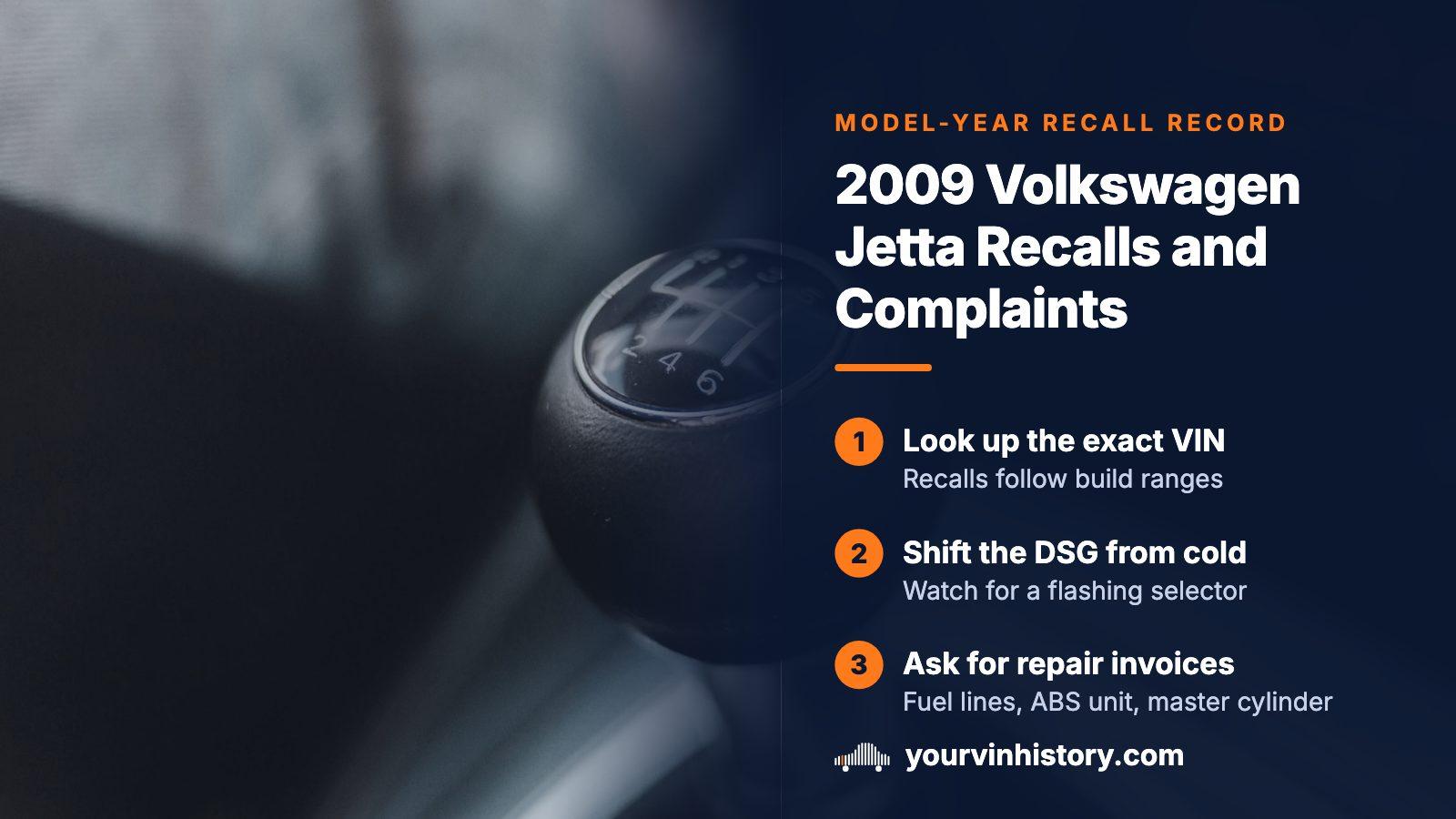
THE SHORT ANSWER
NHTSA has 7 recall campaigns on the 2009 Jetta: a DSG gearbox sensor, a driveshaft cover, gasoline and diesel fuel lines, an ABS control unit, an aftermarket brake master cylinder and a Volkswagen buyback offer. Owners filed 903 complaints, led by the fuel system at 227 and service brakes at 215. No crash ratings are published. Recalls follow VIN ranges, so look up the exact car.
- Recall campaigns
- 7 on NHTSA's record
- Owner complaints
- 903, led by fuel system at 227
- Crash ratings
- Not rated in either configuration
- Versus other Jetta years
- 4.61 times the median year
Three federal records, three different weights
NHTSA keeps separate files on a model year, and they should not be blended into one score. A recall is a defect the maker accepted responsibility for, and the 2009 Jetta has 7. A complaint is an owner's unverified account, and there are 903. An investigation is the agency studying a possible pattern, and 6 touch this model year.
Some complaints carry flags drawn from what the filer wrote. Of the 903, 31 mention a crash, 8 a fire and 17 an injury. One event can produce several reports and no flag is a finding, but those are the entries worth reading in full.
The seven campaigns, oldest first
Six were issued by Volkswagen for the car itself. The seventh is an equipment recall from a parts company and matters only if that part was fitted later.
| Campaign | Reason | Remedy start as filed |
|---|---|---|
| 09V164000 | Loose driveshaft cover screws | June 24, 2009 |
| 09V333000 | DSG sensor wiring that can force neutral | October 20, 2009 |
| 10V621000 | Gasoline fuel line rubbed by a plastic tab | By January 31, 2011 |
| 11V490000 | Diesel injector line that can crack | Expected November 2011 |
| 16V913000 | ABS control unit failure | February 2017 |
| 19V679000 | Buyback after internal-evaluation changes | November 6, 2019 |
| 20E064000 | Aftermarket master cylinder seal | October 30, 2020 |
Gearbox and driveshaft: a sudden neutral and loose screws
Campaign 09V333000 concerns the Direct Shift Gearbox on cars built from September 2008 through August 2009. Poorly crimped connector wires in a temperature sensor's harness can make it report overheated gearbox oil when the oil is fine. The transmission then drops into neutral without warning, which NHTSA says could cause a crash; the selector indicator flashes and a depress-brake-pedal light comes on. Dealers reprogram the control module at no charge.
Campaign 09V164000 is mechanical and applies to certain fifth-generation Jettas. Screws on the driveshaft cover plate may miss factory specifications or be torqued wrongly, and they can work loose. The first sign is a knock; in a severe case the driveshaft pulls away from the gearbox and damages its housing. Dealers inspect and replace the screws at no charge.
Power train owners filed 142 complaints, about 16%, with the median report at 1.6 years of age, so ask for the paperwork.
Two fuel campaigns, one for gasoline and one for the TDI
Campaign 10V621000 reaches certain gasoline Jettas, limited by engine size. A plastic tab on the windshield washer fluid reservoir can chafe an underhood fuel supply line, and chafing could let fuel leak. Dealers inspect the line, replace it if needed and remove the tab.
Campaign 11V490000 covers the 2.0L TDI common rail diesel in 2009 to 2012 Jetta and Jetta SportWagen models built from May 2008 through September 2011. Injection pulses can match the natural frequency of the number 2 injector line and stress it enough that it could crack, and fuel leaking near an ignition source may start a fire. The remedy is an improved line for that cylinder on certain cars plus vibration dampers on every injector line.
Fuel system is the biggest complaint bucket at 227 reports (25%) and diesel adds 195 (22%), but both are broad and neither isolates the recalled lines. Confirm the engine first.
Brakes: an ABS software fix and a part from another company
Campaign 16V913000 covers the ABS control unit in 2009 and 2010 Jetta sedans and the 2009 SportWagen, plus several sister models. The unit may fail while ABS or stability control is working, which could cost the driver control. Dealers load software that improves the module's self-test and replace any module that fails it, at no charge.
Campaign 20E064000 is an equipment recall. Tenneco pulled Beck/Arnley replacement master cylinders sold for 2004 to 2018 Jettas because the fluid seal crimp may be too weak, letting the cylinder leak or come apart and reduce braking. It matters only when that brand was installed, so repair invoices help.
Service brakes drew 215 complaints (24%) and stability control 98 (11%), both arriving late, at a median of 8.2 years.
The buyback recall few Jetta buyers will meet
Campaign 19V679000 reads unlike the others. Volkswagen Group of America says modifications made while certain vehicles sat in an internal evaluation period may leave them short of some regulatory requirements, which could raise the odds of a crash, a fire or an injury. The remedy is not a repair: Volkswagen notifies owners and repurchases the vehicles. It expands an earlier recall, 18V-329. The notice lists many models, including 2007 to 2009 Jetta sedans and 2008 to 2009 Jetta Sportwagens, but NHTSA's record shows only a small number of vehicles, so the VIN lookup is the only reliable way to know.
Where the 903 complaints land
NHTSA files each complaint under the component the owner blamed, and one report can name more than one, so the rows add up to more than 903. The top bucket holds about a quarter, which reads as several themes, not one dominant failure.
| Reports | Share | NHTSA component |
|---|---|---|
| 227 | 25% | Fuel system |
| 215 | 24% | Service brakes |
| 195 | 22% | Diesel |
| 142 | 16% | Power train |
| 111 | 12% | Electrical system |
| 103 | 11% | Fuel/propulsion system |
| 98 | 11% | Electronic stability control |
| 95 | 11% | Engine |
| 72 | 8% | Engine and engine cooling |
| 37 | 4% | Unknown or other |
| 35 | 4% | Hydraulic |
| 35 | 4% | Air bags |
These are buckets, not part names. Use them to decide what a mechanic should examine, not to diagnose.
How old the car was when each problem was reported
Each complaint carries the date the owner says the trouble began, giving the car's age at that moment. Sorted earliest to latest, the groups divide in two.
| System | Dated reports | Median age in years | Within first three years |
|---|---|---|---|
| Power train | 141 | 1.6 | 62% |
| Diesel | 194 | 2.5 | 61% |
| Fuel system | 226 | 2.6 | 62% |
| Fuel/propulsion system | 103 | 5.2 | 2% |
| Engine | 95 | 5.8 | 0% |
| Electrical system | 111 | 6.8 | 14% |
| Service brakes | 215 | 8.2 | 13% |
| Electronic stability control | 98 | 8.2 | 4% |
Power train, diesel and fuel system reports mostly fell in the first three years, so a well-kept car may have had that work done under warranty. Brakes and stability control come last and are the budget line. Filings peaked in 2011. A median shows when owners who chose to complain said something failed; it is not a failure rate.
Where 2009 sits among Jetta model years
A raw complaint count mostly follows sales, so the fairer yardstick compares each model year with the median Jetta year. On that scale the 2009 is the heaviest of the 15 model years on record, 2008 through 2022, at 4.61 times the median. The lightest settled year is 2018, at 0.16 times the median. Two Jettas at the same asking price can carry very different histories.
The ratio rests on complaint counts alone, so it says nothing about how one particular car was maintained, driven or repaired, or whether its recall work was done.
No crash stars and no driver-assist equipment
NHTSA lists two configurations for this model year, the 4-door Jetta and the Jetta Sportwagen. For both, the overall, frontal, side and rollover entries read not rated, and rollover probability is not published. Not rated means no score, which is different from a poor one. The listing also shows no forward collision warning offered and no lane departure warning available.
Stars describe a tested car as built, and a poor collision repair erases them. With none on file, the car's own repair history carries the weight, so ask whether it has been in a collision and how the damage was fixed.
When a recall repair stops being free
The duty to repair at no charge expires. The cutoff sits in 49 U.S.C. §30120(g), which lifts the requirement when the first purchaser bought the vehicle, or replacement equipment, more than 15 calendar years before the owner notice or the agency order, whichever came first.
All seven campaigns date from 2009 through 2020, well inside that window for a car first sold around its model year. A Jetta first sold in 2009 is past the line for anything announced now, so a new campaign may carry no right to a no-charge repair. Dealers sometimes do the work anyway, so ask.
What to check on the car and what to ask the seller
- Gearbox: on a DSG car, work through every gear from cold and watch for a flashing selector or a drop into neutral.
- Driveline: listen for a knocking sound.
- Fuel lines: look beside the washer reservoir for chafing; on a TDI, check for dampers on the injector lines.
- Brakes: pedal feel, ABS and stability lamps, and an invoice if the master cylinder was ever replaced.
- Wiring: 8 complaints describe fires, so look for heat damage and amateur electrical work.
- Age wear: corrosion, tired bushings, standing water in the trunk, uneven ride height.
- Which of the 7 campaigns were done, and can you show dealer receipts?
- Is it a TDI or a gasoline car, and who has serviced it?
- May my own mechanic inspect it before we agree on a price?
Then run the VIN through NHTSA's recall lookup, a free federal tool, for campaigns still open on that exact car. Title brands, accidents, salvage and odometer history sit outside recall data; a yourvinhistory report covers them, with title records from ClearVin LLC, an approved NMVTIS data provider. The preview is free and the full report is a one-time purchase.
Where this information comes from
- NHTSA: recalls and VIN lookup — Where a VIN is entered to see open campaigns; the campaign records described above come from the same federal data.
- NHTSA: vehicle safety and complaints — Starting point for the owner filings behind the 903 total, the category counts and the investigation count.
- NHTSA: 5-Star Safety Ratings — The federal crash-test program whose not-rated entries are described in the crash ratings section.
- 49 U.S.C. §30120: remedy without charge — Statute text for the no-charge repair duty and the 15-calendar-year cutoff in subsection (g).
- NMVTIS: national title record — Federal source for title brands and history, which recall and complaint data never cover.
Sources and photos: Facts checked against the sources above in October 2026. Photo by Erik Mclean on Unsplash; diagrams by YourVINHistory.
Keep reading
- Volkswagen Jetta years to avoid: 2008 to 2022 ranked by NHTSA complaintsRanks every Jetta year against the median, so you can see how 2009 compares.
- Volkswagen recallsShows how to run any Volkswagen by VIN for open campaigns.
- Volkswagen Jetta water pump replacement cost, and which VW coverage may applyCovers one repair bill a Jetta of this age can bring, with the warranties that apply.
- Buying a car with an open recallExplains what to do when the lookup shows a repair was never made.
Frequently asked questions
How many recall campaigns are on a 2009 VW Jetta?
Seven campaigns appear in NHTSA's file. Six come from Volkswagen; the seventh is a Tenneco equipment recall on aftermarket master cylinders, so it reaches only cars that received that part. Recalls attach to VIN ranges, so two 2009 Jettas can have different open campaigns.
What do 2009 Jetta owners complain about most?
Fuel system leads with 227 of 903 complaints, then service brakes with 215, diesel with 195 and power train with 142. NHTSA assigns the category from what the owner chose, and nothing is verified. Brake complaints arrive years after the early power train and fuel ones.
Does the TDI diesel change which recalls apply?
Yes. Campaign 11V490000 covers only cars with the 2.0L TDI common rail diesel built from May 2008 through September 2011, while the washer reservoir tab campaign addresses gasoline engines. The VIN confirms which engine a car has. Do not apply diesel complaint counts to a gasoline car.
Will a dealer still fix a 2009 Jetta recall at no charge?
Inside the federal limit, yes. The rule stops applying when the first buyer purchased the vehicle more than 15 calendar years before the notice or order. The older campaigns were announced inside that window, while a new one now may not be. Ask the dealer first and get the answer in writing.
How do I check a specific 2009 Jetta for open recalls?
Enter the 17-character VIN in NHTSA's recall lookup, which reports campaigns still open on that vehicle. Repeat the search on the day you buy, because a new campaign can appear after a listing goes up. Keep dealer paperwork for completed repairs.
Now check the car itself
The guide explains what to look for. The report shows what this VIN has on record.