THE SHORT ANSWER
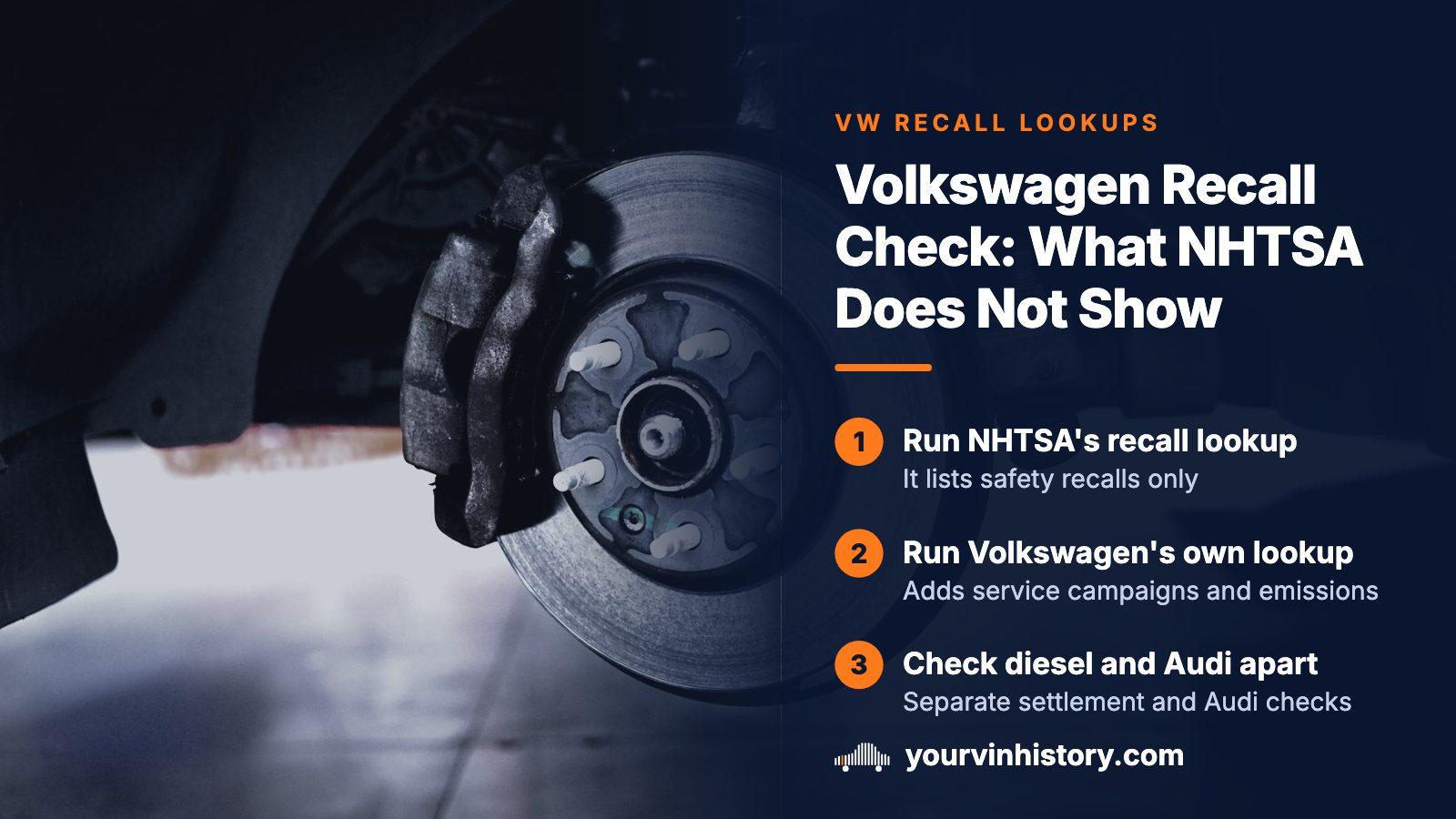
Enter the 17-character VIN in NHTSA's recall lookup, then in Volkswagen's own Recall/Service Campaign Lookup. NHTSA reports safety recalls only. Volkswagen's tool also lists service campaigns, some of them emissions related, and diesel owners get a separate settlement lookup. A safety recall remedy is done at no charge unless the first buyer purchased the car more than 15 calendar years before the notice. Audi has its own check.
- Federal lookup scope
- Safety recalls only
- Volkswagen lookup window
- Notifications from the last 15 years
- No-charge cutoff
- First purchase more than 15 calendar years before the notice
- Engine cover example
- NHTSA 25V-100, Volkswagen code 10X5
What a clean NHTSA result tells you, and what it does not
Type a Volkswagen's VIN into the NHTSA lookup and get nothing back, and you have learned one specific thing: no safety recall is outstanding for that car. The database is built around safety. A campaign gets in when a vehicle or its equipment carries an unreasonable safety risk, or misses a federal safety standard.
Work that exists for another reason sits outside it. An emissions fix is not a safety defect, so the federal tool has no reason to list it, even while the work waits on your car. The tool is not broken. The mistake is in the reading, when a buyer takes "no recalls found" to mean "nothing outstanding."
Read the result narrowly
A blank federal screen means no safety recall is outstanding on that VIN today. Run the search again on the day you hand over money, since new campaigns are added as they are filed.
Three kinds of factory work that can attach to one VIN
Volkswagen's own recall page draws a line between two categories. Recalls address defects tied to motor vehicle safety, including failures to meet federal safety standards. Service campaigns address technical problems not directly about safety, and the page says they may also be emissions related. The diesel settlement program it points to adds a third.
| Kind of work | Who sets the rules | Where it shows up |
|---|---|---|
| Safety recall | Federal safety law; the maker files a Part 573 report with NHTSA | NHTSA's VIN lookup and Volkswagen's lookup |
| Service campaign | The manufacturer, for technical issues not directly tied to safety | Volkswagen's lookup, not the federal safety database |
| Emissions modification | Emissions rules, carried out under a manufacturer campaign code | Volkswagen's lookup; diesel settlement cars also have their own lookup |
Only the first row is reachable through the federal tool. The other two need Volkswagen's side of the check.
One recall, two reference numbers
A real Volkswagen recall shows how the paperwork looks. The engine cover recall on the Atlas and Atlas Cross Sport appears in NHTSA's records as 25V-100, and the sample owner letter posted there also carries Volkswagen's own code, 10X5, in the subject line: Safety Recall 10X5, Engine Cover.
The fault is mundane. If the cover is not fitted properly after a service visit, it can work loose and touch very hot parts of the engine bay. The cover may melt, and the letter warns that melted material reaching a hot turbocharger could lead to a fire. The fix is to take the cover off, which the letter says the dealer does in under an hour at no charge.
For a buyer, the pairing matters. A safety recall carries a federal number and a manufacturer code, so either one leads to the same job. An emissions campaign carries a manufacturer code only. If a service invoice shows a code the federal search cannot find, you are probably looking at the second kind. Copy every code exactly as printed.
Running Volkswagen's own lookup, step by step
Volkswagen runs a recall and service campaign lookup on its owner pages, and it works from the VIN.
- Read the 17-character VIN through the windshield at the lower driver's side corner, and photograph it so no character is copied wrong.
- Search NHTSA first and save the result for comparison.
- Enter the same VIN on Volkswagen's recall page and read the recall and service campaign sections separately.
- Write down each campaign name and code, and note whether it is a safety recall, a service campaign or an emissions item.
- Check the date range. Volkswagen says its search covers customer notifications made during the last 15 years, so an older campaign could fall outside it.
The page lists no phone number. It sends owners to an authorized dealer or to Volkswagen's contact page, so use the dealer for anything the screen leaves unclear.
Diesel cars carry a separate settlement lookup
On a diesel, the recall page is only part of the job. Volkswagen's page links to a separate section on its TDI emissions settlement program, which it describes as explaining ways to modify or buy back select models. That section has its own Emissions Modification Lookup.
The program grew out of a federal civil settlement over diesel emissions. The EPA's summary says the agency and the California Air Resources Board approved the emissions modifications, while Volkswagen carries out the buybacks and recalls. None of that is a safety recall, so a federal safety search stays quiet about it.
On a used diesel, ask the seller whether the car went through the program and ask to see the paperwork. Then run the VIN yourself. The lookup covers select models only, so a missing entry is something to ask a dealer about, not a verdict.
Audi needs its own check
NHTSA's search works from the VIN, so it treats an Audi exactly like a Volkswagen. Nothing changes on the federal side.
The manufacturer side is where people assume too much. Volkswagen's recall page speaks only about Volkswagen vehicles. Shared platforms and parts are common inside a corporate group, but the lookup to rely on is the one run by the maker of the badge on the grille. For an Audi, use Audi's own owner pages with the same VIN.
When cross-shopping a Volkswagen and an Audi, run the federal search on both, then each maker's tool, and compare the printouts. Label each printout with the badge and VIN so two similar cars never get mixed up.
The no-charge rule for safety recalls, and its age cutoff
Federal safety law requires the manufacturer to remedy a safety recall at no charge to the owner. The manufacturer picks the method: repair the vehicle, replace it with an identical or reasonably equivalent one, or refund the purchase price less a reasonable allowance for depreciation. The duty attaches to the car, so a second or fifth owner can claim it as the first one could.
There is a cutoff, and it is about age, not owners. The no-charge requirement does not apply when the first purchaser bought the vehicle more than 15 calendar years before the manufacturer gave notice or an order was issued. A Volkswagen older than that can come with a bill, so confirm the cost before you book.
Two different 15-year clocks
Volkswagen says its lookup covers customer notifications made during the last 15 years. The statute counts 15 calendar years from the first purchase to the notice date. One limits what the search shows, the other limits who owes you a no-charge repair.
Bills that sit next to a recall
The no-charge promise covers the remedy and nothing around it. If the shop spots worn brake pads while the car is on the lift, that is ordinary paid work. Ask for recall lines and other lines to be listed separately.
Service campaigns and emissions work are a different matter. The federal no-charge rule is tied to safety recalls, and the Volkswagen page does not say how service campaigns are billed. Ask what a campaign costs, in writing, before you agree to it.
If you already paid for a repair that a recall later covered, say so. The federal statute requires a recall remedy program to include a plan for reimbursing owners who paid before the notice, and Volkswagen's sample owner letter says an enclosed form explains how to ask. Bring the invoice.
Having a dealer confirm what is open on the VIN
Both public lookups are useful, but a dealer's service system is the tool that decides whether a car qualifies for the work. Volkswagen's engine cover bulletin tells technicians to check the campaign screen on the day of repair and says the status must read open. It also tells them to alert the customer to other open actions, so the work can be done in one visit.
That is a good reason to have a dealer run your VIN before you buy or book service. Bring a short list of requests.
- A printout of every open campaign, with the codes.
- The type of each item: safety recall, service campaign or emissions.
- Whether parts and procedure are available now, or the car goes on a waiting list.
- What, if anything, you would pay for each item.
- An explanation for any difference from your own two searches.
What a campaign check cannot tell you about the car
Recall and campaign lookups describe the manufacturer's work orders and nothing about the car's past. A Volkswagen with no open recalls and no open campaigns can still have been wrecked, branded salvage or rolled back on the odometer.
- Accident and structural repair history
- Title brands such as salvage, rebuilt or flood
- Odometer readings and rollback
- Liens, theft and impound records
- Service history and how the car was driven
A vehicle history report collects those records. A yourvinhistory report sets open recalls beside title, accident and odometer records for the same VIN, with a preview first and a one-time purchase after. Use it next to the two lookups above, then have the car inspected on a lift before you pay.
Where this information comes from
- NHTSA: Check for recalls by VIN — The federal VIN lookup, whose scope is safety recalls rather than every campaign a maker runs.
- NHTSA: Search safety issues — Lists complaints, investigations and recalls by vehicle, a useful second look beside the VIN search.
- NHTSA: Volkswagen recall 25V-100 — Dealer bulletin and sample owner letter showing a federal number beside Volkswagen's own recall code.
- NHTSA: vPIC VIN decoder — Confirms which vehicle a VIN describes before you start searching for campaigns.
Sources and photos: Facts checked against the sources above in October 2026. Photo by Justin Cron on Unsplash; diagrams by YourVINHistory.
Keep reading
- Recall check by VINWhy a search by model and a search by VIN answer different questions.
- Buying a car with an open recallWhat a seller may legally hand you with a safety recall still open.
- Volkswagen warranty by VINCoverage on diesel Volkswagens that exists because of the federal settlement.
- AudiReading an Audi VIN before you run that maker's own campaign check.
Frequently asked questions
Does a clean NHTSA result mean my Volkswagen has no open campaigns?
It means no safety recall is outstanding on that VIN, which is all the federal tool is built to show. A service campaign or an emissions modification can still be open, and those appear in Volkswagen's own lookup. Search both, save the results, and repeat the search on the day you sign, since new campaigns are added over time.
Why does a Volkswagen campaign code from the shop not appear on NHTSA?
Federal safety recalls carry an NHTSA number such as 25V-100 plus a manufacturer code such as 10X5. Emissions campaigns carry a manufacturer code but no federal number, and service campaigns sit outside the safety database altogether. A code missing from NHTSA is a prompt to look it up on Volkswagen's side or ask the dealer which kind it is.
Will a used Volkswagen owner be charged for a recall repair?
For a safety recall, the manufacturer must provide the remedy at no charge, and a change of owners does not alter that. Age does: if the first buyer purchased the car more than 15 calendar years before the notice, the federal rule no longer applies. Related work a shop suggests is separate, and service campaigns fall outside that rule, so ask for the price first.
Does an Audi need a separate recall check?
The federal search works the same way for an Audi, using the VIN. On the manufacturer side, do not assume Volkswagen's page covers it, because that page describes Volkswagen vehicles only. Run the VIN on Audi's own owner pages as well, and ask an Audi dealer to settle it if the two lists look different.
How do I confirm the VIN is right before I search?
Read the 17 characters through the windshield at the lower driver's corner and photograph them. A single wrong character gives you results for the wrong vehicle or none at all. NHTSA's vPIC decoder shows what the VIN describes, using manufacturer-reported data for vehicles meant for sale in the United States, so you can match it to the listing first.
Now check the car itself
The guide explains what to look for. The report shows what this VIN has on record.