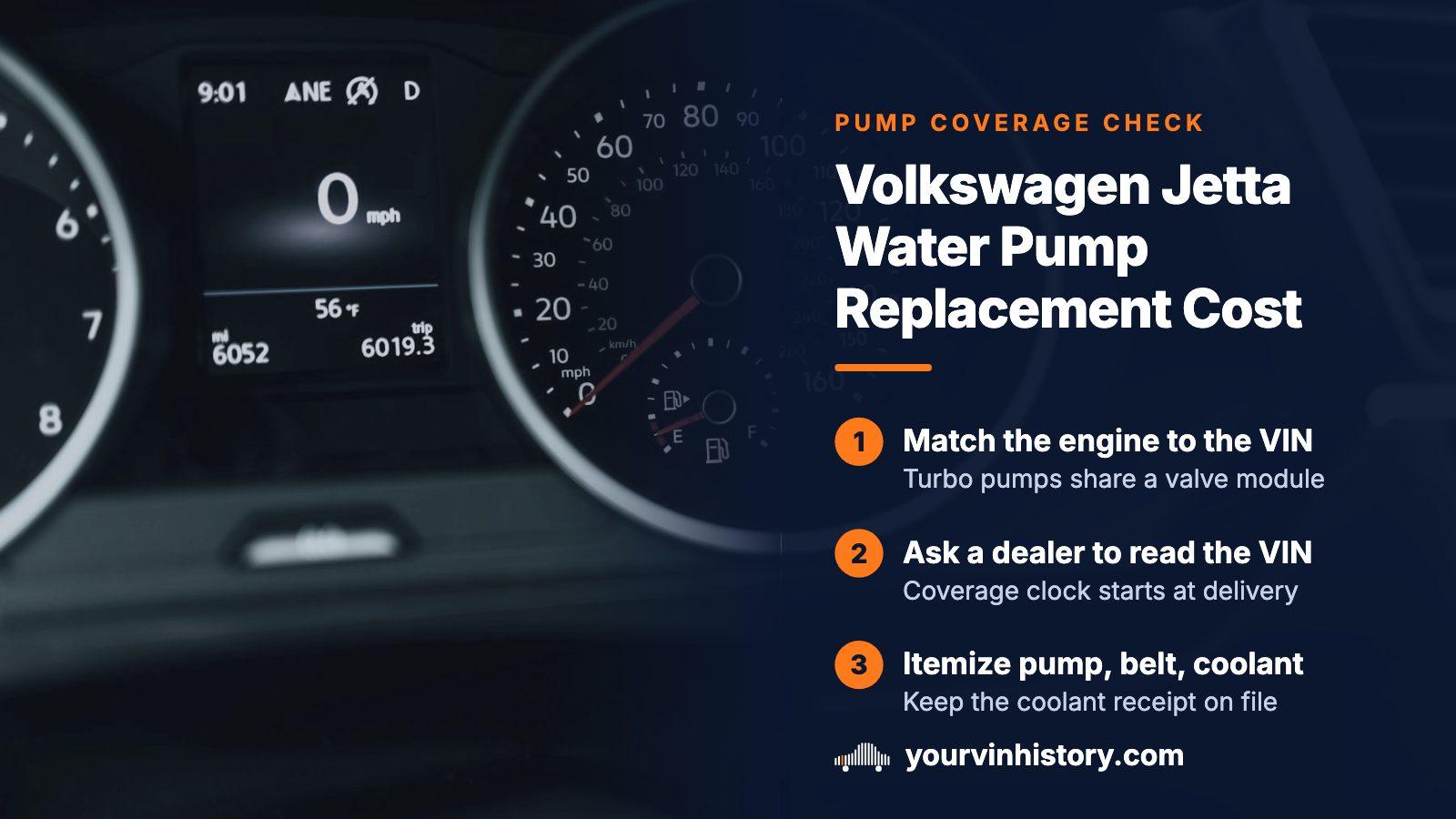
THE SHORT ANSWER
RepairPal's Jetta estimate runs from $1,040 to $1,302 for all years listed, and Kelley Blue Book shows $1,023 to $1,187 for a 2018 priced in one San Francisco ZIP code. Parts make up close to half. No safety recall targets the pump, but Volkswagen bulletins VWP-19-08 and VWP-22-06 extended coverage, and the second may still reach a 2019–2021 Jetta with under 80,000 miles. A VW dealer confirms by VIN.
- RepairPal, all years listed
- $1,040 to $1,302
- KBB, 2018 Jetta, ZIP 94102
- $1,023 to $1,187
- Newer VW extension
- VWP-22-06, 8 years or 80,000 miles
- Safety recall for the pump
- None found
What RepairPal and Kelley Blue Book publish for a Jetta pump
This site sets no repair prices, so each dollar figure belongs to the publisher beside it, as listed on October 26, 2026. Both sites reprice by date and ZIP code. RepairPal's Jetta page splits its range into labor of $472 to $692 and parts of $568 to $609.
| Publisher | Car and place | Range shown |
|---|---|---|
| RepairPal | Jetta, all years listed | $1,040 to $1,302 |
| RepairPal | 2014 Jetta | $1,117 to $1,454 |
| Kelley Blue Book | 2018 Jetta, ZIP 94102 (San Francisco) | $1,023 to $1,187 |
| Kelley Blue Book | 2021 Jetta GLI, ZIP 27833 (Greenville, North Carolina) | $1,040 to $1,160 |
The FAQ text on those Kelley Blue Book pages also carries a generic $375 to $787 range, but it repeats under unrelated models, so it is not a Jetta quote. Nearly every year clears $1,000, and parts are near half the total, rare for a compact sedan.
The engine under the hood decides which pump you are pricing
Pull the engine from the VIN before comparing quotes. EPA's fueleconomy.gov lists what Volkswagen certified for each Jetta sedan year.
| Model years | Engines EPA lists |
|---|---|
| 2008 | 2.5L five-cylinder and a 2.0L turbo |
| 2009–2010 | 2.5L, a 2.0L turbo, and the TDI diesel |
| 2011 | 2.5L, a non-turbo 2.0L and the TDI |
| 2012–2013 | 2.5L, 2.0L, TDI, the GLI's 2.0L turbo, and a 1.4L turbo in the Hybrid from 2013 |
| 2014–2015 | 2.0L, TDI, 1.8L turbo, 2.0L turbo and the Hybrid |
| 2016–2018 | Turbos only: 1.4L, 1.8L and 2.0L |
| 2019–2022 | 1.4L turbo (1.5L turbo in 2022), plus the GLI's 2.0L turbo |
The TDI diesels had their own emissions buyback and repair programs, a separate matter. A diesel is not a turbo gasoline engine, so the gasoline figures do not carry over.
Why the part costs so much: a pump built into the thermostat valves
An NHTSA-hosted copy of Audi's November 2013 training program for third-generation EA888 engines (1.8L and 2.0L) describes an Engine Temperature Control Actuator. Two linked rotary valves do a thermostat's job, mounted as one assembly with the coolant pump, and a cutaway labels a toothed belt just for that pump.
The 1.8T that arrived for 2014 (VW notes give codes CPKA and CPRA) is commonly placed in that family, as is the GLI's 2.0T. A failed pump there usually means a new pump-and-valve assembly plus belt. A Ford dealer's catalog listed a Focus pump at $55 to $62 in October 2026, so RepairPal's Jetta parts line runs close to ten times that.
The earlier 2.0T (codes CCTA and CBFA) used another design with a similar reputation: NGP Racing, an aftermarket seller of an aluminum version, says the factory pump came only in plastic. The 1.4T drives its pump with a toothed belt as well: Volkswagen's 2018 maintenance schedule lists a check at 150,000 miles on the 1.4L Jetta only.
Volkswagen's two pump extensions, side by side
Two class-action settlements led Volkswagen to publish a pump warranty bulletin each time, and NHTSA hosts both.
| Point of comparison | VWP-19-08 | VWP-22-06 |
|---|---|---|
| Dated | December 2, 2019 | June 21, 2022 |
| Jetta years | Certain 2008–2014 | Certain 2014–2021 |
| Parts named | Primary engine water pump | Water pump, thermostat and thermostat housing |
| Limit from in-service date | 10 years or 100,000 miles | 8 years or 80,000 miles |
| Engine damage the pump caused | Prorated; years eight through ten pay 25% down to 5% by mileage | Prorated, starting once other warranties end |
OpenClassActions, which followed the later case, says the class takes in some Volkswagen and Audi models carrying either a 1.8-liter or a 2.0-liter engine, meaning the 1.8T and GLI on a Jetta. The bulletin says only certain vehicles, so a dealer's VIN read is the real test.
The clock starts at delivery, not at the model year
Volkswagen counts from the original in-service date, the day the car went to its first buyer or lessee. By late 2026 the ten-year window of the first bulletin has closed on practically every 2008–2014 Jetta. Under the second, a 2014–2018 Jetta has passed its eighth year or is reaching it, but a 2019–2021 Jetta with fewer than 80,000 miles may still qualify.
- Repairs must be done by an authorized Volkswagen dealer.
- Owners supply receipts or a signed declaration showing proper coolant, checked on schedule.
- Totaled vehicles are excluded, and the newer bulletin also excludes salvaged titles.
- Coverage passes to later owners, except for commercial resale.
Coolant loss: the pump, or a cheaper culprit
A failing pump tends to show itself through coolant, not noise. Typical signs:
- A coolant or temperature warning on the dashboard
- A reservoir that sinks between top-ups
- Dried coolant crust or wetness at the pump housing
- Steam or a sweet odor after parking
A slow seep with a steady gauge buys a few days, if you check the level each morning. A rising gauge cannot wait: overheating can warp an aluminum head, which on a turbo engine costs far more than a pump. Volkswagen's notes name look-alike causes.
| Car and engine | Volkswagen's guidance to technicians |
|---|---|
| 2.0L turbo (CCTA/CBFA) | Oil swelling the pump gasket starts the seep; clean it off and vacuum-bleed (Tech Tip 19-13-02) |
| 2011–2014 2.5L | Low flow and overheating may trace to a clogged oil cooler holding air in the housing (Tech Tip 19-18-01) |
| 2013–2016 1.4L turbo, Hybrid included | Bulletin 2045451: a coolant pipe rubbing the air filter housing can leak; fit a new pipe |
| 2019 Jetta | Circular 19O3: coolant can seep from the reservoir into the level sensor connector |
On an older 2.0T, oil on the pump means a new pump alone will leak again. The first extension's dealer guidance also leaves out a pump hurt by another part's failure, such as a valve cover oil leak.
Recalls: none for the Jetta pump, one aftermarket exception
NHTSA's recall records for 2008–2022 Jettas show no Volkswagen safety recall for the coolant pump. The few that mention a pump involve a brake vacuum pump or a fuel-tank pump.
The exception is aftermarket. In 2014 the Gates Corporation recalled Tru-Flow replacement pumps, part number TFW 41127, that certain NAPA stores sold or technicians installed after November 1, 2013, for a list of cars that includes Jettas from 1999–2008 and 2011–2013. Gates warned that the pulley or sprocket turning the timing belt could develop microfractures and let the belt fail. A 2011–2013 Jetta given an aftermarket pump around then deserves a check against recall 14E007.
Two other VW recalls touch the cooling area without involving the pump: 14V182 (seals leaking in the transmission cooler of 1.8T-equipped 2014 Jettas) and 17V070 (an improperly cast 1.4L block that could seize in 2017 Jettas). Dealers repair open safety recalls at no charge within the federal rule's limits; a tech tip is guidance for technicians and pays for nothing alone.
What NHTSA complaints can and cannot say about Jetta pumps
NHTSA has no water pump category, so owners file pump failures under ENGINE, beside oil leaks and misfires. Treat ENGINE as background and a ceiling, never a pump tally. A count of the Jetta file for 2008 through 2022 finds 858 ENGINE complaints among 5,457 on record, using only years where ENGINE reached the top five.
ENGINE accounted for at least 10% of complaints on 2008–2012 models, reaching 23% for 2013–2017 models and 24% for 2019–2022 models, even as overall filings fell. The peak count, 147, belongs to 2019; 2022 has the top share on a mere 42 complaints.
Only each year's five largest categories are stored, so in 2009, 2018 and 2021, when ENGINE sat below the top five, its count is an unlisted figure rather than zero, and every sum is a minimum. Just 31 complaints exist for 2018. A handful of narratives mention a water pump, a coolant pump or the thermostat housing, none from a car newer than 2016, and NHTSA keeps editing its file. The strongest evidence of Jetta pump trouble is Volkswagen's own settlement bulletins.
Settle these points before you approve a Jetta pump quote
- Confirm the engine by VIN, since a 2.5L, a 1.4T, a 1.8T, a 2.0T and a TDI each take different parts.
- On a 2019–2021 Jetta under 80,000 miles, have a Volkswagen dealer read the VIN for extension VWP-22-06 before an independent shop starts.
- Ask where the leak was seen: at the pump itself, or only as a falling level.
- On a 2.0T, ask whether engine oil is sitting on the pump.
- Ask for the pump, thermostat, belt and coolant itemized.
- Put the factory-specified coolant back in and file the receipt.
The coolant paperwork carries weight
Both bulletins exclude damage from improper coolant and expect owners to document the right fluid, by receipts or a signed declaration. A coolant lookup by VIN reports the factory specification.
If you are buying a Jetta rather than repairing one
To a shopper the pump is a budgeting item more than a reason to walk away. Priced a bit above $1,000 for most years, it belongs in the numbers on any turbo gasoline Jetta without proof of a replacement. Request service receipts, since a documented pump and thermostat job is worth something, and at the pre-purchase inspection look for dried coolant at the pump.
On a 2019–2021 Jetta, ask whether VWP-22-06 could still apply. Both bulletins exclude totaled vehicles, and the newer one salvaged titles, so title history matters. A vehicle history report by VIN shows title brands, accidents, odometer readings and open recalls; a Volkswagen dealer reads extension status.
Where this information comes from
- RepairPal: Volkswagen Jetta water pump replacement estimate — Origin of the all-years range, the parts and labor split and the 2014 row in the price table.
- Volkswagen bulletin VWP-19-08, hosted by NHTSA — Terms of the 10-year, 100,000-mile pump extension, its prorated engine-damage table and the coolant paperwork.
- Volkswagen bulletin VWP-22-06, hosted by NHTSA — Terms of the 8-year, 80,000-mile extension covering the pump, thermostat and housing, plus its exclusions.
- Audi eSelf-Study Program 920243, hosted by NHTSA — Shows the pump built into the thermostat valve module and driven by its own toothed belt.
- NHTSA: Volkswagen Jetta complaints and recalls — Federal complaint and recall records used to look for a pump campaign and to frame the ENGINE counts.
- EPA and DOE: fueleconomy.gov vehicle records — Lists the engines certified for each Jetta model year, the basis for the engine table.
Sources and photos: Facts checked against the sources above in October 2026. Photo by Nathan Dumlao on Unsplash; diagrams by YourVINHistory.
Keep reading
- Volkswagen Jetta years to avoid: 2008 to 2022 ranked by NHTSA complaintsYear-by-year Jetta complaint counts that reach beyond the engine category.
- Volkswagen warranty by VINShows how a VIN ties to Volkswagen extended coverage and what a dealer's system reports.
- Coolant type by VINLooks up the coolant Volkswagen specified, the fluid both extensions expected owners to document.
- Volkswagen recallsLook up a specific Jetta VIN for open recalls from the maker.
Frequently asked questions
What does a Volkswagen Jetta water pump replacement cost?
Published estimates cluster a little above $1,000. RepairPal lists $1,040 to $1,302 for its all-years Jetta page, and Kelley Blue Book gives $1,023 to $1,187 for a 2018 in one San Francisco ZIP code. Your engine, location and any added thermostat or belt can shift the bill.
Does Volkswagen cover a failed Jetta water pump?
Not through a safety recall, but possibly through a warranty extension. VWP-19-08 gave certain 2008–2014 Jettas 10 years or 100,000 miles, and VWP-22-06 gave certain 2014–2021 Jettas 8 years or 80,000 miles. Both start at first delivery, require an authorized dealer and exclude improper coolant. The dealer reads your VIN to confirm.
Why is a Jetta water pump pricier than one on a Civic or Focus?
On the turbo engines the pump belongs to a module with the thermostat valves and runs from a toothed belt of its own. RepairPal puts parts at $568 to $609, while a Ford dealer listed a Focus pump at $55 to $62. Labor adds another $472 to $692.
How can I tell if my Jetta water pump is failing?
Look for dried coolant at the pump housing and a reservoir that keeps falling. A sweet smell or a temperature warning also points at the cooling system. Ask a shop for a pressure test before replacing anything, and on a 2.0T look for oil on the pump first.
Should I repair or skip the pump job on an older Jetta?
Repair it, provided the engine never overheated. A bill around $1,000 to $1,300 is moderate even on a high-mileage sedan. If the gauge ever climbed, request a pressure test and a combustion-gas check on the coolant first, since a warped head makes a pump repair into an engine repair.
Now check the car itself
The guide explains what to look for. The report shows what this VIN has on record.