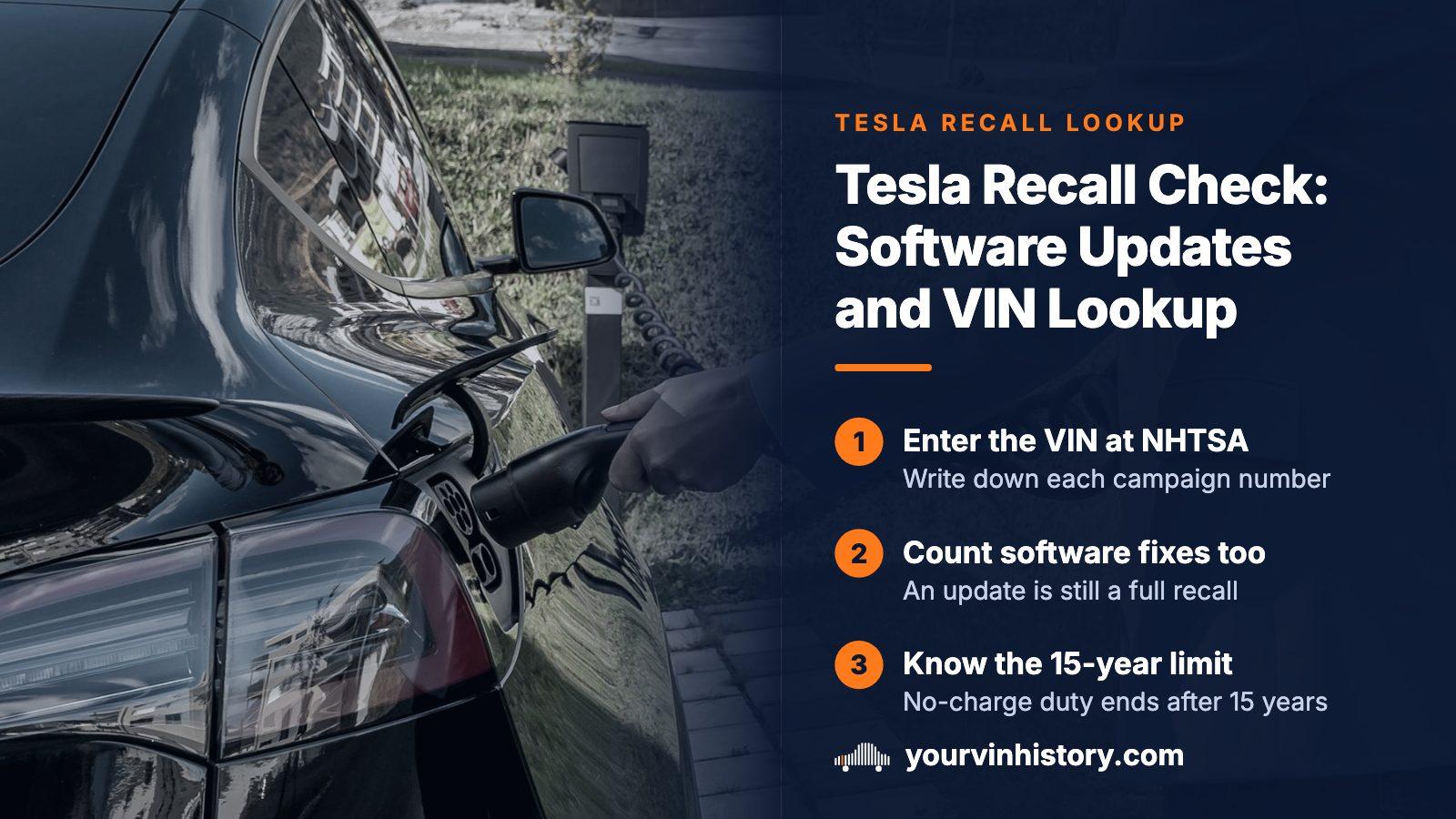
THE SHORT ANSWER
Enter the 17-character VIN in NHTSA's recall lookup and write down any campaign number it lists. A recall delivered as an over-the-air software release is still a full safety recall, and an entry that stays open usually points to a car that has not installed the fix. Federal law generally requires the repair at no charge, but that duty ends when the first purchaser bought the car more than 15 calendar years before the notice.
- Filing
- A Part 573 report, even when the remedy is software
- Owner action
- Install the release the report names, or a later one
- Notice
- Letters are still mailed to the registered owner
- Age limit
- No-charge duty ends past 15 calendar years from first purchase
Start with the VIN, then read the campaign itself
The federal lookup is the quickest first test. It asks for the 17-character VIN and returns any recall campaigns on record for that exact car. Copy the VIN from the car and from the title or registration, and confirm the two match first.
- Enter the VIN in the NHTSA recall lookup and note each campaign number it returns.
- Open the campaign's documents on NHTSA's site and find the Part 573 report.
- Read the description of the defect (or noncompliance) and the description of the remedy.
- Look for the software release or component that the report names.
- Compare that release with what the car is running, then run the lookup again after any update or repair.
A clean result means nothing is open against that VIN today. It says nothing about campaigns that were closed earlier, which is why the repair record matters on a used car.
Why an overnight update still gets a campaign number
Federal law ties the recall duty to the problem, not to the repair method. A manufacturer that decides in good faith that a defect relates to motor vehicle safety, or that a vehicle fails an applicable federal safety standard, must notify NHTSA, owners and dealers. Nothing in that trigger asks how the fix will be delivered.
Tesla's filings show the principle at work. The two reports reviewed for this guide are Part 573 Safety Recall Reports, the same form any automaker submits, and both describe a software remedy sent to cars over the air. The numbers follow the standard pattern of a two-digit year, a V and a sequence. A car repaired in the driveway while its owner sleeps is still a recalled car.
Two Tesla campaigns, side by side
Real filings show how varied software-remedy recalls can be. These two are not interchangeable, and neither predicts what a different campaign would say.
| Detail | 25V-092 | 24V-935 |
|---|---|---|
| Problem | Power steering assist may drop out once the car stops, leaving manual steering | Tire pressure warning light did not stay lit from one drive to the next |
| Kind of recall | Safety defect | Noncompliance with a federal safety standard |
| Models named | Certain Model 3 and Model Y vehicles from a single model year | Certain Model 3, Model Y and Cybertruck vehicles |
| Remedy | Over-the-air release that prevents the electrical overstress | Over-the-air release that corrects the warning light |
| Owner action stated | None for cars on the named release or later; no service visit | None for cars on the named release or later |
In the steering case, Tesla's report says a regulator in another country opened an inquiry, after which the company chose to recall the affected vehicles in every affected market. The same report says Tesla knew of no crashes, injuries or deaths tied to the condition. A recall number does not always mean harm has already happened.
The software can be the cause as well as the cure
The tire pressure case runs the other way from what most people expect. Tesla's report traces the problem to a software release that reset the warning light whenever the car woke from sleep, so a detected fault vanished at the next drive. The company says it spotted the issue during routine compliance testing for markets outside the United States.
That shapes who is in the recall. Each report defines its population partly by software release: cars that installed the faulty one in the tire case, cars still on something older than the repaired one in the steering case. Once a car reaches the release the report names, or any later one, the reports say nothing further is needed from the owner. For a Tesla, the installed release is as much a part of the recall record as the VIN.
Fixes that reach cars before the recall is filed
Timing can look backwards. In the steering campaign, the report says the software remedy began reaching US cars, and cars leaving the factory, more than a year before the recall report was submitted. By the filing date, the report puts the share of affected US vehicles that had installed it at nearly all of them.
For a shopper this matters twice. A campaign number that looks recent can describe a problem patched long ago on any car that stayed connected. And the few vehicles that never took the update become what the open record is really about, since the fix existed the whole time and simply never landed.
Why one car can lag behind the rest of the fleet
A software remedy reaches cars in waves, and it only works if the car receives and installs the release. That leaves room for a Tesla to sit behind: one parked for months without a connection, or one whose owner keeps postponing updates. The lookup then keeps listing the campaign against that VIN while newer cars are long past it.
Remember where the lookup gets its status. It depends on completion data the manufacturer supplies, so a delay in reporting is possible in either direction. If the database and the car disagree, trust neither alone: compare the software screen with the release named in the report and ask Tesla service to confirm.
Notice letters still go out by mail
A recall that fixes itself invites the belief that nobody will tell you about it. The filings say otherwise: both state that owner notification letters will be mailed under the federal notice rule, and that Tesla stores and service centers are told about the campaign as well.
That rule sends the notice by first-class mail to the registered owner whose name and address the manufacturer can obtain from state records. When no owner can be identified, the most recent known purchaser gets it. This is why a recent buyer can miss a letter: if registration records lag behind the sale, it can land with the previous owner instead.
What to ask before you buy a used Tesla
Treat the recall check as the start of a conversation. The answers cost a seller nothing to give, and hesitation tells you something.
- Ask for a printout of the NHTSA lookup for this VIN, or run it yourself during the viewing.
- Ask to see the software screen and compare the release with any campaign the lookup lists.
- Ask whether the car stayed connected or spent long stretches parked and offline.
- Ask for service records covering any campaign whose remedy involves a part instead of software.
- Ask whether recall letters ever arrived, and who the registered owner was at the time.
Hardware campaigns still need a workshop
Not every Tesla recall is software. The company also files campaigns whose remedy is a physical inspection or part replacement, and those stay open until somebody does the work. On a used car, an open hardware recall is a task you take on when you buy.
Read the remedy line before the headline
The remedy section of the Part 573 report says what the repair actually is. The steering report names a supplier-made steering rack as an involved component, yet its cure was a software change. A part named in the report does not guarantee a workshop visit, so read the remedy before judging the campaign.
The no-charge repair rule and where it stops
Under federal law, a manufacturer must remedy a recalled vehicle at no charge when it is presented for the fix. The remedy can be a repair, a replacement vehicle, or a refund of the price less a reasonable allowance for depreciation. The two Tesla reports describe their software remedies as costing owners nothing.
That duty has an edge. It does not apply when the first purchaser bought the vehicle more than 15 calendar years before the required notice or the order behind it. For tires the line is 5 calendar years. The count starts at the first purchase, so the number of owners in between does not move it, and a very old car can fall outside the rule whatever its history.
Teslas are young cars, but the earliest builds are no longer so young that this can be ignored. For anything near that age, ask the manufacturer in writing whether a campaign covers the car before assuming the repair costs nothing. The rule covers the recall remedy only, not other work suggested during the same visit.
What a recall lookup cannot tell you
A recall lookup answers a single question: does this VIN have an outstanding manufacturer campaign. It says nothing about crashes, title brands, odometer readings or how the car was used. On an electric car it also cannot describe the condition of the traction battery, which is a matter for service records, a diagnostic and a test drive.
A vehicle history report by VIN covers part of that gap, bringing title brands, accident records with a damage map, odometer readings and open recalls into one place. It still does not replace an inspection by someone who knows the car.
Where this information comes from
- NHTSA: Recalls lookup by VIN — The federal search where you enter a VIN and see which campaigns are on record for that car.
- NHTSA: Part 573 Safety Recall Report 25V-092 (Tesla) — Tesla's steering assist filing: how the defect is described, the over-the-air remedy, and the statement that owner letters are mailed.
- NHTSA: Part 573 Safety Recall Report 24V-935 (Tesla) — Tesla's tire pressure warning filing, which shows a software release as both the cause and the remedy.
- NHTSA vPIC: VIN decoder — Decodes a VIN so you can confirm the model and model year before matching a campaign to the car.
Sources and photos: Facts checked against the sources above in October 2026. Photo by smart-me AG on Unsplash; diagrams by YourVINHistory.
Keep reading
- TeslaWhat a Tesla VIN encodes, so you know which model and build a campaign could cover.
- Used electric car checkThe checks that matter on an electric car beyond recalls, battery questions included.
- Recall check by VINHow the federal lookup works for any make and how to read its result.
- Buying a car with an open recallWhat the sale rules and the age limit mean if an open recall turns up on a car you want.
Frequently asked questions
Does an over-the-air update count as a Tesla recall?
Only when a campaign number exists. A routine feature release has no NHTSA filing, while a recall release comes with a Part 573 report, a number such as 25V-092 and a mailed owner notice. If the lookup lists a number against your VIN, the update behind it is the recall remedy, however quietly it installs.
How do I know whether my Tesla installed the recall fix?
Read the remedy section of the campaign's Part 573 report to find the release it names, then compare that with the version on the car's software screen. Run the VIN lookup again afterward, since status can take time to change. The two reports reviewed here say owners on the named release or a later one need do nothing more.
Do I have to visit a Tesla service center for a software recall?
The steering report states that no service visit is necessary once the car has the named release, and the tire report says no further action is needed from owners on its fixed release. A recall whose remedy involves a part is different. If the car has been offline, connect it first, then contact service if the update never arrives.
Can a dealer sell a used Tesla that has an open recall?
Federal law stops a dealer from selling a new vehicle it holds under recall until the remedy is done, and stops rental companies from renting covered vehicles. It does not name used cars, so a used Tesla with an open campaign can generally be sold. That leaves you to run the VIN, ask about the remedy and settle who arranges it before signing.
What does a recall number like 24V-935 mean?
The first two digits track the year NHTSA logged the campaign, followed by a V and a sequence number. In the reports reviewed here, 24V-935 was filed in December and 25V-092 in February of the next year, which fits a count that climbs through the year. Quote the full number when you phone a service center.
Now check the car itself
The guide explains what to look for. The report shows what this VIN has on record.