THE SHORT ANSWER
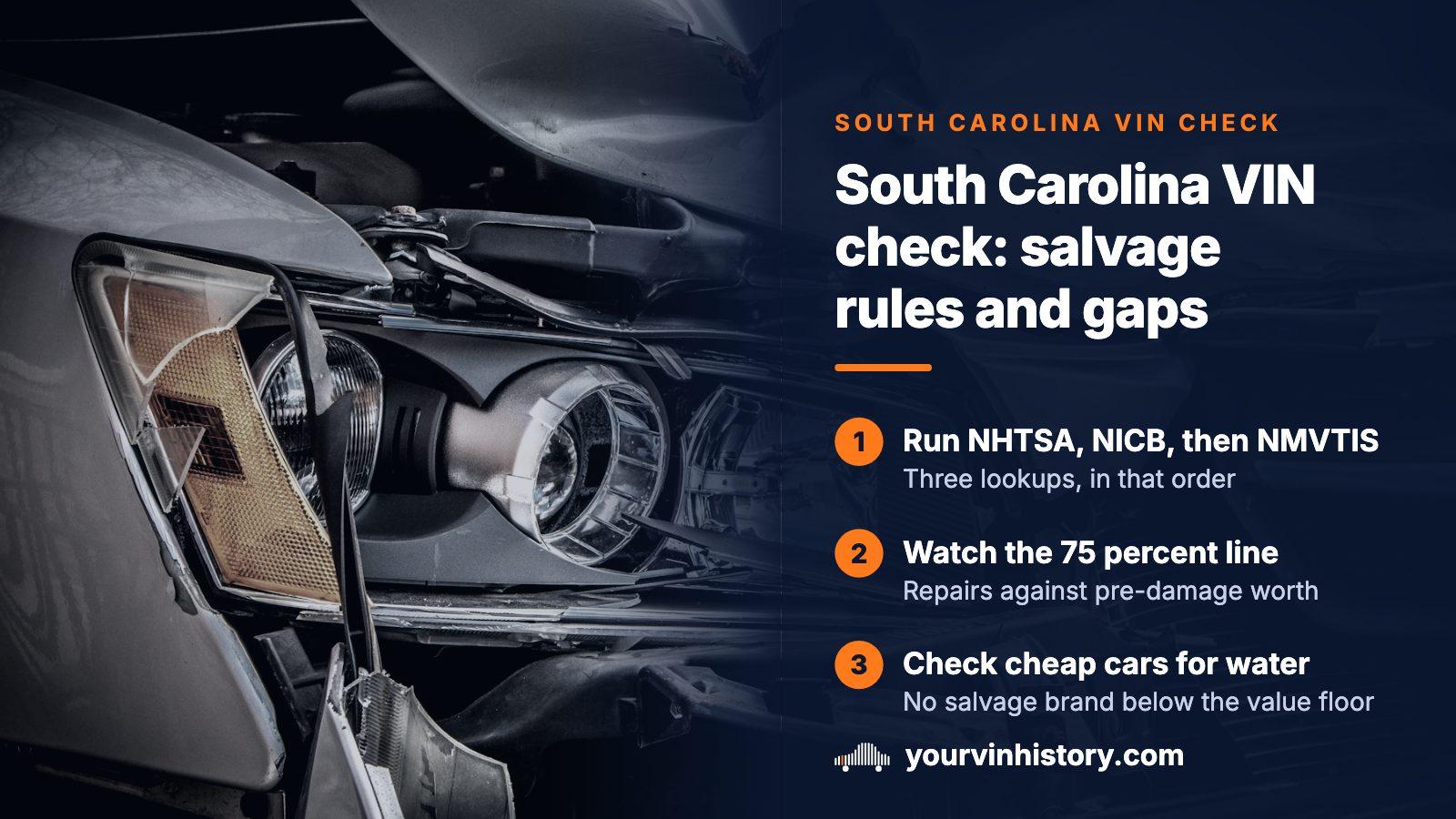
Decode the VIN with the NHTSA tools, run NICB VINCheck, then buy an NMVTIS report from an approved provider. South Carolina brands a title salvage after an insurer total loss, when the repair bill passes 75 percent of the car's pre-damage worth, or when body or frame damage makes it unsafe. Under $2,000 the salvage brand does not apply, so a clean title on a cheap car needs a physical water check too.
- Repair-cost trigger
- Repairs above 75 percent of pre-damage value
- Value floor
- No salvage brand on vehicles worth under $2,000
- Water and fire
- Separate brands: salvage flood and salvage fire
- Cross-state record
- NMVTIS report from an approved provider
Three lookups that all get called a VIN check
Search for a South Carolina VIN check and you will find three different products sold under one name. The first is a decode, which reads the 17 characters and reports what the factory built: make, model, engine, body style. The second is a recall lookup, which shows whether a safety campaign is open on that exact vehicle. Both are available at no charge from public tools.
The third is a history search, which answers what happened to the car after it left the plant. Only this one can surface a total loss, a title brand or a theft record. For a used car you are about to pay for, the history search carries the weight, and in South Carolina it comes with a wrinkle that the sections below explain.
The three ways a South Carolina title earns a salvage brand
The state recognizes three separate routes to a salvage brand, and any one of them is enough. The SCDMV sets out the rules on its title brands page, with a second page on insurer total-loss claims.
- An insurance company writes the vehicle off as a total loss.
- Repairing the vehicle would cost more than 75 percent of its value immediately before the damage.
- Damage to the body, unibody or frame leaves the vehicle unsafe to operate.
These triggers are very different in kind. The first rests on an insurer's decision, the second on a calculation, and the third on someone's judgment about what a damaged structure can still do. Each one can miss a car for its own reason, so the next sections take the weak points in turn.
What the 75 percent line lets through
The proportional test sets the repair bill against the vehicle's worth in the moment before it was hurt. With the line at 75 percent, a car can need repairs costing nearly three quarters of its value and still leave the shop with no brand from this trigger. A state that draws the line at half the value catches more cars. The higher the line, the more repaired vehicles slip beneath it.
That is a policy choice, and it is not wrong in itself, but it changes how you read a clean title. Not branded means the car did not cross the line. It does not mean the car was never badly damaged. When a seller admits to a past repair, ask to see the invoices, and compare the work described with what you find under the car.
The $2,000 floor under the salvage brand
According to the SCDMV, the salvage brand does not apply when a vehicle is worth less than $2,000. Think about a car valued at $1,800. It sits under the floor, so no repair estimate trips the proportional test in the normal way, and a serious wreck can end with a title that carries no mark at all. The effect is lopsided: the buyers most tempted by a low asking price are the ones the brand system protects least. Before you lean on the title, run the federal records described below and inspect the car with your own eyes.
What to take from the floor
On a cheap older car, a clean title from this state is weaker evidence than the same paper on an expensive one. The brand system does not record damage below the floor, so paperwork alone cannot be your proof.
Flood and fire get brands of their own
Plenty of states use one salvage brand and leave the cause off the record. South Carolina has salvage flood and salvage fire as distinct designations, so when one appears the title tells you which sort of disaster hit the vehicle, not just that something happened.
The distinction matters because the two problems behave differently. Fire damage tends to stay local and visible. Floodwater creeps into wiring, connectors and low panels, and the faults surface months or years afterward, which makes water the harder problem to catch by inspection. As the SCDMV words its carve-out for lighter damage, it applies only where no water or fire was involved, so those two sit outside the percentage test.
Why water is the first worry on a coastal-state car
The state faces the Atlantic and sees a hurricane season each year, and water-damaged vehicles pile up in coastal states in a way they do not inland. Storm surge reaches parked cars near the shore, and flooding from tropical systems reaches them farther in.
The cars worth worrying about are rarely the ones seen drifting down a street in news footage. They took water to the door sills, dried out, got detailed and went back on sale looking ordinary. Electrical faults then show up over the following years, come and go, and cost a lot to chase. If a used car has any South Carolina history, treat water as a standard question and not a remote one.
How a clean title travels beyond the state line
Titles move. A car first titled here can be sold, shipped and retitled somewhere else, and the new state's title reflects the brands on the old one, which here may be none. The exposure is therefore not limited to buyers inside the state. Any buyer in any state who picks up an inexpensive older car with roots in South Carolina is subject to this rule, usually unaware that it exists.
This accounts for a story that sounds like fraud and often is not. Some sellers who point to a clean title are simply reading the paper aloud. They are accurate about the document and unaware of the car's past. The only way to find out is to look at records that do not depend on one state's thresholds.
Rebuilt vehicles and the safety-system rules
A branded South Carolina vehicle does not get a regular title back on request. The owner applies, stating that the vehicle was rebuilt, identifying it, and describing where the parts came from, what they cost and how much work was done. More recent state legislation also speaks to safety systems on rebuilt vehicles: the rules touch air bags, three-point restraints and devices that prevent fuel spills, which have to be present and working.
That emphasis shows where rebuilt-car risk gathers. Restraint systems are costly and easy to skip, and nobody sees a missing air bag from behind the wheel until a crash tests it. If you consider a rebuilt car, ask for the parts and cost details from that application, and have an independent shop confirm that the restraint systems are real and working.
The order to run checks on a South Carolina VIN
- Decode the VIN and look up open recalls with the NHTSA tools. This costs nothing and confirms that the car matches the listing.
- Run NICB VINCheck, also free. It draws on theft and salvage-title records supplied by participating insurers, so it can show a total loss that the state title does not.
- Buy an NMVTIS report from an approved provider. Federal data pools records across states, so no single state's thresholds limit it. The Justice Department keeps the provider list, and some listed names serve dealers only, so choose one open to the public.
- Inspect the car for water yourself, using the checklist in the next section.
A yourvinhistory report is one way to cover step three. Its NMVTIS title records come from ClearVin LLC, an approved NMVTIS data provider, and it adds accident, salvage and auction records with photos. You see a free preview first and pay once for the full report.
A water check you can do in the driveway
No database can tell you whether a cheap car sat in standing water, so give it ten minutes of hands-on attention.
- Lift the carpet and look beneath the spare tire for moisture, staining or grit.
- Check the seat rails and the connectors under the dashboard for corrosion. Those spots should be dry on a car that never took water.
- Run a finger along seams and crevices and look for silt.
- Trust your nose. A musty cabin counts for more than a tidy title.
Then ask the seller straight out whether the car ever sat in standing water and whether an insurer ever declared it a total loss. An evasive answer is information, even when the paperwork looks spotless.
Using a plate instead of a VIN
A plate will not hand you the owner's name or address. Federal privacy law restricts the release of personal details held in vehicle records, and no consumer search can override it. Be wary of any site that promises otherwise.
A plate is good for one job: confirming you are looking at the same vehicle the ad described. Treat it as a pointer and nothing more. Read the VIN from the vehicle itself, compare it with the title, and use that number for the decode, the recall lookup and every history search described above. If a seller offers only a plate number, ask for the VIN in writing and check that it matches the number printed on the title.
Where this information comes from
- SCDMV: Title brands — The state's own description of the salvage triggers, the value exclusion and the separate flood and fire brands.
- SCDMV: Total loss claims — How an insurer's total-loss declaration moves a South Carolina title into branded status.
- U.S. Department of Justice: NMVTIS vehicle history — The public list of approved providers who sell federal title-history reports, including which names serve dealers only.
Sources and photos: Facts checked against the sources above in October 2026. Photo by Clark Van Der Beken on Unsplash; diagrams by YourVINHistory.
Keep reading
- South Carolina title checkThe title paper itself, and the single brand that names a cause.
- Flood-damaged carsWhere to look when a flooded car still shows a clean title.
- Title washingHow a brand can disappear once a car crosses a state line.
- NMVTIS reportWhat the federal title record contains and how to read it.
Frequently asked questions
Does a South Carolina title show if a car was in a flood?
Only when the title carries the salvage flood brand. A flooded car worth under $2,000, or one that never went through an insurer claim, can be titled with no mark. Cross-check with NICB VINCheck and an NMVTIS report, then look for silt, corrosion and damp carpet yourself.
Can I check a South Carolina VIN for free?
Partly. The NHTSA decode and recall lookup and NICB VINCheck cost nothing, and NICB covers theft and salvage records from participating insurers. A full title history comes from an approved NMVTIS provider for a fee, which is the step that gets you records from other states.
Can a branded South Carolina car get a regular title again?
It can, but not automatically. The owner applies, says the vehicle was rebuilt, identifies it, and details the source and cost of parts and the extent of the work. Newer legislation adds rules on air bags, three-point seat belts and fuel-spill protection. Ask a seller for copies of those details before you buy.
I live outside South Carolina. Why does the $2,000 rule affect me?
Because titles travel. A damaged car that never earned a brand can be sold and retitled in another state, and the new title simply inherits the clean record. If a cheap car you are considering ever lived in South Carolina, run the federal records no matter where you are buying.
Will a license plate give me a South Carolina vehicle history?
A plate confirms which car you are looking at, but it will not return the owner's identity, because federal privacy law restricts that information. Take the 17-character VIN from the car itself and run every check from that number. Compare it with the VIN printed on the title too, since a mismatch is a reason to stop.
Now check the car itself
The guide explains what to look for. The report shows what this VIN has on record.