THE SHORT ANSWER
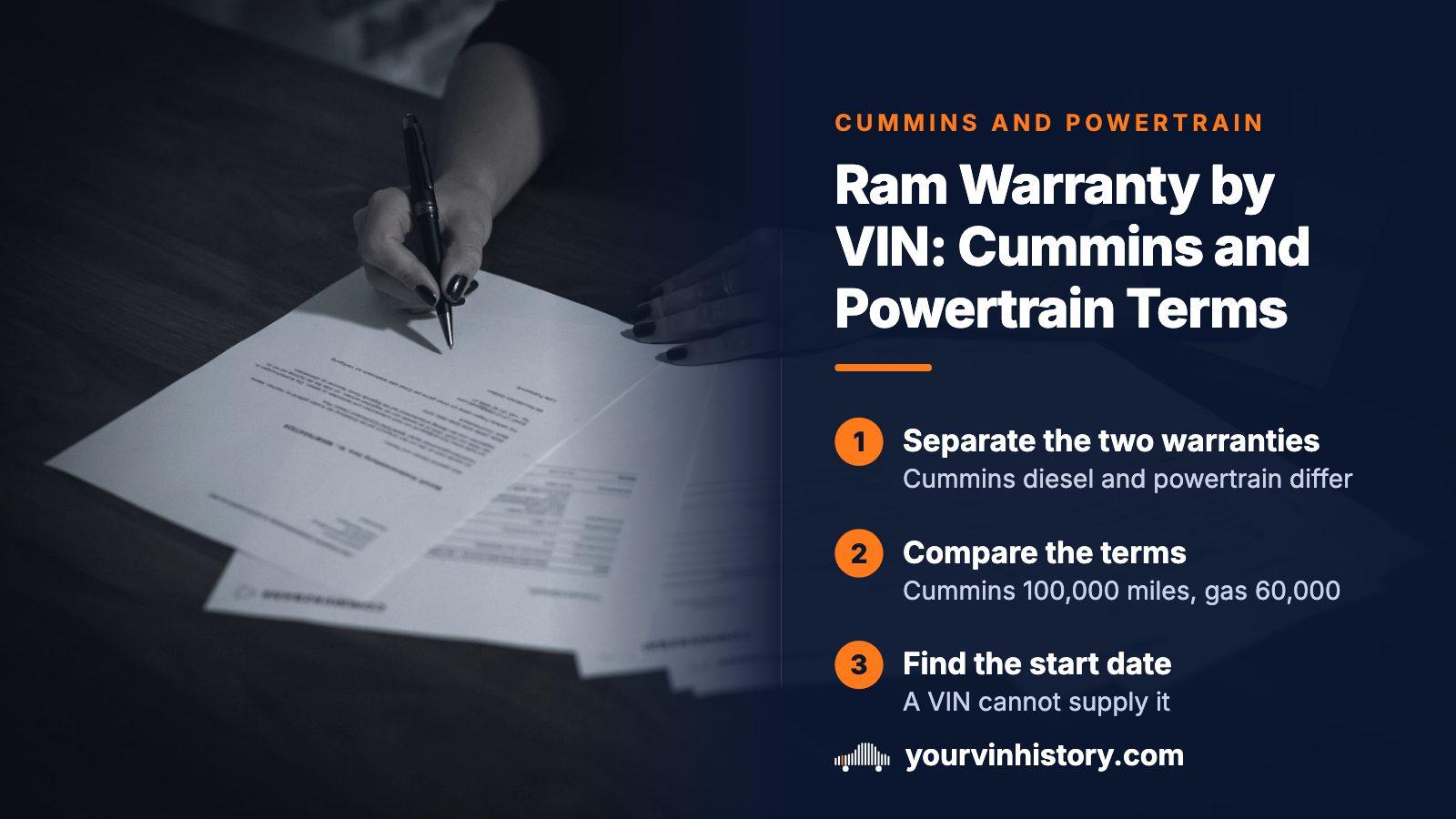
Ram's 2025 Heavy Duty warranty guide gives the Cummins diesel its own warranty: five years or 100,000 miles, whichever comes first, for a named list of engine parts. The powertrain warranty is a separate document that, for a gas engine, stops at 60,000 miles within five years. Both count from the Basic Limited Warranty start date, which a VIN cannot supply, so get it from Ram or a dealer.
- Cummins term
- Five years or 100,000 miles, whichever comes first
- Powertrain term
- Five years or 60,000 miles, stated for a gas engine
- Who makes the promise
- The truck maker's warranty guide, not the engine builder
- Clock starts
- At first delivery or first use, whichever is earlier
What a VIN settles and what it leaves to Ram
Run a Ram's VIN through a decoder and you learn how the truck left the factory: model, body, engine, model year, plant and serial. None of those 17 characters says how much warranty is left.
That answer lives in the manufacturer's records, attached to the VIN, and it hinges on a date the VIN cannot hold: the day the truck's warranty clock began. Two trucks with neighboring serial numbers can sit at very different points if one sold the week it arrived and the other spent months as a dealer demonstrator. Use the decode to confirm the truck, then take the VIN to Ram or an authorized dealer for the coverage position.
Diesel trucks carry more than one warranty, and a seller who says it still has warranty may mean any one of them.
The engine maker is not the one holding the warranty
It is easy to hear the phrase Cummins warranty and picture a program run by the engine builder. Ram's heavy-duty guide frames it differently. The booklet says the warranties inside it are the only express ones its warrantor, FCA US LLC, makes for the vehicle, and the Cummins diesel shows up as one numbered section (2.3) beside the powertrain warranty (2.5).
So the coverage comes from the truck. The Cummins section tests equipment: you are covered if your vehicle has a Cummins diesel engine. The basic and powertrain sections word it another way, covering a purchaser for use of the vehicle. A claim starts at an authorized dealer, and the guide never sends you to the engine builder.
Match the booklet to the truck
The terms in this article come from the 2025 Ram Heavy Duty guide. Terms shift between model years and truck lines, so confirm the figures for a specific VIN with Ram before relying on them.
What the Cummins coverage includes
The Cummins section pays parts and labor to fix a listed engine part that fails from a flaw in workmanship or material. It runs five years or 100,000 miles, whichever arrives first, counted from the Basic Limited Warranty start date. If a covered part fails and the truck cannot be driven, it also pays for a tow to the nearest authorized Business Link dealer. Pick another dealer and the tow is your cost.
The word to underline is ONLY. The section covers just the parts it names, so the engine is not covered as a whole. Grouped by where they sit, those parts are:
- The block and everything inside it, the cylinder head assemblies and the core plugs
- Fuel side: the injection pump, the injectors and the glow plugs
- Air side: the intake and exhaust manifolds, plus the turbocharger housing and its internal parts
- Covers and housings: the oil pan, the valve covers, and the timing gear drive with its cover
- Fluid movers: the oil pump and the water pump
- Gaskets and seals, but only those belonging to the parts above
The powertrain warranty reaches the driveline, on its own terms
The powertrain warranty is a separate section with a separate list. The guide states its limit as 60,000 miles within five years, whichever occurs first, with a gas engine in parentheses. It counts from the same start date. Towing goes through Roadside Assistance and is not tied to the Business Link network alone.
On a diesel truck, what matters is what this list adds beyond the engine: the transmission case and its internals, the torque converter, the transmission control module, then drivetrain parts by configuration, such as the transfer case on four-wheel drive, axle housings, shafts and universal joints. The Cummins section never touches those. Manual-transmission clutch parts are excluded altogether.
No separate diesel mileage is restated there, so ask Ram how the term reads for a diesel truck instead of borrowing the gas number.
The warranties on a Cummins truck, side by side
| Warranty | Who the guide says is covered | Term in the guide | What it reaches |
|---|---|---|---|
| Basic Limited | A purchaser for use of the vehicle | Three years plus a mileage cap, the shortest headline term | Factory items not excluded elsewhere; tires and a few others are carved out |
| Cummins Diesel Engine Limited | A vehicle equipped with a Cummins diesel | Five years or 100,000 miles, whichever first | Only the named engine parts |
| Powertrain Limited | A purchaser for use of the vehicle | Five years or 60,000 miles (gas engine), whichever first | Engine, transmission and drivetrain parts on its own list |
| Federal emission warranty | A vehicle equipped with a listed emission part | Set by part group in the emission section of the guide | Exhaust aftertreatment, exhaust gas recirculation, fuel system and sensor parts |
All four count from one Basic Limited Warranty start date, so a wrong assumption about it throws off every row. A high-mileage diesel can be past the powertrain figure and still inside the Cummins one, or past both. Past both, a good inspection counts for more than the booklet.
Where the clock actually starts
The guide defines the start as the earlier of two dates: the day the first buyer took delivery, or the day the truck was first put into use, with a dealer demonstrator or a manufacturer company vehicle given as examples. It is not the date you bought the truck, and it is not the model year.
That earlier-of rule explains why two trucks that look identical on paper can differ. A work truck that spent time as a demo has used part of its term before any retail buyer signed. One that sat unsold has used none, because neither trigger has happened yet.
Since the whole calculation hangs on this date, request it first. Without it, any figure for remaining coverage is a guess.
Diesel emission hardware sits in another warranty
Costly diesel hardware missing from the Cummins list is not folded into the engine warranty. The Federal Emission Warranty section has parts lists of its own by truck line. The diesel lists include the particulate filter assembly, the selective catalytic reduction catalyst, exhaust gas recirculation parts, the diesel exhaust fluid injector and tank, and nitrogen oxide sensor modules, each with its own time and mileage limits.
Two cautions. The exclusions section says the warranties do not cover damage from tampering with the emission systems, which matters on any truck that has had emissions equipment removed or programmed around. And the limits differ by truck line and part group, so read the emission section for the truck's own model year.
What can shrink or erase coverage
A warranty on paper can be worth nothing on a particular truck. Four rules in the exclusions section matter to a used-truck buyer.
- Total loss, rebuilt, salvage, junk or scrap history. A truck an insurer declared a total loss, one rebuilt afterward, or one titled with a salvage-type word has no warranty coverage of any kind. Emission warranties and recall campaigns are exempt.
- Odometer tampering. Altering or disconnecting the odometer voids the warranties, unless a technician follows the legal rules for repairing or replacing one.
- Aftermarket and performance parts. They do not void coverage by themselves, but the parts and any repairs they cause are not covered.
- Neglect and misuse. Poor maintenance, wrong fluids, overloading and abuse can lead to denial.
The first two items are title and odometer questions, which is where a vehicle history report helps. It shows title brands and odometer readings tied to the VIN, so you learn about a salvage brand or a rollback before you count on a warranty that may already be void.
Questions the guide leaves open
- Transfer to a later owner. The sections describe who is covered, but none states a rule for a sale by the first buyer. Ask Ram against the VIN.
- Service contracts. The guide calls the manufacturer-backed FlexCare plans a complement to the warranties, not a replacement. A contract is its own product with its own paperwork.
- Prior claims. A dealer can see warranty work done under a VIN. No public database lists it.
- Commercial use. The guide says implied warranties do not apply to a vehicle used mainly for business, to the extent the law allows. A former fleet truck may rest on the written terms alone.
Remaining coverage is part of what a truck like this is worth, so settle these questions before you agree on a price.
Checking one truck before you pay
- Match the VIN on the windshield plate, the door jamb and the seller's paperwork.
- Ask Ram or an authorized dealer for the Basic Limited Warranty start date tied to that VIN.
- Put three separate questions to them: what is left on the engine, powertrain and emission warranties.
- Request any prior warranty work on the engine, transmission and emission parts.
- Run the NHTSA recall lookup, which answers a different question from warranty.
- Pull the title and odometer record, and have an independent mechanic examine a high-mileage diesel.
A recall is not a warranty claim
The guide says its total-loss exclusion does not apply to recall campaigns, so a truck with no warranty left can still have an open recall. Ask the dealer about the repair cost: the federal free-repair rule does not reach very old vehicles.
Where this information comes from
- Mopar: 2025 Ram Heavy Duty warranty information — The manufacturer's booklet behind the Cummins, powertrain, emission and exclusion details, including how the warranty start date is defined.
- NHTSA: Recalls lookup — The federal lookup for open safety recalls on one VIN, which runs independently of any warranty status.
- NHTSA: Recalls and safety issues — Background on how safety recalls differ from manufacturer warranty and customer support programs.
Sources and photos: Facts checked against the sources above in October 2026. Photo by Dimitri Karastelev on Unsplash; diagrams by YourVINHistory.
Keep reading
- VIN warranty checkHow to get the in-service date by VIN and what carries over when you buy.
- RamReading a Ram VIN, including the split from Dodge and the engine serial.
- Ram recallsThe recall side of a Ram, kept separate from any warranty position.
- Buying a deleted dieselWhat emissions removal does to a diesel truck's coverage and legal standing.
Frequently asked questions
Can I check a Ram's remaining warranty with just the VIN?
Not from a public tool. A decode confirms what the truck is, but remaining coverage is a record held by Ram and visible to its dealers. Give a service department the VIN and ask for the Basic Limited Warranty start date plus what is left on each warranty. Get the answer in writing before you negotiate.
Is a second owner covered on the Cummins engine?
The guide does not say either way, and the Cummins section words its test around the truck's equipment instead of the buyer. Get Ram's answer for that VIN before you pay. If a dealer sells the truck As Is, that label speaks to the dealer's own warranty; factory coverage, if any remains, is a separate matter.
What happens to the warranty on a salvage or rebuilt title?
Per the guide, a vehicle declared a total loss, rebuilt after one, or titled as salvage, junk, rebuilt or scrap has no warranty coverage of any kind. Ram can deny a claim without notice once it learns of the brand. Emission warranties and recall campaigns are the exceptions.
Does adding a lift kit or an engine tuner void the Ram warranty?
Not automatically. The guide says many aftermarket changes do not void the warranties by themselves, but parts that were not on the truck at the factory are not covered, and neither are repairs they cause. Performance parts count as non-Ram parts. Odometer tampering voids coverage.
Which warranty booklet applies to my truck?
The one for its model year and truck line. Terms change between years and between product lines, so the 2025 heavy-duty figures here show the shape of the coverage, not a promise for every truck. A dealer can tell you which booklet fits the VIN, and the manufacturer publishes warranty guides by model year.
Now check the car itself
The guide explains what to look for. The report shows what this VIN has on record.