THE SHORT ANSWER
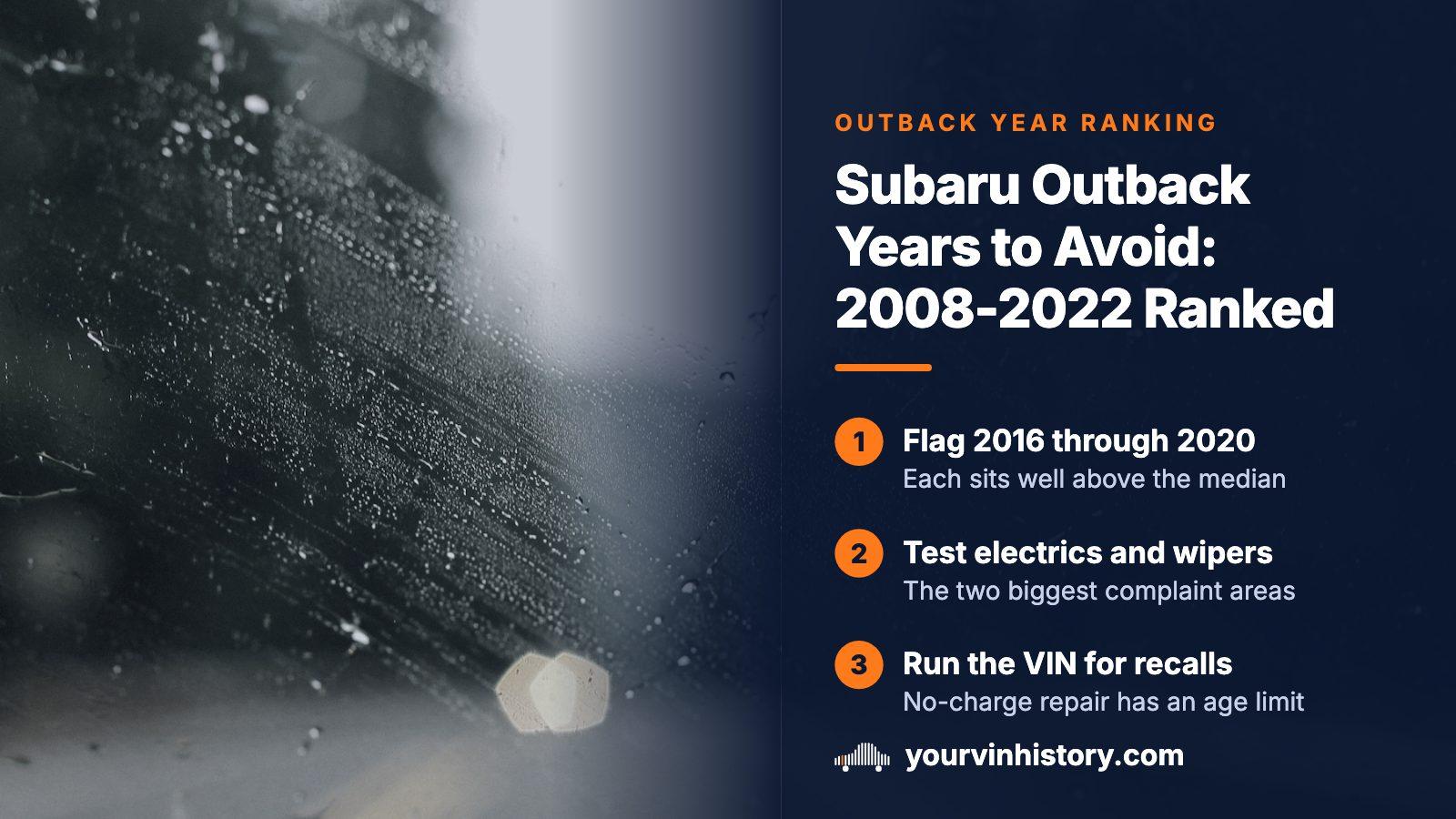
On NHTSA complaint volume, the 2016 through 2020 Subaru Outback years stand out, led by 2019 with 1,032 reports against a yearly median of 460, and 2011 is the one early year above the median. Among settled years, 2009, 2014 and 2008 have the lightest records. Electrical system is the largest complaint area at 1,959 reports. A complaint count is an unverified owner account, not a failure rate, so a flagged year means inspect harder.
- Complaints on record
- 7,698 across 2008 to 2022
- Median year
- 460 complaints
- Heaviest year
- 2019, with 1,032 complaints
- Top complaint area
- Electrical system, 1,959 reports
Why every year is scored against the Outback's own median
A raw complaint total says as much about how many cars were sold and how long they have been on the road as it does about the cars. To blunt that, each Outback model year here is set against the Outback's own median year, which comes to 460 complaints. A year at 1 times the median is ordinary for this wagon. A year at 2 times has drawn about double the usual volume.
The pool is every NHTSA consumer complaint filed for the 2008 through 2022 model years: 7,698 filings across fifteen model years. Duplicates were removed using NHTSA's complaint number, and the data was pulled on 2026-08-15, so anything filed later is missing. Recall counts sit beside the complaints because they measure something else.
All fifteen model years in one table
Standing is a plain reading of the multiple: light is 0.5 times the median or less, typical runs from 0.63 to 1.1 times, and heavy starts at 1.39 times. Only 2019 clears 2 times, so it gets its own label.
| Model year | Recalls | Complaints | Times the median | Standing |
|---|---|---|---|---|
| 2008 | 8 | 230 | 0.5× | Light |
| 2009 | 13 | 111 | 0.24× | Light |
| 2010 | 18 | 360 | 0.78× | Typical |
| 2011 | 16 | 651 | 1.42× | Heavy |
| 2012 | 16 | 291 | 0.63× | Typical |
| 2013 | 12 | 296 | 0.64× | Typical |
| 2014 | 10 | 208 | 0.45× | Light |
| 2015 | 5 | 507 | 1.1× | Typical |
| 2016 | 4 | 640 | 1.39× | Heavy |
| 2017 | 4 | 917 | 1.99× | Heavy |
| 2018 | 3 | 807 | 1.75× | Heavy |
| 2019 | 3 | 1,032 | 2.24× | Peak |
| 2020 | 6 | 895 | 1.95× | Heavy |
| 2021 | 4 | 293 | 0.64× | Typical |
| 2022 | 4 | 460 | 1× | Typical |
| Median year | n/a | 460 | 1× | Benchmark |
The benchmark is not abstract here: 460 is the middle value of the fifteen counts, and it happens to be the 2022 figure itself. Every year from 2016 through 2020 sits at 1.39 times the median or higher, a block that no other stretch of the table matches.
The five heaviest years, and the run behind them
Ranked by complaints, these are the five heaviest model years, each shown with the area owners filed against most often.
| Model year | Most-reported area | Complaints | Times the median |
|---|---|---|---|
| 2019 | Electrical system | 1,032 | 2.24× |
| 2017 | Electrical system | 917 | 1.99× |
| 2020 | Visibility and wiper | 895 | 1.95× |
| 2018 | Electrical system | 807 | 1.75× |
| 2011 | Power train | 651 | 1.42× |
The 2016 model year, at 640 complaints and 1.39 times the median, finishes just behind 2011 and belongs to the same late-model block. Older cars have had longer to collect reports, which normally pushes old years up. Here the later cars lead, so age by itself does not obviously explain the 2016 to 2020 volume.
2011 stands alone early, and recalls tell a different story
Before 2015, one year rises above the median: 2011, with 651 complaints. The rest of the early run is quieter. The 2012 and 2013 years land at 291 and 296, 2010 at 360, and 2009 at 111.
Recall counts run the other way. The 2010 year has the most recall entries of any, 18, with 16 each for 2011 and 2012, 13 for 2009 and 12 for 2013. From 2015 on, every year shows between 3 and 6. A recall is a defect the maker acknowledged and has to repair, so a year with many recalls and modest complaints usually means problems were found and fixed while the cars were still covered. Read the recall column as context, never as a second score.
The lightest records, and the catch that comes with them
Among settled years, three Outbacks carry the thinnest complaint files: 2009 with 111 complaints at 0.24 times the median, 2014 with 208 at 0.45, and 2008 with 230 at 0.5. Their recall counts are 13, 10 and 8.
The newest three model years in the data, 2020 to 2022, are kept out of any cleanest list. A young car has had little time to attract filings, so 2021, at 293 complaints, may look lighter than it has earned.
The catch runs the other direction. The three cleanest years are also the oldest cars in the table. A thin complaint file says little about wear, skipped maintenance or whether an old recall was ever completed, and the oldest cars may sit past the federal no-charge window for a new campaign.
Where the complaints cluster: electrical and visibility lead
NHTSA files each complaint under a component bucket picked when the report is made. Across 2008 to 2022, the Outback's buckets rank like this.
| NHTSA component | Reports | What the bucket spans |
|---|---|---|
| Electrical system | 1,959 | Battery, wiring, lighting and control modules |
| Visibility and wiper | 1,642 | Wiper and visibility faults |
| Unknown or other | 1,093 | Filings with no clear component |
| Power train | 640 | The transmission and related drive parts |
| Engine | 512 | Any engine fault, not one part |
| Air bags | 374 | Air bag system faults |
Electrical system leads, and visibility and wiper follows closely. The third-largest bucket is filings with no clear component, which is more than power train or engine alone. Engine ranks only fifth. In 2019, the peak year, electrical and visibility are both prominent.
NHTSA has no category for a single part, so a count points at a system and not at what broke. The totals here do not split the visibility and wiper bucket by part, so read the individual complaints for your target year on NHTSA's site.
What a complaint count cannot tell you
- Sales volume: a popular year collects more reports than a scarce one of equal build quality, which is why each year is judged against the Outback's own median.
- Time on the road: older years had longer to collect filings, while the newest years have barely started, so they stay out of the cleanest list.
- Unverified accounts: a complaint records what one owner believed happened. It is useful in bulk and shaky one report at a time.
- No rate: the count is not a failure rate or a reliability score, because nothing in it measures how many cars are still on the road.
A count marks where to look. It does not grade a car you have not seen.
Recalls, and the 15-year line on the no-charge fix
A recall is a defect the manufacturer has acknowledged and must repair at no charge to the owner, within limits. Under 49 U.S.C. §30120(g), that no-charge duty does not apply when the first purchaser bought the car more than 15 calendar years before the recall notice. The count runs back from the notice, not from the day you shop, so an older campaign on a car then inside the window should still be repaired at no cost, while a new campaign on a much older Outback may not be.
Campaigns attach to production ranges, not to whole model years. A year with 16 recalls can leave one particular car with none open, and a year with 3 can leave one with an open campaign, so only a VIN lookup on NHTSA's recall page settles it. The 2015 year, at 507 complaints and 5 recalls, has its own record page on this site naming its campaigns and splitting its complaints by component.
What to check on a flagged Outback
Because the buckets point at systems and not parts, a pre-purchase look at a heavy year has to be broad, with extra time where the complaints cluster.
- Electrical system: with the engine running, work every switch, window, lamp and display, and ask the seller about any warning light that has come and gone.
- Visibility: run the wipers at every speed, fire the washers, test the defroster, and look over the windshield for chips and cracks.
- Power train: drive through a cold start, gentle acceleration and slow stop-and-go, and note any hesitation, shudder or odd noise.
- Air bags: the warning light should glow at start-up and then go out. One that stays lit, or never appears, is a flag.
- Engine: it ranks fifth by complaints, so give it a normal check for leaks, noises and oil-change history.
- Records: ask for service invoices. On a wagon of this age they outweigh any model-year statistic.
From a shortlist of years to one specific car
Once the years are narrowed, everything that decides the purchase belongs to one car, not to a model year.
- Choose the years you are comfortable with, and treat a heavy multiple as a reason to bargain, not a veto.
- Enter the 17-character VIN in NHTSA's recall lookup and write down any open campaign.
- Screen the same VIN with NICB's VINCheck for theft and total-loss flags.
- Read up on the national title record through the NMVTIS site, which covers the title history a complaint table cannot.
- Pay for an independent inspection with a mechanic who puts the car on a lift.
A flagged year is a bargaining position
Each year in the table holds Outbacks that were looked after and ones that were not. A heavy multiple is grounds to look closer and ask for a lower price, not to walk away from a car you have not seen.
A free preview comes first on this site, and the full report is a one-time purchase. It covers title brands, accidents with a damage map, odometer readings, salvage and auction photos, liens, theft and open recalls for that one VIN.
Where this information comes from
- NHTSA: Vehicle safety — Home of the owner complaint database that supplies the 7,698 filings counted in this ranking.
- NHTSA: Recalls — Where the yearly recall figures come from, and the VIN lookup for open campaigns on a single car.
- Bureau of Justice Assistance: NMVTIS — Federal explainer on the national title record, the layer this page cannot see for any one Outback.
- NICB: VINCheck — A no-cost screen for a reported theft or total loss on a specific VIN.
Sources and photos: Facts checked against the sources above in October 2026. Photo by Justin Cron on Unsplash; diagrams by YourVINHistory.
Keep reading
- 2015 Subaru Outback recalls, windshield cracks and crash ratingsThe one Outback year with its own record page: recall campaigns and complaints split by component.
- Subaru recallsHow to look up open Subaru recalls by VIN, the first check on any Outback.
- Subaru Outback head gasket replacement cost: sorting the quotes by engineEngine ranks fifth among the complaint areas here; this post prices one engine repair on the Outback.
- Subaru Forester years to avoid: 2014 to 2020 draw the most complaintsThe same year-by-year complaint comparison for the Forester, a common cross-shop with the Outback.
Frequently asked questions
Which Subaru Outback years should I avoid?
The heaviest records belong to 2019, 2017, 2020 and 2018, at 1,032, 917, 895 and 807 complaints, with 2011 at 651 and 2016 at 640 close behind. None is a ban. A heavy year with full service records, no open recalls and a clean inspection can still be a fair purchase, and a light year can hide a neglected car.
Which Subaru Outback years have the fewest complaints?
Among settled years, 2009 has 111, 2014 has 208 and 2008 has 230. The 2021 year shows 293 but is left out of that comparison because it is young. A short complaint file also says nothing about how a particular car was maintained, so service history still decides more than the year does.
Which problem do Subaru Outback owners report most?
By NHTSA component, electrical system leads with 1,959 reports, then visibility and wiper at 1,642. Power train has 640, engine 512 and air bags 374. The buckets are broad and do not name a part, so use them as a map of where a mechanic should spend the most time.
Does a high recall count make an Outback year worse?
Not by itself. The 2010 year has the most recalls at 18 yet sits at 0.78 times the median for complaints, while 2019 has only 3 recalls and the highest complaint total. A recall shows the maker acknowledged a defect and owes a repair, so the count is context and not a verdict.
How do I check a specific Subaru Outback before buying it?
Start with the VIN. Run NHTSA's recall lookup for open campaigns and NICB's VINCheck for theft and total-loss flags, then look into the NMVTIS title record. Ask for service invoices, confirm the odometer readings climb steadily, and book an independent inspection. A model-year table describes a group of cars; only the VIN speaks for yours.
Now check the car itself
The guide explains what to look for. The report shows what this VIN has on record.