THE SHORT ANSWER
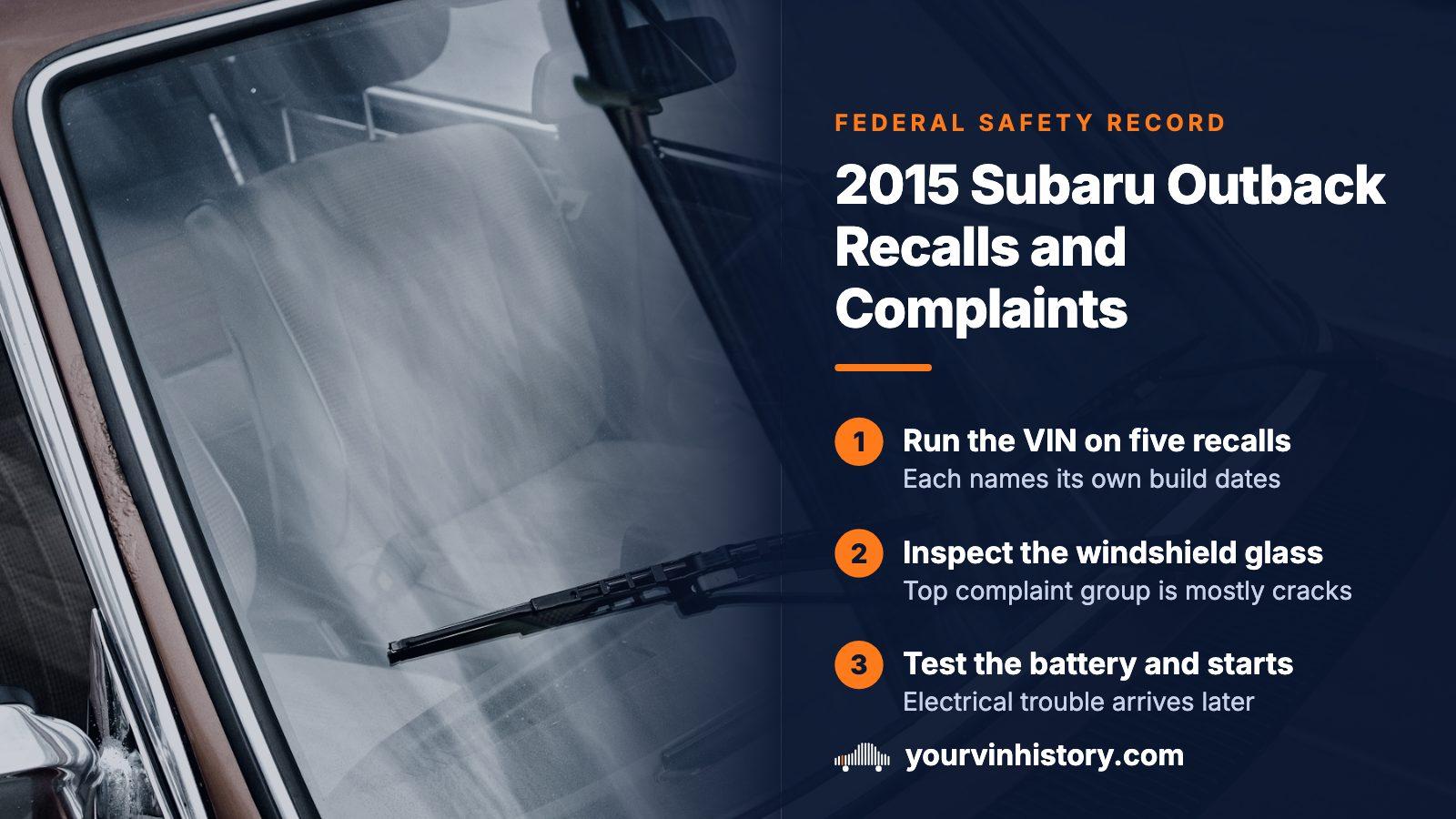
The 2015 Subaru Outback has 5 recall campaigns at NHTSA: brake fluid and stability control, a driveshaft seal, the Eyesight braking switch, an accessory trailer hitch and a steering column. Owners filed 507 complaints, led by visibility and wiper at 130 and the electrical system at 127. NHTSA gives it 5 of 5 stars overall and 4 for rollover. Every recall covers certain build dates only, so run the VIN.
- Recall campaigns
- 5 on file with NHTSA
- Owner complaints
- 507, with 130 in visibility / wiper
- NHTSA crash rating
- 5 of 5 overall, 4 of 5 rollover
- Against other Outback years
- 1.1 times the median year
The crash ratings, and the one line that is not five stars
NHTSA's rated configuration for this model year is the 2015 Subaru Outback SUV AWD. It earned 5 of 5 stars overall, with 5 in the frontal test and 5 in the side test. Rollover resistance is the softer score at 4 of 5.
| Rating | Result |
|---|---|
| Overall | 5 of 5 stars |
| Frontal crash | 5 of 5 stars |
| Side crash | 5 of 5 stars |
| Rollover resistance | 4 of 5 stars |
| Modeled rollover probability | 17.5% |
NHTSA lists electronic stability control as standard and two driver aids as optional: forward collision warning and lane departure warning. A listing that only says Outback does not show which of those the car has, so read the window sticker or decode the VIN. The stars also describe a new test car, not later collision repairs.
Five campaigns, each tied to its own build window
NHTSA files five safety recalls under the 2015 Outback. None covers every car, and two apply only if the car has certain equipment. The table runs in the order the repairs began.
| Campaign | What it covers | Cars named in the notice | Repair offered from |
|---|---|---|---|
| 14V577000 | Subaru accessory trailer hitch | Outbacks built January 22 to August 18, 2014 | October 7, 2014 |
| 15V366000 | Eyesight pre-collision braking | Outbacks built February 24, 2014 to April 16, 2015 | July 20, 2015 |
| 15V502000 | Propeller shaft seal | Built July 3 to July 27, 2015 | August 28, 2015 |
| 16V251000 | Brake fluid and stability control | Built July 20, 2015 | May 20, 2016 |
| 16V292000 | Steering column | Model years 2016 and 2017, built February 29 to May 6, 2016 | May 13, 2016 |
Brake fluid and a driveshaft seal: the July 2015 builds
Two campaigns concern cars assembled in July 2015. In 16V251000, Subaru found that brake fluid in Legacy and Outback cars built on July 20, 2015 could carry too much moisture. That can blunt the stability control system and leaves the car short of the federal stability control standard, FMVSS 126. NHTSA names loss of control as the risk. Dealers run an ABS activation, then flush and refill the fluid.
Campaign 15V502000 is about a seal. A cap on the propeller shaft yoke was deformed in some 2015 and 2016 model year Legacy 4-door and Outback cars built July 3 to July 27, 2015, so transmission oil could seep out. Oil reaching the exhaust pipe meant a fire risk. The fix is a new propeller shaft. On a car from that window, ask for the work order on both campaigns and look under it for oil near the driveshaft.
Eyesight and the trailer hitch: recalls that depend on equipment
Campaign 15V366000 reaches only cars fitted with Eyesight, Subaru's driver assist package. If the brake light switch fails, automatic pre-collision braking stops working, and the car would not react to an obstacle on its own. The remedy is a reprogramming of the system. The notice also lists several other Subaru models, so the VIN matters more than the model name.
Campaign 14V577000 concerns Subaru's own accessory hitch. During installation the mounting nuts may have been tightened too far, and the studs could fail, letting a trailer come loose while towing. Dealers replace all eight nuts and inspect all eight studs. If a used Outback has a hitch, ask whether it is the Subaru accessory and whether the nut replacement was done before anyone tows with it.
A steering column notice that names later model years
Campaign 16V292000 sits in the 2015 Outback's list, yet its text names model years 2016 and 2017 built from February 29 to May 6, 2016. An early-build 2015 should fall outside that range, and the VIN lookup will say for certain.
The defect it describes is a serious one. A steering column may have been machined incorrectly, and then turning the wheel might not change the direction of the road wheels. Dealers check a lot number on the column and replace it where needed. NHTSA's note tells owners of affected cars not to drive them until inspected. If the lookup shows this one as open on a 2015, treat it as a stop sign.
What the leading complaint category actually describes
Visibility / wiper tops the complaint list with 130 of 507, roughly 26%. The label sounds like blades and motors. NHTSA's own entries for this model year say otherwise: most describe windshield glass cracking, frequently with the owner saying nothing struck it. A handful concern a broken sunroof or a touchscreen that washed out in sunlight.
The age pattern fits a problem that showed up early. The category's dated reports have a median age of 0.6 years, and 73% came inside the first three years. A well-kept example may therefore have had its glass dealt with long ago. On a test drive, look along the edges of the windshield for a crack that starts at the border, and ask whether the glass was replaced.
Which systems complain early and which ones wait
Each complaint carries the date an owner says the trouble occurred, so the gap from the model year gives a rough age at the time. This table sets the eight biggest categories beside that median.
| Category | Complaints | Share | Median age, years | Within three years |
|---|---|---|---|---|
| Visibility / wiper | 130 | 26% | 0.6 | 73% |
| Electrical system | 127 | 25% | 5.8 | 28% |
| Unknown or other | 108 | 21% | 2.9 | 51% |
| Engine | 47 | 9% | 4.9 | 30% |
| Power train | 37 | 7% | 3.1 | 49% |
| Structure | 33 | 7% | 3 | 52% |
| Service brakes | 28 | 6% | 4.7 | 39% |
| Vehicle speed control | 26 | 5% | 4.2 | 48% |
The electrical system is the late one: a median of 5.8 years, with 28% inside the first three. NHTSA's electrical entries for this car lean heavily toward batteries that drained or died, plus hard starting, the kind of trouble that lands on a second or third owner. These medians come from unverified reports. They show when complaining owners say a part failed, not the odds of it failing.
Where 2015 sits among Outback model years
A raw complaint total mostly follows sales, so the fairer comparison is between a model year and the Outback's own median year. On that scale the 2015 comes out at 1.1 times the median and ranks 7th heaviest of the 15 model years on record, 2008 to 2022. The heaviest is 2019 at 2.24 times the median, and the lightest settled year is 2009 at 0.24 times.
That makes 2015 a middle-of-the-pack year: not one to steer around on volume alone, and not a clear standout. Filings peaked in 2015 itself, an early burst that suggests warranty-era trouble.
Crash, fire and injury flags: the entries to read in full
Among the 507 complaints, owners marked 19 as involving a crash, 5 a fire and 16 an injury. NHTSA does not verify these flags, and one incident can produce several reports, yet they are the entries worth opening before you buy. NHTSA also lists 1 investigation touching this model year, which is a warning sign at most, not a conclusion.
The fire entries in NHTSA's file include flames under the hood at highway speed, a burned electrical connector found by a shop, and a parked car that ignited after a short drive. None is confirmed as a defect. Because the driveshaft recall names a fire hazard, check the underside and engine bay for heat damage or amateur wiring.
A pre-purchase checklist built from this record
These checks come from the complaint pattern and the recall notices. General used-wagon checks apply on top of them.
- Windshield: look for cracks that start at an edge, and ask when the glass was replaced and why.
- Battery and charging: ask how old the battery is, whether it ever died after sitting, and have a shop test it.
- Underside: check for oil residue near the propeller shaft and exhaust, and ask for the 15V502000 work order on a car built in July 2015.
- Engine bay: look for scorched plastic or wiring that someone added after the fact.
- Eyesight: confirm it is fitted, that no warning shows on the dash, and that the braking recall was done.
- Trailer hitch: if one is fitted, find out whether it is the Subaru accessory and whether the eight nuts were replaced.
- Tailgate wiring, cargo floor, spare well and roof-rail mounts: check for broken wires, damp and worn seals.
Running the VIN, and how long recall repairs stay at no charge
Type the 17-character VIN into NHTSA's recall lookup. It lists the campaigns open on that exact car, which beats the five on this page, because completed repairs are logged against the VIN. Run it again on the day you sign.
Federal law sets the rules for no-charge repairs. Under 49 U.S.C. §30120, the manufacturer must fix the defect without charge, but that duty does not apply when the first retail purchase came more than 15 calendar years before the earlier of the recall notice or the order. A 2015 Outback is not near that cutoff yet, but it is a finite window, so ask a dealer in writing before assuming a new campaign will cost nothing.
What this record leaves out
Recalls, complaints and star ratings say nothing about title brands, accident and damage records, odometer readings or liens. A yourvinhistory report covers those, and a preview comes before any purchase.
Where this information comes from
- NHTSA: recalls lookup by VIN — Where a 17-character VIN is entered to see open campaigns; the five campaign summaries here come from those records.
- NHTSA: vehicle safety and owner complaints — Entry to the complaint filings behind the 507 total, the category shares and the crash, fire and injury flags.
- 49 U.S.C. §30120: remedy without charge — Statute text for the no-charge repair duty and its 15-calendar-year limit.
- NHTSA: 5-Star Safety Ratings — The federal crash-test program behind the overall, frontal, side and rollover results.
- NMVTIS: national title information system — Federal title record covering brands and history, which recall data leaves out.
Sources and photos: Facts checked against the sources above in October 2026. Photo by Max Tokarev on Unsplash; diagrams by YourVINHistory.
Keep reading
- Subaru Outback years to avoid, ranked by NHTSA complaintsRanks every Outback model year against the same median, so 2015 can be weighed against its neighbors.
- Subaru recallsShows how to run any Subaru by VIN and read what the lookup returns.
- Buying a car with an open recallCovers what to do when the lookup shows a repair was never made.
- Pre-purchase inspectionExplains what a shop looks at when you bring a car in before signing.
Frequently asked questions
How many recall campaigns apply to a 2015 Subaru Outback?
Five campaigns are on file, but a single car rarely falls under all of them. The notices name build windows between 2014 and 2016, and two apply only with certain equipment. A spring 2014 Outback with Eyesight and a Subaru hitch could be covered by two, while a July 2015 build could fall under the brake fluid and driveshaft pair.
What do 2015 Outback owners complain about most?
Visibility / wiper leads with 130 reports and the electrical system follows with 127. Cracked windshields dominate the first group, and dead or draining batteries are common in the second. The third largest group, at 108, is unknown or other, with no specific part assigned. All of it is unverified.
Is the 2015 Subaru Outback safe?
NHTSA rates it 5 of 5 stars overall, 5 in the frontal and side tests, and 4 for rollover. Stability control is standard, while forward collision warning and lane departure warning were optional. On a used one, finished recall repairs and the quality of any past collision repair matter more than the original star table.
Is a 2015 Outback recall repair still done at no charge?
Generally yes for campaigns announced inside the federal limit: 15 calendar years from the first retail sale to the earlier of the notice or the order. The five known campaigns date from 2014 to 2016. Ask the dealer for a written answer on any newer one, and keep the work order.
Does a clean recall result mean the 2015 Outback has a clean history?
No. Recall lookups cover safety defects only. A car can have every repair done and still carry a salvage brand, a past accident, a lien or a rolled-back odometer. Title brands come from NMVTIS, the federal title database, and a yourvinhistory report lays those records out alongside accident and odometer data.
Now check the car itself
The guide explains what to look for. The report shows what this VIN has on record.