THE SHORT ANSWER
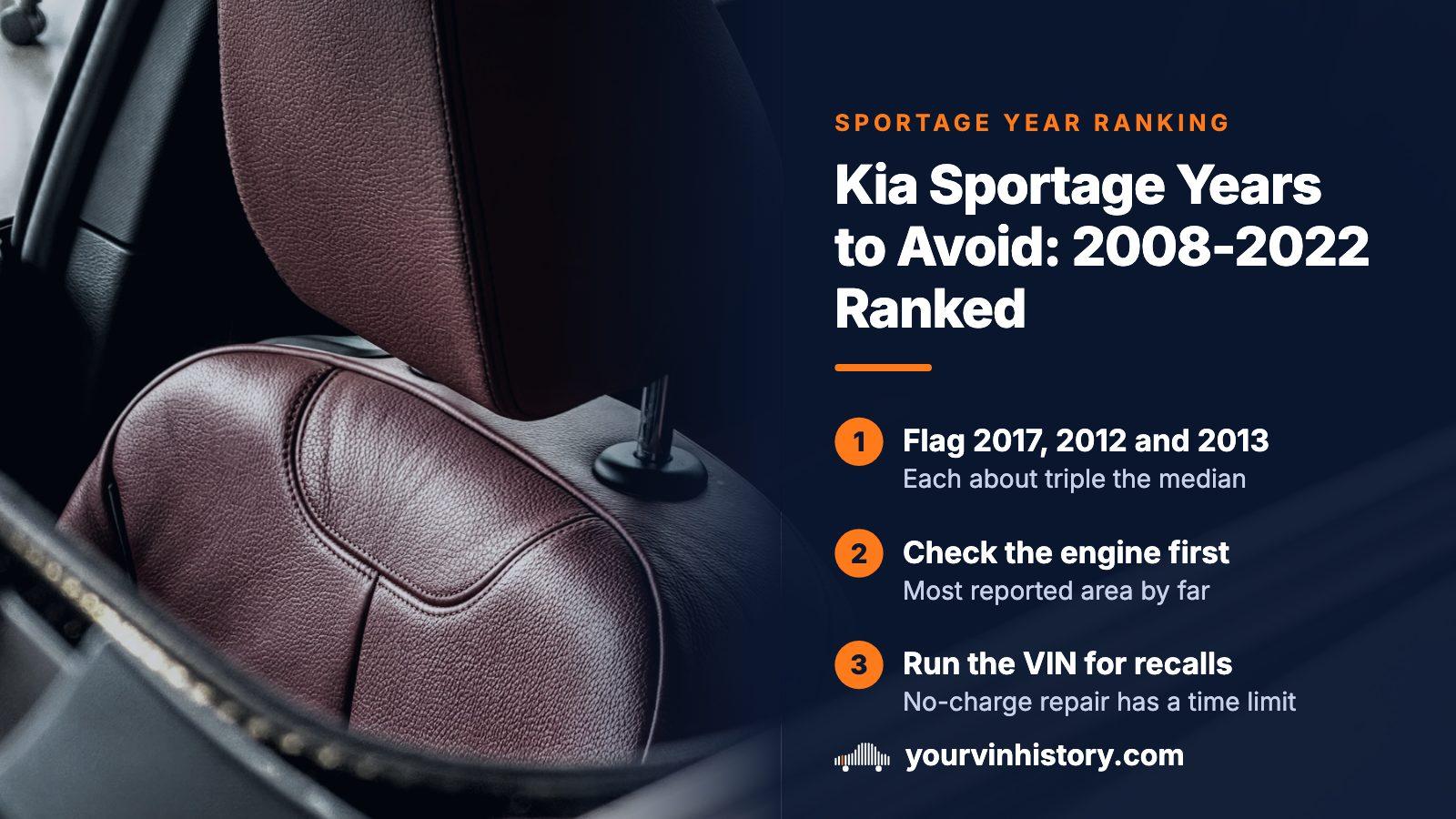
On NHTSA complaint volume, the Kia Sportage years to treat with the most care are 2017 (398 complaints), 2012 (392) and 2013 (380), each roughly three times the Sportage's own median of 130 a year. The lightest records belong to 2010, 2022 and 2021. Engine is the leading complaint area by a wide margin, with 1,401 reports. Complaints are unverified owner accounts, not failure rates, so a flagged year means inspect harder, not walk away.
- Complaints on record
- 2,430 across 2008 to 2022
- Median year
- 130 complaints
- Heaviest year
- 2017, with 398 complaints
- Top complaint area
- Engine, 1,401 reports
How this ranking is scored
A raw complaint total mostly reflects how many cars were sold and how long they have been on the road. To soften that, every Sportage model year is divided by the Sportage's own median year, which comes to 130 complaints. A year at 1 times the median is ordinary for this nameplate, and a year at 3 times has drawn roughly triple the usual volume. Sales volume is reduced as a factor, not removed, so the multiples are a guide, not a verdict.
The pool is NHTSA's consumer complaint file for the 2008 through 2022 model years: 2,430 entries once duplicates were dropped using NHTSA's complaint number, pulled on 2026-08-16. Each entry is one owner's unverified account. None of it is a failure rate or a reliability score, and reports filed after the pull date are not counted.
All fifteen Sportage years in one table
The reading column turns each multiple into one word. Heavy means close to three times the median, elevated means a clear step above it, typical covers the wide band from about half the median to about a quarter over it, and light means well below.
| Year | Reading | Times the median | Complaints | Recalls |
|---|---|---|---|---|
| 2008 | Typical | 0.75× | 98 | 3 |
| 2009 | Typical | 0.62× | 80 | 3 |
| 2010 | Light | 0.15× | 20 | 2 |
| 2011 | Elevated | 1.39× | 181 | 6 |
| 2012 | Heavy | 3.02× | 392 | 5 |
| 2013 | Heavy | 2.92× | 380 | 3 |
| 2014 | Typical | 0.94× | 122 | 3 |
| 2015 | Typical | 1.12× | 146 | 2 |
| 2016 | Typical | 1× | 130 | 2 |
| 2017 | Heavy | 3.06× | 398 | 4 |
| 2018 | Typical | 1.24× | 161 | 3 |
| 2019 | Typical | 0.53× | 69 | 2 |
| 2020 | Typical | 1.22× | 159 | 2 |
| 2021 | Light | 0.38× | 49 | 2 |
| 2022 | Light | 0.35× | 45 | 1 |
| Median year | Benchmark | 1× | 130 | n/a |
Two details are easy to miss. The 2016 row lands exactly on the median, and the three heavy years are bunched so tightly that ranking them against each other means little.
The step between 2016 and 2017
The sharpest break in the table sits between two neighbors. The 2016 Sportage drew 130 complaints, precisely the median. The 2017 drew 398, the largest file of any year. A jump that size from one model year to the next more often follows a redesign or a major mechanical change than random drift, so pin down which side of that line a particular car falls on before you compare asking prices.
Recalls tell a different story. The 2017 year lists 4, fewer than the 5 for 2012 or the 6 for 2011, so the heaviest complaint year is not the heaviest recall year. After 2017 the volume falls back: 161 for 2018, 69 for 2019, a rebound to 159 for 2020, then 49 and 45.
Four years that deserve a harder look
Three years sit near three times the median and one more sits above it. Engine is the most-reported area in all four.
- 2017: 398 complaints, 3.06 times the median, 4 recalls
- 2012: 392 complaints, 3.02 times the median, 5 recalls
- 2013: 380 complaints, 2.92 times the median, 3 recalls
- 2011: 181 complaints, 1.39 times the median, and the largest recall count of any year at 6
The 2011 to 2013 stretch is the part worth noticing: three model years in a row with thick files, 2012 and 2013 supplying most of the weight, before 2014 drops back to 122. A heavy file is a reason to inspect harder and bargain with evidence in hand. It says nothing certain about a single car, because every year includes cars that were looked after and cars that were not.
The unremarkable middle of the table
Eight model years land in the broad band around the median: 2008 with 98 complaints, 2009 with 80, 2014 with 122, 2015 with 146, 2016 with 130, 2018 with 161, 2019 with 69 and 2020 with 159. That means no outlier, a narrower claim than good, because every year in this band still has a complaint file, and across the full run that file is led by engine reports.
The 2014 to 2016 trio is tight, at 122, 146 and 130 complaints with 3, 2 and 2 recalls. The 2018 and 2020 years sit a little above the median at 1.24 and 1.22 times, while 2019 dips to 0.53 times, a little over half.
Why 2010, 2022 and 2021 look so quiet
Three years come in well under the median: 2010 with 20 complaints (0.15 times), 2021 with 49 (0.38 times) and 2022 with 45 (0.35 times). The 2021 and 2022 cars are the youngest in the table, and young cars have had the least time to collect reports, so part of that quiet is simply youth. No year in this set was held back as too recent, which means the newest rows deserve less credit than their numbers suggest.
The 2010 file is a different case. That model year has been on the road far longer than 2021 or 2022, yet it holds the smallest file of all. That counts in its favor, though a modest sales total could also explain it, since sales volume is the factor the median method only partly corrects. Even 2010 lists 2 recalls, so the VIN lookup still matters.
What owners complain about, by component
NHTSA files each complaint under the vehicle component the owner names, and one complaint can name more than one. That is why the six leading Sportage categories, added together, come to more than the 2,430 total. Read each count as reports that mention an area, not as separate cars.
- Engine: 1,401 reports, the leader by a wide margin
- Electrical system: 310 reports, a bucket that spans battery, wiring, lighting and control modules rather than one part
- Unknown or other: 282 reports that fall into the catch-all category
- Service brakes: 248 reports of brake defects, which is different from routine pad and rotor wear
- Power train: 123 reports, a category that covers the transmission and related parts
- Hydraulic: 103 reports
In the 2017 peak year, engine and the unknown-or-other bucket both stand out. For 2011, 2012 and 2013, engine is the most-reported area. The labels name a place, not a symptom, so the narrative each owner wrote on NHTSA's site is where you learn what actually went wrong.
Inspecting a Sportage with the engine in mind
Engine reports dominate every flagged year, so the engine is where a careful look pays off. This routine suits a 2011 to 2013 or 2017 car in particular, but it makes sense on any Sportage.
- Ask for the service file before the test drive. A run of dated oil changes says more about an engine than any chart of model years.
- Start the engine cold, before the seller warms it. Listen for knocking, ticking or rough running, and note any warning light that stays on.
- Check the dipstick for level and color, and ask the seller to explain any oil that has been added between changes.
- Look around and under the engine for fresh oil leaks or wet patches, then have a shop read the stored trouble codes.
- Drive until the engine reaches full operating temperature, including a stretch at highway speed, and watch for hesitation, smoke or temperature swings.
- Pay an independent mechanic for a pre-purchase inspection and tell them the complaints concentrate on the engine.
Recalls: what the counts say and where they stop
A recall is a manufacturer acknowledging a safety defect, and it comes with a documented fix. Counts run from 1 for 2022 up to 6 for 2011, and they do not track complaint totals. The 2011 model year has the most recalls beside a middling 181 complaints, while 2013 pairs 380 complaints with just 3 recalls. Even 2010, the year with the lightest file, lists 2.
Two limits apply when you act on one. Campaigns are written for production ranges, so a year's count says little about whether your VIN is covered. And the no-charge repair duty has an end date: under 49 U.S.C. 30120(g), it does not apply when the first buyer bought the car more than 15 calendar years before the recall notice or order. A recall announced on an older Sportage can therefore arrive with a bill attached.
Either way, enter the 17-character VIN in NHTSA's recall lookup, which costs nothing, and ask for paperwork on any repair already done.
From model year to the one car in front of you
A model year describes a group of cars. A single Sportage has its own title record, its own odometer sequence and its own repair past, and none of that appears in a complaint chart. Three outside checks fill the gap.
- NHTSA's recall lookup, run by VIN, for campaigns that apply to that exact car
- NICB's VINCheck, a screen for theft and total-loss records tied to the VIN
- NMVTIS, the national title database, for the title record of the individual vehicle
Where a history report fits
A yourvinhistory report starts with a free preview and is then a one-time purchase. It pulls title brands, accident records with a damage map, odometer readings, salvage and auction entries, liens and open recalls into one view for the VIN. Its NMVTIS title records come from ClearVin LLC, an approved NMVTIS data provider.
Where this information comes from
- NHTSA: vehicle safety and complaint filing — The federal home for owner complaints, the file behind every complaint count in the tables above.
- NHTSA: recalls lookup — Search a VIN here to see whether a specific Sportage has an open campaign, and compare the yearly recall counts.
- Bureau of Justice Assistance: NMVTIS — Explains the national title database that holds the record of an individual car, which a model-year page cannot supply.
- NICB: VINCheck — A no-cost theft and total-loss screen you can run on a Sportage's VIN before a visit.
Sources and photos: Facts checked against the sources above in October 2026. Photo by Obi on Unsplash; diagrams by YourVINHistory.
Keep reading
- Kia engine warrantyEngine reports lead every flagged Sportage year, so see how engine warranty coverage is checked by VIN.
- Recall check by VINA step-by-step walk through the recall lookup that the year counts here cannot replace.
- KiaConfirm which model year and build a particular Kia really is before you compare it to this table.
- Kia Sorento years to avoid: 15 model years ranked by NHTSA complaintsThe same year-by-year ranking for another Kia SUV, if the Sportage shortlist falls through.
Frequently asked questions
Is the 2017 Kia Sportage a bad year?
It has the largest file of the fifteen years at 398 complaints, and it follows a 2016 year that sat right on the median. That jump justifies a close look, not a verdict. Four recalls are listed for it, fewer than for 2011 or 2012. Decode the VIN, read which recalls were completed, and have a mechanic examine the engine before agreeing on a price.
Which Kia Sportage years have the fewest complaints?
The 2010 year has the smallest file with 20 complaints, followed by 2022 with 45 and 2021 with 49. After those three, 2019 is next at 69. The two newest years have had the least time to collect reports, so they earn less credit than 2010 does.
Do Sportage recalls cost money to fix?
Usually not, within the federal limits. A manufacturer must repair a recalled defect at no charge, but 49 U.S.C. 30120(g) lifts that duty when the first buyer purchased the car more than 15 calendar years before the recall notice. On an older car, ask a dealer what the repair costs before any work starts.
Can I trust a Sportage from a quiet year without inspecting it?
No. A quiet year only means that group of cars drew fewer complaints. One car inside it can still have an unreported accident, a questionable odometer or a skipped service history. Those details belong to the VIN, which is why a recall lookup, a theft and total-loss screen and a title record matter more than any year chart.
How do I check a specific Kia Sportage before buying?
Get the 17-character VIN from the seller before you visit. Run it through NHTSA's recall lookup and NICB's VINCheck, both of which cost nothing, then pull a title and history report that shows brands, accidents and odometer readings. Finish with an independent inspection that puts the engine first.
Now check the car itself
The guide explains what to look for. The report shows what this VIN has on record.