THE SHORT ANSWER
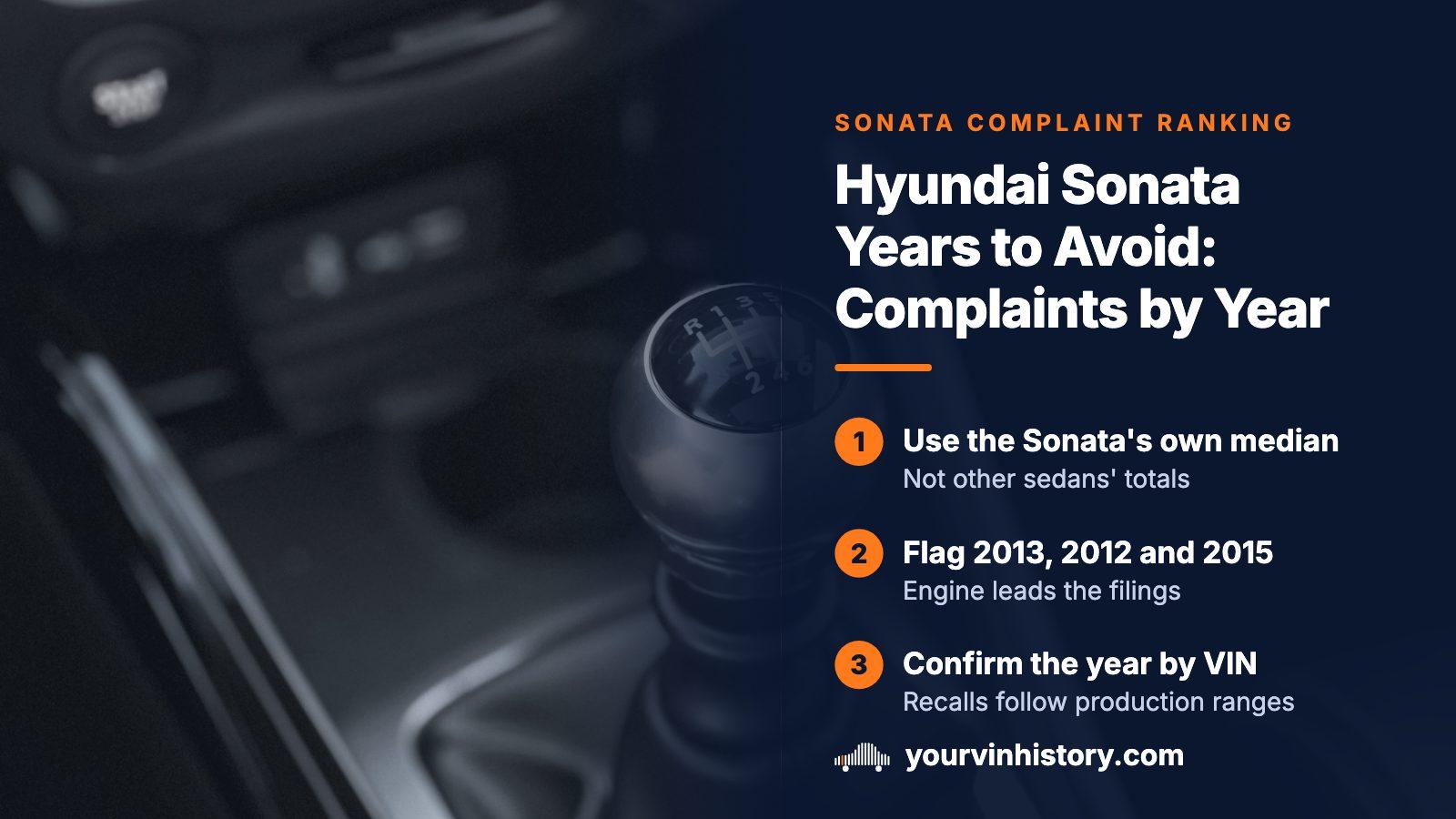
Measured against the Sonata's own median of 425 complaints a year, 2013 stands out at 2,007, followed by 2012 at 1,710 and 2015 at 1,188. The 2016 and 2017 cars each run about double the median. The lightest settled records are 2011, 2022 and 2019. Engine is the largest complaint area with 3,916 reports. Complaints are unverified owner accounts, not failure rates.
- Owner complaints on file
- 9,764 for 2008 to 2022
- Median year
- 425 complaints
- Peak year
- 2013, with 2,007 complaints
- Largest area
- Engine, 3,916 reports
Scoring each Sonata year against its own median
Raw complaint totals favor whatever sold the most, so lining a Sonata up against a Camry or an Altima says little. This page sets each Sonata model year beside the Sonata's own middle year instead. Across the 15 model years from 2008 to 2022, that middle year draws 425 complaints, and every other year is shown as a multiple of it.
The counts come from NHTSA consumer complaint filings, each counted once by its complaint number and pulled in August 2026. Together they reach 9,764 reports. Every one is an owner's unverified account of a problem, which means the figures show where owners chose to complain, not how often a part fails.
The full table: complaints, recalls and standing for every year
In the last column, heavy means double the median or more, elevated is a step below that, typical sits near the median, and light is under half of it.
| Model year | Complaints | Multiple of median | Recalls | Standing |
|---|---|---|---|---|
| 2008 | 425 | 1× | 5 | Typical |
| 2009 | 460 | 1.08× | 2 | Typical |
| 2010 | 345 | 0.81× | 2 | Typical |
| 2011 | 95 | 0.22× | 14 | Light |
| 2012 | 1,710 | 4.02× | 8 | Heavy |
| 2013 | 2,007 | 4.72× | 9 | Heavy |
| 2014 | 770 | 1.81× | 7 | Elevated |
| 2015 | 1,188 | 2.8× | 9 | Heavy |
| 2016 | 875 | 2.06× | 6 | Heavy |
| 2017 | 872 | 2.05× | 3 | Heavy |
| 2018 | 375 | 0.88× | 1 | Typical |
| 2019 | 166 | 0.39× | 0 | Light |
| 2020 | 186 | 0.44× | 4 | Light |
| 2021 | 180 | 0.42× | 4 | Light |
| 2022 | 110 | 0.26× | 3 | Light |
| Median year | 425 | 1× | n/a | Benchmark |
The median year is 2008, which lands exactly on 425 and scores 1×. The recalls column counts NHTSA recall filings for each model year. Campaigns apply to production ranges, so one car may fall under only some of its year's recalls.
Why 2011 and 2012 read like two different cars
The sharpest feature in the table is the step from 2011 to 2012. The 2011 model year has 95 complaints, the thinnest record of all fifteen, and 2012 jumps to 1,710, roughly four times the median.
Gaps this wide more often mean the car itself changed than that owners suddenly got pickier. The counts cannot say what changed, so treat the boundary as a question for the VIN and the seller: confirm the actual model year of the Sonata in front of you instead of trusting the listing.
The 2011 row has a second oddity. It carries 14 recalls, more than any other year, next to the fewest complaints. That pairing can mean the manufacturer caught and corrected problems early. It can also mean the 2011 record is simply thinner than its neighbors for reasons the data do not show, so a 2011 car deserves a VIN-level check like any other.
The five years running at double the median or more
- 2013: 2,007 complaints, 4.72 times the median, the peak of the whole run, with 9 recalls
- 2012: 1,710 complaints at 4.02 times the median, with 8 recalls
- 2015: 1,188 complaints at 2.8 times the median, with 9 recalls
- 2016: 875 complaints at 2.06 times the median, with 6 recalls
- 2017: 872 complaints at 2.05 times the median, with 3 recalls
Engine is the most reported area in every one of these five years, and steering is also prominent in 2013. The 2014 car sits just under the line at 1.81 times the median with 770 complaints, so it earns an extra look without the same level of caution.
A flagged year only says that more owners than usual filed reports. Plenty of cars from these years have run without trouble, and the flag is best spent on a harder inspection and a firmer price.
The quietest records, and why the youngest cars get an asterisk
Five model years carry the lightest records: 2011 with 95 complaints, 2022 with 110, 2019 with 166, 2021 with 180 and 2020 with 186. Each sits below half the median.
Model years newer than 2022 are left out of the comparison entirely, since a car that has been on the road briefly always looks clean. Even inside the table, the 2020 to 2022 cars are the youngest, so part of their low counts is age and not merit. Among them, 2019 is the only year with no recalls at all, while 2020 and 2021 each have 4 and 2022 has 3.
The middle of the table is calmer than the heavy years suggest. The 2008, 2009, 2010 and 2018 cars all sit near the median, between 345 and 460 complaints, and 2018 manages that with a single recall.
Where owners point: engine first, electrical second
Adding up NHTSA's component tags across all fifteen years gives this order of owner complaints:
- Engine: 3,916 reports, far ahead of any other area
- Electrical system: 1,398 reports
- Unknown or other: 918 reports
- Steering: 862 reports
- Service brakes: 598 reports
- Power train: 429 reports
These tags are coarse. Engine gathers every engine fault an owner chose to report, electrical system takes in the battery, wiring, lighting and modules, and power train covers the transmission and more. Brake entries are owners describing defects, not ordinary pad and rotor wear. No tag isolates a single failed part, so read each count as an upper limit on any one problem.
Why recalls and complaints belong in separate columns
A complaint is one owner's report. A recall is a defect the manufacturer has acknowledged and has to repair at no charge to the owner, so a long recall list does not by itself signal a bad year. The 2011 row shows the extreme: many recalls, few complaints. The 2013 row shows the other pairing, with 9 recalls and 2,007 complaints.
That obligation has limits. Under 49 U.S.C. §30120(g), the no-charge remedy does not apply to a car first bought more than 15 calendar years before the recall notice went out. The count runs to the notice date, not to today. A recall issued while a Sonata was inside the window should still be repaired at no charge, but a recent recall on one of the oldest cars in this table may not be, so ask the dealer about cost before you buy.
Recalls also attach to production ranges rather than whole model years. Two Sonatas from the same year can differ, and only the VIN says whether a given car has an open campaign.
Five ways a complaint count can mislead a buyer
- Sales volume: a popular model piles up more reports than a low-volume one in the same condition. That distortion is the reason each year here is measured against the Sonata's own median.
- Age: older years have had longer to collect reports, so a young year can look clean for the wrong reason.
- Accuracy: each complaint records what an owner believed happened. That helps in bulk and misleads one report at a time.
- Recalls: they are acknowledged defects with a repair attached, so a large number can mean problems were handled.
- Individuality: none of these figures describes the car you are looking at. Its own history does.
Use the flag to price and inspect, not to rule out
Good cars and neglected ones turn up in every model year. A high-complaint year is a reason to look harder at the engine, ask for records and negotiate. It is not a reason to refuse a Sonata you have not seen.
What to check on a used Sonata, starting with the engine
- Run the VIN through NHTSA's free recall lookup and write down every open campaign before the test drive.
- Ask for the service file. Regular maintenance outweighs any model-year statistic on a sedan this age, and gaps in the paper trail give you room to bargain on a heavy year.
- Start the engine cold with the hood open. Listen for knocks, ticks or rattles, and watch the tailpipe for smoke.
- Check the oil level and color, then ask how much the owner has to add between changes.
- Test the steering through its full range, parked and moving, noting any noise, notchy spots or pull.
- Work every electrical feature: windows, locks, lights, climate controls and the infotainment screen.
- Book an independent pre-purchase inspection on a lift for any car from the heavy years, and use the related guide on Hyundai engine warranties to see whether extended coverage applies to the VIN.
From the model year to the exact car
A model year describes a population. The Sonata on the lot has its own recalls, title record and mileage history, and those decide the purchase far more than which row of this table it belongs to. One year here has a record page of its own: the 2016 Sonata page, linked below, lists that year's recall campaigns and complaint areas.
Three lookups from others cover a lot of ground: NHTSA's recall search by VIN, NICB's VINCheck for theft and total-loss flags, and the Bureau of Justice Assistance's NMVTIS site, the federal starting point for national title records.
On this site, a VIN preview comes first, and the one-time paid report adds title brands, accident records with a damage map, odometer readings and salvage or auction history for that specific car.
Where this information comes from
- NHTSA: Vehicle safety — The federal safety agency whose consumer complaint database supplies the owner reports counted for each Sonata model year.
- NHTSA: Recalls — Where the yearly recall tallies come from, and where a VIN can be entered to see which campaigns apply to one car.
- Bureau of Justice Assistance: NMVTIS — The federal overview of the national title record, which covers an individual car's paperwork history, something a model-year ranking cannot.
- NICB: VINCheck — A no-cost screen of a single VIN for reported theft and total-loss status.
Sources and photos: Facts checked against the sources above in October 2026. Photo by Nils Keesmekers on Unsplash; diagrams by YourVINHistory.
Keep reading
- 2016 Hyundai Sonata: 8 recalls, 875 complaints and what to checkThe record page for the one Sonata year covered on its own, with recall campaigns and complaint areas.
- Hyundai recallsHow to run a Hyundai VIN through the recall lookup and read what comes back.
- Hyundai engine warrantyEngine is the top complaint area, so see whether a given VIN has extended engine coverage.
- Pre-purchase inspectionWhat a mechanic examines before you buy, useful for any Sonata from a heavy year.
Frequently asked questions
Is the 2013 Hyundai Sonata a bad year to buy?
It is the year to inspect most closely, not a car to rule out sight unseen. The 2013 model carries 2,007 complaints and 9 recalls, with engine and steering the prominent areas, but each complaint is an unverified owner account. Ask for service records, run the VIN through the recall lookup, and have a mechanic look at the engine before deciding.
Is there a most reliable Hyundai Sonata year?
Complaint data cannot crown one, because it measures filings, not failures. The lightest settled records are 2011, 2022 and 2019, and 2019 has no recalls at all. Still, the 2011 count looks unusually thin beside its neighbors and the youngest years have had little time to collect reports, so treat those years as a shortlist and then check the individual car.
Do older Sonatas still get recall repairs at no charge?
Often, but not always. Under 49 U.S.C. §30120(g), a maker need not repair at no charge a car first bought more than 15 calendar years before the recall notice. The clock stops at the notice date, so a recall issued while the car was inside that window should still be honored. A recall issued later on one of the oldest Sonatas may not be. Check the VIN on NHTSA's lookup, then ask the dealer about cost.
How can I confirm a Sonata's model year before judging it?
Read the VIN. Its tenth character encodes the model year, so compare that with the year in the listing and on the title. It matters here because the record steps from 95 complaints in 2011 to 1,710 in 2012, and a listing that rounds a car into the wrong year can point you at a very different population.
Which Hyundai Sonata years have engine problems?
NHTSA's engine category is the most reported area in each of the heavy years: 2013, 2012, 2015, 2016 and 2017. Across all fifteen years it totals 3,916 reports. The category lumps every engine fault together, though, so it cannot tell you which part failed. For a specific car, rely on service records and a mechanic's inspection.
Now check the car itself
The guide explains what to look for. The report shows what this VIN has on record.