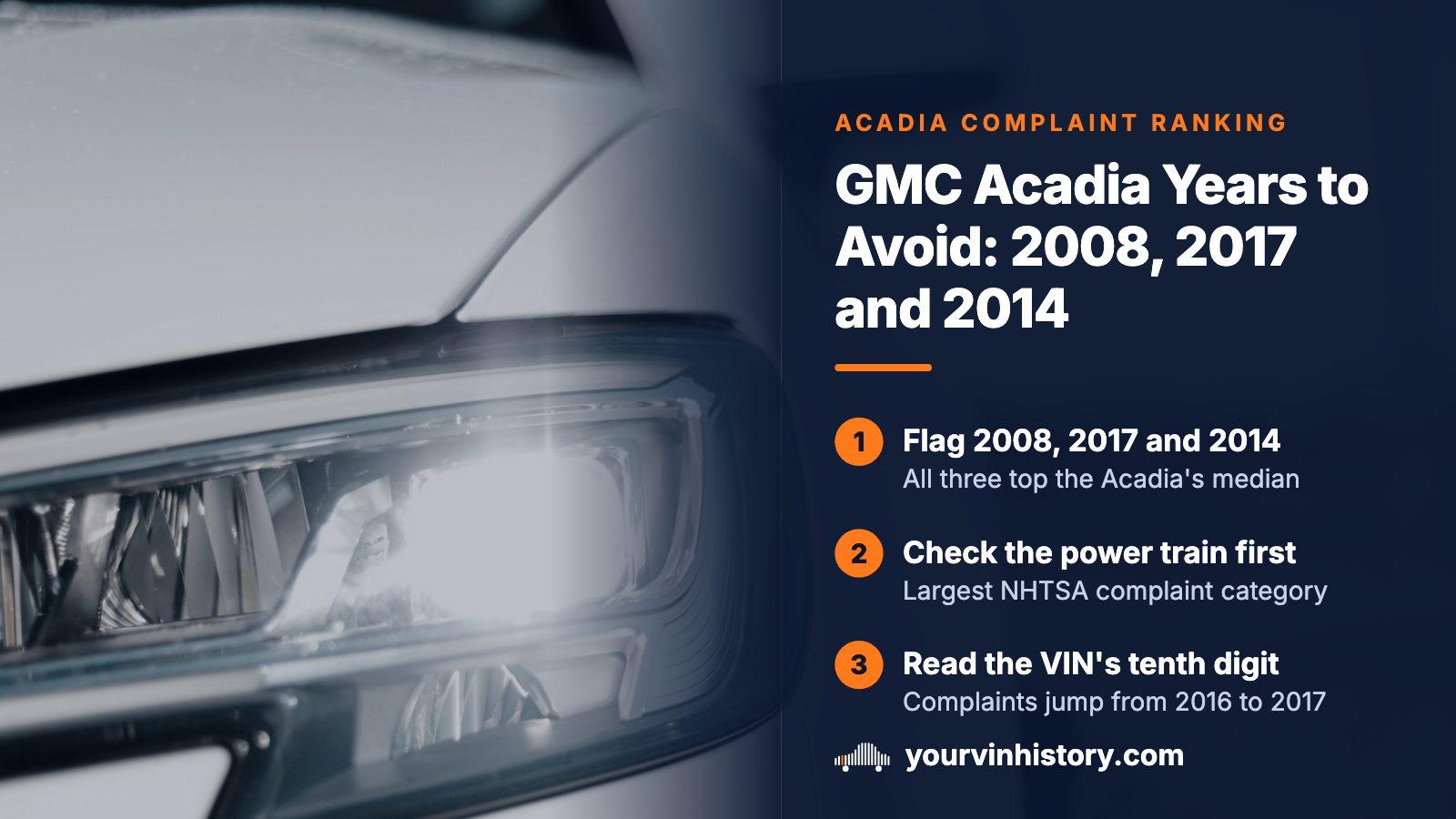
THE SHORT ANSWER
Measured against the Acadia's own median of 302 complaints a year, 2008 (858), 2017 (701) and 2014 (466) sit highest, and power train is the biggest problem area at 1,147 reports overall. The lowest counts belong to 2022, 2020 and 2013, but the newest cars have had the least time to collect reports. A complaint is an unverified owner account, not a failure rate, so a flagged year is a reason to inspect harder rather than skip the car.
- Complaints filed
- 4,980, 2008 to 2022
- Yardstick
- 302 complaints in the median year
- Heaviest year
- 2008, with 858 reports
- Biggest area
- Power train, 1,147 reports
The yardstick: each year against the Acadia's own median
Putting the Acadia's raw total beside another SUV's mostly shows which one sold more. This page sets the Acadia against itself instead. Each of the 15 model years from 2008 to 2022 has its own yearly complaint count in NHTSA's consumer database, and the middle value of those counts is 302. A year is then written as a multiple of 302: 1× is an ordinary year for this SUV, and 2× means roughly twice the usual flow of owner reports.
The pool is 4,980 complaints. NHTSA's complaint number was used to strip out repeat entries, and the data was pulled in mid-August 2026, so anything filed later is absent. That gap matters most for the newest model years, whose owners are still filing. Recall counts sit beside the complaints in the table, although they record a different kind of evidence.
Every model year from 2008 to 2022, side by side
The standing column turns each multiple into a word. The typical band in this table runs from 0.77× to 1.29×. Three years land above that band and four fall below it.
| Model year | Standing | Times the median | Complaints | Recalls |
|---|---|---|---|---|
| 2008 | Far above | 2.84× | 858 | 5 |
| 2009 | Typical | 1.1× | 333 | 7 |
| 2010 | Typical | 1.15× | 348 | 4 |
| 2011 | Typical | 0.93× | 280 | 5 |
| 2012 | Typical | 1× | 302 | 5 |
| 2013 | Low | 0.46× | 139 | 3 |
| 2014 | Above | 1.54× | 466 | 6 |
| 2015 | Typical | 0.86× | 260 | 4 |
| 2016 | Typical | 0.77× | 234 | 4 |
| 2017 | Far above | 2.32× | 701 | 4 |
| 2018 | Typical | 1.29× | 390 | 2 |
| 2019 | Typical | 1.25× | 379 | 2 |
| 2020 | Low | 0.32× | 97 | 6 |
| 2021 | Low | 0.48× | 146 | 2 |
| 2022 | Low | 0.16× | 47 | 3 |
| Median year | Benchmark | 1× | 302 | n/a |
Two details sit outside the headline years. The 2012 model year is the median itself, at exactly 302 complaints. And 2009 holds the most recalls of any year, 7, beside a complaint count of 333 that is unremarkable.
The step from 2016 to 2017
Read the complaint column from top to bottom and the data has a shape. It opens tall at 858 for 2008, sags to 139 for 2013, climbs to 466 for 2014, dips again, and then makes its sharpest move: 234 for 2016 becomes 701 for 2017. After that the counts ease to 390 for 2018 and 379 for 2019.
A jump that size often lines up with a redesign or a major mechanical change, but a complaint table cannot say which happened here, so treat any confident explanation with caution. What the pattern does tell a buyer is to settle which side of the line a car sits on before comparing asking prices. The tenth character of the VIN encodes the model year, which makes it a better guide than the headline in a listing.
2008, 2017 and 2014: the three flagged years
Three model years sit clearly over the Acadia's own median. Their leading complaint areas are not identical, so no single story ties them together.
- 2008 is the peak: 858 complaints, 2.84 times the median, 5 recalls. Power train is the most reported area, and air bags are also prominent.
- 2017 follows with 701 complaints, 2.32 times the median and 4 recalls. Power train leads here as well.
- 2014 logged 466 complaints, 1.54 times the median and 6 recalls, the most of the three. Air bags lead.
Every one of these years contains well-kept Acadias and neglected ones. The flag justifies a harder inspection and a sharper price, not a refusal to look. For the peak year there is a separate record page on this site that names its recall campaigns and splits its complaints by component.
The quiet years, and which ones deserve trust
Four model years have the lightest records: 2022 with 47 complaints (0.16×, 3 recalls), 2020 with 97 (0.32×, 6 recalls), 2013 with 139 (0.46×, 3 recalls) and 2021 with 146 (0.48×, 2 recalls).
Three of those four are the youngest rows in the table. A 2022 Acadia has spent far less time on the road than a 2013, so a small count says little yet. That leaves 2013 as the one older year whose record can be taken at face value, and even there the next model year, 2014, is the third heaviest of all. Confirm the year from the VIN before leaning on 2013.
The typical group holds everything else: 2009 through 2012, 2015, 2016, 2018 and 2019. Those years are neither a warning nor an endorsement. The 2020 row pairs one of the smallest complaint totals with 6 recalls, a mix that can mean defects were found and repaired early, though the table cannot confirm it.
Which systems owners complain about
NHTSA files every complaint under a component category. Across all 15 model years, these are the six largest buckets:
| Component category | Reports, 2008 to 2022 |
|---|---|
| Power train | 1,147 |
| Electrical system | 1,004 |
| Air bags | 745 |
| Steering | 635 |
| Engine | 594 |
| Unknown or other | 583 |
Power train comes first, which makes it the most useful pointer in the data for any Acadia, whatever year you choose. The labels are wide, though. Power train takes in the transmission and other drivetrain parts, and electrical system covers wiring, modules and lighting as well as the battery, so none of these counts names a failing part. They tell a mechanic which systems deserve the first look.
What the recall column adds, and its 15-year limit
A recall is the maker's own acknowledgment of a defect, which is stronger evidence than one owner's complaint. Dealers carry out recall repairs at no charge, but only inside federal limits. Under 49 U.S.C. §30120(g), the no-charge duty does not reach a vehicle first sold more than 15 calendar years before the recall notice or order, so an older Acadia may sit outside it.
Campaigns also follow production ranges rather than whole model years. One 2008 car can fall inside a campaign while another 2008 does not. A recall count in the table therefore shows how active a year has been, never whether a given car has an open one. Only the VIN settles that, through NHTSA's recall lookup.
Four ways to misread the table
- Volume: a popular year gathers more reports than a rare one of equal quality. The median yardstick softens that effect but cannot remove it.
- Age: older model years have had longer to collect complaints, which is why the newest rows are not credited as the cleanest.
- Accuracy: each complaint is one owner's unverified account, useful in aggregate and unreliable one report at a time.
- Meaning: a count is not a failure rate or a reliability score. It says how many owners filed, not how many Acadias had a fault.
Totals across nameplates need the same care. Over the same 2008 to 2022 window, NHTSA shows 5,738 complaints for the Toyota RAV4, 6,353 for the Hyundai Santa Fe, 6,265 for the Honda Pilot and 5,042 for the Subaru Forester, each above the Acadia's 4,980. Gaps like those can reflect sales and time on the road as much as quality, so judge each SUV against its own median.
What to inspect on a 2008, 2014 or 2017 Acadia
- Run the VIN through NHTSA's recall lookup and write down every open campaign. Ask the seller for proof of any recall work already done.
- Ask for service records covering the transmission and drivetrain. Power train is the largest complaint area and leads the 2008 and 2017 rows, so a gap in that paperwork should lower your offer.
- On a 2008 or 2014, confirm that any air bag recall was completed and that the air bag warning light goes out after the engine starts.
- Work every switch, window and light, and note steering that feels loose or notchy. Electrical system and steering rank second and fourth among the complaint areas.
- Pay a mechanic to put the car on a lift and read stored fault codes before you agree to a price.
Use the flag to bargain, not to decide
A year above the median tells you where to press. A car with documented repairs and a clean inspection can be a fair purchase in any year on this list, and a quiet year does not excuse skipping the checks.
From a model year to the one car in front of you
A model year describes a crowd of cars. The Acadia on the lot has its own title record, odometer history and accident past, and this page sees none of them. NICB's VINCheck screens a VIN for theft and total-loss flags, and the federal NMVTIS system holds title brands and odometer readings.
A yourvinhistory report begins with a preview before any purchase. It draws NMVTIS title records from ClearVin LLC, an approved NMVTIS data provider, and sets them beside accident, salvage and recall information for that single VIN. Use the year to choose what to look at, then use the VIN to decide.
Where this information comes from
- NHTSA: Vehicle safety — The federal agency whose consumer complaint database supplies every owner-report count ranked on this page.
- NHTSA: Recalls — Source of the recall counts by model year, and the place to enter a VIN to see which campaigns are open on one car.
- Bureau of Justice Assistance: NMVTIS — Federal overview of the national title system that holds the per-car brand and odometer history a model-year ranking cannot show.
- NICB: VINCheck — A no-cost screen of one VIN for reported theft and total-loss records.
Sources and photos: Facts checked against the sources above in October 2026. Photo by Sara Kurfeß on Unsplash; diagrams by YourVINHistory.
Keep reading
- 2008 GMC Acadia recalls, 858 complaints and what to inspectThe peak year's own record page, with its recall campaigns and complaint components.
- Recall check by VINHow to look up open recalls on one Acadia, the first check on any year in this ranking.
- GMCWhat the characters of a GMC VIN reveal, including the model year behind the 2017 split.
- Chevrolet Traverse years to avoid, ranked from 5,003 NHTSA complaintsThe same median-year comparison for another General Motors crossover shoppers weigh against the Acadia.
Frequently asked questions
What are the worst GMC Acadia model years?
Going by NHTSA complaint counts, 2008 (858 reports), 2017 (701) and 2014 (466) rank highest against a yearly median of 302. Treat them as years to inspect harder and bargain over, not automatic rejects, since sales and age feed a count as well as defects. Ask for service records, check recalls by VIN, and have a mechanic examine the drivetrain.
Which Acadia model year has the lightest complaint record?
Among older cars, 2013, with 139 complaints at 0.46 times the median. The 2022, 2020 and 2021 years look lighter still, yet they are too young to trust. No complaint count ranks reliability, and whichever year you like, service history and a VIN-level recall check say more than the model-year number.
What is the most common problem with the GMC Acadia?
Power train draws the most complaints, 1,147 across 2008 to 2022, ahead of electrical system at 1,004 and air bags at 745. Each label is broad and covers many parts. When shopping, ask what was repaired and when, then have a shop read stored fault codes so the vague category turns into a specific answer.
Will a dealer fix an Acadia recall at no charge?
Within federal limits, yes. The no-charge duty fades for a vehicle first sold more than 15 calendar years before the notice or order, so a 2008 hit by a brand-new campaign may fall outside it. Look the VIN up on NHTSA's recall page and ask a GMC dealer to confirm coverage before you book anything.
How do I check a specific Acadia before I buy it?
Confirm that the 17 characters in the listing match the car, and read the tenth one to verify the model year. Then run NHTSA's recall lookup, NICB's VINCheck and an NMVTIS title search, gather service records, and book an independent inspection. A ranking of model years sees none of that, because it describes the group and not the car.
Now check the car itself
The guide explains what to look for. The report shows what this VIN has on record.