THE SHORT ANSWER
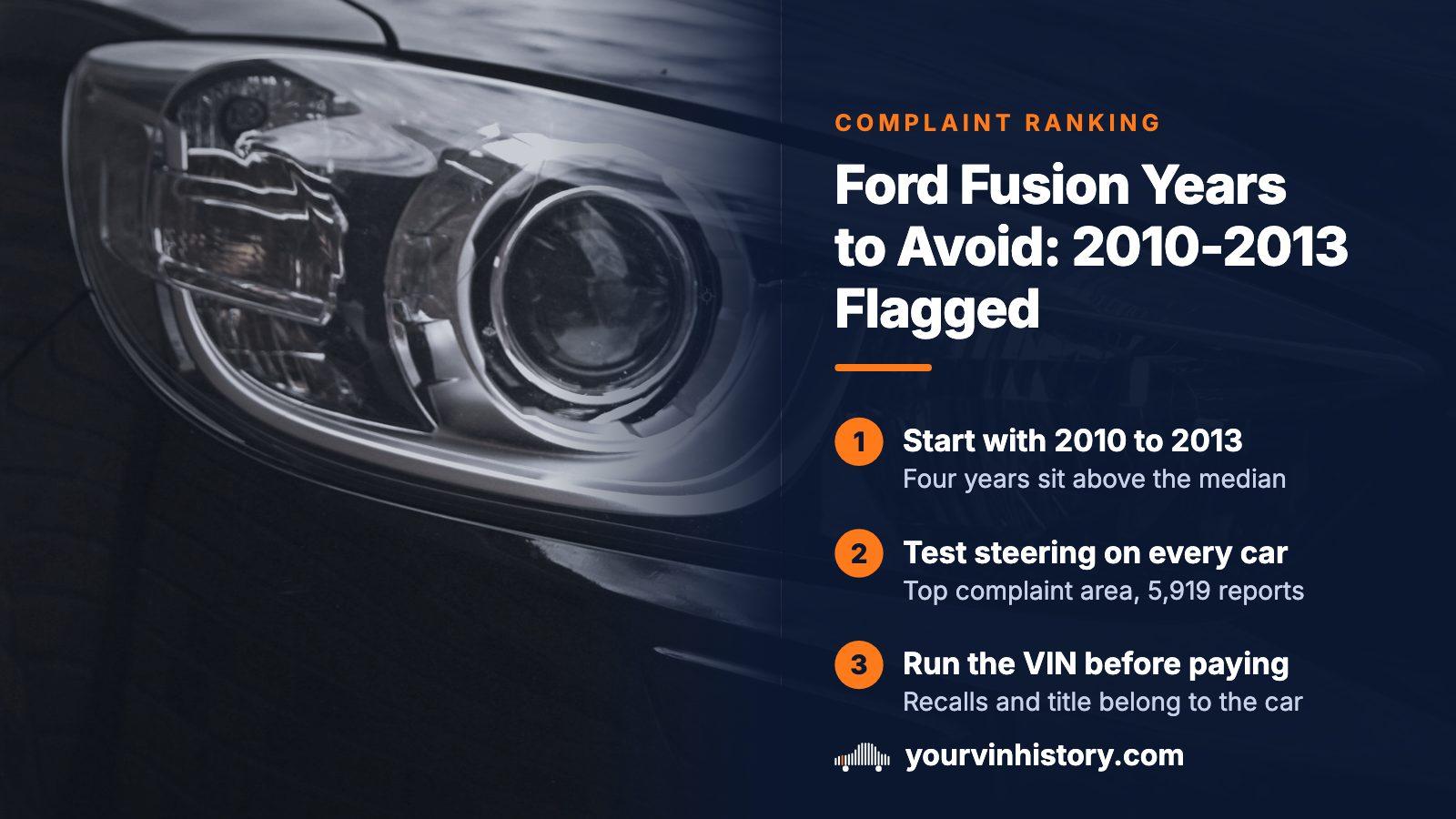
Start the scrutiny at 2010 through 2013. Those four Fusion years run above the model's own median of 1,353 complaints, and 2010 reaches 4.37 times that figure with 5,917 reports. The lightest records belong to 2018, 2019 and 2020. Steering draws the most reports across the run at 5,919, so test it on any Fusion. Complaints are unverified owner accounts, which makes a flagged year a reason to inspect harder and haggle, never a verdict on one car.
- Complaints on file
- 22,285 for model years 2008-2020
- Yearly median
- 1,353 complaints
- Peak year
- 2010, with 5,917 (4.37× the median)
- Leading complaint area
- Steering, 5,919 reports
The yardstick: the Fusion's own median year
A raw complaint total mostly reflects how many cars Ford sold in a given year and how long those cars have been driven. To blunt that, every Fusion year here is scored against one yardstick: the median year for this single sedan, which is 1,353 complaints. A year right at the median scores 1×, and a 2× year would carry double the usual volume.
The pool is every NHTSA complaint filed against Fusion model years 2008 through 2020, 22,285 in all, with repeats removed by ODI complaint number. The pull is dated August 15, 2026, so anything filed later is absent. The median is also a real year: 2008 comes in at exactly 1,353, which is why it scores 1×.
What comes out of this is a tally of reports. Each one is an owner's unverified account, and the tally says nothing about how many Fusions ran for years without a complaint. It is neither a failure rate nor a reliability score.
All 13 Fusion model years side by side
The standing column is a plain-word label for the multiple: heavy and raised are above the median, ordinary is near it, and light is well under.
| Model year | Standing | Times the median | Complaints | Recalls |
|---|---|---|---|---|
| 2008 | Ordinary | 1× | 1,353 | 6 |
| 2009 | Ordinary | 0.75× | 1,021 | 7 |
| 2010 | Heavy | 4.37× | 5,917 | 13 |
| 2011 | Heavy | 2.15× | 2,915 | 9 |
| 2012 | Raised | 1.93× | 2,610 | 6 |
| 2013 | Raised | 1.44× | 1,949 | 19 |
| 2014 | Ordinary | 1.05× | 1,420 | 19 |
| 2015 | Ordinary | 0.78× | 1,053 | 13 |
| 2016 | Ordinary | 1.24× | 1,672 | 13 |
| 2017 | Ordinary | 0.88× | 1,184 | 4 |
| 2018 | Light | 0.37× | 500 | 2 |
| 2019 | Light | 0.34× | 463 | 3 |
| 2020 | Light | 0.17× | 228 | 3 |
Nine of the 13 years land around or below the median. The recall column does not follow the complaint column, a gap the recall section below picks up.
The jump between 2009 and 2010
The series is lopsided. A 2009 Fusion drew 1,021 complaints, under the median. The 2010 drew 5,917, the highest figure in the whole run.
A step that large between neighboring years often traces to a redesign or a significant hardware change, though complaint data alone cannot say which happened here. Ask the seller exactly what the car is, and do not treat a 2009 and a 2010 as one vehicle.
After the peak the count walks down: 2,915 for 2011, 2,610 for 2012, 1,949 for 2013 and 1,420 for 2014, which is close to the median. The slide has a bump in it. The 2016 year reaches 1,672 after 2015 dipped to 1,053, so the decline is a tendency and no guarantee.
The four years that deserve a harder look
Four consecutive model years sit over the median, and each lists steering as its most reported area.
- 2010: 5,917 complaints, 4.37× the median, 13 recalls. Steering leads and the power train also stands out.
- 2011: 2,915 complaints, 2.15×, 9 recalls. Steering again tops the list.
- 2012: 2,610 complaints, 1.93×, 6 recalls, the fewest of the four, with steering on top.
- 2013: 1,949 complaints, 1.44×, 19 recalls. The mildest of the four on complaints and the heaviest on recalls.
Sitting above the median describes a population. Each of these years also contains cars that were looked after and never gave trouble, so the flag works as a cue to inspect and price with care. It does not justify dropping a car you have not seen.
2018 to 2020: the lightest files, with a caveat
The quietest Fusions on record are 2020 with 228 complaints (0.17×), 2019 with 463 (0.34×) and 2018 with 500 (0.37×). Their recall counts are 3, 3 and 2. Among the earlier cars, 2017 scores 0.88× and has just 4 recalls, the lowest count before 2018.
Read the quiet years with some skepticism. Counts follow sales and time on the road, so part of the gap is plain exposure. Rankings like this also leave out the very newest model years of any nameplate, because a young car has had little time to collect reports. The three years here count as settled, while a model year only a season or two old would not.
Where the complaints cluster
NHTSA files every complaint under a vehicle component. Added up over 2008 through 2020, six categories lead:
| Component category | Reports, 2008-2020 |
|---|---|
| Steering | 5,919 |
| Engine | 3,246 |
| Power train | 3,102 |
| Air bags | 2,534 |
| Service brakes | 1,357 |
| Vehicle speed control | 1,182 |
Steering sits well ahead of the rest, which makes it the first thing to test on any Fusion whatever the year. In 2010, the peak, steering and the power train both stand out. A category label says where an owner reported trouble, not which part failed, so each line is a prompt for inspection and no diagnosis. Power train takes in the transmission and neighboring drive components, and engine covers any engine fault at all, which is why those two counts are broad.
Recall counts tell a different story
The recall column is not a second complaint count. A recall is a campaign Ford is obliged to repair; a complaint is a single owner's version of events, unchecked. The 2013 and 2014 Fusions each carry 19 recalls yet score 1.44× and 1.05× on complaints. The 2010 car pairs 13 recalls with the highest complaint count of the run.
NHTSA's recall data for the 2010 Fusion shows how little the two lists overlap. Seven of its 13 campaigns involve air bag inflators or modules, and the rest scatter across brake control hardware, fuel tank pressure, floor mats, wheel studs, a seat recliner and a transmission park mechanism. None is a steering campaign, though steering leads that year's complaints. The 2013 list does include steering campaigns beside transmission-linkage ones.
Repairs at no charge have a limit. Under 49 U.S.C. 30120(g), the requirement does not apply when a car was first bought more than 15 calendar years before the recall notice, so a campaign announced late in an older Fusion's life may not come with a no-charge fix.
Inspecting a Fusion from a flagged year
The steps below follow the complaint areas in the table above, starting with steering.
- Drive with the steering in mind: turn lock to lock in a parking lot, hold a straight line at speed, and cross some rough pavement. Note heaviness, slack, noises or a dash warning light.
- Ask for every steering and transmission repair order. Those two areas stand out in 2010, and a seller who has the paperwork is easier to trust.
- Have a mechanic put the car on a lift and look over the steering parts and the drivetrain before you agree on a price.
- Run the VIN through NHTSA's recall lookup and set the open campaigns beside the repair records.
- Watch the air bag light at start-up. It should come on briefly and then go out.
From the model year to the actual car
The year describes a population, and the VIN describes one car. Recall campaigns attach to production ranges, so two Fusions of the same year can differ on which campaigns apply and whether the work was done. NHTSA's lookup answers that by VIN. The NMVTIS title system covers the title history of a single vehicle, which no complaint tally can, and the NICB's VINCheck screens a VIN for theft and total-loss records at no cost.
Where a history report fits
A yourvinhistory report is built on NMVTIS title records supplied by ClearVin LLC and adds accident, odometer, lien and auction records for the specific Fusion. The VIN search shows a preview first, and the full report is a one-time purchase.
Where this information comes from
- NHTSA: Vehicle safety and owner complaints — The federal agency where Fusion owners file the complaints counted in the ranking.
- NHTSA: Recalls — Where recall campaigns are published and where a VIN can be checked for open ones.
- NMVTIS: National Motor Vehicle Title Information System — The federal title-record system for one car's history, which a model-year ranking cannot show.
- NICB: VINCheck — A no-cost screen of a single VIN against theft and total-loss records.
Sources and photos: Facts checked against the sources above in October 2026. Photo by Tristan Beischel @Autoily.com on Unsplash; diagrams by YourVINHistory.
Keep reading
- 2013 Ford Fusion: 20 recalls, 1,949 complaints and what to checkThe one Fusion model-year record, with that year's recall campaigns and complaint areas in detail.
- Ford recallsHow to look up open Ford recalls by VIN, which settles what year-level counts cannot.
- Ford Fusion transmission replacement cost: four faults that look alikeA look at the transmission side of a Fusion, since the power train is among the leading complaint areas.
- Pre-purchase inspectionWhat a mechanic's inspection covers before you commit to a flagged year.
Frequently asked questions
Which Ford Fusion years should I avoid?
Start with 2010, which has 5,917 complaints, 4.37 times the median of 1,353. The 2011 and 2012 cars follow, and 2013 is a smaller step above the line. If your budget points to one of those years, let the price reflect it and make the inspection thorough, because many individual cars in those years have no history of trouble.
Is the Ford Fusion a reliable car?
This data cannot score reliability. Complaint counts are unverified owner reports that follow sales and age. What it supports is narrower: nine of the 13 model years land around or below the 1,353 median, and 2018 to 2020 have the thinnest files. For one car, service records and a mechanic's inspection say far more.
Which problem do Ford Fusion owners report most?
Steering is the most reported category, with 5,919 NHTSA complaints across 2008 to 2020, ahead of engine at 3,246 and power train at 3,102. Those are category labels, so they show where owners filed reports and not a single failed part. Ask for steering and transmission repair records on any Fusion you consider.
Do Ford Fusion recalls mean the car is bad?
Not by themselves. The 2013 and 2014 cars each have 19 recalls but sit near or modestly above the complaint median. A recall means the maker has to repair something, so the question is whether that work was done on your car. Check the VIN, and remember the no-charge duty reaches only cars first sold within 15 calendar years of the recall notice.
How do I check a specific Ford Fusion before buying?
Use the VIN. NHTSA's recall lookup shows open campaigns for that exact car, NICB's VINCheck screens for theft and total-loss records, and NMVTIS covers title history. Add an inspection by a mechanic who will put it on a lift. Finish all of it before money changes hands, since no model-year statistic speaks for the car in front of you.
Now check the car itself
The guide explains what to look for. The report shows what this VIN has on record.