THE SHORT ANSWER
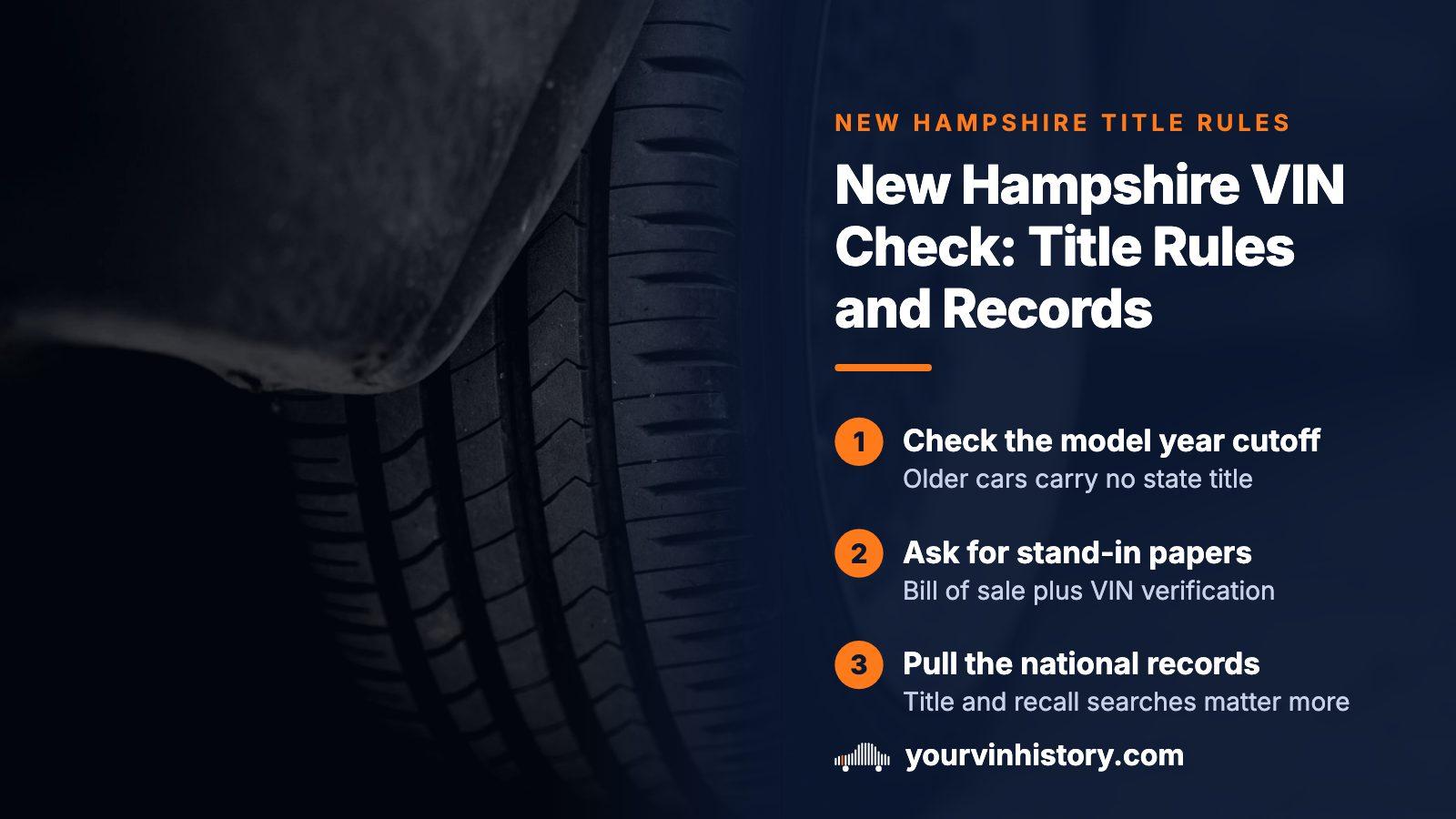
The state does not issue titles for vehicles of model year 1999 or older, so a missing title on one of those is normal. Heavy trucks with three or more axles above 18,000 pounds, and truck tractors above that weight, are always titled. On an exempt vehicle the bill of sale and VIN paperwork stand in for the title, which makes the national title record and the recall search matter more.
- Title cutoff
- Model year 1999 and older: no state title
- Always titled
- Heavy trucks with 3+ axles and truck tractors over 18,000 lb
- Stand-in papers
- Bill of sale plus VIN verification or the earlier registration
- Recall search gap
- NHTSA VIN search omits recalls over 15 years old, with exceptions
Where New Hampshire stops issuing titles
For vehicles of model year 1999 or older, New Hampshire issues no state title at all. That is the DMV's own wording on its exempt-vehicles page, and it changes what a paperwork check looks like. A seller with no title for a 1997 pickup is describing how the state works, not hiding something.
The cutoff used to float. Earlier descriptions of the state's system mention a rolling fifteen-year test that released another batch of vehicles from titling each year. That test is gone. The line is now fixed and will not creep forward.
Any untitled passenger vehicle in the state is therefore more than a quarter century old, and the VIN will confirm that in seconds.
Decode the tenth character before judging the paperwork
Everything else in the check depends on one VIN character. Position 10 of a 17-character VIN carries the model year, and the boundary sits between two neighboring letters: X stands for 1999 and Y for 2000. A decoder reads it for you, but the letters let you sanity-check a listing from the driveway.
The cutoff follows model year, not the date of assembly or first sale. A manufacturer can assign a model year that differs from the calendar year of assembly, so a car built late in one year may carry the next year's designation.
The letters repeat as years pass. On cars and light trucks, a number in position 7 means the tenth-character code belongs to the older cycle that includes 1999, while a letter there means the code is reused on a newer vehicle. If the listed year disagrees with those characters, distrust the listing until a decoder settles it.
Reading the 1999 line
Model year 1999 or older: expect no state title, and plan on a bill of sale plus VIN paperwork. Model year 2000 or newer: expect a title in the seller's name, and wait until a title or duplicate is in hand.
Which vehicles get a title and which do not
The cutoff is narrower than 'old vehicles need no title'. The DMV's never-titled list also includes boats, mopeds, mobile homes and snowmobiles, but a car buyer cares more about the vehicles that cut against the rule.
| Vehicle | Title position |
|---|---|
| Motor vehicle, model year 1999 or older | No state title, with the exceptions below |
| Motor vehicle, model year 2000 or newer | Titled |
| Heavy truck with three or more axles, gross weight above 18,000 lb | Titled at any age |
| Truck tractor, gross weight above 18,000 lb | Titled at any age |
| Certain antique vehicles | May be titled if the owner asks |
Anyone shopping for older commercial equipment should read the middle rows twice. A three-axle truck or heavy tractor with no title is a missing document, not a quirk of state law, and the seller owes you an explanation.
The papers that stand in for a title
For selling an exempt vehicle, the DMV's guidance comes down to a short bundle. A seller who holds a title signs it over on the back. Otherwise the seller supplies the state's report of sale or transfer of a non-titled motor vehicle, which works as the bill of sale, plus a verification of vehicle identification or a copy of the earlier registration or title.
- Check that the sale form is the state's own, filled in completely and legibly, with the seller's name matching the seller's photo ID.
- Compare the VIN on the paperwork with the dashboard and the door label, character by character.
- Confirm the verification of vehicle identification is completed, or that the copy of the earlier registration or title is readable.
- Bring proof of residency, and ask the town or city clerk who will register the car which other items they want.
Handle the bundle the way you would handle a title. If the seller vanishes, there is no state-issued title to duplicate, so rebuilding the chain later is slow and uncertain.
What a missing title takes out of the local record
A title is the document a brand gets written on. Salvage, flood and rebuilt notations all live on titles, so a vehicle that never received a New Hampshire title has no New Hampshire document where any of them could appear. The older and more eventful the car, the more that thin record matters.
The state does keep some damage controls. Its DMV says New Hampshire has a salvage law, and a salvage vehicle needs a salvage inspection before it can be registered. If a seller says an older car was rebuilt, ask whether it went through that inspection and see the paperwork. A rebuild story with nothing behind it is only a story.
Silence is not a clean result
On an untitled car, an empty local record means nothing was ever written down, not that nothing happened. Treat the gap as missing information and fill it from other sources.
Where the national title record earns its place
Brands applied by other states do not disappear at the New Hampshire line. They sit in NMVTIS, the national title record built from state title data, the one place a brand from a neighboring state can still show up after the car arrives here. For a title-exempt vehicle, that makes it a main check rather than an extra.
A yourvinhistory report includes NMVTIS title records from ClearVin LLC, an approved NMVTIS data provider, alongside accident entries, odometer readings, salvage and auction records, and open recalls. The VIN preview is free; the full report is a one-time purchase.
Know the limit, though. A car that spent its whole life in New Hampshire without ever being titled elsewhere may return little or nothing. Read a sparse result as a reason to lean harder on the paperwork and the underbody, not as approval. NICB's VINCheck adds a no-cost screen for reported theft and salvage, with gaps of its own, so use it beside the title record.
Why the recall search can come up empty on an older car
NHTSA's recall search by VIN is the standard no-cost first stop, but its edges fall right where exempt vehicles sit. By the agency's own description, the VIN and plate search leaves out safety recalls more than 15 years old unless the manufacturer offers more coverage. It also omits recalls already repaired, new recalls whose VINs are still being added, and campaigns by small manufacturers.
Every vehicle exempt from titling is older than that window. A reply of '0 unrepaired recalls associated with this VIN' on such a car means nothing open is on record. It does not mean no recall ever applied.
Two workarounds help. Search by year, make and model too, which returns general recall, investigation and complaint results. And ask a dealer for the brand to check the VIN in the manufacturer's own system, since a maker may cover older campaigns the federal search omits.
Salt, winter and the coast: what to put on a lift
Databases will not tell you what road salt did. Cars that have spent winters on New Hampshire roads pick up underbody corrosion, and a car kept near the short coastline adds salt air. On a vehicle old enough to be title-exempt, that wear is the likeliest source of an expensive surprise.
- Brake lines and fuel lines, which rust through where nobody looks and can fail without warning
- Frame rails and subframe mounting points, looking for flaking, swelling or patched metal
- Rocker panels, wheel arches and the floor under the carpet
- Suspension mounts and fuel tank straps
- Fresh undercoating, which can be maintenance or can be a cover-up
Pay a shop to raise the car before any money changes hands. On a vehicle with a hand-written history, the lift is the one part of the check no paperwork can replace.
Plate searches and owner names
A plate will not hand you an owner's name. Federal privacy rules limit who can pull personal details from motor vehicle records and for which purposes, and a history check does not need them. Work from the VIN.
NHTSA's recall page does let you enter a license plate and a state. The agency says it builds that result from state DMV data, so a plate that changed hands can return the previous vehicle. If the result looks like the wrong car, search by VIN instead. New Hampshire's own plate and insurance quirks have a separate guide on this site.
A sequence for the day you buy
- Before you travel, decode the VIN from the listing and note which side of the 1999 line the model year falls on.
- Ask the seller to describe the paperwork in advance: a signed title for a newer vehicle, or the sale form plus VIN verification or an earlier registration for an older one.
- At the car, match the VIN on the dashboard, the door label and every document. A mismatch ends the conversation until it is explained.
- Run the NHTSA recall search and the NICB VINCheck, and pull the national title record, before you pay.
- Have the underbody inspected, then negotiate using what the lift showed.
- Finish the transfer paperwork on the spot and keep copies of everything.
Where this information comes from
- NH DMV: Exempt Vehicles — Supports the model year 1999 cutoff, the list of never-titled items and the heavy trucks and tractors that must always be titled.
- NH DMV: Title Frequently Asked Questions — Lists the documents used when selling an exempt vehicle, the duplicate title steps and the salvage inspection requirement.
- New Hampshire RSA 261:3: Exempted vehicles — The statute the DMV points to for the full roster of vehicles exempt from titling.
- NHTSA: Check for Recalls — Explains what the VIN and plate search shows, and the recall types it leaves out, including those over 15 years old.
Sources and photos: Facts checked against the sources above in October 2026. Photo by engin akyurt on Unsplash; diagrams by YourVINHistory.
Keep reading
- Bill of sale for a carWhat a sale document proves, and what it leaves for the title to carry.
- NMVTIS reportA plain-terms look at the federal title record that fills the gap on untitled cars.
- New Hampshire platesThe plate and registration side of buying a car in the state.
- VermontThe neighboring state's take on rust, the other big risk on an older New England car.
Frequently asked questions
Can I register a New Hampshire car that has no title?
Registration and titling are separate steps. The DMV describes the registration permit as what allows you to operate a vehicle and the title as proof of ownership. An exempt vehicle has no title to show, so expect the town or city clerk to rely on your bill of sale and VIN paperwork. Call the clerk before you buy to confirm what they accept.
Can I still get a title for an older car if I want one?
The DMV says certain vehicles of antique status may be titled when the owner asks, and it describes vehicles of model year 1999 or older as titled only on request. The conditions sit in the exempt-vehicle statute, so ask the clerk whether your car qualifies. A title also gives future brands a document to be recorded on, which an untitled car lacks.
What if the seller lost the title to a car that does need one?
A lost title can be replaced through an application for a duplicate. The DMV says a release of lien must be attached if a lien was recorded, and every owner of a jointly owned vehicle must sign. Issuing a title takes several weeks, so do not pay on a promise to mail it later.
What should the bill of sale say for an untitled car?
Use the state's report of sale or transfer of a non-titled motor vehicle, with both names, the sale date, the price, the full VIN and both signatures. Add a written line that the seller owns the vehicle and knows of no loan against it. That statement is your own protection, not a state requirement.
Is there a free New Hampshire VIN check?
No-cost tools exist, but they come from federal and industry sources rather than a state history lookup: NHTSA's recall search for open recalls and NICB's VINCheck for reported theft and salvage. A VIN decode confirms the model year. Title brand history needs a national title record from an approved provider, which is a paid product.
Now check the car itself
The guide explains what to look for. The report shows what this VIN has on record.