THE SHORT ANSWER
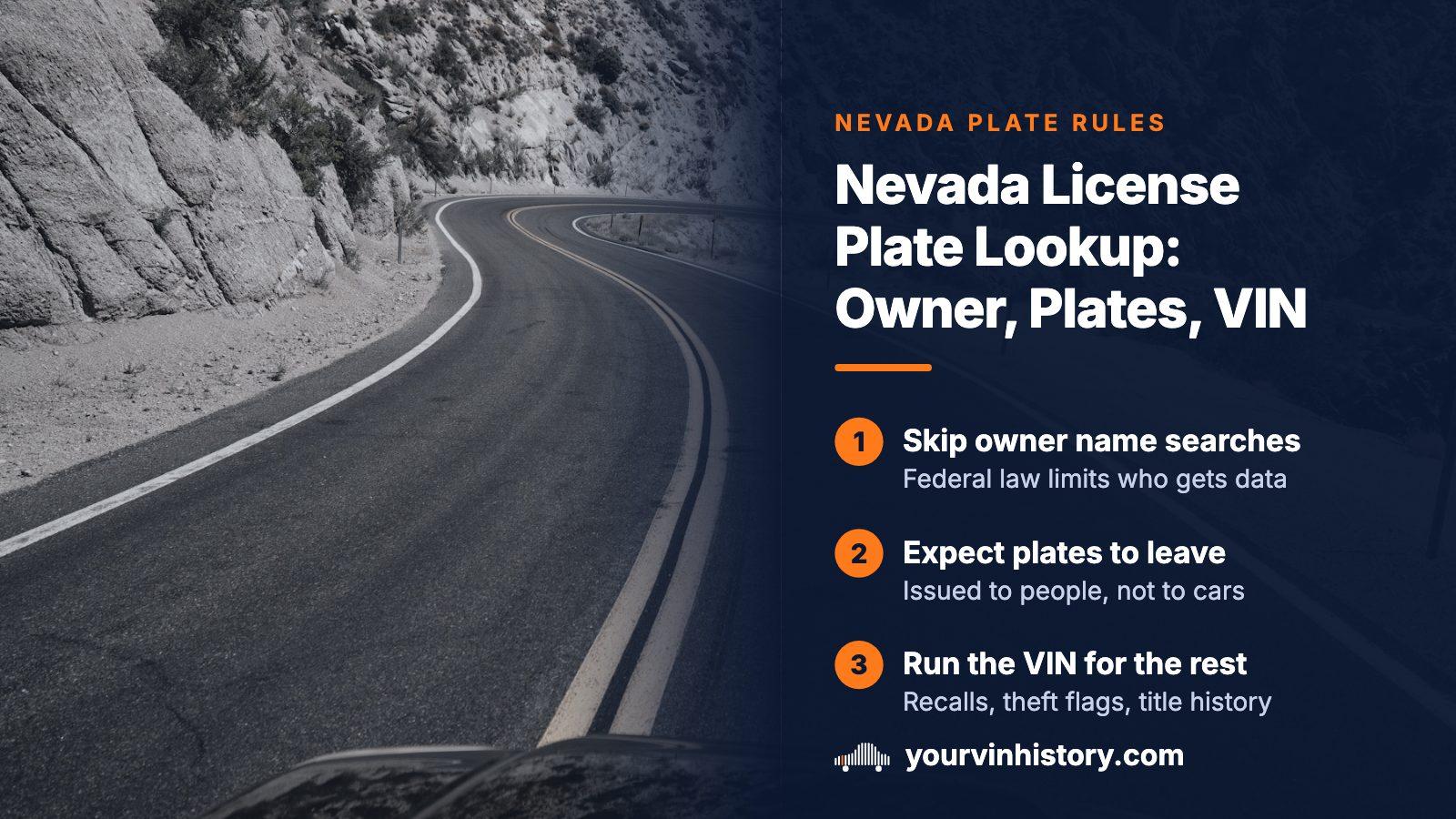
A Nevada plate number will not return the owner's name to a private buyer. The federal Driver's Privacy Protection Act limits that data to permitted uses such as police work and insurance claims. Run the VIN instead for recalls, theft flags and title history. Nevada plates are issued to people, not cars, so the seller keeps them at sale, and most vehicles must show two plates, with a narrow exception for models built without a front mount.
- Plates per vehicle
- Two, front and rear; motorcycles and trailers take one for the rear
- Who keeps plates at sale
- The seller
- Released plates must be used within
- 60 days (Home Means Nevada) or 30 days (specialty)
- Seller's reuse or turn-in window
- 18 months for standard and special plates
Why a plate number will not return an owner's name
The record linking a Nevada plate to a person sits with the DMV, and federal law controls who can see it. The Driver's Privacy Protection Act stops a state motor vehicle agency from knowingly releasing personal information from its files, then lists the exceptions. Each ties to a function: government agencies, courts and police, insurers working a claim, parties in a lawsuit, employers verifying a commercial driver, and licensed investigators.
Idle curiosity and a wish to confront a careless driver are not on the list. The Nevada DMV says it does not disclose owner information to prospective buyers, and it points them to the VIN. Be wary of any site that promises a name for any Nevada plate.
When the plate matters for a real reason
After a crash with a driver who left, give the plate number to the police and your insurer. They can pursue the owner record under the permitted uses; a private citizen cannot.
Four lookups that do work from the VIN
Read the VIN off the car itself, not just the ad, and match it to the title and registration card. Then run it through the tools the DMV lists for buyers.
- NICB VINCheck: flags thefts and salvage records, at no charge.
- NHTSA VIN decoder: confirms the number is a valid VIN, at no charge.
- NHTSA recall lookup: lists open safety recalls for that exact car, at no charge.
- NMVTIS title information: title records pulled from states nationwide, with small fees according to the Nevada DMV.
A paid report from this site draws on the same national title data: its NMVTIS title records come from ClearVin LLC, an approved NMVTIS data provider. It adds accidents with a damage map, odometer readings, and salvage and auction records with photos, and the preview is free.
Nevada plates are tied to a person, so they leave with the seller
Nevada issues plates to people and businesses, not to vehicles, so the seller keeps them when a car sells. The DMV's page for buyers and sellers says the seller either surrenders the plates or puts them on another vehicle.
A car at a viewing that still wears the seller's plates is normal, but those plates carry no registration for you. Cover the drive home with a movement permit or the short drive-away allowance described below, not with borrowed plates.
One sanctioned handoff exists. The seller completes the DMV's License Plate Release form, and the new owner submits it when applying for an original registration.
How a seller retires a Nevada plate
Order matters. The DMV's first instruction to sellers is to cancel the registration before dropping insurance, because the reverse order can bring fines.
- Cancel the registration. MyDMV handles it online at any hour. By mail, send the plates, the decal and a signed letter requesting cancellation, with a return address and daytime phone number. In person, any DMV office works, as does a County Assessor in rural areas.
- Settle the plates. Put them on another vehicle in your name or surrender them. In person, bring the rear plate so the decal can be removed, and hand the plates to the information desk, not a drop box unless it is marked for plates.
- File a resale notification. It records that you no longer own the car and shields you from liability for the next driver. File it during cancellation or on its own.
After an online cancellation you can no longer get a movement permit or transfer plates online, and the cancellation is not meant for a trade-in at a Nevada dealer.
Four deadlines that get mixed together
The figure repeated most often is 60 days, and it frequently lands on the wrong person. It belongs to whoever receives plates that a seller has formally released. After that handoff, Home Means Nevada plates must be put to use inside 60 days and specialty plates inside 30, or they become unusable for the recipient.
| Situation | Who is on the clock | Window |
|---|---|---|
| Released plates, Home Means Nevada design | The person receiving them | 60 days |
| Released plates, specialty design | The person receiving them | 30 days |
| Seller keeps standard or special plates | The seller, to reuse or turn them in | 18 months |
| Seller keeps a discontinued special plate | The seller, to reuse or turn it in | 30 days |
The seller's windows appear in the plate transfers and returns part of the DMV's Register a Vehicle page, separate from the cancellation page. A fee credit runs on its own clock: it ends on the original expiration date of the canceled registration and never passes to the buyer.
Two plates, and the one narrow exception
Most vehicles receive two plates from the DMV and must show both, front and rear. Motorcycles and trailers get a single plate for the rear. A car or truck can skip the front plate only when it was not designed for one and the manufacturer supplied no bracket.
A bumper with a molded recess or a factory bracket was built for a plate, so a bare nose there is a missing plate, not an exception. Where the front plate is legitimately unused, the owner stores it and returns both later.
Placement rules apply to either plate. Fasten it so it cannot swing, keep the bottom edge at least 12 inches off the ground, and keep it free of foreign material. It must be readable from 100 feet in daylight.
What the plate and decal tell you at a viewing
| On the car | What it suggests | What to do |
|---|---|---|
| Decal at the upper right of the rear plate | The month and year registration ends, on the exact date on its slip rather than month's end | Ask for the slip and compare dates |
| Seller's plates still mounted | The registration is the seller's and may be ending | Settle how the car gets home and who cancels |
| No front plate and no bracket | It may fit the narrow exception | Look for factory mounting points |
| A specialty design instead of Home Means Nevada | A cause, school or hobby choice, which carries extra fees | Ask whether the seller keeps or releases it |
None of this proves the title is clean. A plate speaks to registration, while brands such as salvage or rebuilt live on the title, so the VIN check and the paper title come first.
Insurance gaps surface as registration trouble
Nevada requires liability insurance from a Nevada-licensed carrier on registered vehicles used on public streets, and the DMV states that there are no grace periods. Insurers validate coverage electronically, so the DMV can spot a lapse without anyone filing a complaint.
When the DMV cannot confirm coverage, it first sends a Verification Request, and the owner must answer within 15 days of mailing. If coverage truly lapsed, a certified letter follows and the registration is suspended 10 days after that mailing date. Officers must take the plates from a vehicle driven on a suspended registration, and they may impound it.
For a buyer, a suspended registration points to a coverage break at some earlier point. Ask the seller when and why, and use the DMV's online status check for registration and insurance.
Paperwork to hold before you hand over money
The DMV warns that cash-only or too-good-to-be-true social media offers often cover stolen vehicles, switched VINs or tampered odometers. Hold out for the following.
- A properly signed title. A bill of sale alone is not acceptable to the DMV, and with no title the DMV's advice is to walk away.
- A VIN that matches across the car, title and registration, ideally confirmed at a DMV VIN inspection station.
- A photo of the seller's ID and contact details, and dealings only with the person who advertised.
- Nevada liability insurance in the exact names going on the registration and title, effective on or before the registration date. An out-of-state policy is not accepted.
- A driving plan. Without a movement permit you may drive up to three days after purchase, carrying proof of ownership and insurance and heading straight home or to the DMV. After that you need a permit, available online through MyDMV for 30 days or in person.
One more filter: a person may not sell more than three personally owned vehicles a year without a dealer license, so a driveway full of cars deserves extra questions.
Ex-rental cars in the Las Vegas market
Las Vegas hosts large rental fleets, and those cars cycle into dealer lots and private listings on a schedule. A fleet car often has on-time oil changes and processed recalls. It also has many drivers and desert heat behind it, none of which a plate can show.
The title record gives them away: a rental or leasing company as an earlier owner, sometimes followed by an auction transfer. A history report lists ownership and use type, which is where that fleet past shows up.
Ex-rental is a pricing question
Check who owned the car before, look over the seats, pedals and switchgear, and ask for service records. Negotiate on what you find instead of ruling the car out.
Where this information comes from
- Nevada DMV: License plates — Two-plate rule, the front-plate exception, display and mounting requirements, and plates being issued to people rather than vehicles.
- Nevada DMV: Registration cancellation and plate surrender — Cancel-before-dropping-insurance warning, the three cancellation routes, the resale notification, plate release, and the 60-day and 30-day windows.
- Nevada DMV: Register a vehicle — Seller reuse windows, signed-title rule, drive-away allowance and movement permits, and the DMV's list of VIN tools for buyers.
- Nevada DMV: Liability insurance requirements — No grace period, the Verification Request and certified letter sequence, and what suspension means for plates.
- U.S. Code: 18 U.S.C. 2721, Driver's Privacy Protection Act — The federal limit on releasing personal information from motor vehicle records, and the list of permitted uses.
- Bureau of Justice Assistance: NMVTIS — The national title information system behind multi-state title checks keyed to the VIN.
Sources and photos: Facts checked against the sources above in October 2026. Photo by Will Truettner on Unsplash; diagrams by YourVINHistory.
Keep reading
- License plate lookupThe national version of the privacy limit, and what a plate search can and cannot return.
- Arizona platesThe neighboring state where the plate and the fee credit also stay with the seller.
- Temporary tagHow long a fresh purchase may be driven, and the deadline that follows.
- Buying a used rental carWhat to ask about a fleet car's history before you settle on a price.
Frequently asked questions
Can I find out who owns a Nevada license plate?
Not as a private buyer. The DMV does not release owner information to prospective buyers, and the federal Driver's Privacy Protection Act confines that data to permitted uses. If a driver hit your car and left, report the plate number to the police and your insurer. For a purchase, ask the seller for the title and verify the VIN.
Do Nevada plates stay with the car when it is sold?
No. They are issued to a person or business, so the seller moves them to another vehicle or surrenders them. A buyer can inherit the seller's plate number only through the DMV's release form, and the old registration for that plate is canceled if it has not been already. Otherwise expect new plates.
Is a front license plate required in Nevada?
For most vehicles, yes. Motorcycles and trailers carry only a rear plate, and a vehicle with no factory bracket or design for a front plate may leave it off. Frames and covers are allowed if the plate stays legible and meets the mounting rules. Keep the unused plate safe, since both go back to the DMV at surrender.
Does the Nevada DMV know if my car insurance lapsed?
Yes. Insurers validate coverage electronically, and the DMV mails or emails a Verification Request when it cannot confirm a policy. Penalties scale with the length of the lapse and the number of earlier lapses, and can include fees, fines and a financial-responsibility certificate. Cancel the registration first if you are dropping coverage.
What is the 60-day rule for Nevada license plates?
It applies when a seller releases plates to another person. The recipient submits the release form with an original registration application, and the registration still on those plates is canceled if it is active. Home Means Nevada plates then have 60 days of use, specialty plates 30. It is not a general deadline for every seller.
Now check the car itself
The guide explains what to look for. The report shows what this VIN has on record.