THE SHORT ANSWER
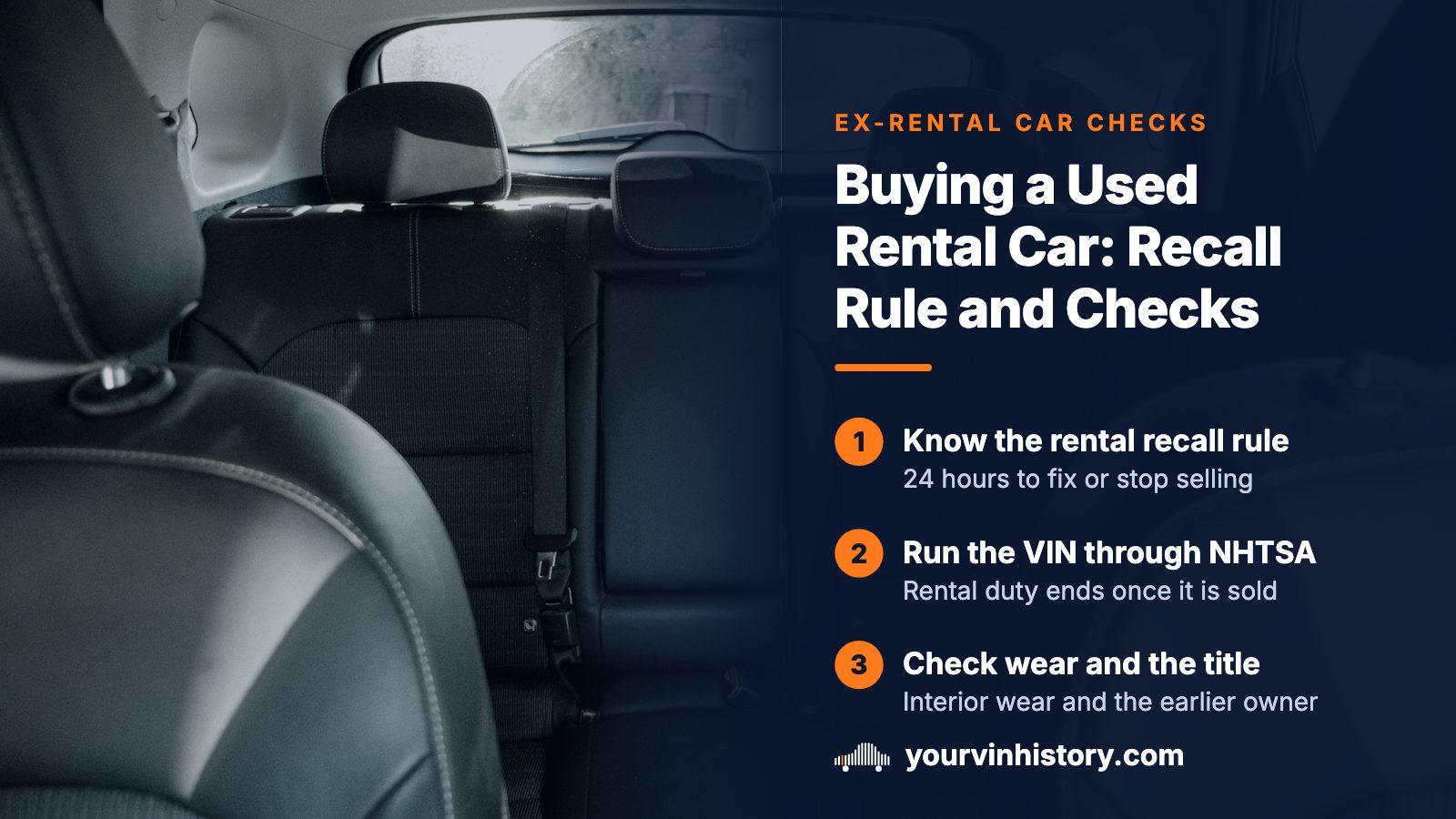
Buying an ex-rental is reasonable when you check it yourself. Federal law gives a rental company 24 hours after a recall notice (48 hours when one notice covers more than 5,000 cars) to fix a car or stop selling it. That duty ends when the car leaves the company's hands. Run the VIN through NHTSA's recall lookup, confirm the earlier owner on the title, and look for the wear that many drivers leave behind.
- Rental recall deadline
- 24 hours after the notice, 48 hours if it names over 5,000 cars
- Repair not ready yet
- The car may be rented after temporary steps, never sold or leased
- Federal title record
- Five indicators, and rental history is absent
- Where the rule lives
- 49 U.S.C. § 30120(i)
Where ex-rental cars come from
Rental companies rotate their fleets while the cars are still young. The retired vehicles reach buyers through auctions, dealer lots and, in some cases, the rental company's own used-car sales. That timing is the whole attraction: a nearly new model at the lower price the ex-rental label brings.
It is also the source of the unease. A rental car has had many drivers and no owner, and it is easy to assume some of those drivers were rough on it. That assumption may fit one car and miss on the next. Nothing on paper tells you which kind you are looking at, so it helps to separate what can be known from what cannot.
The abuse question has no records behind it
No federal or state database records how a car was driven. There is no field for hard launches, curb strikes or careless parking, so neither side of the old argument can produce evidence. Skeptics point at the strangers behind the wheel. Defenders point out that most renters are travelers on a business trip or a family vacation who drive normally, and that fleets service their cars on a schedule many private owners never keep.
Both points are reasonable and neither is checkable. The better use of your time goes to questions that do have answers: what the law required of the seller, whether the car carries an open recall today, and what the car itself shows when you look closely.
The federal rule that sets rental fleets apart
Section 30120(i) of Title 49 of the U.S. Code restricts what a rental company may do with a recalled car. Suppose the manufacturer has notified the company about a covered rental vehicle it holds, and the notice describes a defect tied to vehicle safety, or a car that falls short of an applicable federal standard. The company may then sell, lease or rent that car only if the problem is fixed before the car is delivered under the sale, lease or rental agreement.
This is statute, not an industry habit. It sits in the same subsection that applies to new vehicles on a dealer's lot. Used-car dealers and private sellers are not named in it. On the narrow subject of open recalls, then, an ex-rental has passed through a seller held to a tighter standard than the dealer next door.
The 24-hour and 48-hour clocks
Safety statutes rarely give exact time limits. This one does, and the numbers are useful when you are deciding how much to trust a fleet car's recall history.
| Situation | Time allowed to comply |
|---|---|
| Ordinary recall notice reaches the rental company | As soon as practicable, and within 24 hours |
| A single notice names over 5,000 vehicles in the fleet | As soon as practicable, and within 48 hours |
| When the clock starts | The earliest receipt of the notice naming the car's VIN, by electronic means or first class mail |
The longer window exists for scale. Grounding thousands of cars at once takes longer than grounding a few dozen, and the statute gives that single concession. Everything else stays the same. Note what the clock controls: whether the company may sell, lease or rent the car, not whether a mechanic has already done the work.
When the parts are not ready
Manufacturers sometimes announce a recall before the repair exists. If the notice admits the repair cannot be done right away but lists temporary steps that remove the safety risk, a rental company may perform those steps and keep the car in the rental line. It may not sell or lease the car. Once the real repair becomes available, the car cannot be rented again until the work is done.
The law also leaves room for one exit. A rental company may sell a covered car that qualifies as a junk automobile under federal law, has been retitled as junk under state law, and has been reported to the national title system when required. That car is leaving the road, not heading for a retail lot.
What this means on a sales lot
A company that is still waiting for repair parts may rent a recalled car but may not sell it. If an ex-rental with an open recall is offered for sale, ask directly when the notice arrived and when the car was sold. The answer may be that the sale came first.
Where the protection stops
The sale limit applies to a car in the rental company's possession when the notice arrives. After the car has gone to auction, then to a dealer, then to a first private owner, a new recall can appear and nothing in this subsection reaches back to it.
| Seller | Named in the sale limit? |
|---|---|
| Rental company, for a covered rental vehicle it holds | Yes |
| Dealer, for a new vehicle on its lot | Yes |
| Dealer, for a used vehicle | No |
| Private seller | No |
A separate part of the statute says who pays for a recall repair. The manufacturer's duty to provide the remedy without charge stops applying to a vehicle its first purchaser bought more than 15 calendar years before the notice. An ex-rental is young, so that cutoff rarely matters here. It is still worth asking a dealership service department to confirm the cost for your VIN before you assume anything.
Proving the car was a rental
The recall rule only helps if you know the car was a fleet vehicle, and federal records say less than most buyers assume. The Justice Department describes an NMVTIS report as resting on five key data points: title status with the date of the latest title, brands, the odometer reading, total losses, and salvage records. Prior use, such as rental, taxi or police service, is not among them. The brands that page names are junk, salvage and flood.
So the record that tells you about title brands will not say rental. Evidence comes from elsewhere: the seller saying so, a title or bill of sale naming a rental or leasing company as an earlier owner, a sale run by the rental company itself, or a commercial report that includes ownership and use type. A yourvinhistory report lists ownership and use type, which is where fleet history would appear if it was recorded.
Treat "never a rental" as a claim
A private seller's statement that the car was never a rental cannot be checked against the federal record. Ask for the earlier owners' names and read the title. An ex-rental you cannot identify is simply a used car, with no recall protection you can lean on.
Trade-offs that have nothing to do with recalls
Some differences are real and need no guesses about strangers' driving habits.
- Plain equipment. Fleet buyers favor mid-range trims and common colors, which helps the price when you buy and hurts a little when you sell.
- Fast mileage. Miles pile up over a short span, so the odometer often looks high for the car's age.
- Scheduled service. Fleet maintenance follows a calendar, which beats an owner who puts work off, but regular oil changes do nothing for a design flaw.
- Many drivers, many habits. The visible result is parking damage on the panels, which never appears in a database.
- A resale discount. Later buyers will mark the car down for its history, just as you are being offered a discount now.
A routine for any ex-rental you consider
- Run the VIN through NHTSA's free recall lookup on the day you plan to buy. A campaign could have been announced after the rental company let the car go.
- Ask who owned the car before, and read the title and bill of sale for a rental or leasing company's name.
- Compare the odometer with the car's age and ask for service records. Scheduled fleet service should leave records.
- Drive it with the radio off. Use every wiper and washer setting, try cruise control, make a firm stop on empty pavement, and listen for wheel noise at highway speed.
- Walk around the body looking for scuffed bumper corners, curb-rashed wheels and dings along the door edges. They are cosmetic and give you bargaining room.
- Pay an independent mechanic to inspect it, and pull a history report that covers title brands, accident damage and odometer readings.
Where this information comes from
- U.S. Code: 49 U.S.C. § 30120, remedies for defects and noncompliance — Subsection (i) holds the sale limits, the 24-hour and 48-hour clocks, the rent-but-not-sell rule and the junk automobile exception. Subsection (g) holds the age cutoff on no-charge remedies.
- BJA: Understanding an NMVTIS vehicle history report — Lists the five indicators in a federal title-based report, none of which is prior use.
- NHTSA: Recalls — Where a buyer enters a VIN to see recall campaigns that are still open on that car.
Sources and photos: Facts checked against the sources above in October 2026. Photo by THLT LCX on Unsplash; diagrams by YourVINHistory.
Keep reading
- Buying a car with an open recallWhat an unfixed campaign means for an ordinary used purchase.
- Recall check by VINStep-by-step recall lookup for the car you are considering.
- Previous owners by VINHow to find out whether a rental or leasing company held the car.
- Pre-purchase inspectionWhat an independent mechanic checks before you pay.
Frequently asked questions
Is it safe to buy a used rental car?
Safety depends on the individual car, not the label. The federal rule helps only at the moment the rental company sells, and it covers recalls announced while the company held the car. After that, the lookup, a close inspection and a test drive do the work. A clean recall result on the day of purchase counts for more than any story about the car's past.
Do rental companies have to fix recalls before selling a car?
For a notice received while the car is in their possession, yes: they may sell it only if the defect is fixed before delivery, within 24 hours of the notice, or 48 hours when it covers more than 5,000 cars. One exception covers a car retitled as junk. Another lets a company rent, but not sell, a car whose repair is not yet available.
Can a VIN check tell me a car was a rental?
Not through the federal title record, which carries five indicators and none of them is prior use. Some commercial reports add ownership and use type from other sources, and a title naming a leasing or rental company settles it. Absence of a rental entry is weaker evidence than a positive one, so ask the seller directly as well.
Should I ask for a discount on an ex-rental?
Usually yes. The label lowers resale value, and you will carry that discount into your own sale later. Strengthen your offer with things you can document: wheel and bumper scuffs, door-edge marks, thin service paperwork or an odometer high for the model year. Skip arguments about how strangers drive, since no record can back them up.
How many miles does a typical ex-rental have?
No authoritative figure exists, and it varies with the company and how long each car stayed in the fleet. Judge the car against its own age instead. Because mileage builds in a short window, an ex-rental can look high for its model year while still being young, so lean on service records and the inspection rather than the number alone.
Now check the car itself
The guide explains what to look for. The report shows what this VIN has on record.