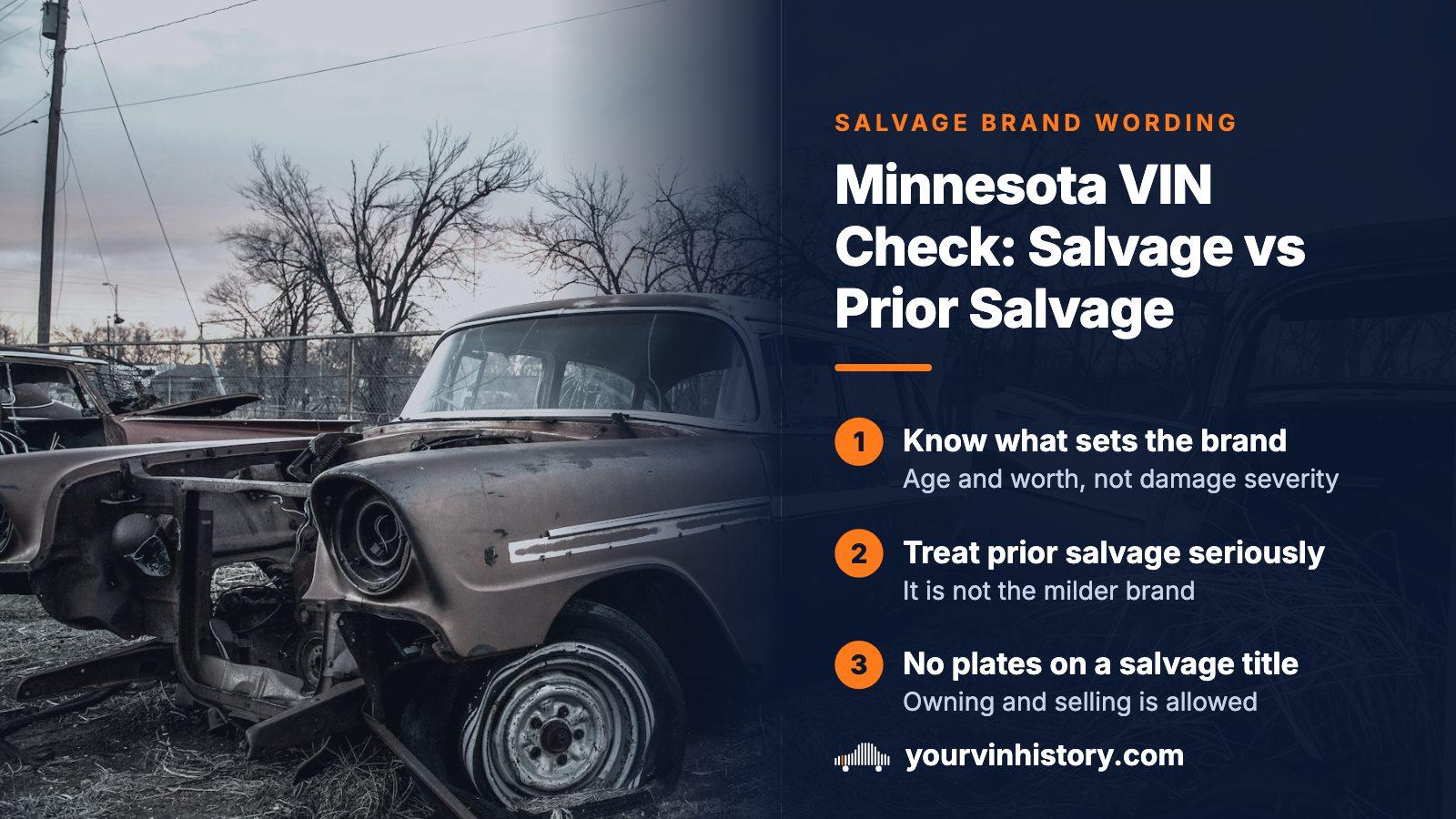
THE SHORT ANSWER
Minnesota brands a written-off vehicle salvage when it counts as late-model or high-value, and prior salvage when it does not. Age and worth pick the word, not how bad the damage was. A salvage title lets you own, move and sell the car but not register it. Prior salvage also gets applied to damaged cars arriving with a brand from another state.
- Damage brands
- Salvage and prior salvage
- What sets the brand
- Vehicle category, not damage severity
- Salvage title
- Can be owned and sold, but not registered
- Inspection fee
- $35 before certain prior salvage titles issue
What a Minnesota VIN check can settle, and what it cannot
Run a VIN and you get the factory build of the car, its open safety recalls, and whatever title events were reported into the national record. You do not get a verdict. In Minnesota the useful thing to pull out of that pile is the damage brand, because the state's two brands decide what you can lawfully do with the car once you own it.
Begin with the lookups that cost nothing. NHTSA's recall tool and NICB's theft and salvage screen both accept a bare VIN. Neither one reads a Minnesota title, so use them to rule cars out cheaply rather than to approve one. The national system behind title records, NMVTIS, was set up to protect consumers from fraud and unsafe vehicles, and it gathers the brands that participating states report.
One trigger, two words: how Minnesota sorts a write-off
Both brands start the same way. An insurer pays damages and ends up holding the title, and the insurer then has ten days to notify the department. What differs is the word that goes on the new title. Under Minnesota Statutes 168A.151, a late-model or high-value vehicle is branded salvage. Every other vehicle is branded prior salvage.
Owners who carry their own risk are not exempt. A self-insured owner applies once repair costs would pass 80 percent of the car's cash value before the damage. The definitions section of the same chapter uses that yardstick for a salvage vehicle, next to the plainer test of an insurer declaring a total loss or paying a total loss claim. No adjuster is asked to grade the damage as light or severe.
Why prior salvage is not the milder brand
The dividing line sits in the definitions, not in the repair estimate. A late-model vehicle is one whose model year falls inside a window of recent calendar years. A high-value vehicle is one that was worth more than a set dollar figure before the damage, and very heavy trucks that are not late-model get pulled in as well. Nothing in either definition asks how bad the damage was.
| Vehicle | Insurer takes it after paying | Brand applied |
|---|---|---|
| Late-model car with heavy collision damage | Yes | Salvage |
| Older, lower-value car with the same damage | Yes | Prior salvage |
| Any car repaired without an insurer taking ownership | No | Not triggered by the insurer rule |
Some sellers describe prior salvage as cosmetic. It is not. The only damage fact the brand carries is that someone decided repair did not make economic sense. Price the car, and inspect it, as you would any written-off vehicle.
How damage from another state follows a car into Minnesota
Minnesota does not rely on its own insurers alone. A person taking on a damaged vehicle owes the department an application for a prior salvage title, provided no salvage brand is required and the title already shows one of these terms:
- Rebuilt or reconditioned
- Salvage
- Repairable or damaged
- Any similar term the issuing state prefers
A second path reaches deeper. A damaged vehicle that had a salvage certificate or brand issued by any other jurisdiction at any point in its history also qualifies, even if the current title looks clean. When the incoming car falls in the late-model or high-value group and holds an out-of-state salvage certificate, the Minnesota brand is salvage rather than prior salvage. The rule only works when someone applies, which is a good reason to pull a national title record yourself.
Why a salvage title stops short of plates
Minnesota Statutes 168A.152 draws a hard line. A title carrying the salvage brand lets the holder keep the car, move it and sell it. It does not let the holder register it. A buyer can therefore purchase a car legally and still be unable to put plates on it.
For cars in the late-model or high-value group, the way forward runs through a prior salvage title. The commissioner may not issue one unless the application carries an inspection certification in the form the department specifies, and a $35 fee goes to the department before the title issues.
Read the brand as a timeline
On a newer or higher-value car, prior salvage says the inspection paperwork went in with the title application. Salvage says that step is still ahead, and the time, the cost and the risk of an unwelcome result sit with whoever owns the car at that point.
What a Minnesota dealer must put in writing
Section 325F.6641 covers licensed dealers. Before a sale, the dealer owes the buyer written statements on three subjects:
- Prior damage: whether repair cost passed 80 percent of what the vehicle was worth just before the damage, as far as the dealer actually knows.
- Title brands: any brand the dealer knows about, including the salvage and prior salvage brands described above.
- Flooding: whether water rose above the bottom of the dashboard while the vehicle sat on the dealer's own lot.
The buyer signs the written notice and the dealer keeps it in the sales file. An oral disclosure is also required, except on sales done online, so a remote buyer has only the paper to go on. The prior-damage statement follows a fill-in form with a has or has not choice, which makes it easy to spot on the transfer document. Anyone who receives a flood disclosure and later resells the car has to pass it along.
Keep the limit in view: the duty tracks what the dealer actually knows. A signed line saying the car has not sustained that level of damage is a statement of belief, so check it against a national title record before relying on it.
Salt and quiet repairs: what no Minnesota brand records
Every trigger described so far needs an insurer or a self-insured owner to cross a line. A collision fixed with cash never puts the car in an insurer's hands, so no brand follows. The same goes for slow damage. Minnesota winters and the salt that comes with them eat at a vehicle from underneath. Rust is not something any state's title records.
A car can carry a clean Minnesota title, have no claim history, and still be weak under the floor. A lift is the only honest way to look at these spots:
- Rocker panels: the long steel boxes under the doors, where moisture collects.
- Subframe mounts: the points where the suspension and engine cradle bolt to the body.
- Brake and fuel lines: thin steel tubing that corrodes along its length.
- Strut towers: the raised pockets in the engine bay or trunk that hold the suspension.
Reading the paper title before you hand over money
Ask to see the title itself, not a description of it. The brand sits in the lower part of the document, so photograph that part along with the VIN and the owner details. Then compare. The brand on the paper should match what a national title record shows, and the VIN on the title should match the VIN on the car. A mismatch is not proof of fraud, but it is a reason to stop and ask questions before any money moves.
If the brand is salvage, ask directly whether an inspection certificate has been filed. If it is prior salvage, ask where the history began: with a Minnesota insurer, or with a title issued somewhere else. Vague answers on either point deserve a lower offer or a pass.
The order that works for checking a Minnesota used car
- Decode the VIN. The model year and configuration show which category the car would have fallen into if an insurer had taken it.
- Search the federal recall database and the NICB theft and salvage check before paying for anything.
- Photograph the full title, brand box included, and ask for the dealer's written disclosures.
- Pull a national title record to see what other states reported.
- Compare the paper title with the record. The brand and the VIN should agree.
- Put the car on a lift, whatever the paperwork says.
A report from this site covers step four and more. It starts with a preview you can read before you pay, and the full version lists title brands from NMVTIS data supplied by ClearVin LLC, an approved NMVTIS data provider, along with accident records on a damage map and salvage and auction records with photos.
Where this information comes from
- Minnesota Revisor of Statutes: section 168A.151, salvage titles — Where the salvage and prior salvage split comes from, and the rule for damaged vehicles arriving with another state's brand.
- Minnesota Revisor of Statutes: section 168A.152, use of a title — Says what a salvage-branded title permits, why it cannot support registration, and the inspection certificate and fee tied to prior salvage titles.
- Minnesota Revisor of Statutes: section 325F.6641, damage disclosure — Sets out the written damage, brand and flood statements a dealer owes, the buyer's signature and the online-sale exception.
- Bureau of Justice Assistance: National Motor Vehicle Title Information System — Federal home of the national title record, which collects brands reported by participating states.
Sources and photos: Facts checked against the sources above in October 2026. Photo by Leo_Visions on Unsplash; diagrams by YourVINHistory.
Keep reading
- What is a branded title?Walks through every kind of brand, so you can place salvage and prior salvage among them.
- Salvage title VIN checkA step-by-step way to catch a title that was washed across state lines.
- Minnesota platesThe plate side of a Minnesota purchase, including the plates that do not stay with the car.
- Wisconsin VIN checkCompares the neighboring state's salvage rule with Minnesota's for buyers who shop across the border.
Frequently asked questions
Can a Minnesota salvage title be turned into a prior salvage title?
Yes for cars in the late-model or high-value group, but only through the department. The application must include an inspection certification, and a $35 fee applies under the statute. Until that title issues, the car stays in the keep-move-sell category and cannot be registered. Ask the seller whether the application has been filed or whether you would be starting it.
Is a prior salvage car in Minnesota worth buying?
Sometimes, at a price that reflects the history. Prior salvage means an insurer, or a state elsewhere, treated the car as a loss, so compare it with clean-title examples of the same model and pay an independent shop to look at the structure. Ask your own insurer and any lender how they handle branded titles, since policies differ, and expect the brand to follow the car at resale.
How do I know if a Minnesota car counts as late-model or high-value?
The VIN decode gives you the model year, which is the input for the late-model test. The pre-damage worth is the part you cannot see from outside, so do not guess which side of the line a car fell on. Rely on the brand itself, and remember that either word marks an insurer write-off.
Does a Minnesota dealer have to tell me about flood damage?
Only in a defined case: water rising above the bottom of the dashboard while the car sat on that dealer's lot. A car flooded somewhere else reaches a brand only if one of the triggers above fired. Check the carpet, seat rails and electrical connectors yourself, and look at what the national title record says.
Can I run a Minnesota VIN check for free?
Partly. NHTSA's recall search and the NICB check for theft and salvage reports cost nothing and need only the VIN. Neither reads the Minnesota title, so they cannot tell you whether the car carries salvage or prior salvage. The national title record is the step that surfaces brands reported by other states, and that one is paid.
Now check the car itself
The guide explains what to look for. The report shows what this VIN has on record.