THE SHORT ANSWER
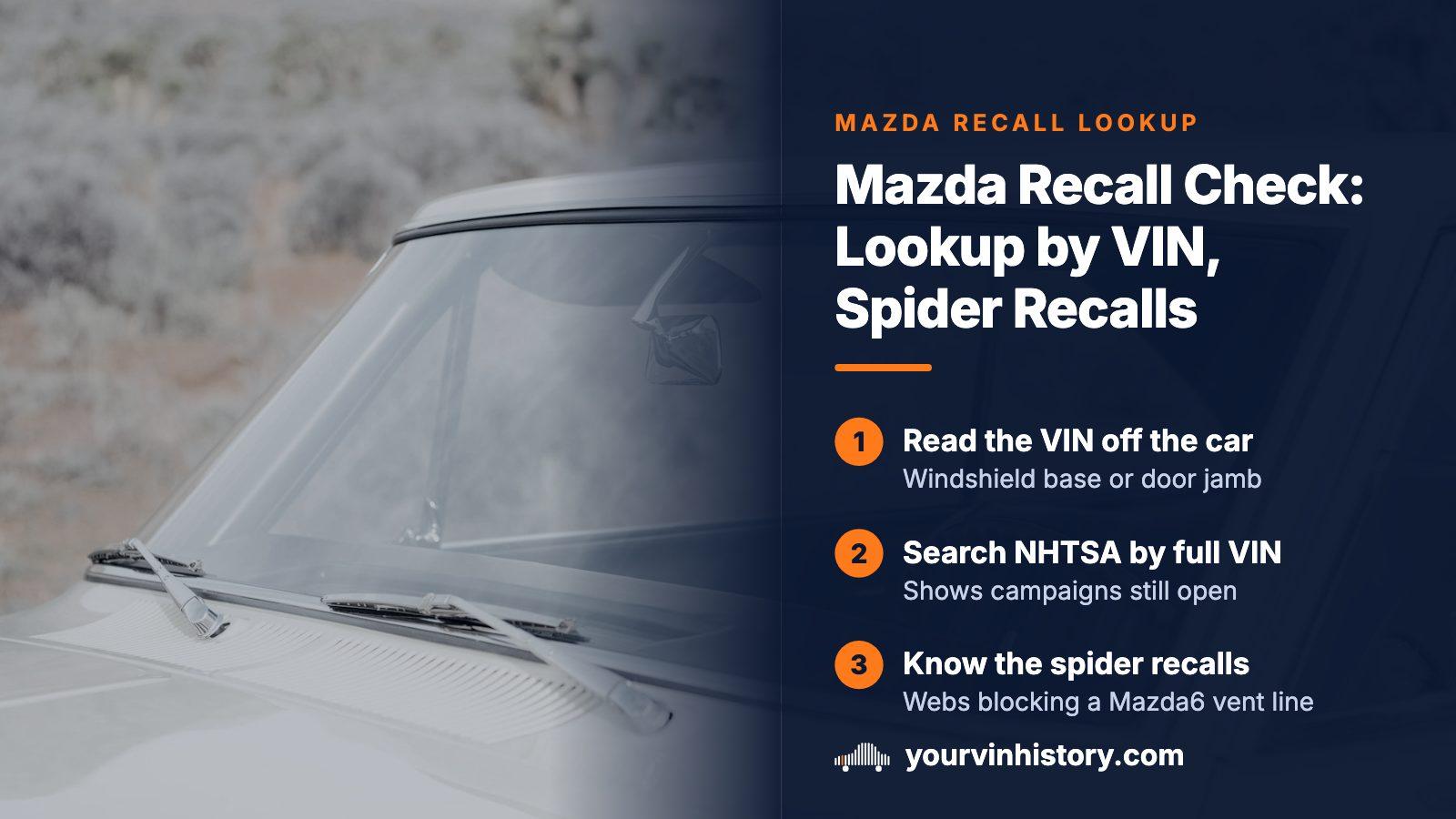
To check a Mazda for recalls, read the 17-character VIN at the base of the windshield or on the driver's door jamb and enter it into NHTSA's recall lookup. It returns safety campaigns still open on that exact car. Add Mazda's owner site and a dealer call for service programs and completed-repair history. The notable Mazda campaigns are 11V-134 and 14V-114, both on the Mazda6, both about spider webs blocking a vent line.
- Spider campaigns
- 11V-134 (2011) and 14V-114 (2014), both on the Mazda6
- Vehicles covered
- About 52,000 in the first, about 42,000 in the second
- Where to search
- NHTSA recall lookup, using the 17-character VIN
- Age limit on no-charge repairs
- Car first sold more than 15 calendar years before the notice
Read the VIN off the car before you search
Two spots on a Mazda carry the number: the plate at the base of the windshield, readable from outside, and the label on the driver's door jamb. Read both. They should match each other and the title, and if they do not, that discrepancy deserves more attention than any recall.
Photograph the characters instead of typing from memory. A recall lookup needs all 17, and a single wrong one returns nothing or, worse, the record of a different car. Seller listings and old paperwork contain typos, so the physical car is the version to trust.
With a clean string in hand, you have three places to run it. Each sees a different slice of a Mazda's history, which is the subject of the next section.
Three lookups, three views of the same car
NHTSA's lookup is the one to run first. It spans all makes sold in the U.S., and it reflects what is open today rather than what was true when the last owner letter went out. Mazda's own site and a Mazda dealer fill in what the federal record cannot.
| Where to look | What it adds | What it misses |
|---|---|---|
| NHTSA recall lookup | Safety campaigns still unrepaired on this VIN, for any make | Repairs already completed, and company programs that are not safety recalls |
| Mazda owner site | Service programs and extended coverage that never reach the federal database | Anything outside Mazda |
| Mazda dealer, given the VIN | The completed campaign history for the car | Takes a phone call or a visit |
The dealer call is the only way to learn whether a previous owner had a recall repair done or simply never received the notice. A clean federal screen cannot answer that, because a repaired campaign drops off the list.
Campaign 11V-134: a web in the vent line
On February 25, 2011, Mazda reported a defect to NHTSA covering about 52,000 Mazda6 vehicles, model years 2009 and 2010, with build dates running from April 8, 2008 through February 8, 2010. The cause: one kind of spider was spinning webs in the evaporative canister vent line, narrowing or closing it.
What follows is ordinary engineering. The evaporative system parks fuel vapor in a canister, and the engine later draws that vapor in to burn it. Drawing it in requires fresh air to enter through the vent line. With the vent blocked, the tank cannot make up the difference, its pressure drops below normal, and every purge cycle strains the metal. Over time that stress can crack the tank, which means leaking fuel and a fire risk.
A defect without a broken part
Nothing in these cars wore out. The design left an opening that an animal could use, and that still counted as a safety defect. A recall covers any condition that creates an unreasonable risk to safety, whether or not a component failed.
From a spring to new software
The first remedy was physical. A dealer inspects and cleans the vent line, then installs a spring built to keep this type of spider out. When the second campaign arrived in 2014, the repair had grown more involved.
| Campaign | Filed | Vehicles | Remedy |
|---|---|---|---|
| 11V-134 | February 25, 2011 | About 52,000 Mazda6, model years 2009 to 2010, built April 8, 2008 to February 8, 2010 | Inspect and clean the vent line, then fit a spring that keeps the spider out |
| 14V-114 | March 11, 2014 | About 42,000 Mazda6 with the 2.5L engine, model years 2010 to 2012, built September 14, 2009 to May 2, 2011 | Reprogram the powertrain control module, inspect and clean the vent line, and replace the tank and vent check valve if a web turns up |
Read side by side, the remedies tell a story. A spring excludes the spider but does nothing once one gets past it. Software aimed at keeping tank pressure in check, plus new parts where webbing is found, deals with the consequence as well as the cause.
When the same defect is recalled twice
A second recall on an identical failure is worth reading closely. The 2014 filing was not a larger copy of the first: it named different model years, limited itself to the 2.5L engine, and changed the repair. That suggests a barrier alone was not trusted to carry the whole load.
The build windows also overlap. A 2010 Mazda6 with the 2.5L built between September 14, 2009 and February 8, 2010 sits inside the dates of both campaigns, so a repair under the first does not settle the second. A short routine keeps you from guessing.
- Decode the VIN in NHTSA's vPIC tool to confirm which engine the car has, since the 2014 campaign covers only the 2.5L.
- Run the NHTSA recall lookup and note anything still open.
- Ask a Mazda dealer whether the vent-line work was done under each campaign, and get a separate answer for each.
Air bag recalls that name states
Some of Mazda's air bag inflator campaigns look unlike most recalls because they are written around a list of places. The filings name places where vehicles were sold or registered: the Gulf and Southeast states of Texas, Louisiana, Mississippi, Alabama, Georgia, Florida and South Carolina, plus California and Hawaii, plus the territories of Puerto Rico, Guam, American Samoa, the U.S. Virgin Islands and the Northern Mariana Islands. NHTSA's plan called that group Zone A.
The reason is the part itself. Propellant in Takata inflators breaks down faster after long exposure to heat and humidity, so the hazard runs higher on the Gulf Coast than in a dry, cool climate. Replacement inflators could not be built all at once, so the recalls were phased by climate, with the hottest and most humid areas going first.
A place name on that list does not decide whether your car is affected. Only the VIN lookup applies a campaign's scope to the specific car.
Why a car's earlier addresses matter
Scope tied to where a car was sold or registered follows the car, not its current plate. A Mazda that spent its first years in Florida and now lives in Ohio can still fall under a campaign written for hot, humid places.
- Ask the seller where the car was first sold and where it has been registered since.
- Look at the title history for earlier states, because the seller may not know them all.
- Search the VIN instead of assuming geography keeps a car out of a campaign.
- Treat a long stretch in a humid or coastal area as a reason to look for corrosion and flood damage too, which the recall lookup does not address.
Few facts about a used car change a manufacturer's obligation the way this one does, so raise it with the seller before you make an offer.
Who pays for the repair, and where the federal rule stops
Federal safety law requires the manufacturer to remedy a recalled defect at no charge to the owner of a covered vehicle. The duty attaches to the vehicle, so a second or fifth owner stands where the original buyer stood.
There is an age limit. The no-charge requirement does not apply when the first purchaser bought the vehicle more than 15 calendar years before the manufacturer gave notice of the defect, or before NHTSA issued an order, whichever came first. The clock runs from first sale to that notice, not to today's date.
Applied to the spider campaigns: the cars were built between 2008 and 2011 and the notices came in 2011 and 2014, so first sales fell well inside the 15-year window. A much older car, or one first sold long before its recall, could land outside the rule.
Ask before you pay
If a dealer quotes a price for recall work, ask which campaign number it falls under and whether the VIN is covered. Then compare the answer with the NHTSA lookup before you agree to anything.
Buying a used Mazda6 from these years
A spider recall should not sink a Mazda6 that is otherwise sound. It is a reason to ask for paper instead of taking a verbal assurance.
- Run the VIN through NHTSA before you pay, and again just before you sign, in case a new campaign was filed in between.
- On a 2009 or 2010 car, ask about the spring. On a 2010 to 2012 car with the 2.5L, ask about the software and vent-line work as well.
- Request a dealer printout of completed campaigns rather than accepting 'it was done years ago'.
- If anything is still open, make the repair part of the deal: done by a Mazda dealer before delivery, or written into the agreement.
What a recall search cannot tell you
A recall lookup answers one question: does the manufacturer currently owe this car a safety repair. It says nothing about collisions, title brands, odometer accuracy or lender claims, because those sit in other systems. A car with zero open campaigns may still have been flooded, rebuilt and retitled in another state.
NICB's VINCheck, a no-cost lookup, searches theft and salvage records. NMVTIS is the federal title database, reached through approved providers who charge for access. A vehicle history report by VIN, such as the one on this site, brings title brands, accident records, odometer readings and open recalls into a single report.
Where this information comes from
- NHTSA: Recalls lookup — Where a 17-character VIN returns the safety campaigns still open on that car, and the federal record behind both Mazda6 spider campaigns.
- NHTSA: Takata air bag recall spotlight — Background on why inflator recalls were released in phases by climate zone, with heat and humidity setting the order.
- NHTSA: vPIC VIN decoder — Decodes a VIN so you can confirm the engine, which decides whether the 2014 Mazda6 campaign applies.
Sources and photos: Facts checked against the sources above in October 2026. Photo by Wesley Tingey on Unsplash; diagrams by YourVINHistory.
Keep reading
- MazdaRead what each position of a Mazda VIN says about the car you are checking.
- Recall check by VINThe general method for searching any make, and why a VIN search beats a model search.
- Buying a car with an open recallWhat to do when the lookup does show an open campaign on a car you want.
- Honda recallsAnother brand with inflator recalls, and how the Takata categories differ.
Frequently asked questions
How can I look up a Mazda recall using the VIN?
Search the 17-character VIN on NHTSA's recall page. It takes seconds and needs no account. A result lists safety campaigns still unrepaired on that car. For work already completed, ask a Mazda dealer to pull the campaign history by VIN, since the federal screen drops anything that has been fixed.
Was there really a Mazda recall because of spiders?
Yes, twice, and both are in NHTSA's records. Campaign 11V-134 in 2011 covered about 52,000 Mazda6 cars, and 14V-114 in 2014 covered about 42,000 with the 2.5L engine. Each described a web restricting the evaporative canister vent line and a risk of a cracked, leaking fuel tank.
Does a clean result mean my Mazda was never recalled?
No. The lookup lists campaigns still unrepaired. A car that already had the spring fitted or the module reprogrammed shows clean for that campaign. Ask a dealer for completed-campaign history, and check Mazda's owner site for service programs that never appear in the federal record.
Does a recall repair cost anything if I am not the first owner?
The no-charge duty follows the vehicle, so later owners have the same standing as the first. The limit is age: it does not apply when the first buyer purchased the car more than 15 calendar years before the manufacturer's notice. Confirm coverage by VIN with a dealer before you pay anything.
Why do some Mazda air bag recalls list specific states?
Those campaigns were scoped by climate. Heat and humidity degrade Takata propellant faster, so the hottest regions went first. Because scope follows where a car was sold or registered, a Mazda now in a cool state can still be covered. Search the VIN and let the lookup apply the scope.
Now check the car itself
The guide explains what to look for. The report shows what this VIN has on record.