THE SHORT ANSWER
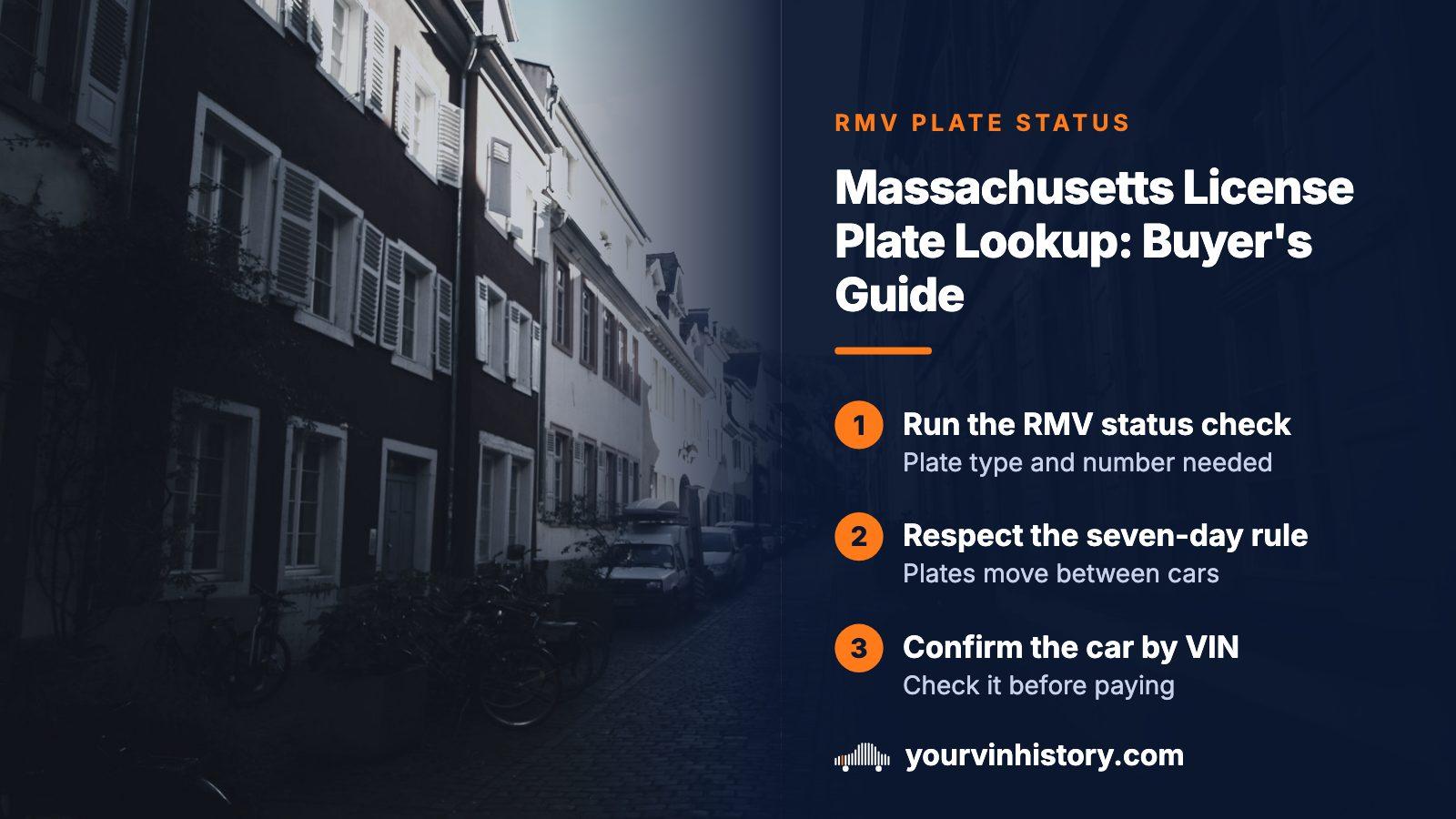
The Massachusetts RMV offers an online status check that takes a plate type and registration number and returns registration status, expiration date, vehicle year, make and model, and the last inspection date and result. Owner names stay off limits unless a permitted use under federal law applies. Plates move between cars under the seven-day transfer rule, so confirm the vehicle by its VIN before paying.
- First plates
- Massachusetts began issuing plates in 1903
- Transfer window
- Until 5 p.m. on the 7th calendar day
- Inspection after a purchase
- Within 7 days of registering
- Owner name
- Protected by federal law
The official plate check and what it returns
The Registry of Motor Vehicles runs the one plate-based lookup worth your time. Enter the plate type and the registration number and it reports on the vehicle's registration, with no fee charged. The RMV words the page for owners checking their own vehicle, so ask the seller to run it beside you or show you the result on a phone.
- Registration status and expiration date, which show whether the car is legal to drive today.
- Year, make and model, to compare with the listing and the title.
- Last inspection date and result, including a failure the seller may not volunteer.
- Insurance information, as the RMV lists it among the results.
Both the plate type and the number are required, so take a clear photo of the plate at the viewing.
Why the owner's name stays private
The Driver's Privacy Protection Act is codified at 18 U.S.C. § 2721, and it bars a state motor vehicle agency from handing out personal information from its records except for listed purposes. The list is narrow: government agencies and courts, insurers working a claim, parties to a lawsuit, towing notices, licensed private investigators acting within those same purposes, and employers verifying commercial drivers. Curiosity about a parked car is not on it.
A site that promises a name for any plate is selling something the statute fences in, and a recipient who resells such data may pass it on only for a permitted use. After a collision or a hit-and-run, give the plate number to the police and your insurer, who have a lawful route to ask.
The seven-day transfer rule, clause by clause
A registered owner who sells or trades one vehicle and acquires another can keep driving while the registration moves across. The terms come from M.G.L. c.90 § 2, and the RMV's own page restates them.
| Condition | What the rule requires |
|---|---|
| Who | A registered owner aged 18 or older who sold, traded or otherwise lost possession of the previous vehicle |
| Which vehicle | A newly acquired one of the same type and with the same number of wheels |
| Plates | The plates from the old registration must be mounted on the newly acquired vehicle |
| Paper in the car | An original bill of sale that names the plate number being moved, or a dealer's certificate of transfer on the registrar's form, standing in for the registration certificate |
| Deadline | 5 p.m. on the seventh calendar day after the transfer |
The cutoff is a clock time, not midnight, so an evening drive on day seven falls outside the window. The RMV counts the seven calendar days from the date the previous vehicle was disposed of.
Buying when you have no plate to move
The grace period belongs only to someone who already holds a registration. The RMV says there is none if you do not currently have a registered vehicle, and that it does not issue temporary registration plates. The statute also ends a registration when ownership changes, so the plates on a car at the viewing are the seller's, not part of the deal. Buyers coming from another state should follow their home state's temporary-registration rules instead of assuming this window applies.
- Buy active insurance through a licensed Massachusetts agent, who completes and stamps the Registration and Title Application.
- Collect the certificate of title with the seller's stated mileage and the printed names, signatures and dates of buyer and seller. If the title has no space for a price, add a bill of sale.
- File at an RMV Service Center, or let an agent or dealer do it for you.
- Leave with a registration certificate, new plates and a year-of-expiration decal for the rear plate. The paper title follows by mail in about 6 to 8 weeks.
The RMV adds that title law calls for titling within 10 days of purchase.
Registration decal and inspection sticker are different things
A Massachusetts car can carry two pieces of evidence, and sellers sometimes blur them. The year-of-expiration decal goes on the rear plate and arrives with a new registration. The inspection sticker comes from the yearly inspection that every vehicle registered in the state must pass at a licensed station.
- A newly purchased vehicle needs its inspection no later than 7 days after it is registered.
- Driving without a valid inspection sticker is a traffic violation that can bring a fine and affect insurance rates.
- Vehicles with onboard diagnostic systems that are under 15 years old must also pass an annual emissions test.
An expired sticker on a car you want is a bargaining point: the seller's problem becomes the first errand on your list.
Reading the sticker month without overreading it
Starting November 1, 2022, each passing inspection produces a sticker showing the month the previous sticker expired, not the month of the test. The month is a fixed annual deadline that follows the car. It does not show how recently the inspection happened, so lean on the status check, which reports the last inspection date and result.
January stickers invite one question
If the previous sticker lapsed during an earlier calendar year, the inspection counts as late and the new sticker reads January of the current year, regardless of the test date. The same outcome applies to a car returning after a year or longer outside Massachusetts with an expired sticker, unless the owner submitted the Out-of-State Inspection Form, which earns a sticker for the month of the test. A January sticker is not a defect. It is a reason to ask where the car has been and why the earlier sticker ran out.
Low number plates and the annual lottery
The RMV awards low number plates through an annual lottery and publishes the list of winners. Winners are notified by mail, have until a stated deadline to pay and swap their plates, and forfeit any plate left unclaimed to the alternates drawn alongside them. Each plate is registered only to the winning applicant named on the application and cannot be transferred to anyone else.
So a short, low-digit plate in a listing photo belongs to the seller's registration, and a lottery plate cannot be bought along with the car. Do not pay extra for it, and plan on new plates in your own name. Other short or inherited registrations may follow different rules, so ask the RMV before treating any plate as part of the price.
Plates since 1903, and what the statute still says
Massachusetts began issuing plates in 1903 and is usually credited with the first state-issued plates in the country. The modern rules still sit in chapter 90 of the General Laws. The registrar furnishes two number plates for each registered motor vehicle, and a plate stays valid only until the expiration date on the registration certificate. Registration fees vary by plate type.
The registrar can also issue distinctive plates, including initial plates whose register number runs to no more than six letters or numbers. Antique and year-of-manufacture plates have a separate application at the RMV.
What happens to the seller's plates after a sale
Because the seller's registration ends with the sale, the seller has two clean options: move the plates to a replacement vehicle under the seven-day rule, or cancel the registration. Cancelling can be done online with a MyMassGov account, unless there are two owners, in which case both sign an affidavit. The RMV does not require plates to come back after cancellation, but it expects them to be recycled or destroyed, and it gives the owner a cancellation receipt to share with the insurer.
Cancelling also stops the annual excise tax bill, which the RMV generates for every active registration. A revoked registration keeps drawing excise until it is cancelled. For a buyer the practical point is simple: if the seller's plates are still on the car at handover, ask what the plan is for them, and do not count on them to cover your drive.
Where the plate stops and the VIN takes over
Registration records describe the registration. They do not hold title brands, damage history or the odometer trail. Salvage and rebuilt brands live on the title and in the national title record, NMVTIS, which is keyed to the VIN, so a clean registration status says nothing about whether the car was ever declared a total loss.
Compare the VIN on the car with the VIN on the title and the application before you sign anything. A yourvinhistory report works from the VIN. It opens with a free preview, and the full report is a one-time purchase covering title brands, accidents with a damage map, odometer readings, liens, theft records and open recalls. Its title records come from ClearVin LLC, an approved NMVTIS data provider.
Where this information comes from
- Massachusetts General Laws: c.90 § 2 — Statute text for the transfer window, the 5 p.m. cutoff, the bill of sale carried in the car and the two plates furnished per vehicle.
- Massachusetts RMV: agency home page — Entry point to registration and title services and to the annual low number plate lottery listing.
- Massachusetts RMV: vehicle inspections — Yearly inspection requirement, the deadline after registering a purchase, and the sticker month and January rules.
- U.S. Code: 18 U.S.C. § 2721 — The federal limit on releasing personal information from state motor vehicle records, with its list of permitted uses.
- Bureau of Justice Assistance: NMVTIS — The national title record that carries brands from reporting states, searched by VIN rather than by plate.
Sources and photos: Facts checked against the sources above in October 2026. Photo by Karwin Luo on Unsplash; diagrams by YourVINHistory.
Keep reading
- License plate lookupThe national rules on what a plate search can legally return.
- MassachusettsThe next step once the plate checks out: running the VIN.
- Massachusetts title checkWhat a Massachusetts title shows about the car you are buying.
- Temporary tagHow driving time on a fresh purchase works in states that do issue temporary tags.
Frequently asked questions
Can I find the owner of a Massachusetts license plate?
Not out of curiosity. Federal law limits what the RMV can release to listed uses such as law enforcement, courts, insurers handling claims and licensed investigators. After a crash or hit-and-run, write down the plate, photograph the scene and report it to the police and your insurer. When buying, compare the name on the title with the seller's photo ID instead.
Is the Massachusetts plate status check free, and what can't it find?
The RMV charges no fee. It needs a plate type and registration number, and it does not cover dealer, manufacturer, repair, farm, owner contractor or transport plates online; those go through the RMV's Section 5 department. Results reflect the registration only, so a car with a spotless status can still carry a salvage brand on its title.
How long do I have to inspect a car I just bought in Massachusetts?
Seven days from the registration date, which can differ from the purchase date. A car that fails gets a reject sticker, and the station hands you a printed inspection report. A failed motorcycle receives no new sticker. If a used car's sticker month looks odd, remember it tracks the previous expiration, so check the actual last inspection through the RMV status tool.
Does a Massachusetts car need a front license plate?
Yes. The registrar issues two plates for a registered motor vehicle, and the display rule calls for one on the front and one on the rear. If only one plate was issued, it goes on the rear where it stays plainly visible. Keep plates clean and legible, and fit nothing that obscures the numbers.
Does cancelling my plates get my excise tax back?
Not automatically. Cancelling stops future bills, but an abatement needs a qualifying reason: you moved out of Massachusetts, reported the vehicle stolen or no longer own it. You apply through your local assessors' office with documentation, and the tax is owed to the city or town where the vehicle is garaged. Unpaid excise can block a license or registration renewal.
Now check the car itself
The guide explains what to look for. The report shows what this VIN has on record.