THE SHORT ANSWER
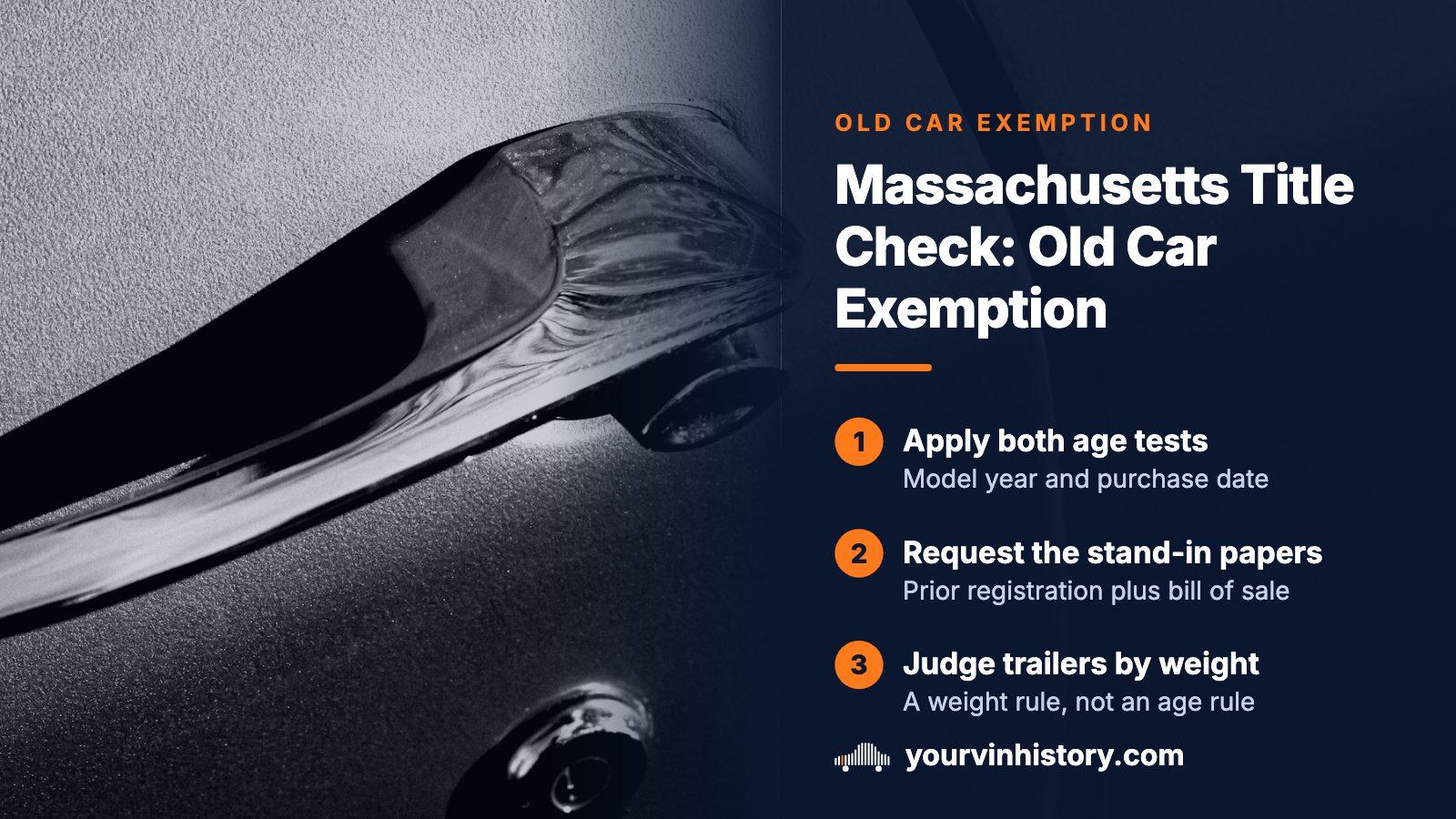
A Massachusetts car can legitimately have no title only if it passes both tests: a 1980 model year or older, and bought before November 26, 1990. Fail either test and a title should exist. For a genuinely exempt car, the earlier owner's registration and a bill of sale serve as the ownership record. Trailers rated at 3,000 pounds or less are exempt by weight instead of age.
- Model year test
- 1980 or older
- Purchase date test
- Before November 26, 1990
- Trailer exemption
- GVWR of 3,000 pounds or less
- Ownership record
- Earlier registration plus bill of sale
An untitled old car can be legitimate, or a problem
A missing title usually ends the conversation with a seller. Massachusetts is different in one narrow case, because its law exempts a set of old passenger vehicles from titling altogether. A seller who says an old car simply has no title may be telling the truth.
The exemption has two parts, and both must hold. The car has to be a 1980 model year or older, and it has to have been purchased before November 26, 1990. Satisfy only one of those and the car sits outside the exemption. The rest of this guide shows how to test both parts against the person selling, which papers stand in for the missing one, and which checks carry more weight when the state record is thin.
Apply both tests to four example cars
Model year comes from the car and its papers. The purchase date comes only from the owner's account and paperwork, which is where stories tend to get fuzzy. Run the model year first, then the date.
| Example car | When it was bought | Exempt from titling? |
|---|---|---|
| 1975 model | Before November 26, 1990 | Yes, both tests are met |
| 1975 model | In 1995 | No, the purchase fell after the cutoff |
| 1981 model | Before November 26, 1990 | No, the model year is one too new |
| 1980 model | A few years ago | No, the model year passes but the date fails |
The 1981 row catches people out. A car can be old enough to feel like a classic and still sit a single model year past the line.
What to ask the seller of an untitled car
If a car really is exempt, its story usually reaches back before the cutoff: a family car, a project that sat in a barn, an estate. Whoever holds one should be able to tell you where it has been. Put these requests to the seller before price comes up.
- Ask for the month and year of purchase, and the name of the person who sold the car to them.
- Ask whether the car came by purchase, by gift or through an estate, and who can confirm that.
- Ask to see the earlier registration before you talk about money.
- Ask whether a certificate of title has ever been issued on the car, even to a former owner.
A purchase date after the cutoff, paired with no title, is the combination to slow down on. Either a certificate exists that nobody has produced, or the account of the date is off.
The two documents standing in for a title
For an exempt vehicle, the ownership record is a pair of papers: the registration issued to the earlier owner, and a bill of sale. On a titled car those would be supporting players. Here they are the evidence, and no central file sits behind them to be reissued if they go missing.
- The registration names the person selling to you, not a friend or relative of theirs.
- The bill of sale is a full document with parties, date, a vehicle description and signatures, not a scrap carrying a dollar figure.
- The VIN or serial number on each page matches the number on the car itself.
Treat a gap in this chain as more serious than a lost title. A lost title can be applied for again. A lost chain of registrations and sales has to be rebuilt from whatever people kept in a drawer.
Trailers follow a weight rule, not an age rule
A separate exemption covers trailers whose GVWR is 3,000 pounds or less. Age has nothing to do with it. A light utility trailer built this year can be sold without a title while the truck pulling it carries one.
GVWR is the maker's stated maximum loaded weight, and it is printed on the plate or label attached to the trailer. Read it before deciding that a missing title means anything. A buyer told that a small trailer's title was lost may be hearing about a document that was never issued. A trailer rated above that weight is outside this exemption, so the seller's claim has to be tested rather than accepted.
Getting an exempt car a title before you buy it
Exempt does not mean unable. The state publishes an application route that gets an exempt vehicle a certificate of title, and the supporting evidence is the same pair of papers: the earlier registration and a bill of sale.
Owners take that route for practical reasons. Lenders want a title to lend against, some buyers will not deal without one, and moving a car to another state goes more smoothly with one in hand. You can use this as a buyer. If the paperwork looks shaky, the cleaner outcome is for the seller to settle it first and hand you a car you can register, rather than leaving the question to you after payment.
Either way, read the RMV's instructions for buying from a private seller before you agree on a price, and ask the agency directly how an exempt car is handled for the next owner.
Liens and brands when no certificate exists
On a titled car, a lender's claim is printed on the certificate, which is why a clean one is reassuring. An exempt car has no certificate to print it on. A financed old car is not likely, since most are low in value and owned outright, but the question is still open. It means the document that would normally answer the question is absent, and you have to look elsewhere.
Brands are the other half. A brand recorded by any reporting state is carried into the national NMVTIS database under the VIN, whatever a Massachusetts document does or does not say. When the state paper trail is thin, that national layer matters more. A yourvinhistory report returns NMVTIS title records through ClearVin LLC, an approved NMVTIS data provider, alongside lien, theft, accident and odometer records.
No certificate means no lienholder line to read
If the seller says the car is paid off, that statement is all you have from the title side. Look for the lien in a separate record and, where the amount at stake is large, ask for a written statement that no one else has a claim.
Recall and theft lookups on a pre-1981 car
Two lookups sit entirely outside the title system: the NHTSA recall search by VIN, and the NICB theft and salvage search. Both are offered at no charge, and both deserve a run even for an exempt car.
Both expect a modern VIN. Cars built before 1981 predate the 17-character format, so a search can come back empty for a car that has a real history. For recalls on a very old car, ask the manufacturer's customer line as well, and do not assume the maker owes a no-cost repair: the federal free-repair rule does not reach very old vehicles.
An empty search is not a clean search
On a pre-1981 serial, no result tells you the database did not recognize the number. It does not tell you the car is clear. Compare the serial on the car, the registration and the bill of sale, and weigh a mismatch heavily.
A buying sequence for a Massachusetts car
Money moves last. Each step below is cheaper to fix while the seller still wants the sale.
- Pin down the model year and the purchase date, in writing if you can. Both tests decide whether a title ought to exist.
- Match the papers to the answer: a certificate of title for any 1981 or newer car, and for an older car whose current owner bought it after the cutoff, or the earlier registration plus a bill of sale for a truly exempt one.
- Compare the serial on every document with the car. A sparse state record makes the serial your first line of defense, and a mismatch is a reason to walk.
- Pull the national title record to see brands recorded by other states.
- Run the NHTSA and NICB lookups, and read an empty result on an old serial with caution.
- Settle the paperwork fix before payment: either the seller obtains a title, or you confirm with the RMV what you will need.
Where this information comes from
- Mass.gov: Vehicle certificate of title — Where the state sets out which vehicles are exempt from titling, including the model year, purchase date and trailer weight conditions.
- Mass.gov: Apply for a certificate of title — The application route an owner follows to obtain a title, and the supporting documents it asks for.
- Mass.gov: Registration and title for a vehicle bought from an individual — What the RMV expects from a buyer in a private sale.
- NMVTIS: Vehicle history — The federal page listing approved providers who supply title and brand information from the national database.
- NHTSA: Recalls — The federal recall lookup by VIN, which works independently of any state title record.
Sources and photos: Facts checked against the sources above in October 2026. Photo by Linus Belanger on Unsplash; diagrams by YourVINHistory.
Keep reading
- Bill of sale for a carA bill of sale carries the weight of a title on an exempt car, so see what a sound one contains.
- Vehicle lien checkWith no certificate to show a lender, learn where else a lien can be found.
- NMVTIS reportThe national record picks up brands that a Massachusetts paper may not show.
- Classic car VIN decoderPre-1981 serials follow no common format, and this explains how to read them.
Frequently asked questions
Does every old car in Massachusetts lack a title?
No. Age alone never removes the requirement. Many old cars carry certificates because their owners bought them after the cutoff, and an owner of an exempt car can still choose to obtain one. Once a certificate exists, read it like any other title: check the owner's name, any lienholder and any brand before you pay.
What if the seller bought the car after November 26, 1990 and has no title?
Treat it as a paperwork problem to solve before payment. The exemption does not cover a purchase after that date, so a title should be part of the picture somewhere. Ask the seller to locate it or to ask the RMV what is needed, and do not pay on a promise to sort it out later.
Can a Massachusetts trailer be sold without a title?
Yes, when its GVWR is 3,000 pounds or less. Read the rating on the maker's label rather than judging by size, because a trailer that looks small can carry a higher rating. Above the weight line the exemption does not apply, so a seller cannot turn a heavier trailer into an exempt one by calling it small.
Will a lender finance a car that has no title?
Many lenders want a certificate of title before they will lend against a vehicle, which is one reason owners of exempt cars pursue one. If you plan to borrow, raise the question with the lender before you agree on a price and ask exactly which documents they accept for an older car.
Does a clean NMVTIS record prove an old car is fine?
No. It shows what reporting sources sent in, mainly title and brand history. It says nothing about rust, past repairs or mechanical condition, and a record on a very old car may be thin. Use it to screen for brands, then pay a mechanic you trust to inspect the car in person.
Now check the car itself
The guide explains what to look for. The report shows what this VIN has on record.