THE SHORT ANSWER
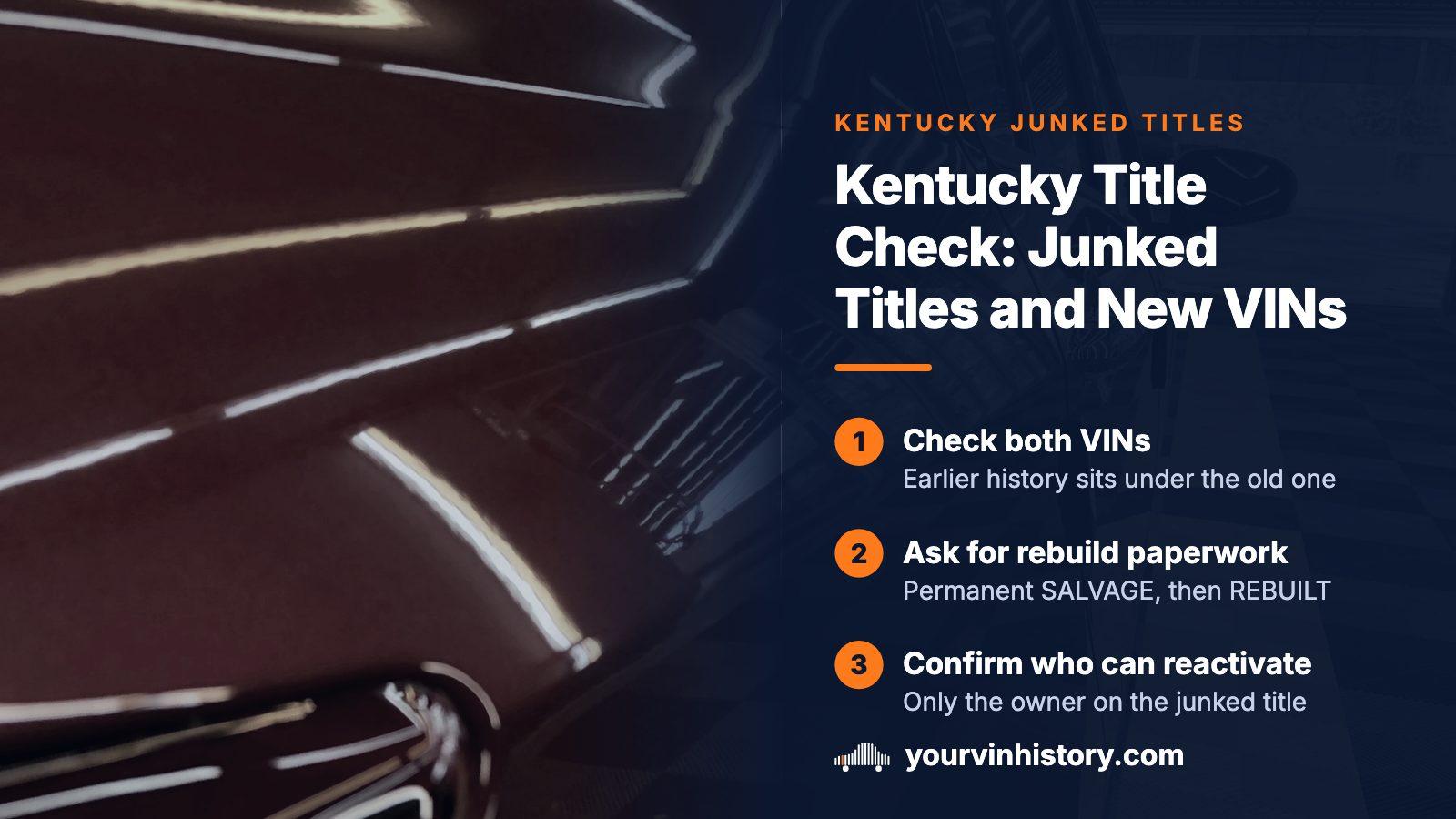
Kentucky lets an owner junk a title, which puts a permanent SALVAGE brand on it. Only the owner named on that title can reactivate it, and the car must then be rebuilt, given a Kentucky-assigned VIN and branded REBUILT for good. Up to five years of taxes may also come due. Because earlier history sits under the old number, check both VINs, ask for the rebuild paperwork and confirm who holds the right to reactivate.
- VIN after reactivation
- Kentucky-assigned, per KRS 186A.090(1)(b)
- Brands
- Permanent SALVAGE, then permanent REBUILT
- Who can reactivate
- Only the owner named on the junked title
- Back taxes
- Up to five years, if owed
Why one Kentucky car can end up with two VINs
A VIN is supposed to be permanent. The manufacturer stamps it at the plant, recall records and most history lookups are keyed to it, and buyers treat it like the car's legal name. Kentucky runs one process that breaks that habit. Under the Transportation Cabinet's junk-title application, a vehicle whose junked title is reactivated has to be rebuilt and then receives a KY-assigned VIN, citing KRS 186A.090(1)(b).
The result is a car with two identities. The factory number may hold the sales, crashes and insurance losses from the car's first life. The assigned number holds only what has been recorded since the rebuild. A buyer who checks just the number on the dash can see a short, tidy record and mistake it for a clean past.
Plenty of Kentucky cars never go near this process. The question applies to vehicles whose titles were junked and later brought back, which is why it is worth asking the seller directly instead of assuming.
What junking does to a Kentucky title
Junking is a deliberate filing that only runs in one direction. The Cabinet's form warns the owner at the very top, ahead of any checkbox, that it applies a permanent SALVAGE brand, that resale value may fall, and that the vehicle may become ineligible for registration in some states.
The form also limits who should be using it. Its stated purpose is a vehicle damaged beyond its resale value that will be kept for parts only or handed to a salvage or junk yard. The owners sign, a notary attests, and a county clerk acknowledges the filing.
For a buyer, the thing to absorb is that the brand records a decision about the title. It does not describe the damage. Learning what actually happened to the car takes records and an inspection, not the brand alone.
What a reactivated car carries afterward
Reactivation is not a reversal. According to the form, a reactivated vehicle must go through the rebuilding process, take a KY-assigned VIN and carry a permanent REBUILT brand. Both brands are described as permanent, so the second one adds to the first instead of erasing it.
| Stage | Brand on the title | Identifying number |
|---|---|---|
| Ordinary Kentucky title | None from this process | Manufacturer's VIN |
| After the title is junked | Permanent SALVAGE | Manufacturer's VIN |
| After reactivation and rebuild | Permanent REBUILT | Kentucky-assigned VIN |
Read the last row as a prompt to ask which route the car took. The form ties the assigned number to reactivating a junked title specifically, so a REBUILT brand by itself does not prove the VIN was replaced.
How an assigned number skews a lookup
Run a standard lookup on an assigned VIN and the output can look oddly thin: few events, no old sales, nothing alarming. That quiet reflects a young number, not a calm history. Silence from a database is a gap in coverage. It is not a finding.
Recall checks share the weakness. Manufacturer recall records are organized around the number the factory stamped, so a state-issued number may match nothing there. NHTSA's lookup is still worth running because it costs nothing, but a no-recalls answer on an assigned number deserves less trust than the same answer on a factory number.
The fix is to collect the original VIN and search it as well. Ask the seller for it, and ask to see the rebuild paperwork, which is built around the original salvage title. A seller who cannot say what the car's number used to be has told you something about the deal.
Only the named owner can reopen the title
The form is blunt about this. Reactivation is open to one person: the owner named on the junked title. Having the car, a bill of sale or a handshake does not substitute.
That makes a junked Kentucky project car a different kind of purchase than it looks. The route back to a drivable, titled vehicle runs through the person whose name is on the junked title. If that person has moved, cannot be found or has no interest in helping, the form offers no workaround, and a buyer should not assume the county clerk has one.
Before any money moves, ask who is named on the junked title, whether that person is the seller, and whether that person is willing to cooperate. Get the answers in writing.
Back taxes belong in the price
Reactivation has a financial tail. The form warns that taxes for as many as five years can come due when they are owed. That condition matters, because the bill depends on the car's history, but on a vehicle that sat on a junked title for years the amount could add up.
When you price a junked Kentucky project, count four lines instead of two:
- The purchase price you are being quoted
- Parts, labor and the receipts that must accompany them
- Back taxes, up to five years' worth if owed
- The time spent on notarized forms and clerk visits
The first two are the visible costs. The third is the easiest to forget because it never appears in the listing.
Four cases where junking is the wrong tool
The Cabinet's form carries clerk instructions, and each one amounts to a refusal. A title must not be junked in any situation below, and each has its own correct filing.
| If this is true | The form says to do this instead |
|---|---|
| An insurer has taken over the vehicle after paying a claim | Transfer ownership to the insurer |
| The vehicle is damaged and a salvage or junk yard will take it for parts or rebuilding | Sign the vehicle over to the salvage or junk yard |
| The vehicle was sold but the transfer was never completed, leaving a tax liability | File an incomplete transfer |
| The owner still has the vehicle but no longer drives it | Leave the title alone; the owner keeps paying taxes until the car is out of their hands |
That final case catches ordinary owners. Filing to junk a title just to end the tax bill on a parked car permanently brands a vehicle that may never have been damaged. If a Kentucky car with a SALVAGE or REBUILT brand looks undamaged and comes with a thin story, ask the seller how the brand got there.
The paper trail a proper rebuild leaves
Kentucky's rebuilt-title process runs on documents, which helps a buyer, because a careful rebuild leaves something to ask for. The state's DRIVE site lists these items:
- TC 96-215, an affidavit that the vehicle was assembled from wrecked or salvaged vehicles, which must be notarized
- TC 96-182, the application for a Kentucky title and registration, also notarized, with copies not accepted
- TC 96-353, a statement describing the repairs carried out on the vehicle
- The original salvage title, or for a car from a registration-only state, the original registration
- Original receipts for parts, including each private seller's name, address and phone, plus the VIN of every donor vehicle or a notarized explanation when it is unavailable
- A lien termination statement, if a lien was recorded
Two conditional items round it out. An insurer's letterhead statement describing the damage is needed when the vehicle was not damaged beyond 75% of its current value, which usually means minor fire, flood, theft recovery or hail; an auction receipt stating the damage can stand in for a car bought at auction. For a vehicle under 10 years old, a federal odometer disclosure statement is required when the mileage is missing from the application or from a properly completed title.
Checking a Kentucky car, in order
Work through these steps, and repeat the lookup steps for every VIN the car has worn.
- Ask whether the VIN is state-assigned, and get the original number if it is.
- Run the NHTSA recall lookup on each number. It is a free federal tool and takes seconds.
- Search each number in the NICB's free VINCheck for theft and salvage records.
- Pull the NMVTIS title record for each number, since reported title brands and total losses live there.
- Ask for the rebuild packet described above and compare its donor VINs and repair statement against the car itself.
- If the title is still junked, confirm who is named on it and whether that person will reactivate.
- Have an independent mechanic inspect the car before you commit.
A paid report is one way to get the NMVTIS record. A yourvinhistory report draws its title records from ClearVin LLC, an approved NMVTIS provider, and a free preview comes first. Whichever provider you use, ask whether the report ties an assigned number to the original one, and do not assume it does.
Where this information comes from
- Kentucky Transportation Cabinet: Application to Junk a Vehicle Title (TC 96-351) — Source for the permanent SALVAGE brand, owner-only reactivation, the KY-assigned VIN, the REBUILT brand, the tax warning and the cases where junking is refused.
- Kentucky DRIVE: Rebuilt and Salvaged Titles — Lists the documents a rebuilt title needs: affidavit, application, repair statement, parts receipts, damage statement and odometer disclosure.
- U.S. Department of Justice: NMVTIS vehicle history — The federal page that lists the approved providers of NMVTIS title and total-loss reports.
- NHTSA: Recalls — Federal recall search by VIN, worth running on every number a Kentucky rebuilt car has carried.
Sources and photos: Facts checked against the sources above in October 2026. Photo by Clarence Tioh on Unsplash; diagrams by YourVINHistory.
Keep reading
- KentuckyCovers the state's own lookups and the sheriff's VIN reading on imported cars.
- What is a rebuilt title?Explains how a rebuilt brand affects value, coverage and loans.
- NMVTIS reportShows what the federal title record contains and how to read it.
- Salvage title VIN checkFollows salvage brands as a car crosses state lines.
Frequently asked questions
Does a junked Kentucky title mean the car was badly wrecked?
Not necessarily. The SALVAGE brand records that the owner filed to retire the title, and the Cabinet's stated reason is damage beyond resale value, but the form also lists situations where clerks must refuse the filing. The brand does not describe what happened to the car. Pair it with an accident record and a hands-on inspection.
How can I tell whether a Kentucky VIN was assigned by the state?
The official pages used for this guide describe no public flag for it, so start with the seller and the paperwork. A REBUILT brand alone does not settle it, because the form ties the assigned number to reactivating a junked title. Ask which route the car took, request the original number, and compare it with the rebuild packet.
Can I rely on a free NHTSA recall search for a Kentucky-assigned VIN?
Run it, but treat the result as incomplete. NHTSA's lookup is free and searches by VIN, yet manufacturer recall records follow the number stamped at the factory. A state-issued number may return nothing even when the model has open recalls. Search the original VIN too, and compare both results before reading silence as good news.
Who pays the back taxes when a junked Kentucky title is reactivated?
The form says only that taxes for as many as five years may come due, when owed. It does not say how a buyer and seller should divide the bill, so settle that before you pay for the car. Put the agreement in writing, and ask the county clerk's office what is actually owed on the vehicle rather than guessing.
What if the seller of a rebuilt Kentucky car has no parts receipts?
Ask where they went. The DRIVE site says the Rebuilt Section initials applicant-supplied invoices for the parts used and returns the originals, so a seller may legitimately hold paper. An empty folder on a car the seller claims to have rebuilt is a reason to press for donor VINs, or to walk away.
Now check the car itself
The guide explains what to look for. The report shows what this VIN has on record.