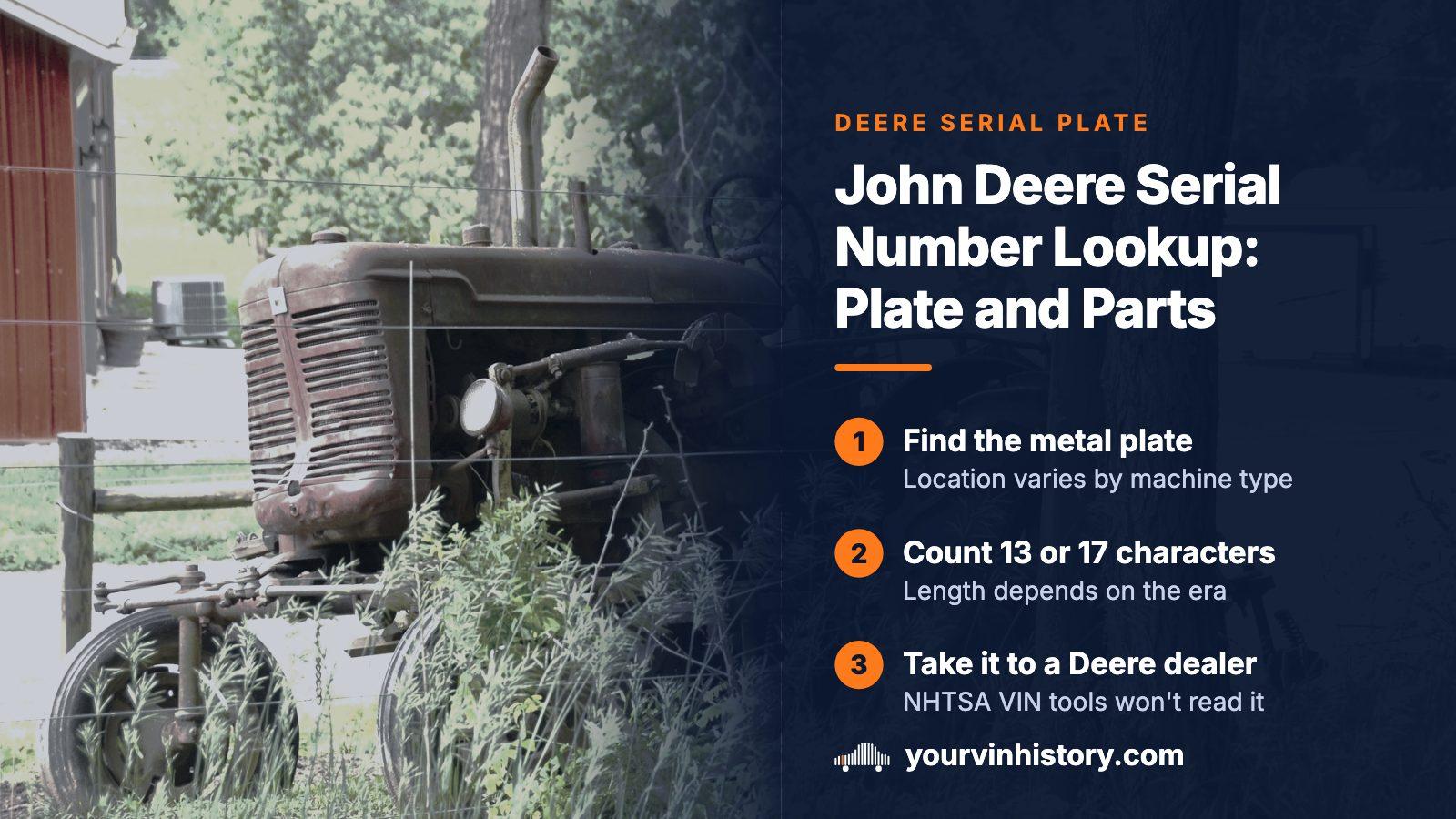
THE SHORT ANSWER
Look for the metal identification plate on the machine's frame: tractors commonly carry it on the right side or under the cab, mowers under the seat or on a frame rail, and compact loaders in the cab. Photograph it, then take the number to a Deere dealer or the manufacturer's parts system, because NHTSA's VIN tools were not built for this equipment. For recalls, search the Consumer Product Safety Commission and ask the dealer about service campaigns.
- Plate location
- On the frame, and it varies by machine type
- Length
- 13 or 17 characters, depending on the era
- Recall source
- CPSC, plus dealer service campaigns
- Who can read it
- Deere's own parts and service systems
Why a VIN decoder returns nothing for a Deere
Type a Deere serial into a public VIN decoder and the page comes back empty. The decoder is working as designed. NHTSA describes its vPIC tool as built for regulated vehicle types, and a tractor, mower or skid steer is not one of the road vehicles that tool was made to read.
The number on a Deere machine is a product identification number. Deere assigns it under its own scheme, records it in no public registry, and keeps the key to it inside its own parts and service systems. A dealer can read it. A generic website cannot.
An empty result says nothing about the machine
A failed decode points to the wrong tool, not a bad machine. Do not read it as a sign that the number was altered or that the seller made it up.
Thirteen characters or seventeen: what the length means
Plates have not always looked the same. Older machines commonly carry a shorter identifier, often 13 characters. Newer ones tend to use 17, which happens to be the count on a real VIN and invites the wrong conclusion.
Length does not settle what you are holding. The type of machine does. A tractor with a 17-character plate still carries an equipment number, and a failed decode on it does not mean the plate is fake.
| On the plate | What it is | Where it gets read |
|---|---|---|
| 13 characters, older machine | Equipment number from an earlier scheme | Deere dealer or the manufacturer's parts site |
| 17 characters, newer machine | Equipment number that only resembles a VIN | The same dealer or manufacturer parts system |
| 17 characters, road-legal utility vehicle | A genuine VIN | Public VIN decoders work normally |
That last row is the exception worth knowing. Where a machine really does carry a VIN, a vehicle history report by VIN can add title brands, accidents, odometer readings and open recalls to whatever the dealer tells you.
Finding the plate, machine by machine
Deere fixes a metal identification plate to the machine's frame, by rivets or adhesive. Where it sits depends on what kind of machine you have, and you should expect to wipe off dirt before you can read a single character.
- Utility and compact tractors: usually on the frame's right-hand side, under or behind the cab, on the transmission housing, or on a rail close to the front axle.
- Riding mowers and lawn tractors: beneath the seat (tilt it up first), on the rail under the operator's platform, or toward the back of the frame.
- Skid steers and compact loaders: in the cab, on the main frame beside the door opening, or at the back of the machine.
- Excavators and larger machines: the main frame near the cab steps, frequently with a second copy inside the cab.
- Attachments and implements: each has its own serial on its frame, so write those down apart from the machine's.
Brush it, then photograph it
Plates spend their lives in mud and weather, and they rust or disappear under paint. A wire brush and a phone photo are safer than a hand-copied number with one wrong character, and parts orders will keep asking you for it.
The engine has a number of its own
A Deere machine is identified twice: once for the chassis and once for the engine. The engine number is stamped into the block or printed on a separate plate, and an engine parts catalog asks for that one, not the machine's.
Record both on the day you buy. Quoting the machine serial for engine parts may get the right part on some models and the wrong one on others. The engine number also lets a dealer see whether the engine in front of you is the one the machine left the factory with, which matters when a seller mentions a swap or a rebuild.
Why the parts counter asks for the serial before the model
This is the practical reason the number matters more on a tractor than a VIN does on a sedan. Manufacturers change components partway through a production run without changing the model name, so two machines with the same model and the same year can need different parts.
Parts catalogs cope by splitting into serial ranges. Search by model alone and the result carries warnings. Search by serial and you get the parts that fit the machine in your yard.
- Quote the serial when you order, not the model and year.
- Keep a photo of the plate on your phone, not only on the machine.
- Put the engine number in the same note.
- Keep attachment serials there too.
- On a used machine, ask whether parts are still supported for that serial range.
What a dealer can confirm from the number
The serial is the key to what only the manufacturer's systems hold: the build year, the factory configuration, the warranty status and any open service campaign. The parts or service counter at a Deere dealer can run it for you.
- Ask the seller for sharp photos of the frame plate and the engine plate. A seller who will not send them has told you something.
- Call a dealer's parts or service department and read out the serial.
- Ask for the build year and the factory configuration, and hold both against the listing.
- Ask about warranty status.
- Ask whether any service campaign is outstanding for that serial.
If the answers disagree with the ad, you learn that before you spend a day and a tank of fuel on the drive.
Where recalls for a Deere come from
Off-road equipment is handled as a consumer product, not a motor vehicle, so recalls for it generally come from the CPSC, short for the Consumer Product Safety Commission. Searching NHTSA's database turns up nothing whether or not a recall exists, which makes it useless for this job.
The CPSC recall page lets you filter by product category. Its category list includes tractors, garden tractors, riding and rotary lawn mowers, snow throwers and chain saws, so search under the one that matches your machine. Not every machine will sit in those lists, which is one more reason to call the dealer.
Deere's own service campaigns and improvement programs are a separate list. They often never appear in any federal database, and the dealer finds them by running the serial.
Check both lists
A clear CPSC search followed by a skipped dealer call leaves half the question open. The reverse is just as incomplete.
The hour meter stands in for the odometer
Wear on a Deere is counted in engine hours, and the hour meter is the most informative single number on the machine. Treat it as you would mileage on a car with no disclosure rules behind it: useful, unverified, and worth testing against what you can see. Meters fail, get replaced and sometimes get tampered with.
- Ask whether the meter is original and whether it was ever replaced.
- Compare the hours with wear on the pedals, seat, controls and linkage.
- Find out what work the machine did, since light residential mowing ages a machine differently than daily commercial use.
- Line up the service records with the hour readings and see whether dates and numbers agree.
- Ask when the last major service interval was performed.
Titles are uncommon, so the bill of sale carries the weight
Few states issue titles for off-road equipment, so ownership usually rests on a bill of sale plus the serial number. A car buyer is used to a title doing that job. Here, a document you write yourself matters more than anything the state hands out.
- Put the machine serial, the date, the price and both parties' details on the bill of sale.
- List each attachment on its own line with its own serial.
- Ask for the original dealer invoice if it still exists.
- Ask in plain words whether anything is financed on the machine.
- Look up your state's rules, because a minority register certain classes of equipment.
- Keep the paperwork for as long as you own the machine.
Financing is common on equipment, and a lien can outlast a private sale. A seller who cannot give a straight answer about a loan should make you cautious.
Theft, tampered plates and why the photo matters
Machines are left in unfenced yards and at work sites, they hold real value, and often no title exists to prove who owns one. A theft report that lacks the serial gives police almost nothing to search for. The number is what makes recovery possible.
- Photograph every plate on every machine you own and store the pictures away from the machine.
- On a machine you are buying, look at the plate for grinding, fresh rivets, a mismatched finish or an odd fit.
- Compare the seller's name with any paperwork that exists, and treat a mismatch as a stop sign.
- Treat a machine offered cheaply with no paperwork at all as a warning.
- Consider an equipment theft registry for your own machines.
NICB's VINCheck is built around vehicles, so it earns a run only when a machine carries a genuine VIN. For a standard Deere plate, a hands-on inspection and the dealer's records do the work.
Where this information comes from
- CPSC: Recalls — The search page where recalls on consumer and off-road machines are published, filterable by product category such as tractors and riding mowers.
- NHTSA: vPIC VIN decoder — Shows the limits of the public decoder, which is meant for regulated vehicle types and is the right tool only for a road-legal machine with a true VIN.
- NICB: VINCheck — A theft lookup centered on vehicles, useful here only if the machine carries a genuine VIN.
Sources and photos: Facts checked against the sources above in October 2026. Photo by Roger Starnes Sr on Unsplash; diagrams by YourVINHistory.
Keep reading
- PolarisAnother off-road brand where recalls come from the CPSC rather than NHTSA.
- Semi trucksA second case where the engine carries a serial separate from the chassis.
- Bill of sale for a carWhat a bill of sale should list when no title backs the sale.
- How to read a VINHow the real 17-character VIN is built, for the road vehicles that carry one.
Frequently asked questions
Can I look up a John Deere serial number online?
Not in any public database. Vehicle decoders cannot read it, so the realistic routes are a Deere dealer's parts or service department and the manufacturer's own parts system. Parts catalogs will ask for the serial before they show which components fit. If you are shopping at a distance, send the dealer the characters from the plate photo.
How do I find out what year my John Deere was built?
Ask a dealer to run the serial. The 13-character and 17-character schemes differ, so guessing the year from the digits invites mistakes. The dealer can return the build date together with the factory configuration, which lets you compare both against what the seller advertised before you commit to a trip.
Will an NHTSA search show a recall on a John Deere riding mower?
No. NHTSA deals with motor vehicles, and a riding mower is not one. Search the Consumer Product Safety Commission's recall page by category instead, such as lawn mowers or tractors, then ask a dealer about service campaigns tied to your serial. Only the second step catches manufacturer programs that never reach the federal lists.
Do I need a title to buy a used John Deere tractor?
Usually not, because off-road equipment is generally personal property proved by paperwork rather than a state title. Check your own state anyway, since a minority register some classes. Whatever the answer, insist on a detailed bill of sale that lists the machine serial and each attachment, and ask about financing before any money changes hands.
What should I photograph before I buy a used Deere?
Take the frame plate, the engine plate, any attachment plates and the hour meter reading. Add wider shots of the area around the plate so you can judge whether it has been ground, re-riveted or repainted. Keep the pictures with your bill of sale, since they start any parts order and any theft report later.
Now check the car itself
The guide explains what to look for. The report shows what this VIN has on record.