THE SHORT ANSWER
Read the first three characters. NHTSA files International prefixes under International Truck and Engine Corporation, International Motors, LLC and Navistar Canada, Inc. The prefixes 1HP, 1HS, 2HP, 2HS, 3HR, 3HS, 93M and 93S are typed Truck, 93V is typed Bus, and 1HT, 1HV, 2HT, 2HV, 3HT and 3HV are typed Incomplete Vehicle, meaning a chassis awaiting a body. NHTSA's vPIC decoder returns what it holds at no charge, with no accident, title, lien or mileage data.
- Bus prefix
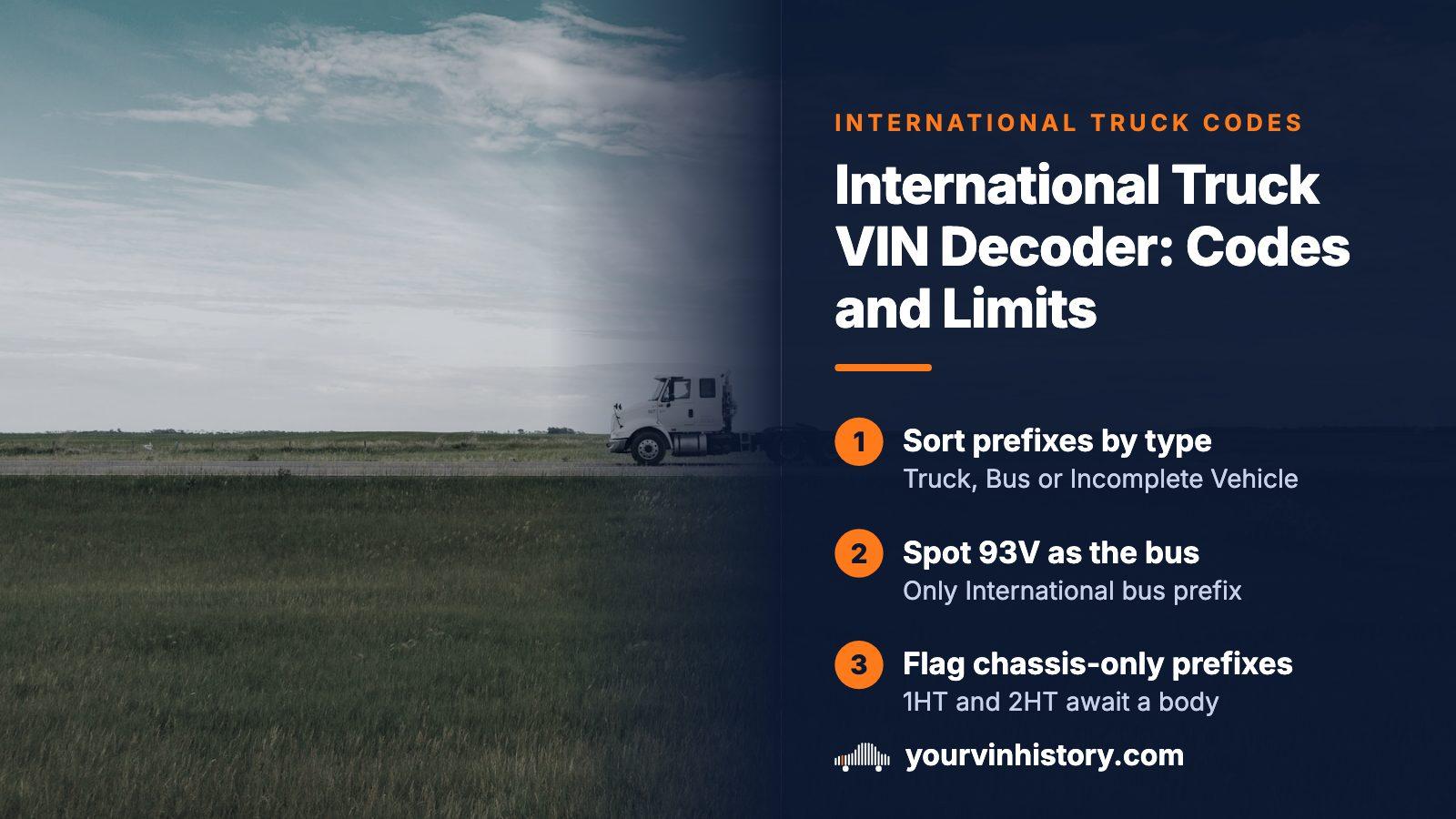
- 93V is the only International prefix typed Bus
- Chassis-only prefixes
- 1HT, 1HV, 2HT, 2HV, 3HT and 3HV are typed Incomplete Vehicle
- Canadian prefixes
- 2HP, 2HS, 2HT and 2HV, filed under Navistar Canada, Inc.
- Decoder cost
- NHTSA's vPIC is public, with no account needed
The International prefixes in NHTSA's register
The first three characters of a 17-character VIN are the world manufacturer identifier, or WMI. NHTSA keeps a register of them, and its public decoder, vPIC, takes the vehicle type straight from that register, from the prefix alone. A search under International's names, plus Navistar Canada, returns the truck, chassis and bus prefixes below. The register gets revised, so confirm any prefix in vPIC itself.
| Prefix | Registered to | Typed as | Country listed |
|---|---|---|---|
| 1HP, 1HS | International Motors, LLC | Truck | United States |
| 1HT, 1HV, 1HA, 7GZ | International Motors, LLC | Incomplete Vehicle | United States |
| 3HR, 3HS | International Motors, LLC | Truck | Mexico |
| 3HT, 3HV | International Motors, LLC | Incomplete Vehicle | Mexico |
| 2HP, 2HS | Navistar Canada, Inc. | Truck | Canada |
| 2HT, 2HV | Navistar Canada, Inc. | Incomplete Vehicle | Canada |
| 93M, 93S | International Truck and Engine Corporation | Truck | Brazil |
| 93V | International Truck and Engine Corporation | Bus | Brazil |
Two patterns show up. The 1H, 2H and 3H families come in pairs, a truck code and an incomplete-vehicle code. The three 93 prefixes are the odd group out, listed for Brazil, with one of them typed as a bus.
93V, the one prefix typed as a bus
Among everything in that table, 93V is the only entry typed Bus. Its neighbors 93M and 93S share the registered company, and the register lists Brazil for all three. A VIN that starts with 93V comes back from the decoder as a bus whatever else it says.
Do not read more into it than that. The type belongs to the prefix, not to the vehicle in front of you, and a school bus does not need a 93V VIN to be a bus. The make list attached to International's prefixes runs from International itself to IC Bus and Workhorse, so a bus is not guaranteed to decode as one.
Incomplete vehicle: the VIN that covers only the chassis
Federal rules define an incomplete vehicle as a chassis, meaning frame, power train, steering, suspension and brakes, that still needs further manufacturing before it counts as a completed vehicle. Prefixes typed that way mark International chassis sold to another company to finish, which is how bodies of every kind end up on them.
The company that completes the job is the final-stage manufacturer, and it attaches its own certification label. That label gives its name, the month and year the work was finished, the weight rating, the axle ratings, the VIN and the type of the vehicle, such as truck or bus. The chassis builder normally attaches a smaller label with its own name, date and weight rating.
Compare the two types
Incomplete Vehicle from the decoder beside truck or bus on the label is normal. A decoder that says Bus next to a label that says truck, or the reverse, is the kind of mismatch to raise with the seller before any money moves.
Three company names for one family of prefixes
The register does not use a single name. The 1H, 3H and 7GZ prefixes are filed under International Motors, LLC, the 2H prefixes under Navistar Canada, Inc., and the 93 prefixes under International Truck and Engine Corporation. On the 93 and 2H records a parent-company field names International Motors, LLC, so the three names describe one family rather than rivals.
The make list on those records is longer than the badge: Navistar, Caterpillar, IC Bus, Workhorse and International. A search on Navistar also turns up Navistar Defense, LLC, which has its own truck prefix, 7NA. Look for recall notices, parts catalogs and build records under every one of those names, and do not treat a listing that says Navistar as a different truck from one that says International.
The first character points to the country of build
The first character of a VIN is a region code. Under the international scheme, 1, 4 and 5 stand for the United States, 2 for Canada and 3 for Mexico, which is why Navistar Canada's prefixes start with 2 and International's Mexican ones with 3. The 93 prefixes sit outside North America, and the register lists Brazil for them.
The decoder also reports a plant country, the country of the plant where the manufacturer affixes the VIN. A truck assembled in Canada or Mexico is nothing to worry about on its own. It can change where build records are held and which dealer network can pull them years later.
What a federal decode returns on a heavy truck
NHTSA's decoder reports make, model, model year, body class, engine maker and model, plant country and a weight class. For buses it adds length, floor type and bus type when those were filed. No account is needed. The model year is read from the 10th character unless you type a year in, and then the decoder repeats your year even if the VIN says otherwise, so leave that box empty.
Read the messages too. The decoder flags a ninth-position check digit that fails to calculate, which can mean a typo or a VIN worth questioning. For some prefixes it answers that no detailed data is available and gives little beyond the manufacturer, the model year and the type. Blank fields are not a clean bill of health. Also, vPIC is built for the 17-character format, so older trucks may not decode.
Weight class, the field a listing gets wrong
Gross vehicle weight rating is the maximum operating weight of the vehicle, counting chassis, body, engine fluids, fuel, accessories, driver, passengers and cargo, but not a trailer. It is a rating, so it says nothing about what the truck weighs today. The decoder shows it as a class, such as Class 6 or Class 8, with a pound range beside it.
That class settles a familiar argument in listings, because a seller who calls a truck medium duty can be checked in under a minute. Remember where the number comes from. The decoder works from patterns the maker filed for the chassis, while the label on a finished truck carries the rating the final-stage manufacturer gave that build. If the two differ, note it and ask which one the registration uses.
Recalls on a chassis that carries someone else's body
NHTSA's recall lookup answers a narrow question: does this VIN have an unrepaired recall from certain manufacturers. NHTSA says the search will not show repaired recalls, recent announcements whose VINs are not all identified yet, recalls more than 15 years old unless the maker offers more coverage, recalls by small manufacturers and specialty applications, non-safety campaigns, or recalls involving an international vehicle. On a bus or a bodied truck, a clean result covers less than it appears to.
- Run the chassis VIN through the NHTSA lookup and save the result with the date.
- Read the certification label to learn who completed the vehicle, then ask that company about its own campaigns, which may be filed under its identification rather than the chassis VIN.
- For a bus, look up the operator too: FMCSA publishes safety information on bus companies, searchable by USDOT number or company name.
Where the maker owes the repair, the owner is not billed, but that duty has an age limit. On an older chassis, ask the manufacturer in writing what it will cover before you count on any repair at no cost.
What no decode will tell you
A decode describes how the chassis was specified at the factory and stops there. It reports no accident damage, no title brands, no liens and no mileage.
Mileage deserves a second look. Federal odometer rules let a seller skip the mileage disclosure on a vehicle above a set weight rating, and on vehicles old enough by model year, so a heavy truck may never have had a formal reading written down at any sale. Ask for engine-hour data where the truck records it and for dated service records, and treat the dash reading as unverified.
Other records live elsewhere. NICB's VINCheck covers theft and salvage records at no charge, and NMVTIS holds the national title record through approved providers. A vehicle history report built on those sources shows title brands, odometer readings, salvage and auction records, liens and open recalls for the VIN. The preview is free and the full report is a one-time purchase, so look at what comes back for a commercial unit before paying.
A buyer's order of operations
- Photograph the certification label, the chassis information label and any body builder's plate before you talk price.
- Decode the chassis VIN with the model year left empty, then compare make, plant country and weight class with the labels.
- Check that the vehicle type from the decoder and the type on the label do not conflict.
- Run the NHTSA recall lookup, then phone the body builder and a dealer about campaigns it will not show.
- Run VINCheck for theft and salvage, then pull the title record.
- Ask for dated service records and, on a bus or work truck, the previous operator's USDOT number.
Anything that fails at the second or third step is a reason to stop there.
Where this information comes from
- NHTSA: vPIC VIN decoder and manufacturer register — Source for each prefix, its registered company, its vehicle type and the fields a decode returns.
- NHTSA: Check for Recalls — Explains what a VIN recall search shows and the cases it leaves out, including older and specialty vehicles.
- FMCSA: Federal Motor Carrier Safety Administration — Agency page for truck and bus operators: DOT number registration, hours of service and a lookup of bus company safety information.
Sources and photos: Facts checked against the sources above in October 2026. Photo by Peter McCrae-Hokenson on Unsplash; diagrams by YourVINHistory.
Keep reading
- Semi trucksThe other serial numbers a heavy truck carries besides the VIN.
- FreightlinerAnother chassis maker whose frames end up under bodies built by others.
- RVs and motorhomesThe same chassis-and-body split, seen from the coach side.
- Recall check by VINHow a VIN recall search works and where it can come back clean by mistake.
Frequently asked questions
What does a 93V prefix mean on an International VIN?
NHTSA files 93V under International Truck and Engine Corporation with a vehicle type of Bus, and lists Brazil as the country. The decoder will show Bus for any VIN that begins with it, even when little else is on record. It does not follow that every International school bus carries this prefix, so check the certification label on the vehicle itself.
Are Navistar and International the same company?
In NHTSA's register they belong together. The prefixes 2HP, 2HS, 2HT and 2HV are filed under Navistar Canada, Inc., and the parent-company field on those records names International Motors, LLC. Navistar Defense, LLC appears separately with its own truck prefix, 7NA. When you request recalls, parts or build records, give both names to whoever you are asking.
Can I decode an International VIN for free?
Yes. NHTSA's vPIC decoder is public, takes no account and charges nothing. Type the VIN and leave the model year blank so the tenth character decides it. Watch for the check-digit warning and for a notice that no detailed data is available, which leaves the result sparse. Trucks from before the 17-character format will not decode.
Why does my International decode as an incomplete vehicle?
The prefix is typed that way because International sold the chassis for someone else to finish. Federal rules call the finishing company the final-stage manufacturer, and its certification label, not the decoder, names the finished vehicle's type, completion month and year, weight rating and axle ratings. A box, dump or bus body is a normal reason for the type, not a defect.
Do I get an odometer disclosure when I buy a heavy International truck?
Often not. Federal odometer rules exempt vehicles above a set weight rating, and vehicles old enough by model year, from the seller's mileage statement. Because a disclosure may not exist, ask for dated service records, inspection paperwork and engine-hour readings where the truck records them, then compare those against the dash reading.
Now check the car itself
The guide explains what to look for. The report shows what this VIN has on record.