THE SHORT ANSWER
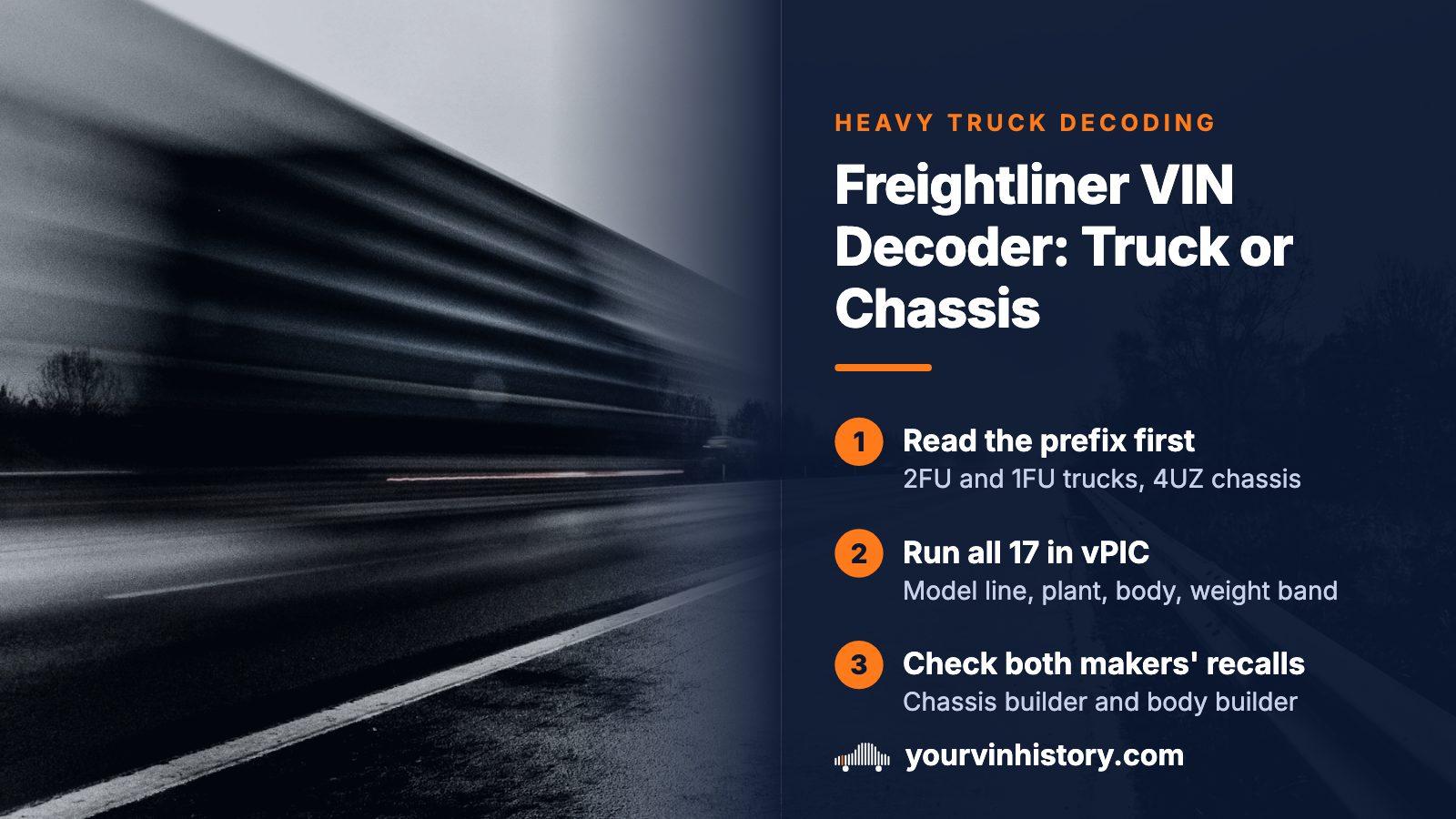
Enter all 17 characters into NHTSA's vPIC decoder, which is public and costs nothing. On a heavy Freightliner the result usually gives the model line and year, the plant country, the body class, a weight band and often the engine. Check the prefix first: 2FU and 1FU mark trucks, while 4UZ marks an incomplete vehicle, the chassis a coach builder finishes.
- Truck prefixes
- 1FU, 2FU, 3AK, AFV, KFB, RSB
- Class 8
- 33,001 lb and above
- Chassis prefix
- 4UZ, listed as an incomplete vehicle
- Federal decode
- Public and free at NHTSA vPIC
Read the first three characters before anything else
The opening three characters of a VIN make up the world manufacturer identifier, usually shortened to WMI. With most brands that code names a company and little more. Freightliner is different, because the maker registers separate codes for vehicles it finished and vehicles it did not.
A truck code means the factory delivered a complete vehicle. An incomplete-vehicle code means Freightliner shipped a rolling chassis, and a second company built everything above the frame. Work out which kind of code you have and the rest of the decode makes sense. Skip the step, and a result that describes a different kind of vehicle than the one in front of you can look like a mistake in the database.
Freightliner prefixes as NHTSA lists them
These rows come from the manufacturer records behind vPIC. The first three are registered to other Daimler entities but carry the Freightliner make. The remaining eight are what a search under the Freightliner name returns.
| Prefix | Registered to | Type |
|---|---|---|
| 1FU | Daimler Truck North America LLC | Truck |
| 3AK | Daimler Vehículos Comerciales México S. de R.L. de C.V. | Truck |
| 1FV | Daimler Truck North America LLC | Incomplete vehicle |
| 2FU | Freightliner Corporation | Truck |
| AFV | Freightliner Corporation | Truck |
| KFB | Freightliner Corporation | Truck |
| RSB | Freightliner Corporation | Truck |
| 4UZ | Freightliner Custom Chassis Corp. | Incomplete vehicle |
| 2FV | Freightliner Corporation | Incomplete vehicle |
| 3FF | Freightliner Corporation | Incomplete vehicle |
| RSA | Freightliner Corporation | Incomplete vehicle |
The 1FU and 1FV rows are the easy ones to miss. A lookup by manufacturer name returns only the last eight entries and leaves them out, yet the leading 1 points to U.S. assembly. If the VIN you are holding starts with a prefix that is not among those eight, that alone is no warning sign.
Why a motorhome can carry a Freightliner VIN
An incomplete vehicle is a chassis: frame, axles, engine and drivetrain, steering and brakes, but no finished body. The 4UZ prefix belongs to Freightliner Custom Chassis Corp., and the companies that buy what it makes are coach builders, bus makers and outfitters of delivery vans and service bodies.
The finished vehicle ends up with another company's name on the outside, while the VIN keeps describing what Freightliner built. That is the usual reason a decode looks plainer than the vehicle parked next to you. NHTSA's record for 4UZ also lists a second make, Mitsubishi Fuso, so read the make field on a chassis decode rather than assuming it.
Two manufacturers, two sets of paperwork
Federal rules for vehicles built in stages ask the chassis maker to supply an incomplete vehicle document, and the company that completes the vehicle to attach its own certification label. Both papers carry weight ratings. When they conflict, the final-stage label describes the vehicle you are actually buying.
- Recalls can come from either company and are filed separately, so a clean result under one name says nothing about the other.
- The ratings printed on the final label take precedence over those on the chassis paperwork.
- Service is often divided: drivetrain and chassis work at a truck dealer, the living space or passenger body with the builder.
- Only the chassis company is named in the first three characters of the VIN.
When you look at a coach, ask the seller which of these documents came with it.
What the federal decoder returns on a heavy truck
NHTSA's vPIC holds the decoding rules that manufacturers file for vehicles sold in the United States, and commercial vehicles are included. On a Class 8 Freightliner, expect the model line and year, the country of the plant, the body class and a weight band. Class 8 means 33,001 lb and above.
Many records name the engine as well, which passenger-car decodes rarely do. Detail depends on what was filed for that VIN pattern, so a thin result reflects the filing and says little about the truck. NHTSA also warns that a vehicle not intended for sale or import into the U.S. returns limited data, which is worth remembering with the export-market prefixes in the table.
Where to find the number on a tractor or a coach
On a conventional tractor, start with the driver's side of the frame rail, then the label on the door frame or jamb. Many units also have a VIN plate along the lower edge of the windshield, though it is harder to read from outside than on a passenger car.
Photograph each location and copy the number from the stamping, not from the listing, because a mistyped character can send the decoder to a different vehicle or to nothing.
A coach built over a Freightliner chassis can show two places: the chassis number stamped on the frame, and the completed vehicle's label inside the entry door. If the two differ, you have found the chassis-and-body split rather than a problem. If they match, you have one number to run instead of two.
Reading the build country from the opening character
The first character of the prefix points to the region of manufacture: 1, 4 and 5 for the United States, 2 for Canada, 3 for Mexico. Under the Freightliner name, vPIC ties its truck codes to Canada, South Africa, Israel and Saudi Arabia, and its incomplete-vehicle codes to Canada, Mexico, Saudi Arabia and the United States.
Mexican-built trucks also appear under 3AK, which NHTSA registers to Daimler's commercial-vehicle company in Mexico. None of this speaks to quality. It matters when a parts counter asks where the unit was assembled, and it explains why two trucks that look identical can open with different characters.
Engine data: a lead, not a guarantee
Freightliner is part of Daimler Truck, the parent of Detroit Diesel, so many of its trucks leave the factory with a Detroit engine. On a lot of records vPIC names the engine model itself, a DD15 for example, where a passenger-car decode would stop at size and cylinder count.
Treat that line as a starting point. The decoder reports what the manufacturer filed for the VIN pattern, and a truck that was repowered with a different engine at some point will not match. On a high-mileage unit, compare the decoded engine with the engine's own data plate, and have the seller explain any mismatch before you make an offer.
Recalls: check the chassis maker and the body maker
The federal recall law that covers passenger cars applies to heavy trucks and buses as well. When a manufacturer determines that a safety defect exists, federal law requires it to provide the remedy at no charge, within limits. One limit is age: the requirement stops covering a vehicle first bought more than 15 calendar years before the manufacturer's notice or the government's order. A well-worn coach may fall outside it, so confirm before you assume a repair will cost nothing.
Use NHTSA's recall lookup with the chassis VIN, then again with the completed vehicle's number if it has a separate one. A campaign filed by the coach builder will not be listed under Freightliner, and the same goes the other way. If a heavy truck returns nothing, ask a Freightliner dealer whether any campaign is open against that VIN.
Using the decode when you shop
Decode first and inspect second. The VIN confirms model year, body class and weight class within a minute, and those are the details an ad is most likely to inflate.
- Read the first three characters and compare them with what the ad claims: tractor, coach, bus or van.
- Match model year, body class and weight class against the listing.
- On a coach, find both numbers, the frame stamping and the entry-door label, and have the seller explain any difference.
- Compare the decoded engine with the engine's data plate.
- Run recalls under each maker's VIN.
- Book an inspection, because the VIN says nothing about how the unit was loaded or driven.
If the unit will haul freight for pay, read FMCSA's rules for commercial vehicle operation before committing. They cover the vehicle in service and its operator, which is outside what a VIN encodes.
What a decode cannot tell you
A decode describes the vehicle as specified at the factory. It is silent about collision damage, title brands, liens and mileage, and on the heavier end of the Freightliner range the mileage gap is wider than usual.
No mileage statement on a heavy truck
Under the federal odometer disclosure rules, vehicles above a weight cutoff are exempt, and a Class 8 tractor is far above it. A legal sale can go through without any mileage statement. That puts more weight on service records and on how the truck was used.
For the other gaps, NICB's VINCheck is a free search for theft and salvage records, and the federal title record sits in NMVTIS. A yourvinhistory report puts title brands, accident, salvage and auction records and liens together, and its free preview by VIN shows what exists for that exact number before you buy anything.
Where this information comes from
- NHTSA: vPIC VIN decoder — The federal register behind the prefix table, including the 4UZ incomplete-vehicle entry and the limited-data warning for vehicles not meant for U.S. sale.
- NHTSA: recalls — The free federal lookup for open recall campaigns on a VIN, to run once per chassis or body number.
- FMCSA: federal motor carrier safety regulations — The federal agency whose rules apply once a truck or coach is operated commercially rather than simply owned.
Sources and photos: Facts checked against the sources above in October 2026. Photo by Ümit Yıldırım on Unsplash; diagrams by YourVINHistory.
Keep reading
- Semi trucksCovers the several serial numbers a single tractor carries besides the VIN.
- RVs and motorhomesLooks at the chassis-and-coach split from the motorhome buyer's side.
- NHTSA VIN decoderExplains the federal decoder's result flags and where its data stops.
- Recall check by VINShows why a recall search by VIN and a search by model are separate questions.
Frequently asked questions
How do I decode a Freightliner VIN for free?
Type all 17 characters into NHTSA's vPIC decoder, which is public and needs no account. Read the make, model year, body class and weight class first and compare them with the door label. If the result looks thin, recheck every character against the stamping, and remember that vehicles not built for U.S. sale return limited data.
Does a Freightliner VIN on a motorhome mean Freightliner built the motorhome?
No. It means Freightliner built the chassis. The company that completed the vehicle attached its own certification label, usually inside the entry door, and that builder is the one to ask about the living space, the body and any campaigns it filed. Chassis questions and coach questions often need two separate phone calls.
Does the VIN show which engine a Freightliner has?
Often, yes. Heavy truck records in the federal database commonly carry an engine model, and a Detroit Diesel unit may appear by name. The entry reflects the truck as built, so a repower or an engine swap leaves it out of date. The data plate on the engine itself should have the last word.
Can a heavy Freightliner be sold without a mileage statement?
Under the federal rule, yes: a Class 8 tractor sits far above the weight cutoff that triggers odometer disclosure. The seller may owe you no mileage figure on the paperwork, so ask for maintenance records, compare them with the wear you can see, and price the truck with the missing statement in mind.
Are recall repairs on a Freightliner chassis free?
The lookup costs nothing, and the manufacturer must provide the remedy at no charge, but only within the federal rule's limits. It stops covering a vehicle first bought more than 15 calendar years before the defect notice or order. On a coach, a campaign may sit with the chassis maker or the body builder, so ask each.
Now check the car itself
The guide explains what to look for. The report shows what this VIN has on record.