THE SHORT ANSWER
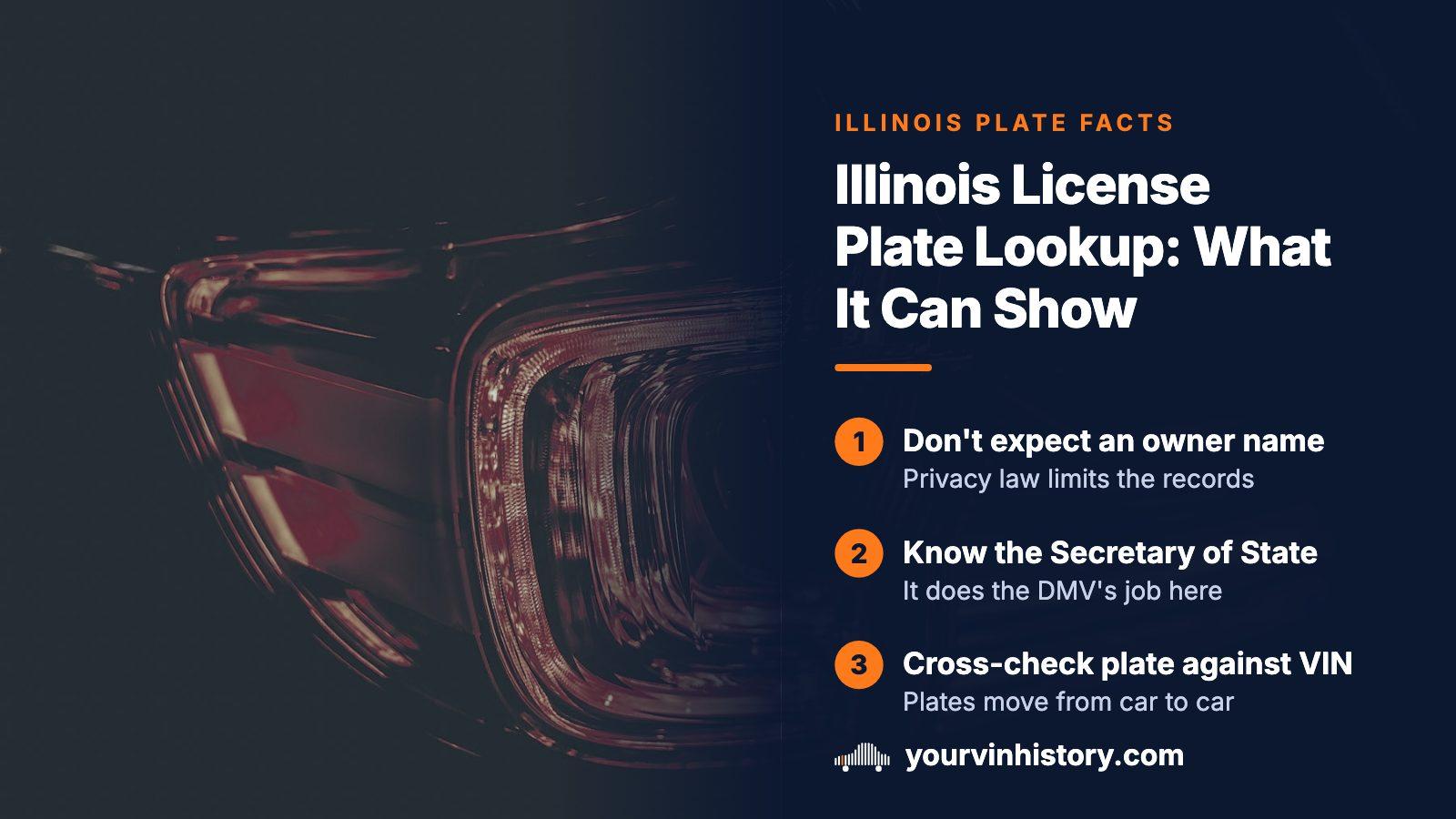
Not out of curiosity. The Driver's Privacy Protection Act confines owner details to a short list of lawful purposes, and in Illinois the Secretary of State, which does the DMV's job here, releases records only within it. A plate also moves from vehicle to vehicle, so it says little about one car's past. Use the VIN for recalls, theft screening and title brands, and treat the plate as a clue to cross-check.
- Agency
- Secretary of State, no DMV
- Plates required
- Two, front and rear
- Pickup class
- B-truck, up to 8,000 pounds
- At a private sale
- Plates stay with the seller
Why a plate number will not name the owner
Type an Illinois plate into a website and the most you can honestly expect back is a make, a model year, and perhaps a VIN once linked to those characters. The registered owner's name and address are a different matter. They sit in motor vehicle records, which federal law treats as protected personal information, and the Secretary of State releases them only to requesters with a recognized reason.
Sites that promise owner details to anyone with a credit card are recycling old scraped data or stretching the truth. Neither helps you judge a car. Plates also change vehicles, so even a correct match may describe the seller's previous car rather than the one parked in front of you.
The short list of people the federal law lets in
The Driver's Privacy Protection Act, found at 18 U.S.C. § 2721, tells state motor vehicle agencies not to disclose personal information from their records, then lists exceptions. Reading them shows why a private buyer is not among the people on the list.
- Government agencies, courts and law enforcement doing official work
- Insurers handling claims, fraud investigations, rating or underwriting
- Parties to court cases, including those serving legal papers
- Employers verifying a commercial driver's license
- Licensed investigators working toward another permitted purpose
- Notices sent to owners of towed or impounded vehicles
- Anyone holding the individual's written consent
Wanting to know who owns the car that clipped yours in a parking lot is not on that list. The workable routes run through police and insurers, who can ask for the record when they have a permitted use. A state may be stricter than the federal baseline, so confirm current procedures with the Secretary of State.
Looking for the DMV? Illinois uses the Secretary of State
No agency called the DMV exists in Illinois. Everything vehicle-related goes through the Secretary of State, shortened to SOS: titles, registration, plates and the stickers that renew them, at a facility or online. Michigan arranges things the same way. Out-of-state buyers lose time searching for a DMV office and landing on pages that describe some other state's rules.
One agency holding the whole paper trail is convenient for owners and the reason record requests must clear the privacy rules above. Fees, forms and processing times change, so check the SOS vehicle services pages for current figures before you plan a trip.
Two plates, and what a bare front bumper can mean
Illinois requires a plate on the front of the car and another on the rear. Enforcement in the Chicago area, including camera systems, depends on both being present and readable, so mounting hardware on the nose is standard equipment on cars that have lived here.
That makes a missing front plate the interesting case. The car may have spent time in a one-plate state, front-end repair may have removed the bracket, or an owner may simply have stopped bothering. None of these is a defect on its own, and each leaves a paper trail: the title history shows which states have registered the car, and damage records show collision repairs. A seller who blames a lost plate should be able to say where the car was registered before.
The B-plate on a pickup is normal
In Illinois a pickup rated up to 8,000 pounds is registered as a B-truck. The class carries its own fee and its own plate series, so a family F-150 or Silverado carries a B-plate where another state would issue an ordinary passenger plate.
Treat the letter as a quick consistency test. If a pickup's registration history shows a passenger class, there is a paperwork gap to settle before any money moves. The class also drives the fee you will pay when you register the truck yourself, so look up the current schedule on the SOS site rather than assuming it matches a car.
At the sale, the plates come off
In Illinois the plates belong to the seller. They are removed at the sale, and the seller can move the registration to a replacement vehicle. A buyer applies to the Secretary of State for title and registration in their own name and pays use tax that scales with the purchase price. Expect a bare car. A seller who offers to leave the plates on until yours arrive is putting their own registration on your vehicle, and that benefits neither side.
A current sticker on the rear plate shows the registration is up to date. An expired one means a lapse, with fees attached, so ask whose problem it will be. The order after a purchase looks like this.
- Collect the title signed by the seller, with the odometer disclosure, and compare the name against the seller's ID.
- File for title and registration with the Secretary of State inside the transfer window, with use tax paid.
- Mount both plates, with the renewal sticker on the rear one.
- Note your class, since a pickup registers as a B-truck and that sets the fee and the series.
Plate types you will see on Illinois cars
Several kinds of plate share Illinois roads. The table gives the one useful fact about each.
| Plate type | What to know |
|---|---|
| Standard passenger | The everyday series, letters and digits, with a renewal sticker on the rear plate |
| B-truck | Class for pickups, with separate fees and a separate plate series, capped at 8,000 pounds |
| Specialty and collegiate | Cause and university designs, each with a separate series |
| Personalized | Characters chosen by the owner, subject to SOS approval |
| Antique vehicle | Reserved for older cars that qualify, with limits on how much they are driven |
Format says little about condition. Use it to raise a question, then let the VIN-based records answer it.
When the plate, the title and the VIN disagree
Plates travel, so a mismatch is not automatically sinister. What counts is which item fails to match.
- The plate differs from the title: ordinary in a private sale, because that plate is heading home with the seller
- The VIN on the title differs from the VIN on the car: stop, since the paperwork describes a different vehicle
- The VIN at the base of the windshield differs from the driver's door jamb label: the clearest sign of a cloned or tampered car
- The seller's name differs from the name on the title: a separate problem, often title jumping
A plate is cheap and easy to swap. A VIN, by contrast, appears on the car itself and in several records, which is why a cloned vehicle usually slips up somewhere. Read it in both spots before you look at the paint, since that single check can end a visit.
Where a plate shines: Chicago's abandoned-vehicle complaints
A plate is good at one job, identifying a vehicle from the street, and Chicago's open data portal shows it. The city posts its historical 311 abandoned-vehicle complaints openly. The set covers December 1999 through July 2020 and holds 261,486 complaints, and 244,322 of them, or 93.4 percent, record a license plate.
| Neighbor's estimate of time parked | Complaint count |
|---|---|
| 7 days | 19,283 |
| 14 days | 23,158 |
| 21 days | 17,047 |
| 30 days | 39,332 |
Answers bunch at round numbers because neighbors estimate how long a car has sat. Another 53,628 records, 20.5 percent, are flagged as duplicates, which happens when several people report one car. So the total counts complaints, not vehicles, and each complaint is a public report rather than a finding. An officer on a street needs the plate. A buyer tracing a car across owners and states needs the VIN, because plates get reassigned, surrendered and moved.
What to run instead of a plate search
Every useful check keys off the VIN. Roughly in order of cost, and cheapest first:
- Decode the VIN to confirm the factory build, and look up open safety recalls on NHTSA's recall tool. Both are free from the government and need no help from the seller.
- Read the VIN on the windshield and on the door jamb label, and compare both with the title.
- Run NICB's VINCheck, a free screen for theft and salvage records from participating insurers.
- Pull title records tied to the VIN. NMVTIS, the federal title database, collects brands reported by states, and a history report built on it, such as this site's, adds accidents, odometer readings and salvage records. A preview comes first, and the full report is a one-time purchase.
- Pay a mechanic to inspect structure, corrosion and mechanical condition, which no database holds.
Manufacturers generally repair open safety recalls at no charge to the owner, but very old vehicles can fall outside the federal rule, so ask a dealer what applies to the specific car.
Where this information comes from
- Illinois Secretary of State: Vehicle Services — The agency that handles titles, registration, plates and renewal stickers in Illinois; check it for current fees, forms and deadlines.
- GovInfo: 18 U.S.C. § 2721, Driver's Privacy Protection Act — The federal restriction on releasing personal information from motor vehicle records, and its list of permitted uses.
- Bureau of Justice Assistance: NMVTIS — The national title information system that gathers state-reported title records for a VIN.
- NICB: VINCheck — A no-cost theft and salvage screen fed by participating insurers.
- City of Chicago Data Portal: 311 Abandoned Vehicles — The historical complaint dataset behind the plate-recording and duplicate counts.
Sources and photos: Facts checked against the sources above in October 2026. Photo by A n v e s h on Unsplash; diagrams by YourVINHistory.
Keep reading
- License plate lookupThe full national picture of what a plate search can and cannot return.
- IllinoisBuying near the Illinois auction corridor and the checks that matter there.
- Illinois title checkHow Illinois brands titles and who may remove a salvage brand.
- VIN cloningWhy a mismatched VIN is the signal worth walking away from.
Frequently asked questions
Can I find out who owns an Illinois license plate?
Not for personal curiosity. If a driver hit your parked car, file a police report with the plate number, because police and your insurer can request the record under a permitted use. If you are buying, skip the owner and ask the seller for the signed title and a matching ID.
Does an Illinois license plate stay with the car after a sale?
No, the plate belongs to the seller, who removes it and can put the registration on a replacement vehicle. A buyer registers in their own name through the Secretary of State and receives plates of their own. Ask any seller who suggests leaving theirs on to take them off.
Is a front license plate required in Illinois?
Yes. Illinois wants a plate on the front and one on the rear, and the rear one carries the renewal sticker. If a car you are viewing has no front plate, ask where it was registered before and whether front-end work removed the bracket.
What does the B on an Illinois license plate mean?
It marks the B-truck registration class, which Illinois uses for pickups up to 8,000 pounds. The class comes with its own fee and plate series. Seeing it on a pickup is routine, while a pickup with a passenger-class registration history is a paperwork question to settle before you buy.
Is there a free Illinois license plate lookup for a used car?
There is no free tool that turns a plate into an owner. The free tools key off the VIN instead: NHTSA's recall lookup shows open safety recalls, and NICB's VINCheck screens for theft and salvage records. Get the VIN from the car and the title, then run those before paying for anything.
Now check the car itself
The guide explains what to look for. The report shows what this VIN has on record.