THE SHORT ANSWER
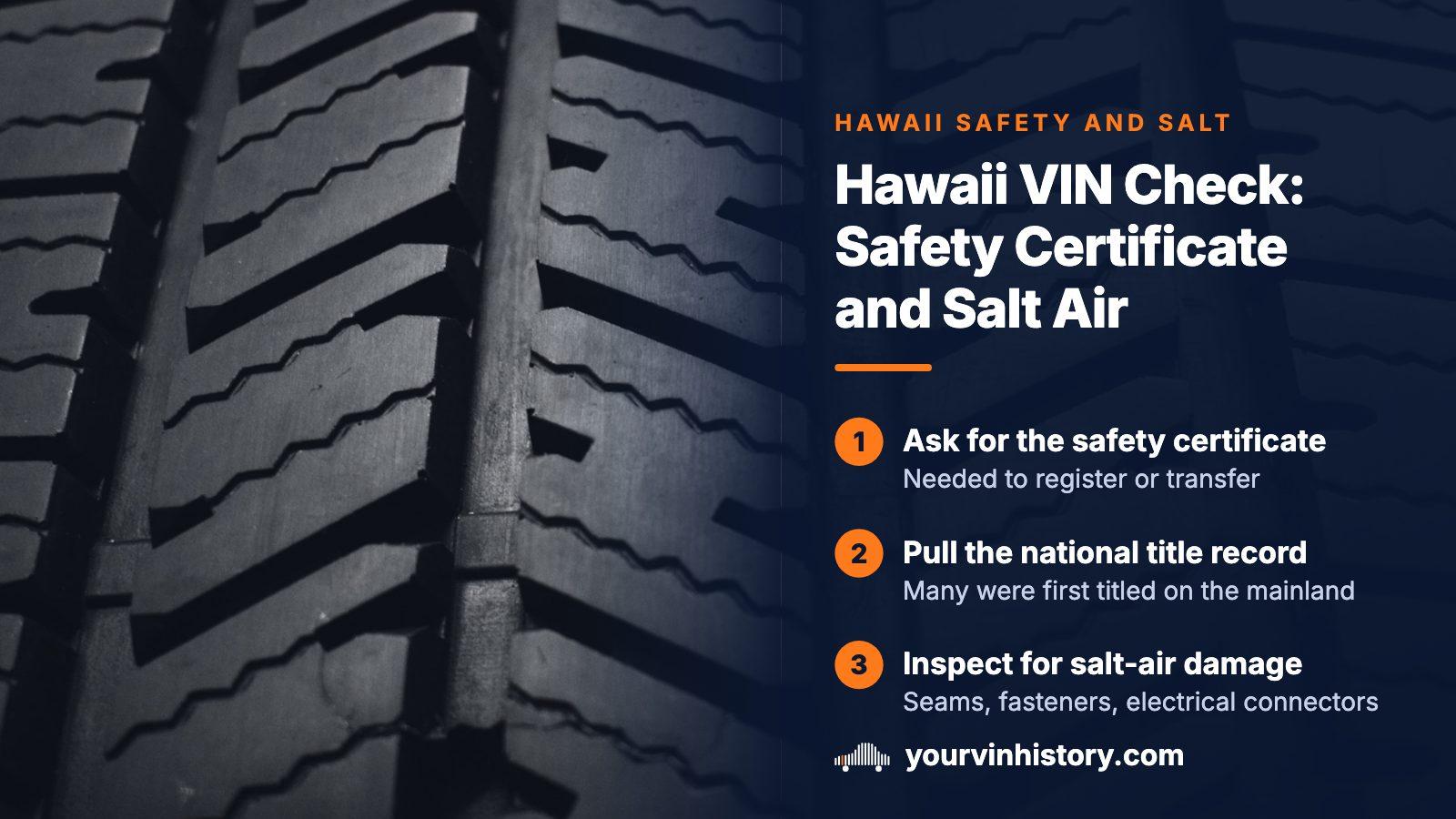
Decode the VIN, search the NHTSA recall lookup and NICB VINCheck, then pull the national NMVTIS title record, because many Hawaii cars were first titled on the mainland. Ask the seller for the current safety certificate, which Hawaii requires before a registration is issued or transferred, and for the older ones, which log the odometer. Finish by checking seams, fasteners and electrical connectors for salt-air damage.
- Safety certificate
- Every 12 months, and before a registration is issued or transferred
- New vehicles
- Two years from first sale before annual certification applies
- Weight limit
- Annual rule covers vehicles up to 10,000 pounds GVWR
- Corrosion source
- Airborne salt and humidity, not road brine
Why most of a Hawaii car's history happened somewhere else
Hawaii builds no vehicles and has no road off the islands, so essentially every car here came by ship. Plenty of the used cars here were first sold on the mainland and crossed the Pacific later, with relocating residents, military families and dealers moving them. For a buyer, that means a Hawaii record may pick up the car midway through its life. A vehicle branded salvage or flood in another state can land here with a short, tidy local file.
The national title record is the tool that reaches back past the shipping container. A yourvinhistory report draws its NMVTIS title records from ClearVin LLC, an approved NMVTIS data provider, so brands recorded by other states can sit beside the Hawaii entries. The record only reports what states and insurers file, so a clean result is one input to your decision, not a verdict.
The safety certificate sits between the buyer and the registration
Under Hawaii law a vehicle must be certified first, ahead of a temporary or permanent registration and ahead of any transfer of a registration. That makes the inspection a step inside the sale rather than an errand for later. A seller whose sticker has lapsed has a problem to fix before the paperwork can move, and if you are buying, that problem lands on your side of the table unless you deal with it deliberately.
Settle the sticker before the money moves
Ask three things up front: is the certificate current, when does it end, and who pays if the car needs repairs to pass. Put the answers in writing on the bill of sale.
The state's Motor Vehicle Safety Office posts lists of permitted inspection stations for cars and light trucks, motorcycles and mopeds, so you can pick a station yourself instead of relying on the seller's usual shop.
Who needs a certificate: nearly everyone, antiques included
The annual rule is broad. It reaches ordinary passenger vehicles, motorcycles, mopeds and trailers up to 10,000 pounds gross vehicle weight rating. Most states loosen the rules for old vehicles; Hawaii names antique motor vehicles as covered.
| Vehicle | How the rule applies |
|---|---|
| Passenger car or light truck | Certified every twelve months |
| Motorcycle or moped | Same annual requirement |
| Trailer at or under 10,000 pounds GVWR | Covered |
| Antique motor vehicle | Included, with no break for age |
| New vehicle | Exempt for two years after the first sale |
| Rebuilt, restored or crash-damaged vehicle | Certified again before it is operated |
Heavier commercial vehicles run under a separate motor carrier program, so a work truck above the weight line is a different conversation. Someone shopping for a classic should expect the same sticker routine as a daily driver.
What the certificate quietly records about mileage
The statute directs each certificate to state the odometer reading on the day of inspection, along with its effective and termination dates and the insurer and policy number. Because cars are certified every twelve months, a seller who kept the old certificates holds a yearly mileage log. An odometer rollback has to survive that log, which is difficult.
Ask for the older certificates as well as this year's, and lay the readings out side by side. Then look for the following.
- Readings that climb steadily from one year to the next
- Any drop, or a reading lower than the one before it
- A long flat stretch that does not match how the owner says the car was used
- A dashboard reading today that sits below the last certificate
Finally, compare the latest figure with any odometer readings in a vehicle history report. Records that agree with each other are worth more than any single number.
Rebuilt, restored or crash-damaged: a second certification trigger
Outside the yearly cycle, a vehicle that was in an accident must be certified again before it is operated if a police officer or an insurer decided the damage made it unsafe. The same applies to a vehicle that was rebuilt or restored.
For a buyer the useful question is which certificate followed the repair. Ask for it and check its date against the story the seller tells. A rebuilt car with no certificate dated after the rebuild is a loose end, and loose ends are where you negotiate.
Keep the certificate in its place. It is an equipment finding at a point in time, and it does not replace a title record. If another state branded the title, the national record is where that shows up, and the brand should shape both the price and your decision about buying at all.
Salt air rusts a car differently than road salt does
Hawaii does not salt its roads, but that is no assurance about rust. Spray and humidity carry salt through the air, and it settles on every surface instead of collecting under the floor. Road brine is thrown upward and eats a car from beneath. Airborne salt turns up in places a winter-car inspection would skip.
- Body seams and the edges of doors, hood and tailgate
- Fastener heads, brackets and mounting points
- Antenna bases and trim clips
- Connectors under the hood and behind lamp housings
- Ground straps at the battery and the chassis
The costly damage is frequently electrical. Corroded connectors and grounds produce faults that look random: a flickering gauge, a window that works on some days. Diagnosing the connector is cheap. Replacing the wrong part again and again is not.
Island resident or recent arrival: two different used cars
Shipping a car off the islands costs real money, so vehicles that a mainland market would wholesale or export tend to stay. Owners keep and repair them longer, and the low end of the local market skews older. A well-kept older car is still a well-kept older car. Even so, an island resident of a given model year has usually spent all of its years in salt air, often under several owners.
A recent arrival is a different proposition: less time exposed to the coast, but a history that mostly lives elsewhere. Ask the seller when and from where the car came over, then see whether the records agree. Title dates, auction entries and odometer readings from other states should fit the account. If the seller describes a one-owner island car and the records show two mainland titles, you have learned something useful for free.
The no-cost checks to run before spending anything
- Decode the VIN and compare the factory build with the listing, then match the number against the dash plate, the door-jamb label and the paperwork.
- Search the NHTSA recall lookup by VIN. The search costs nothing, but repair terms depend on the recall and the age of the vehicle, because very old vehicles fall outside the federal free-repair rule.
- Run NICB VINCheck for theft and salvage reports from participating insurers.
- Pull the national title record from an approved NMVTIS provider. This one is paid.
None of this duplicates the Hawaii inspection. That check covers equipment such as brakes, tires, steering and lights, and the inspector compares the VIN on the car with the VIN on the registration and the insurance card. It is an equipment check, not a recall, theft or title search, so a pass tells you the car met the standard that day and nothing about its past.
Paperwork runs through the counties, and plates will not help
Hawaii has no single statewide counter for vehicle registration. Questions go to county offices for Honolulu, Maui, Hawaii County and Kauai, the same four the safety office page links to. Before you book a transfer, confirm which office handles your transaction and what it wants to see, since the answer is not identical on every island.
A license plate is a weak shortcut. Federal law limits who may obtain personal details from state motor vehicle records, so a plate number will not hand you an owner's name. Work from the VIN.
A short list to settle before you hand over money
- Get the current certificate, note the end date and agree in writing who pays for repairs
- Collect earlier certificates and compare their odometer readings
- Work out whether the car has lived on the islands or only just landed
- Pull the national title record to cover the mainland years
- Check seams, fasteners and brackets for salt-air damage
- Inspect connectors and grounds on any older coastal car
- Confirm the county office and what it requires for the transfer
If those checks hold up, a paid yourvinhistory report can fill in accidents with a damage map, odometer readings and auction photos for the years the car spent elsewhere.
Where this information comes from
- Hawaii Revised Statutes: section 286-26, periodic inspection of vehicles — The legal basis for the twelve-month certification, the requirement before registration or transfer, the odometer line on the certificate and the new-vehicle window.
- Hawaii DOT: Motor Vehicle Safety Office — Where the inspection program is run, with station lists by vehicle type and links to the county registration offices.
- Hawaii DOT: safety inspection program updates — The department's own notice of a change to the inspection program, useful for checking current fees before you budget.
- NHTSA: Recalls — Federal recall search by VIN, run separately from anything the state inspection looks at.
Sources and photos: Facts checked against the sources above in October 2026. Photo by fr0ggy5 on Unsplash; diagrams by YourVINHistory.
Keep reading
- Hawaii platesWhy plates are handled by four counties and what a plate search can and cannot return.
- NMVTIS reportWhat the national title record contains, since it is the part that reaches back before the shipping container.
- Odometer rollback checkHow to compare mileage records against each other once you have collected the old certificates.
- FloridaThe other salt-air state, with a flood checklist that applies to coastal cars generally.
Frequently asked questions
How can I tell whether a Hawaii car came from the mainland?
Ask the seller, then test the answer. A VIN decode shows the factory build but not where the car has been. A national title record can include brands and events reported by other states, and mileage on earlier certificates or auction entries should line up with the seller's story. A car described as local and one-owner that shows a title elsewhere deserves a pause.
Does a passed Hawaii inspection mean the car has a clean history?
No. The certificate says the equipment met the program's standard on the day it was inspected, and it records the odometer reading. It is not a title search, a recall check or a theft screen, so a car can pass and still carry an open recall or a brand from another state. Treat the certificate as one document among several.
What if the seller's safety sticker has expired?
Treat it as a negotiating point, since certification comes before a registration is issued or transferred. Ask the seller to have the car inspected at a permitted station before you pay, or agree on price and repair responsibility first. If it fails, the station gives a signed notice listing what must be fixed, and the rules set a time limit for returning for reinspection. Ask to see that notice.
Is low mileage on a Hawaii car believable?
Believe it when independent readings agree. Line up the odometer figure on each yearly certificate, the dashboard today and any reading in the title or auction history. The numbers should rise in a steady line. A drop, a long stall or a missing year needs an explanation, and a seller who cannot produce earlier certificates has not supported the claim.
Can I find a Hawaii owner from a license plate?
No. The federal Driver's Privacy Protection Act limits who may obtain personal details held in state motor vehicle files, and only for listed purposes. Curiosity is not on the list. For history, recalls and title records, the VIN is the right starting point, and it is printed on the car itself where you can check it against the paperwork.
Now check the car itself
The guide explains what to look for. The report shows what this VIN has on record.