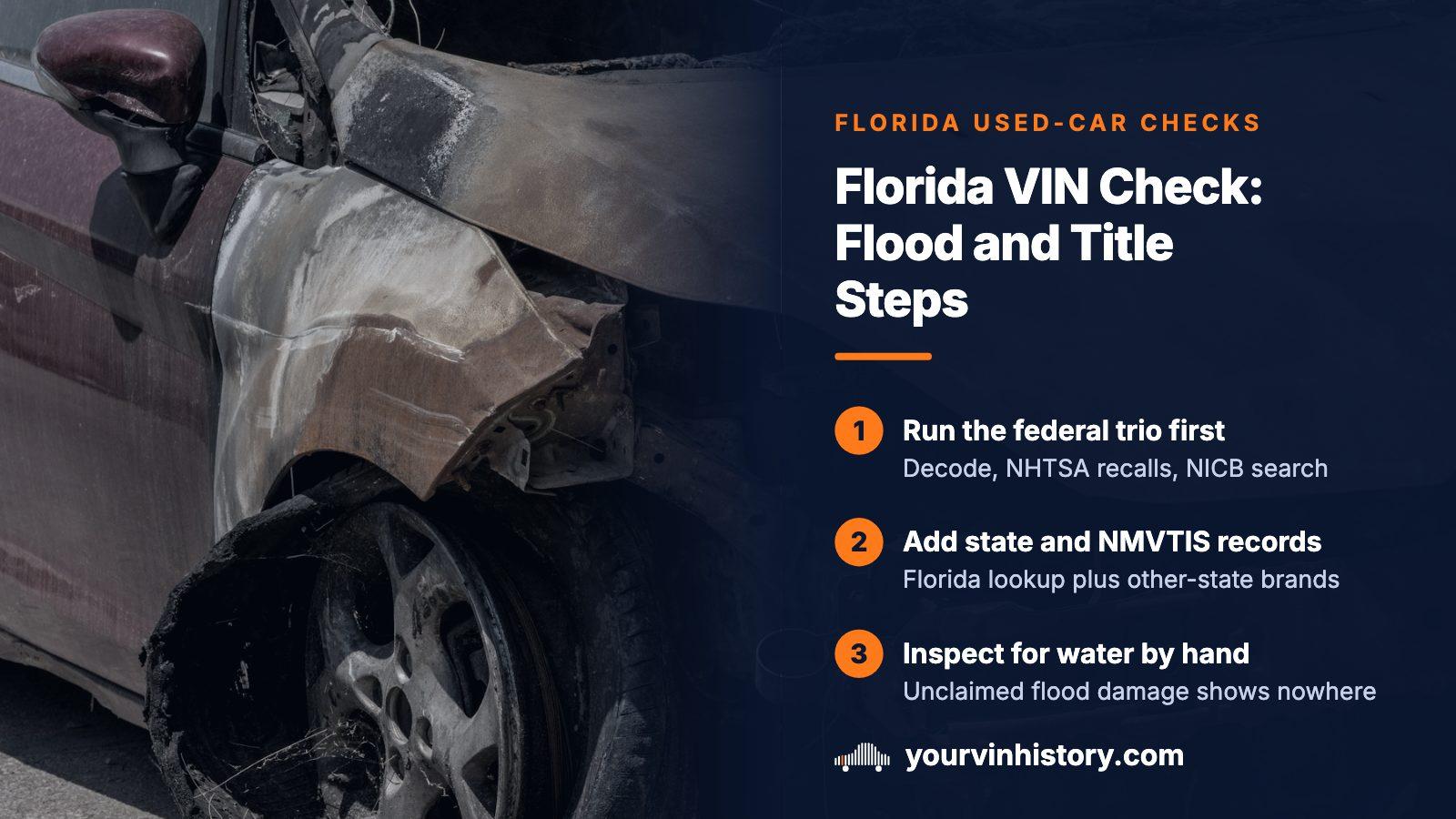
THE SHORT ANSWER
Start with a VIN decode, the NHTSA recall search and the NICB theft and salvage search. Next, look the VIN up in the Florida Highway Safety and Motor Vehicles lookup for the state title record, and in an NMVTIS-approved report for brands from other states. End with a hands-on flood inspection, because water damage that never reached an insurer appears in none of them.
- State record
- FLHSMV lookup, searched by VIN
- National record
- NMVTIS, with brands from every reporting state
- Biggest gap
- Flood damage that never produced an insurance claim
- Plate searches
- Owner details limited by the Driver's Privacy Protection Act
Why Florida gets its own checklist
Every state sees flood cars, but Florida stacks three conditions that make them hard to spot: a coastline that takes hurricanes, warm weather that dries a soaked interior fast, and a used market big enough to swallow almost anything. A car can sit in storm surge on a Tuesday and be dried, detailed and listed within weeks.
The paperwork problem is simple. A brand lands on a title when an insurer or a state records a total loss. If the owner dried the car out and never filed a claim, no brand exists, and every database returns the same tidy answer. Records prove what somebody reported, while water nobody reported is left to your own eyes. So the routine below runs the record checks first, then weights the inspection most.
The order to run the checks
Begin with the quick ones and stop the moment any of them turns up a problem.
- Read the VIN from the car itself, at the base of the windshield and on the door jamb label, and compare it with the title the seller shows you.
- Decode the VIN to confirm that the year, make and engine match the listing.
- Search the NHTSA recall tool for open recalls. It is a federal lookup that costs nothing.
- Search NICB VINCheck for theft and total-loss records from participating insurers. It costs nothing either.
- Enter the VIN in the FLHSMV motor vehicle information lookup to see what Florida holds on the title.
- Pull an NMVTIS-approved history report for brands and title events recorded by any reporting state.
- Have the car inspected for water damage, ideally by an independent mechanic.
A yourvinhistory report is one way to cover the NMVTIS step. Its title records come from ClearVin LLC, an approved NMVTIS data provider, and the report adds accident, salvage and auction records with photos. A preview comes first, then a one-time purchase.
What the Florida state lookup can and cannot tell you
FLHSMV, the state agency behind Florida titles and tags, runs a public lookup that accepts a VIN and reports the title information on file. It costs nothing, and it answers for Florida only.
| Question you have | Florida lookup | Where else to look |
|---|---|---|
| Does Florida have a title on this VIN? | Yes, this is what it is for | Nothing more needed |
| Was the car branded in another state? | Only what Florida recorded | NMVTIS report |
| Did an insurer report it stolen or totaled? | Not its purpose | NICB VINCheck |
| Is a recall still open? | No | NHTSA recall search |
| Was it flooded with no claim filed? | No record exists to find | Hands-on inspection |
Treat a clean state result as one witness agreeing with the seller, not a verdict. A car that spent last year in Georgia has its paper trail there.
What water leaves behind in a car
Dry weather and a good detailer erase the obvious signs. The quieter ones sit where nobody scrubs. Take a flashlight and look for these.
- Sand or dried silt in the spare tire well, along the carpet edges and around the seat rails
- Rust on the bolts that hold the seats down, which detailers rarely touch
- A waterline or fog inside the headlight and taillight housings
- Crusty residue on wiring connectors and bare metal beneath the dashboard
- Carpet or seat fabric that looks newer than everything around it
- A damp, musty smell, or a strong air freshener working to hide one
- Electrical faults that come and go, which is how water in connectors tends to behave
Press the carpet in several spots and smell the padding underneath. Then run every switch, light and motor, and repeat after a drive.
Why sea water is the worse case
Coastal cars live in salt air whether or not they ever flood, so some exterior rust is simply geography. What matters is where the corrosion sits. Surface rust on the underbody and outer panels fits ordinary coastal life. Corrosion deep inside interior connectors, under the dash and on seat hardware points to something else: water got to places that weather cannot reach.
Salt keeps working after the car dries
Storm surge carries sea water, and the salt left in wiring and behind panels keeps corroding long after the carpet feels dry. A car that ran fine at auction can develop electrical faults months later. Treat any sign of salt-water flooding as a reason to walk away, not a repair estimate to bargain over.
Shopping in the months after a hurricane
Flood cars do not hit the market the week of the storm. They trickle out in waves that begin a few weeks later and can last a year or more, moving through auctions and over state borders as they go. After a major hurricane the effect is national, strongest near where the storm came ashore.
- Doubt a freshly detailed car priced under the going rate.
- Find out where the car was registered and titled while the storm season ran.
- Be wary when a title moved to another state right after a hurricane.
- Ask in writing if the car sat in the storm zone. A written reply is harder to walk back.
The Justice Department's NMVTIS site treats storm seasons as a title-fraud risk, with flood-damage notices for reporting entities tied to events such as Hurricane Harvey and Hurricane Irma.
Title brands you may meet on a Florida car
| Brand | What it signals |
|---|---|
| Salvage | The car was declared a total loss. Florida separates rebuildable salvage from a certificate of destruction. |
| Rebuilt | A former salvage vehicle that was repaired and passed the state inspection. Driving it is legal, and the brand stays. |
| Flood | Water damage was recorded. Its absence proves less in Florida than elsewhere, since cars flooded without a claim keep clean titles. |
| Certificate of destruction | The end of the line. The vehicle cannot legally be retitled for road use, so it is meant for parts and scrap. |
A discount on a branded car can be fair when the price and the repair quality line up. What you cannot afford is learning about the brand after the sale. If a seller says a brand was removed, ask for the document showing how.
Private sales: paper habits that protect you
A private seller owes you none of the obligations a dealer carries, so the checking falls to you. Florida titles are transferred at a tax collector's office, and meeting the seller there protects both people before money changes hands.
- Check that the name on the title is the seller's, letter for letter, before any payment.
- Compare both VIN locations on the car with the title.
- If the title was reissued very recently, ask why. A fresh title can follow a title wash or a flood, though the explanation may also be dull.
- Write a bill of sale with the VIN, sale price, date and each party's contact information.
Out-of-state arrivals and the history they bring
A big share of Florida's used inventory came from elsewhere: winter residents' cars, auction purchases, stock trucked south to a strong market. For those vehicles the Florida record starts at the border, so the state lookup knows nothing about the earlier years. NMVTIS pools brands from all reporting states, while the NICB search draws on insurer reports nationwide.
A northern car also brings a corrosion pattern Florida rarely produces. Road-salt rust usually shows up worst along the underbody, so get underneath anything that spent its winters up north. Ask which state it was registered in before Florida, and compare the answer with the NMVTIS history.
What a lien release should look like
Liens are the hidden hazard in a private sale, because the lender's claim stays with the car. Federal export rules supply a useful benchmark. Under 19 CFR 192.2, enforced by U.S. Customs and Border Protection, a financed or leased vehicle cannot leave the country on its title alone. The lender must supply a separate letter approving the export, and Customs wants the paperwork at least 72 hours before a vehicle boards a ship.
Read that as a buyer's checklist. A lienholder's release you can trust has these features.
- It names the vehicle by its full VIN, not only the make and model.
- It sits on the lienholder's letterhead and names the lienholder.
- It lists telephone numbers where the lienholder can be reached.
- It carries an original signature and the date it was signed.
- You dialed one of those numbers yourself instead of trusting the letterhead.
Part 192 covers exports only, so treat it as a yardstick and not a Florida rule.
Why a disturbed VIN plate means walk away
The same export rule shows how seriously the government treats the number itself. Section 192.3 sets a $500 penalty for an exporter who skips the paperwork requirements. A separate paragraph allows up to $10,000 for knowingly importing or exporting a stolen vehicle, or one whose identification number has been stripped off, defaced or otherwise changed. Such a vehicle can also be seized and forfeited.
In plain terms, federal law lists a tampered VIN beside theft. Give a car the same suspicion if its VIN plate has mismatched rivets, sits raised from the dash, or sits near a door label with a cut edge or odd lettering. Nothing in Part 192 will appear on a history report, which is why your own eyes matter at this step.
Where this information comes from
- FLHSMV: Florida Highway Safety and Motor Vehicles — The state agency that runs Florida's VIN-based vehicle information lookup.
- NMVTIS: National Motor Vehicle Title Information System — Justice Department site for the national title record, its buying tips and its flood-damage notices after hurricanes.
- eCFR: 19 CFR 192.2, requirements for exportation — Source for the lienholder letter details and the 72-hour presentation window used as a benchmark here.
- eCFR: 19 CFR 192.3, penalties — Source for the $500 and $10,000 penalties and the treatment of altered identification numbers.
- NICB: VINCheck — The no-cost theft and total-loss lookup that covers vehicles insurers have reported.
- NHTSA: Recalls — The federal search for open recalls by VIN.
Sources and photos: Facts checked against the sources above in October 2026. Photo by engin akyurt on Unsplash; diagrams by YourVINHistory.
Keep reading
- Florida title checkA closer look at what the state's own title lookup returns and where it stops.
- Flood-damaged carsMore ways to spot a flooded car when the title reads clean.
- Florida platesWhat a Florida plate can and cannot tell you in a private sale.
- NMVTIS reportHow the national title record works and what it leaves out.
Frequently asked questions
Is there a free VIN check for Florida cars?
Three pieces cost nothing: the FLHSMV lookup for Florida's title record, NHTSA's recall search, and NICB's VINCheck for theft and total-loss records. Each answers a different question, and none shows brands applied in other states. An NMVTIS-approved report covers that gap, and an inspection covers what no database holds.
Can I find a Florida car owner from the license plate?
Not as a private buyer. The federal Driver's Privacy Protection Act limits who may see personal details in motor vehicle records, and the permitted uses cover groups such as law enforcement and insurers. Be skeptical of any site promising a plate-to-owner search. During a sale, ask for the VIN and compare the seller's name with the title.
Does a clean NMVTIS report mean a Florida car was never flooded?
No. NMVTIS holds title, odometer and certain damage information, so a flood appears only if someone reported it. A car dried out by its owner after a storm leaves no entry. Pair the report with an independent mechanic's inspection, which the Justice Department's own used-car buying tips strongly encourage.
Is rust on a Florida car a sign of flood damage?
Not by itself. Salt air works on exterior panels and the underbody of coastal cars every year. Flood damage turns up where weather does not reach: rust on seat bolts, residue on connectors under the dash, silt in the spare tire well. Look for corrosion in those hidden places.
Should I buy a used car that was in a hurricane area?
It depends on the documents and the price. A car that sat inland or on high ground may be fine, while one that spent the storm near the coast needs proof. Ask for a written statement of where it was, check the title history around the storm months, and have a mechanic look for water. A seller who dodges those requests has told you plenty.
Now check the car itself
The guide explains what to look for. The report shows what this VIN has on record.