THE SHORT ANSWER
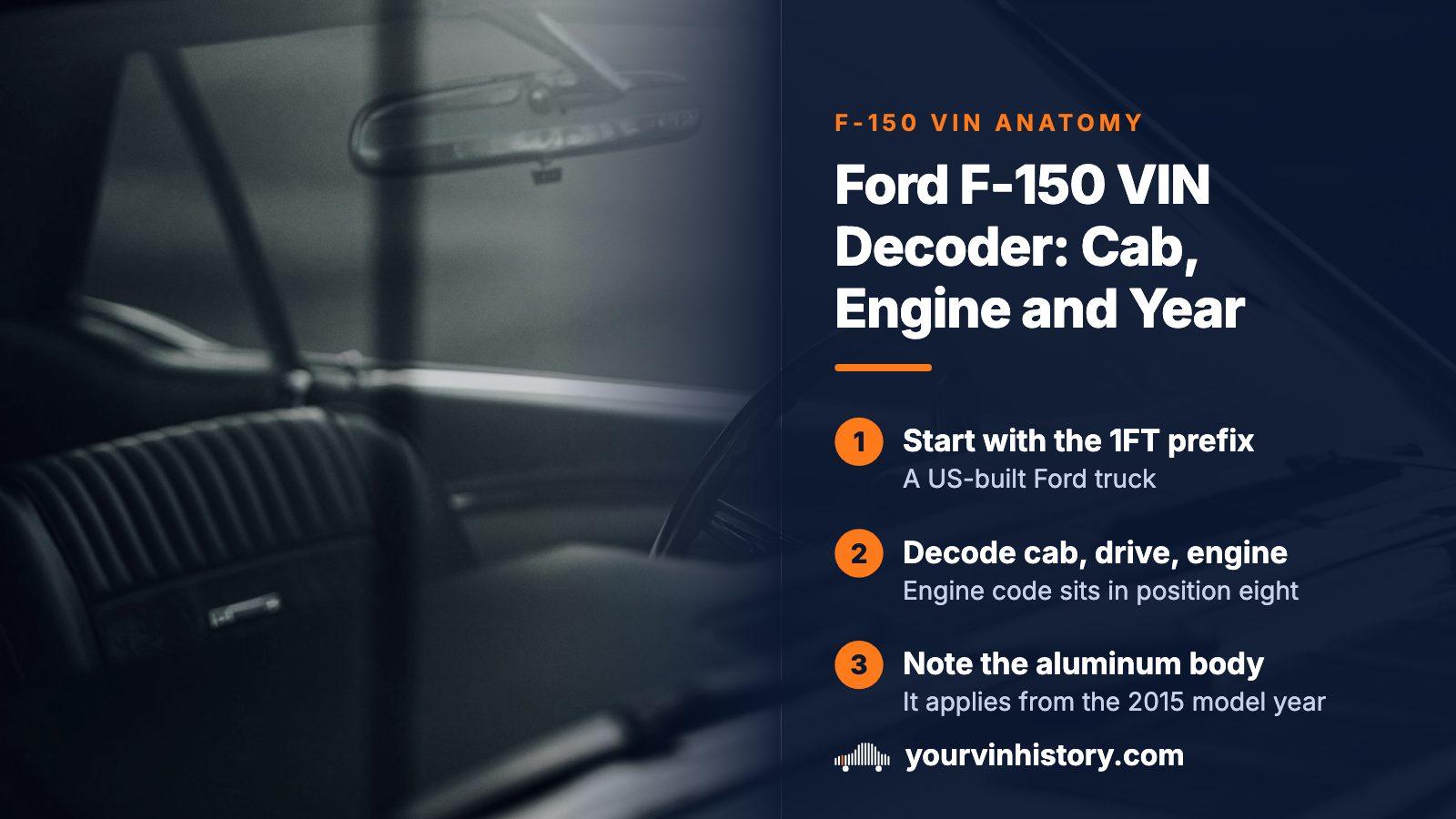
An F-150 VIN opens with 1FT, which marks a Ford truck built in the United States. Positions four to eight are Ford's own codes for weight class, series, cab, drive and engine, with the engine in position eight. Position ten gives the model year and position eleven the assembly plant. Run all seventeen characters through NHTSA's vPIC decoder, then confirm the cab, bed and engine on the truck itself.
- Prefix
- 1FT, a US-built Ford truck
- Engine
- 8th character
- Model year
- 10th character
- Aluminum body
- 2015 model year onward
Find the VIN on the truck, not in the ad
Start at the driver's side of the windshield. A metal plate at the base of the glass carries the VIN and can be read from outside the cab, so photograph that one on a dealer lot or in a driveway. Then open the driver's door and read the sticker on the frame.
That sticker also lists the build date, the gross vehicle weight rating, the axle ratings and the factory tire pressures, the figures that count if you tow.
Finish with the paperwork. The title, registration and insurance card should show the same seventeen characters as both labels on the truck. One character out of place is a question for the seller before money moves.
How an F-150 VIN divides, starting with 1FT
| Position | What it tells you on an F-150 |
|---|---|
| 1 to 3 | World manufacturer code, 1FT for a US-built Ford truck |
| 4 to 8 | Ford's own codes for weight class, series, cab, drive and engine |
| 9 | Check digit, a math test run on the rest of the VIN |
| 10 | Model year character |
| 11 | Plant of assembly |
| 12 to 17 | Running production number at that plant |
The prefix reads country, maker, vehicle class: 1 for the United States, F for Ford, T for truck. Ranger and Super Duty trucks begin the same way. Canadian assembly would show as 2FT, so a truck advertised as a US-market F-150 that opens with anything else needs an explanation, whether a legitimate import or paperwork that describes some other vehicle.
The outer blocks follow an international standard. The middle block does not, and Ford has changed what its letters mean between generations. A chart written for one era can misread a truck from another, so a decoder built on manufacturer-filed patterns, such as NHTSA's, beats a static cheat sheet.
Cab style and bed length, the two details listings fumble
The F-150 comes in three cabs, and they differ in use and in price. The cab sits in the descriptor block, so a decode names it outright.
| Cab | Layout | Used-market note |
|---|---|---|
| Regular Cab | Two doors, one row of seats | Shortest cab, usually matched with the longest bed |
| SuperCab | Extended cab, small rear-hinged rear doors, modest back seat | A compromise between passengers and bed length |
| SuperCrew | Four front-hinged doors with a full-size rear seat | Most common used, and generally the most valuable |
Bed length follows the cab. Within a generation, the bigger the cab, the shorter the bed on offer, because the wheelbase can only stretch so far. A SuperCrew with a long bed is the scarcer, pricier build, and just the detail a careless ad gets wrong.
Some decodes report bed length and others say nothing about it, so use the VIN as the first word and a tape measure as the last. Sellers do round a 6.5-foot bed up to 8 feet, and the load you plan to haul will not accept the rounding.
Position eight and the engine under the hood
The eighth character names the engine. Few trucks have offered as wide a spread of powerplants as the recent F-150, and running cost, towing ability and known maintenance patterns vary a great deal between them.
| Engine | Where it fits |
|---|---|
| 3.3-liter V6, naturally aspirated | Base engine on later trucks; cheapest to run, least capable at towing |
| 2.7-liter EcoBoost V6 | Turbocharged, with more punch than its size implies; suits occasional towing |
| 3.5-liter EcoBoost V6 | Higher-output turbo and the towing pick across several generations; the Raptor's engine is built on it |
| 5.0-liter V8 | Naturally aspirated Coyote, for buyers who prefer a V8 without turbos |
| 3.5-liter PowerBoost hybrid | Gasoline-electric, new with the fourteenth generation; generator capability on trucks fitted for it |
| 3.0-liter Power Stroke diesel | Sold for a short run, so scarce used |
| Triton V8s, 4.6 and 5.4-liter | Older generations, familiar ground for independent shops |
Ford has reused engine codes over time, so read position eight together with the year in position ten, never alone. Then lift the hood and compare. A swapped engine is not a defect on its own, but one the seller never mentioned changes the insurance, the emissions status and the price. For official mileage ratings on the configuration you decoded, try fueleconomy.gov.
Position ten: turning a letter into a generation
The tenth character is the model year, and the year drops the truck into a generation. That is the most useful frame for researching known problems, parts supply and a fair asking price.
| Generation | Model years |
|---|---|
| Eleventh | 2004 to 2008 |
| Twelfth | 2009 to 2014 |
| Thirteenth | 2015 to 2020, aluminum body panels begin |
| Fourteenth | 2021 onward |
Year characters run on a thirty-year cycle that never uses I, O, Q, U or Z. Digits 1 through 9 stand for 2001 through 2009, then letters take over. F marks 2015, the first aluminum year, and M marks 2021, the first of the fourteenth generation. The letters step forward one per year and reach T for 2026.
Model year is not a build date. The door sticker prints the actual month.
Position eleven: the plant, and why recalls care
The eleventh character names the factory. Ford builds the F-150 mainly at two sites: Kansas City Assembly in Claycomo, Missouri, and the Dearborn Truck Plant in Michigan. A decode maps the character to the right one for that model year.
Origin matters mostly for recalls. Ford often confines a campaign to trucks from one plant between two build dates, so two F-150s that look identical can carry different recall exposure. The last six characters settle who falls inside a range at its edges. A model-level search cannot answer that; only the VIN can.
The 2015 aluminum body and your repair bill
For the 2015 model year Ford switched the body panels to aluminum alloy and kept a high-strength steel frame underneath. The goal was less weight. For a used buyer, the consequences show up after a collision.
- Repairs need different tooling, trained technicians and a work area kept separate from steel jobs.
- Many shops lack the equipment or the certification, so a crash leaves fewer places to go.
- Aluminum panels generally cost more to repair than their steel equivalents.
- A poor aluminum repair is harder to detect than a poor steel one.
- Higher panel costs push an insurer toward a total loss sooner.
Ask who fixed it
If a 2015 or newer truck has any accident history, ask which shop did the repair and whether that shop held aluminum certification. The same record on a steel-bodied truck would worry you less.
Trim names are not in the VIN
The descriptor block narrows a truck to a series and an equipment level, but it never prints XLT or Lariat. Those names, and King Ranch, Platinum, Limited, Tremor and Raptor too, are marketing labels laid over the codes that the VIN actually carries.
Badges are cheap and easy to fit, so a base truck dressed as something grander turns up often enough to plan for. The honest record is the factory build data behind the VIN, because it lists what the plant installed rather than what someone added later. Ask for the window sticker or pull the build record before you agree on a price that depends on a trim name.
Recalls: ask about this truck, not the model
Recalls attach to ranges of VINs. Searching F-150 recalls in general turns up campaigns that never touched the truck in front of you. The useful question is whether this exact VIN has an open recall that nobody has repaired.
NHTSA's lookup answers it at no charge. Under the federal rule, the maker pays for recall repairs whoever owns the truck now, but with an age limit: the duty lapses if the first purchase came more than 15 calendar years before the recall notice or order, whichever came first. An eleventh-generation truck may fall on the wrong side of that line, depending on when a campaign was announced, so confirm with a Ford dealer before assuming a no-cost fix.
Search when you start shopping and again before you pay, since new campaigns appear over time. An open recall is a fair talking point with the seller. Where the repair is covered, arranging it costs you time, not money.
A sensible order of checks on a used F-150
- Decode the VIN before you drive over. Cab, bed, engine and drive should agree with the advert; a mismatch saves a wasted trip.
- Read the door sticker. If you plan to tow, its weight ratings set the limit, whatever the seller claims.
- Hunt for a working life: bolt holes in the bed from a gooseneck or fifth-wheel hitch, a worn receiver, aftermarket wiring, a sagging rear end.
- Inspect the frame rails for rust, especially on trucks from states that salt winter roads. Surface rust is normal; flaking or holes are not.
- Run the NHTSA recall check on the full VIN.
- Pay an independent inspector. On an aluminum-bodied truck, ask for a specific look at panel repair and a scan for stored fault codes.
A decode describes how the truck left the plant. What happened afterward, such as accidents, title brands, odometer readings and liens, sits in other records. A yourvinhistory report starts from the same VIN, opens with a free preview, and adds those records along with factory specs before you pay.
Where this information comes from
- NHTSA: vPIC VIN decoder — Federal decoder built from the VIN patterns manufacturers file, used for the cab, engine, year and plant lookups described here.
- NHTSA: Recalls — Where to search open safety recalls by full VIN before buying, and why the result belongs to one truck rather than one model.
- Fuel Economy: fueleconomy.gov — Department of Energy and EPA site for comparing official mileage figures once the engine and drive are known.
Sources and photos: Facts checked against the sources above in October 2026. Photo by Crosby Hinze on Unsplash; diagrams by YourVINHistory.
Keep reading
- FordThe same position-by-position method across Ford cars, SUVs and trucks.
- Ford window stickerThe as-built option list that settles trim claims a VIN cannot.
- Ford recallsHow Ford campaigns are scoped and what an open one means at the sale.
- VIN accident checkWhat accident records can show, which matters more on an aluminum-bodied truck.
Frequently asked questions
Can a VIN decoder tell me if an F-150 engine was swapped?
Not directly. A decode reports the engine Ford fitted at the factory, so a swap only shows when you compare that result with what sits under the hood. A swap can be legitimate, yet one nobody disclosed bears on insurance, emissions compliance and resale value. Ask for receipts.
How do I know if an F-150 is four-wheel drive from the VIN?
Drive type is part of the descriptor block, so a decode normally reports two-wheel or four-wheel drive. Confirm it on the truck, which costs nothing: look for a transfer case selector inside the cab and a front axle differential beneath the truck. If hardware and decode disagree, ask more questions.
How can I tell from the VIN whether an F-150 has an aluminum body?
Read the tenth character. A digit means 2001 to 2009, and the letters A through E run from there up to 2014, so those trucks have steel panels. F means 2015, and every later letter carries the aluminum body forward. Cross-check the year against the door sticker's build date.
Will the VIN tell me if an F-150 is a Lariat or a Raptor?
Only loosely. The VIN carries series and equipment codes, not trim names, so the answer comes from the factory build record or the window sticker. Ask the seller for the sticker; if there is none, look up the build record by VIN. When the badge and the record disagree, believe the record.
Does a clean recall result mean the truck is trouble-free?
No. The lookup reports open safety recalls against that VIN and nothing more. It does not show accidents, title brands, odometer history or liens, and it cannot reveal a repair done badly. Treat a clean result as one box ticked, then review the truck's wider record and have it inspected.
Now check the car itself
The guide explains what to look for. The report shows what this VIN has on record.