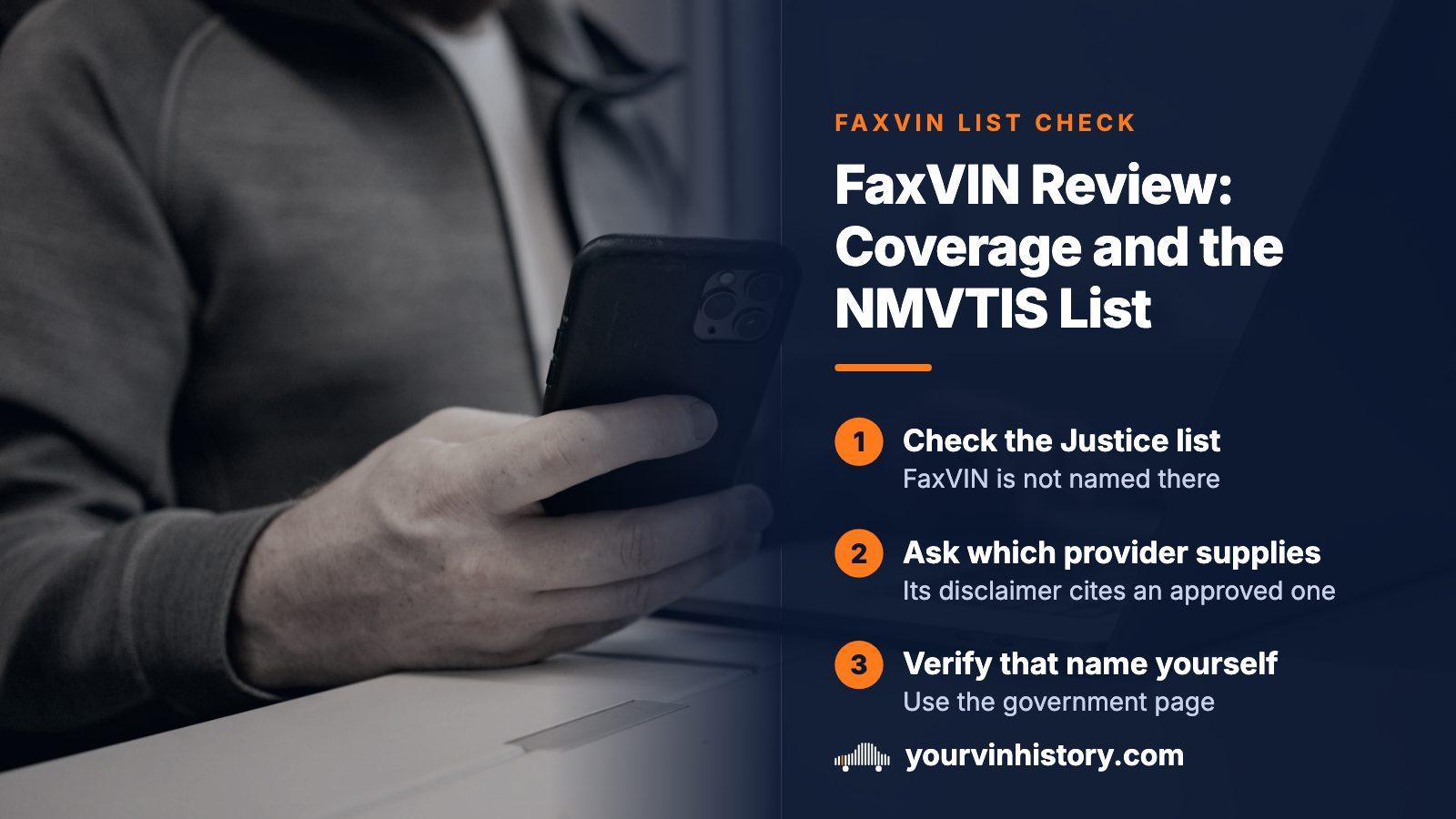
THE SHORT ANSWER
FaxVIN is a working VIN lookup site with a free decode and paid reports. It is not named on the Justice Department's list of approved NMVTIS data providers, yet its own disclaimer says its NMVTIS title and brand data arrives through an approved provider. The sensible move is to ask which one, confirm that name on the government page, and run the free official checks before paying for anything.
- Justice Department list
- FaxVIN is not named on either group
- Free decode
- Year, make, model, trim and engine, per its site
- Its data statement
- NMVTIS fields come via an approved provider
- Carfax
- A separate company with a similar-sounding name
What FaxVIN offers, going by its own site
FaxVIN is a VIN lookup site built around two layers. The first is a free decode that, according to the site, confirms the year, make, model, trim and engine of the car behind a VIN. The second is a paid report that the site describes as covering title status and brands, accidents and damage, mileage, recalls and possible liens, along with other history items.
That paragraph is the site describing itself. This guide did not buy or run a paid report, so it says nothing about how accurate or complete one is. What it can examine are two things anyone can check: the business's place on the federal provider list, and what it says about its data.
The decode layer has a plain use: it tells you whether a listing describes the car it claims to, which is worth knowing before a deposit changes hands. Many tools do the same job, including a federal one covered near the end.
The Justice Department list and the missing name
NMVTIS, the National Motor Vehicle Title Information System, is the federal database of title, brand, odometer and total-loss records. State motor vehicle agencies, insurers and salvage businesses are required by law to send records into it, which makes it the nearest thing to a national title file. The Justice Department publishes the businesses approved to sell reports from it.
The page sorts them into two groups: providers that serve the public as well as businesses, and providers that serve commercial customers only. FaxVIN is not named in either group. The page also says the businesses appear alphabetically with no preference shown, so a listing is a statement about data access, not a rating of service or price.
What FaxVIN says about where its title data comes from
Absence from the list is only half of the picture, and a fair review needs the other half. FaxVIN's FAQ names NMVTIS among the sources behind its reports, next to state registries and insurers. A footer link leads to an NMVTIS disclaimer, which says the site obtains NMVTIS title and brand data through an approved data provider rather than directly.
The same page adds sensible limits. NMVTIS does not cover every vehicle in the country, it lacks detailed repair history, and a history report is no substitute for an independent inspection.
So two things can be true together: the business is not itself a listed provider, and it says it works through one. The government page cannot settle the second point, because it names providers and the sites they own, not the companies they supply. The way to settle it is to ask the site which provider it uses, then look that name up.
A two-minute check you can run on any report seller
The same routine works for FaxVIN and for every other site that sells reports.
- Type the address of the Justice Department's vehicle history page into your browser, or search for it, rather than following a link from an ad.
- Read both groups on the page: the one for public and commercial customers, and the commercial-only one.
- Look for the seller's name, then look again in the lines that say which other websites each provider owns.
- If the name is missing, ask the seller in writing which approved provider supplies its title data, and check that provider's entry.
- When the car justifies the cost, buy a report straight from the listed provider and compare it with the other seller's version for the same VIN.
A clear answer at step four settles the question. A vague one is a reason to buy the title record elsewhere.
What an unlisted name supports, and what it leaves open
Buyers tend to treat the provider list as a verdict. It is narrower than that, and this table keeps the reading honest.
| What you observe | What it supports | What it does not support |
|---|---|---|
| Name absent from the list | The business is not itself an approved provider | That it is fraudulent, or that its decoder returns wrong answers |
| Seller says an approved provider supplies its title data | A claim you can test by asking for the provider's name | That the claim is false, or that it has been confirmed |
| Name on the public-and-commercial side | Federal title data is open to ordinary buyers from that business | That its price, support or layout beats anyone else's |
| Name on the commercial-only side | The business serves commercial customers | That a consumer can buy its federal report |
The list tells you who holds a government approval. It does not grade honesty, price or service.
Why the title record is the part worth caring about
A decode reads the car's build. A title record reads its paperwork history, and the two answer different questions. The paperwork is where a brand such as salvage or flood shows up, and it is where title washing hides: a damaged car retitled in another state, with the brand dropped along the way.
NMVTIS exists largely to catch that move, because records from every state land in one place. If catching a washed title is your reason for buying a report, the data source matters more than the report's layout.
Decode versus title record
A free decode can confirm a car is what the ad says. A title record, state or federal, is what shows whether it has ever carried a brand. A clean decode is not a substitute for a title check.
FaxVIN is not Carfax
The names sound alike, which is enough to make some buyers assume a connection. There is none. They are separate companies, and a similar name transfers no records and no credentials, whatever the search results suggest.
The Justice Department page is direct about Carfax itself. It says consumers cannot receive NMVTIS reports from Carfax, DMVDesk or Experian, which provide information only to car dealerships, and it lists Carfax as offering NMVTIS data to commercial customers in California only. None of that affects FaxVIN's standing. It does show why reading the list beats trusting a famous name.
Several storefronts, one approval
The government page does one more thing that matters once you start shopping. Beside some providers it names other websites that the provider owns, and those sites sell reports built on the same federal data. A sample is below. Comparing two names that share an owner means comparing storefronts, not datasets.
| Site you may land on | Approved provider that owns it |
|---|---|
| VinCheck.Info | Vinaudit.com |
| Vininspect.com | EpicVin.com |
| VehicleHistoryReport.com | Carsforsale.com |
| BeenVerified.com | Bumper.com |
| InfoTracer | GoodCar.com |
Knowing the provider behind a storefront tells you which federal feed a report sits on, and that is the comparison that counts. Two reviews of sites in one row are really reviewing one approval twice.
Plate searches and the question of owners
Many people reach lookup sites by searching a license plate, hoping to learn who owns the car. That hope runs into federal law. The Driver's Privacy Protection Act bars state motor vehicle departments from releasing personal information in their records except for permitted uses, among them government functions, safety and theft work, insurance, certain business verification and litigation.
Idle curiosity is not on that list. FaxVIN's own NMVTIS notice says consumer NMVTIS reports carry no personal owner information, which fits the law. Treat any seller implying otherwise with suspicion. What a buyer can reasonably expect is facts about the vehicle: its build, its title record and its recalls.
Official checks to run before paying anyone
Several of the most useful checks do not come from any commercial seller, FaxVIN included. They come from federal sources and other free tools, and a paid site showing the same data is only re-presenting it.
| Check | What it answers | Cost |
|---|---|---|
| Federal VIN decode | The car's build as the manufacturer reported it: year, make, model, body type, engine, assembly plant | Free |
| NHTSA recall lookup | Open safety recalls matched to the VIN, straight from the regulator | Free |
| NICB VINCheck | Whether participating insurers report the vehicle stolen or salvaged | Free |
| State title lookup, where offered | The state's own title status; Florida's FLHSMV search is one example | Free in Florida, varies elsewhere |
Run those first. Only then decide whether a federal title record is worth buying for this particular car, and if so, which listed provider to buy it from.
Who FaxVIN suits, and what to pair with it
FaxVIN suits a buyer who wants a quick, no-cost identification of a car and understands that a decode is identification, not a title history. It also suits a buyer who will ask which approved provider stands behind the title fields and then check the answer. It suits less well anyone who assumes every paid report equals one bought from a listed provider.
Pair any lookup with the official checks above, an inspection by an independent mechanic, and a close read of the title paperwork in the seller's hands. If you decide a federal title record is worth buying, the listed providers are the ones to choose among. This site's reports are one option, with NMVTIS title records supplied by ClearVin LLC, a business on the list; that is a disclosure, not a ranking.
Where this information comes from
- NMVTIS: approved data providers — The government list used here for FaxVIN's standing, the two provider groups, the owned-sites lines and the note about Carfax.
- Driver's Privacy Protection Act, 18 U.S.C. § 2721 — The statute behind the limit on releasing owner details from motor vehicle records.
- NICB VINCheck — A no-cost theft and salvage screen that does not depend on any report seller.
- NHTSA: recalls lookup — Open recalls by VIN from the regulator itself.
Sources and photos: Facts checked against the sources above in October 2026. Photo by Anastasiia Nelen on Unsplash; diagrams by YourVINHistory.
Keep reading
- NMVTIS reportThe federal title record explained, and what a report from a listed provider contains.
- VinCheckUp reviewAnother review built around confirming a site's federal data claim on your own.
- Carfax alternativesMatches free, cheap and paid options to the question you are actually asking.
- License plate lookupCovers the privacy law that limits what any plate search can return.
Frequently asked questions
Is FaxVIN legitimate?
It operates as a real lookup service with a free decode and paid reports, and nothing on the Justice Department page says otherwise. The page simply does not name FaxVIN as an approved provider, while the site says it receives NMVTIS data through one. Legitimacy is the wrong test. Ask whether the provider behind the title data can be named and verified.
Does FaxVIN have any link to Carfax?
No. The names sound alike, but they are separate companies, and a resemblance in name implies no shared records. On the federal list, Carfax appears only as serving commercial customers in California, and the page says consumers cannot receive NMVTIS reports from it. Judge FaxVIN on its own disclosures rather than on the association its name suggests.
Is FaxVIN free?
The VIN decode is offered at no charge and confirms basics such as year, make, model, trim and engine. Fuller history reports are paid. Before buying one, read exactly what it promises to contain, then compare that with what a title report from a listed provider covers, so you know whether you are paying for the same federal records or for extras.
Will a FaxVIN report reveal salvage or other title brands?
Its site lists title status and brands among the items in a paid report, and its disclaimer says the NMVTIS fields come from an approved provider. This guide did not run a report, so it cannot confirm what a given VIN returns. For a car you are serious about, buy a title report from a listed provider too and compare the two.
Can FaxVIN show who owns a car from a license plate?
Do not expect any consumer lookup to. Federal law restricts the release of personal information from motor vehicle records to defined permitted uses, and a buyer's curiosity is not one of them. FaxVIN's own NMVTIS notice says consumer NMVTIS reports include no personal owner information. If you need to identify a seller, rely on the title paperwork and the VIN.
Now check the car itself
The guide explains what to look for. The report shows what this VIN has on record.