THE SHORT ANSWER
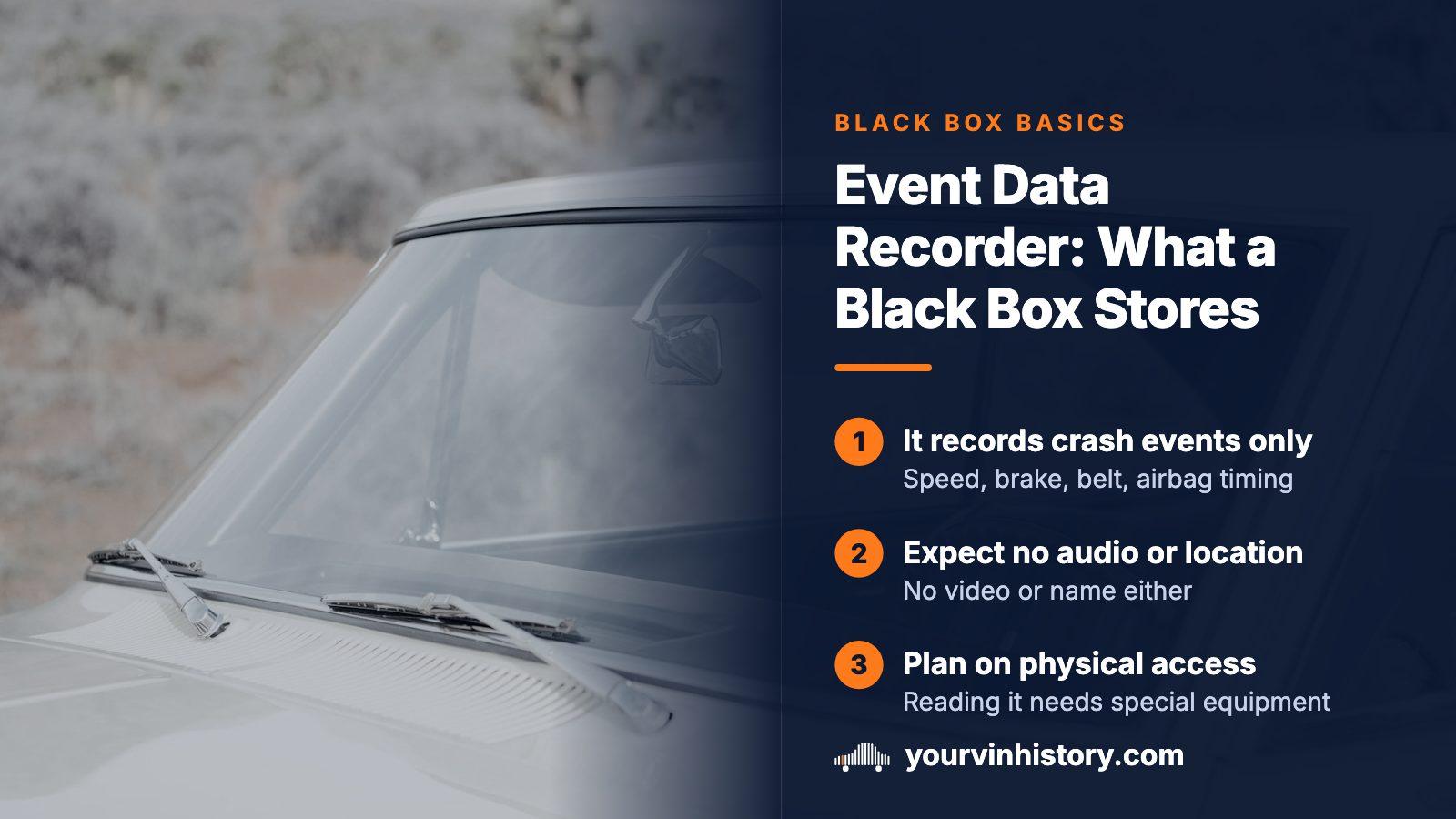
A car's black box is an event data recorder. It stores data only when a crash-level event occurs: speed, throttle or accelerator position, brake on or off, driver belt status and airbag timing, covering about 5 seconds before impact at 2 readings per second, plus roughly a quarter second of impact data. It captures no audio, video, name or location. Reading it takes special equipment and physical access to the car, so no VIN lookup includes it.
- Pre-crash window
- About 5 seconds at 2 readings per second on cars sold now
- Impact data
- 0 to 250 ms after time zero, 100 readings per second
- Manual wording
- Total recording time described as typically 30 seconds or less
- Personal data
- None recorded, per the required manual statement
What the black box is, and what it leaves out
The nickname borrows from aircraft, but a car's version is modest. Federal rules define an event data recorder as a device or function that saves a vehicle's time-series data in the moments before and during a crash, meant to be pulled out afterward. Audio and video are explicitly outside that definition, so no cabin conversation and no camera footage sits in this record.
In many cars it is not a separate box but memory and software inside an electronic control module, often the one that decides when to fire the airbags. That matters later, because replacing the module can replace the memory with it.
The owner's manual has to say so
Federal rules require every covered vehicle's owner's manual to carry a set paragraph announcing that the car has a recorder. It says the unit records vehicle dynamics and safety system data for a short period, typically 30 seconds or less, with four examples: how systems were working, whether the driver and passenger belts were fastened, how far the accelerator or brake pedal was pressed, and how fast the car was moving.
That 30-second phrase is a general description, not the window in the data tables, which is narrower.
If the paragraph is in the manual, the car has a recorder. If the manual is gone, you lose the easiest confirmation, which says nothing about the recorder itself.
What makes it save anything
The recorder keeps a rolling buffer in temporary memory that is constantly refreshed. Nothing moves to permanent memory until an event occurs. The regulation defines an event as a crash or other physical occurrence that reaches the trigger threshold, or the deployment of any non-reversible restraint, whichever happens first. The threshold is a speed change of at least 8 km/h, about 5 mph, within a split second along the length of the car.
Every timing in the standard counts from time zero, the first of three things: the restraint control algorithm waking up, a small but measurable velocity change on a continuously running system, or a non-reversible restraint firing. Data from before that moment are pre-crash data, data from after it are crash data, and the two are timed separately.
Privacy: anonymous data that others can attach a name to
The required manual note answers the tracking worry directly: the recorder saves data only when a non-trivial crash occurs, nothing in normal driving, and no personal details, whether the driver's name, gender and age or where the crash occurred. Left out of the record:
- Audio or video of any kind
- The driver's name, age or gender
- Where the crash took place
- Anything from ordinary trips that never reached the trigger threshold
The same note then states the catch. Police and other parties can pair the readout with the identifying details they gather in a crash investigation, turning anonymous numbers into evidence about a particular driver. Part 563 sets what is recorded and who can obtain the tools, not who owns the data or when someone may demand it; other law handles that.
The data list, item by item
Table I in 49 CFR 563.7 lists what every covered recorder must save, timed from time zero.
| Item saved | When it is measured | Readings per second |
|---|---|---|
| Change in speed along the car's length (delta-V) | 0 to 250 ms after time zero | 100 |
| Peak delta-V and the moment it occurred | 0 to 300 ms after time zero | Single value |
| Indicated vehicle speed | 5.0 seconds before time zero, on cars built before the phase-in | 2 |
| Throttle or accelerator pedal percent, and brake on or off | Same pre-crash window | 2 |
| Driver belt status | 1 second before time zero | Single value |
| Frontal airbag warning lamp, on or off | 1 second before time zero | Single value |
| Frontal airbag firing time for the driver and front passenger | At the event | Single value |
| Ignition cycle count | At the crash, and again at the download | Single value |
| Complete file recorded, yes or no | After the other data | Single value |
The ignition cycle pair is a quiet clue: the recorder logs its power-cycle count at the crash, and the download reports the count at read time, so the gap roughly measures how many starts followed. A second table adds items required only if the maker's design already records them, such as engine rpm, ABS activity and steering input.
Why a used car holds five seconds, not twenty
The headline pre-crash window in the table is 20 seconds at 10 readings per second, and many articles quote it as if it already applies. A footnote turns it into a phase-in, and as of this update the phase-in has not begun for any car you can buy used.
- Built before September 1, 2028: 5.0 seconds before impact at 2 readings per second.
- Built from September 1, 2028: a growing share of each maker's recorder-equipped output must carry the 20-second, 10-per-second version, starting at 25 percent in the first production year.
- Built on or after September 1, 2031: the longer version applies broadly, with later dates for small-volume and limited-line makers and for makers of altered or multi-stage vehicles.
Ten readings of speed, throttle and brake is what to expect from a used car: a rough sketch of the last few seconds, not a replay of the drive.
Two impacts, locked deployments and the completeness flag
Crashes rarely stop at one impact, so the standard allows for two. A multi-event crash is two events starting no more than 5 seconds apart, and the recorder notes the count and the time between them.
How long a saved event survives depends on its type. When a frontal airbag deploys, or a side airbag on a car that records sideways velocity change, the memory holding that event is locked against overwriting. Smaller events that deploy nothing are saved up to two at a time, and when no free buffer remains the maker may overwrite an earlier one or skip the new one. Part 563 sets no expiry date for a stored record.
Every record also ends with a yes or no flag, complete file recorded. A no means the write was cut short, for instance by lost power, so a partial record should never be read as the whole event.
A blank readout is weak evidence
Because non-deployment events can be overwritten or skipped, an empty recorder does not prove a car was never hit. A deployment record is sturdier.
Who can read it, and what that takes
Reading a recorder takes special equipment and access to the vehicle or the recorder itself. According to the manual statement, parties besides the manufacturer, such as law enforcement, can read the data if they have the equipment and the access.
The rule also puts a duty on makers: each must ensure a retrieval tool is commercially available within about three months of the car's first sale to a customer, so investigators and researchers can buy the capability instead of depending on the manufacturer.
Part 563 does not require the data to be transmitted off the vehicle. The record stays in the car, which is why a buyer cannot pull it up remotely.
Whether a particular car has a recorder
Part 563 applies to covered vehicles that are equipped with a recorder; it does not order every vehicle to have one. Covered vehicles are passenger cars, multipurpose passenger vehicles, trucks and buses below set weight limits, with walk-in van-type trucks and vehicles built only for the U.S. Postal Service left out. The rule starts at a production date more than a decade back, so a recorder in an older car follows the maker's own design instead.
That is why no model-year cutoff settles it. Most recent light vehicles carry a recorder, but the dependable check is the owner's manual paragraph.
When a read is worth arranging on a purchase
For a routine used-car purchase, a recorder read is overkill. It fits a narrow situation: one disputed fact about one event, where the cheaper records do not settle it.
- Photos or records point to an airbag deployment, but the seller denies any serious crash
- A seller calls a past impact minor, and you want to see what the car logged
Even then, the limits are real.
- The tool has to be connected to the car, so the read belongs with an inspection
- It describes what happened in an event, not whether the repairs were done properly
- A replaced module holds nothing from before the replacement
- A blank result proves little, since minor events can be overwritten
What a VIN check covers in the meantime
The recorder's contents live in the car, so no VIN-based service reads them. Free federal tools still cover the surrounding questions. The NHTSA recall lookup returns open campaigns for a VIN at no charge, restraint system campaigns included, and the vPIC decoder returns the federal build record, which holds no recorder data.
A yourvinhistory report draws on records kept outside the car: title brands, reported accidents with a damage map, salvage and auction records with photos, and open recalls. A free preview shows what turns up for a VIN before you decide on a report.
- Find the recorder paragraph in the owner's manual.
- Run the NHTSA recall lookup, restraint campaigns included.
- Review title brands, accident records and auction photos.
- Ask the seller whether airbags deployed or a restraint module was replaced.
- Only then consider a physical read, for one disputed fact.
Where this information comes from
- eCFR: 49 CFR Part 563, Event Data Recorders — Source for the definitions, the data element tables, the pre-crash phase-in footnote, the capture and locking rules and the duty to make retrieval tools available.
- eCFR: 49 CFR 563.11, Information in owner's manual — Source for the required manual paragraph, including the privacy note and the statement about who can read the data.
- NHTSA: Recalls — Government lookup for open safety campaigns by VIN, restraint system campaigns among them.
- NHTSA: vPIC VIN decoder — Federal decoder that returns manufacturer-reported build details and nothing from a recorder.
Sources and photos: Facts checked against the sources above in October 2026. Photo by Obi on Unsplash; diagrams by YourVINHistory.
Keep reading
- Airbag deployed checkThe physical evidence a deployment leaves behind, which a recorder read would back up.
- VIN accident checkWhat accident records show and what stays out of them.
- Pre-purchase inspectionThe hands-on exam where a recorder read would be arranged.
- Recall check by VINHow to run the open-recall search for restraint system campaigns.
Frequently asked questions
Does a car's black box record audio or video?
No. The federal definition leaves out audio and video data, and what it saves is numeric: speeds, percentages, on or off states and timings. A dash camera or any other device that films or listens is separate equipment, outside this standard.
Can police read an event data recorder?
The manual statement says other parties, law enforcement among them, can read it with the right equipment and access to the vehicle or recorder. Part 563 covers the technical side only. When someone may legally demand or use the data is a question for other law, so ask a lawyer.
Does unplugging the battery wipe the recorder?
The standard describes saved event data as sitting in non-volatile memory, which keeps its contents after power is lost. The completeness flag exists because power can fail while a record is being written, but a saved event is not meant to disappear just because the car lost power.
How long does a recorder keep a crash record?
Part 563 sets no expiry date. A deployment event is locked so later events cannot overwrite it. Other events share limited space, so a newer one can replace an older one or be skipped. The 10-day figure in the crash-test rules is a lab survivability check, not a retention period.
Can I check a used car's recorder before buying it?
Not with a VIN lookup, because the data sits in the car and nothing in the rule sends it elsewhere. A read needs the retrieval tool connected to the vehicle, so it means asking a shop or examiner that owns the tool, with the seller's agreement to let them work on the car.
Now check the car itself
The guide explains what to look for. The report shows what this VIN has on record.