THE SHORT ANSWER
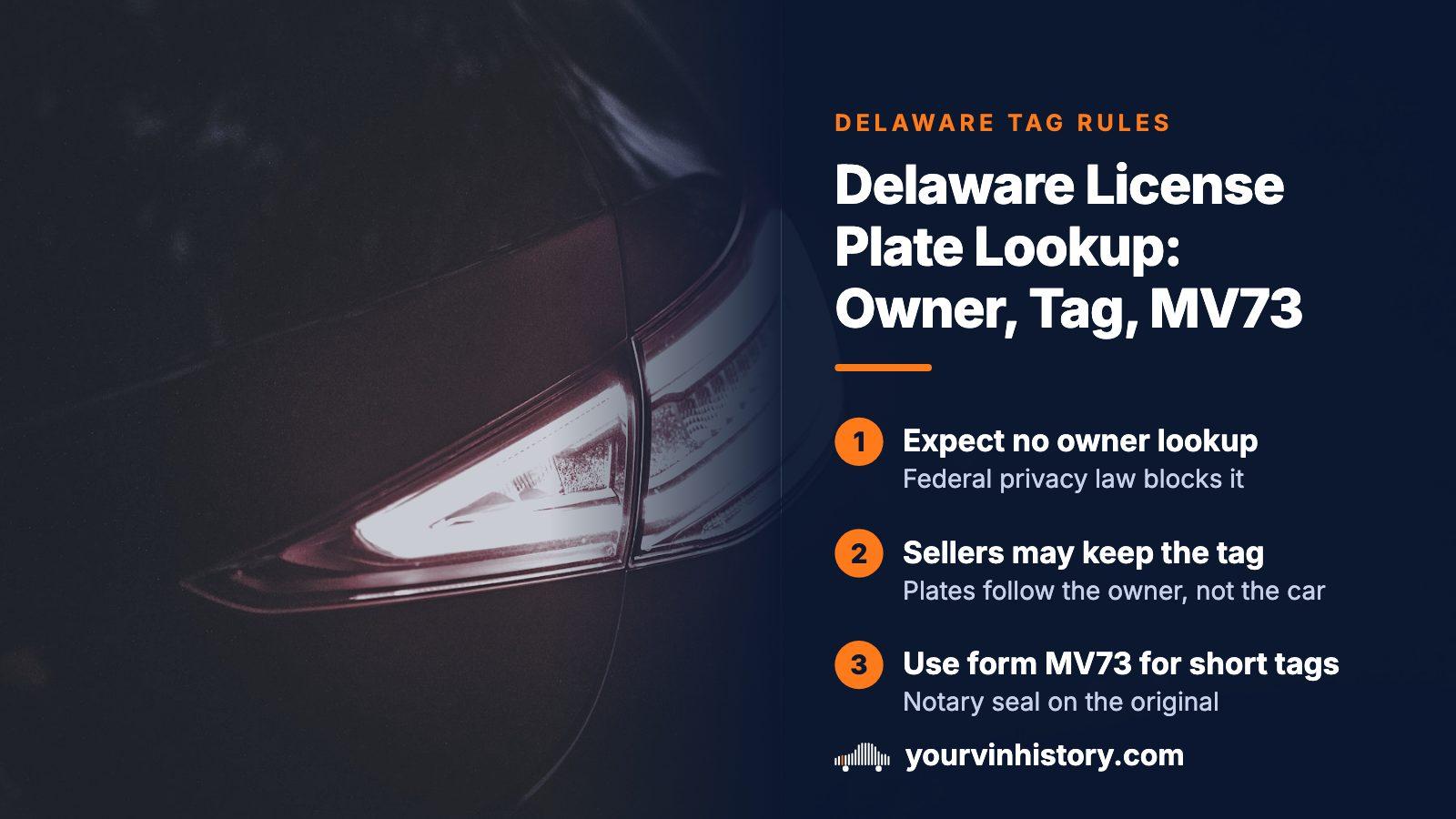
No lawful public tool returns a Delaware plate's owner; the Driver's Privacy Protection Act limits motor vehicle records to listed uses. Delaware owners may retain a plate when they sell, trade or gift a vehicle, so the tag on a car proves little. A scarce plate can go with the car only through a notarized seller's affidavit, form MV73. For checking a used car, work from the VIN, not the tag.
- Owner name
- Not available from a plate under federal privacy law
- Default at sale
- The seller may keep the plate
- Low-digit form
- MV73, original with a notary seal
- Pleasure plates
- Affidavit applies at 4 digits or lower
What a Delaware plate search can return, and what it cannot
The Driver's Privacy Protection Act, codified at 18 U.S.C. 2721, tells state motor vehicle agencies not to knowingly release personal information from their records. It then carves out exceptions, and Delaware's DMV works inside the same framework as every other state. The exceptions include:
- government agencies, courts and law enforcement
- vehicle safety, theft, emissions and recall work
- insurers handling claims, fraud checks and underwriting
- court cases, service of process and preparation for litigation
- licensed investigators, but only for one of the permitted purposes
- notices to owners of towed or impounded vehicles
- employers verifying commercial driver's licenses
Idle curiosity about a driver, or a wish to track down whoever left a car parked on your street, does not qualify, so no lawful public service will name an owner from a Delaware tag. What a plate can sometimes lead to is a vehicle, and in Delaware even that link is shakier than usual.
Why a Delaware tag follows the owner more than the car
In many states the plate belongs to the vehicle. Delaware's DMV treats it differently: an owner may retain the plate from any vehicle that is sold, traded or gifted, whether the buyer is a dealership or a neighbor. Retaining puts the tag number on hold until its sticker runs out.
Once retained, the plate can be moved onto another vehicle registered in the owner's name, held for a later purchase, or given to a different person. A single Delaware number can therefore sit on three cars in a few years. A tag spotted in a classified ad, a dashcam clip or a parking lot tells you who holds that number today, not what the car went through before.
The practical rule for a buyer is to copy the VIN from the dash and from the title, and let the plate stay in the background. The 17-character VIN is the one identifier that stays with the machine.
How a Delaware seller holds on to a plate
The DMV's tag retention page lays out the mechanics. A seller retains the plate in person at a DMV location, or applies online when the vehicle is being sold to someone out of state. The visit calls for the Delaware title. Where the title joins owners with AND, every owner must be present; where it says AND/OR, one owner can handle it.
- A financed vehicle needs a lienholder form, and the lender must mail the title to the DMV before the retention can be processed.
- Proof of Delaware insurance is required if the plate is moving to another vehicle, or a different tag is going on the same one.
- Fees depend on whether the vehicle being tagged carries a lien and on how much registration time is left on the retained tag.
- Eligibility can turn on vehicle type, tag type, registered weight, commercial use, model year and inspection requirements.
One warning on that page matters to sellers more than buyers: letting the vehicle go with the plate still attached, without retaining it first, costs the owner the number. A buyer who sees plates on the car should ask whose number it is and whether it stays.
Bringing a retained tag to a dealership
A buyer who already holds a retained tag has a step to complete before the purchase. According to the DMV, the tag must be retained ahead of time, and the dealership must write the tag number on the paperwork it sends to the DMV so the number can transfer to the new vehicle.
Some dealers will help with the retention, so raise it when you start negotiating rather than at signing. Before you leave, read the contract and the registration paperwork and confirm your tag number appears on them. A number left off the dealer's submission is the kind of omission that is easy to fix at the desk and annoying to fix afterward.
What goes on form MV73
Form MV73 is a seller's sworn statement that a low-digit plate is changing hands along with a car. Its blanks cover the seller's printed name, the plate number, the buyer, and the car's make, model, year and VIN. The seller signs and dates it. If the registration joins two names with AND, a second seller signs as well.
Then comes the notary. The signature is sworn before a notary public, and the DMV says it needs the original showing a raised or stamped seal. Every block on the form must be filled in.
Copies do not count
A scan, a phone photo or a photocopy is not what the DMV asks for. Before leaving the notary, decide who will carry the signed original to the DMV counter.
Why the VIN is printed on the form, and why you should check it
The DMV states its reason plainly: the affidavit protects the Division, dealers and buyers from disputes over who owns the plate. A scarce number has value apart from the car, and that is where arguments start. Without a sworn paper naming the plate, the buyer and the vehicle, a seller could later insist that only the car was sold, and the buyer would have little beyond memory of a conversation.
The VIN is what ties the number to one particular vehicle. Read it yourself off the dash plate or the door-jamb label, then compare it with the title and with the form before anyone signs. A mismatch is a problem better found in the driveway than at the counter.
Buying a Delaware car that comes with a short tag
- Put it in writing whether the plate is part of the sale. Silence on the point invites an argument later.
- Ask the seller to read the plate class off the registration rather than guessing.
- If the class and digit count match the form's list, require a notarized MV73 with the original seal.
- Check that the VIN on the form matches the car and the title.
- Handle the title and the affidavit at the same meeting, and agree who takes the original to the DMV.
- Register the vehicle in your name with the tag you were promised, a newly issued one, or the transferred number, depending on the deal.
Price the number separately
A short plate can make a deal feel special. Agree a price for the car, then a price for the plate, and write both down. A low number says nothing about brakes, accident history or title status.
Checks that still work when the plate has moved
Because a plate can be swapped in an afternoon, vetting a Delaware car happens at the VIN. Decode the number for the factory build and run NHTSA's recall lookup, which costs nothing. Screen it with the NICB VINCheck for theft and salvage flags, also at no charge. The federal NMVTIS record then adds title brands reported by the states, which counts for more in a small state hemmed in by Maryland, Pennsylvania and New Jersey, where inventory moves across borders easily.
A yourvinhistory report starts with a preview and then offers a one-time purchase. It lines up NMVTIS title records, supplied by ClearVin LLC as an approved NMVTIS data provider, beside accident entries, odometer readings, salvage and auction photos, liens and open recalls. Treat any report as a screen: it shows what was reported, and a physical inspection still comes first.
Where this information comes from
- Delaware DMV: Seller's Affidavit to Transfer a Low-Digit Tag with Vehicle — The form text itself: which plate classes it covers, the digit limits, the notary and original-copy requirement, and the reason it gives for existing.
- Delaware DMV: Tag retention — Backs the right to keep a plate when selling, trading or gifting, the options for a retained plate, the documents needed and the dealership step.
- Driver's Privacy Protection Act, 18 U.S.C. 2721 — The federal rule that stops state motor vehicle agencies from releasing owner data outside a defined list of permitted uses.
- Bureau of Justice Assistance: NMVTIS — The federal title information system behind consumer title-brand reports, pulled from the states rather than from a plate.
Sources and photos: Facts checked against the sources above in October 2026. Photo by Maurice Sahl on Unsplash; diagrams by YourVINHistory.
Keep reading
- License plate lookupThe federal privacy limits on what any plate search can return, beyond Delaware.
- DelawareWhat the DMV handles at titling in Delaware, including the inspection and the document fee.
- Bill of sale for a carWritten proof of the sale, a good place to record whether the plate is included.
- Where is the VIN number?Where to read the VIN on the car so you can match it to the title and the affidavit.
Frequently asked questions
Can I find out who owns a Delaware license plate?
Not through any lawful public service. The Driver's Privacy Protection Act limits owner details in motor vehicle records to listed uses such as insurance claims, court cases and licensed investigation. If a plate matters because of a crash, a crime or harassment, give the number to the police or your insurer and let them make the request.
Does the plate stay on the car when I buy it in Delaware?
Not by default. The seller may retain the plate, so plan on registering the car under your own retained tag, a newly issued one, or a transferred number if the sale includes it. A scarce tag goes with the car only if the deal says so and, for the classes on the form, a notarized affidavit backs it. Ask before you pay.
How long can I hold a Delaware plate after selling the car?
Retaining holds the number until its sticker expires, and the plate must be attached to a vehicle before then or it is lost. If you keep the vehicle and simply stop using the plate, the DMV says the number stays assigned for up to one year after the tag expires. Check your own expiry date at the DMV.
Is a plate check the same as a VIN check?
No. A VIN check reads records attached to one vehicle, such as recalls, theft flags and title brands. A plate is a registration tag that the owner can move, so it points to a vehicle only loosely. If the ad shows only the plate, ask the seller for the VIN or a photo of the dash plate and run that.
Does a short Delaware plate mean the car is valuable or well kept?
No. The number reflects how scarce its digits are and who held it, nothing about maintenance, accident history or title status. Judge the car on its condition and records. Treat a short number the seller is including as a separate item with its own price, and have the paperwork match what you agreed.
Now check the car itself
The guide explains what to look for. The report shows what this VIN has on record.