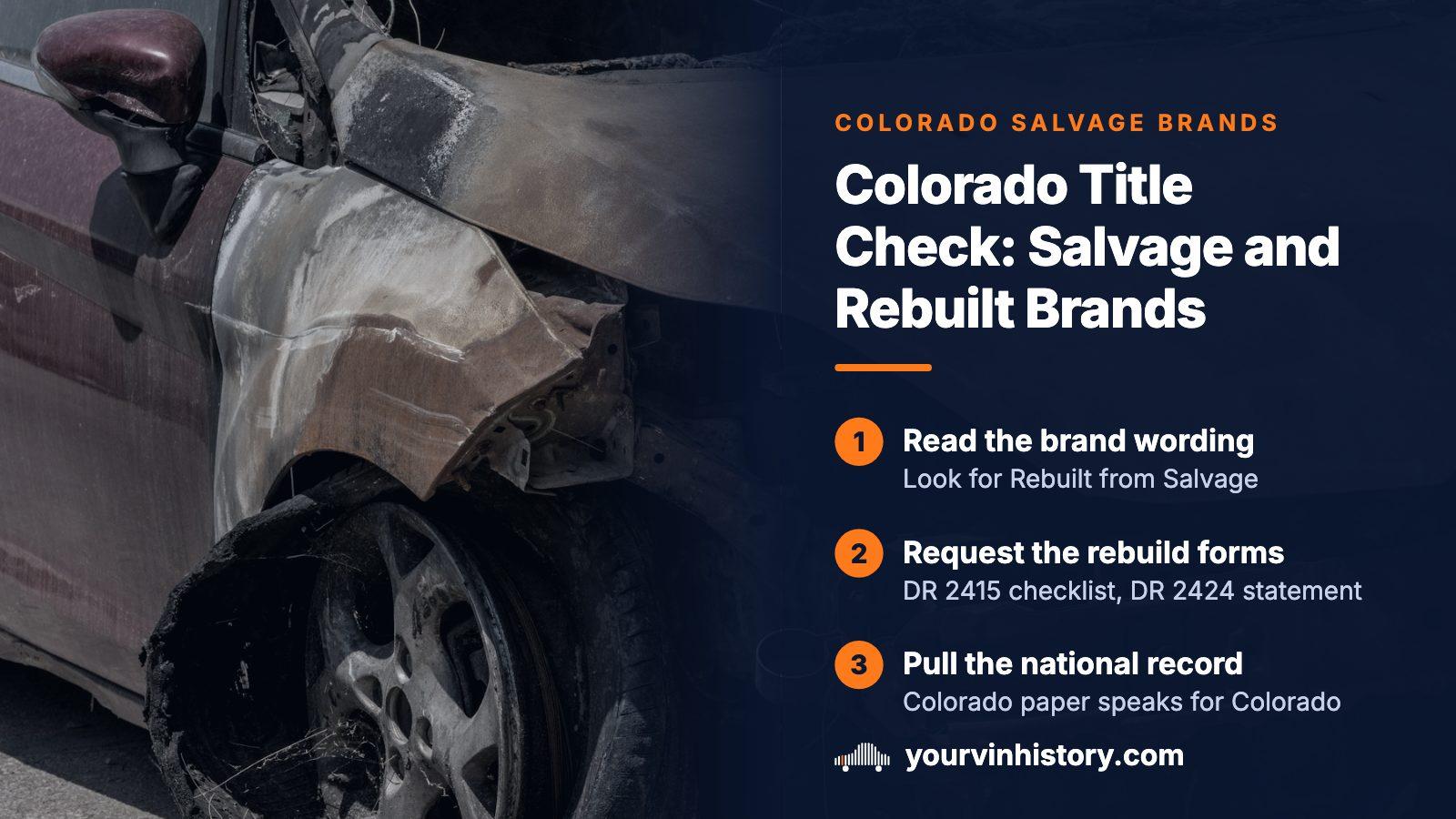
THE SHORT ANSWER
Colorado calls a vehicle salvage when making it safe to drive again would cost more than its retail market value just before the damage. It cannot be registered until it meets the statutory roadworthy definition and the state issues a Rebuilt from Salvage title. Check the brand wording, ask the seller for the rebuild forms, and pull the national NMVTIS record, because a Colorado document only speaks for Colorado.
- Salvage line
- Repair cost above pre-damage retail value
- Registration
- Blocked until roadworthy and retitled
- Brand wording
- Rebuilt from Salvage
- Rebuild forms
- DR 2415 checklist, DR 2424 statement of facts
How a Colorado car earns the salvage brand
Colorado's test comes down to two figures. One is the cost of repairing the vehicle so that it is safe on the road. The other is what the vehicle would have sold for at retail just before the damage, whether the cause was a crash, a fire, a flood or something similar. When the first figure is larger than the second, the car is a salvage vehicle under the state's definition.
Two details in that wording matter to a buyer. The yardstick is the full retail market value, not some fraction of it. And the repair side is measured by what it takes to make the car safe to drive, so the test is built around safety rather than appearance.
Why a clean Colorado title proves less than it seems
A threshold set at the full pre-damage value is demanding. A vehicle can take serious damage and still come in under it, and in that case no salvage brand ever lands on the title. Colorado sits with Texas on this point, and both sit well above the 70 to 80 percent line that many other states use.
So an unbranded Colorado title tells you one narrow thing: the repair bill never passed the state's line. It does not tell you the car escaped a collision. A newer, valuable car can absorb a great deal of repair cost before it crosses, while an older car worth little crosses on a modest bill. Treat a clean title as the absence of one specific finding, then look for other evidence of damage in the records and on the car.
Two conditions between a salvage car and a license plate
Colorado does not allow a salvage vehicle to be registered simply because somebody repaired it. Registration waits on two separate things, and both have to be finished.
Both conditions, and neither replaces the other
First, the vehicle is repaired until it satisfies the roadworthy definition in the Colorado Revised Statutes. Second, the state issues a Rebuilt from Salvage certificate of title. Repairs without the new title leave the car unregistrable. A new title does not cure a car that never met the standard.
The state's rebuild checklist points to the roadworthy definition in section 42-6-102. This is the step sellers tend to blur. A car advertised as repaired and ready may have completed the first condition and skipped the second. You are paying for a vehicle you can legally put on the road, so confirm both steps with documents instead of the seller's word.
Reading the exact words on the title
Colorado spells its rebuilt designation out in full: Rebuilt from Salvage. It is not squeezed into a code or an abbreviation, and the state's own forms use the same phrase from start to finish.
That precision helps when you read listings, because sellers use the word rebuilt loosely and rarely say which state issued the brand. A Colorado title reading Rebuilt from Salvage means the Colorado process was completed. A title from another state that only says rebuilt was issued under that state's rules, so look up what that state means by it before assuming anything. And if the document says salvage with no mention of rebuilt, the car has not yet finished the process and cannot be registered as it stands.
Total loss, salvage and rebuilt are three different labels
Buyers use these words as if they were synonyms. They describe different events and tend to live in different records.
| Label | What it reflects |
|---|---|
| Total loss | An insurer's settlement decision on one claim |
| Salvage | A safe-road repair bill larger than retail value just before the damage |
| Rebuilt from Salvage | A former salvage car that passed the roadworthy standard and received a new title |
A bill numbered HB16-1293 proposed a dedicated total loss brand for Colorado titles. The legislature's bill page lists it as lost, so do not expect a Colorado title to announce a total loss on its own. Reported total losses are something national records collect, which is one more reason the state document should not be your only source.
The paperwork a proper rebuild leaves behind
Colorado publishes a checklist for obtaining a rebuilt title from a salvage title, form DR 2415, and a statement of facts, form DR 2424, that the person doing the rebuild completes. Because the state asks for these, a seller who went through the process should be holding a file.
- Ask to see the completed checklist and statement of facts, or copies of what was filed.
- Ask for the Rebuilt from Salvage title itself and compare its VIN with the number on the car.
- Ask for repair invoices and photos taken during the work, which a seller proud of the job should be glad to share.
- Ask who did the structural repairs and whether that work can still be examined.
Treat vagueness as information. A rebuild the state expects to be documented should be easy to document for you, and a seller who says the papers are lost on a branded car has given you a reason to slow down.
How Colorado's rule compares with other states
Salvage tests differ widely, which is why one state's paper cannot settle a question about a car that has moved. The same wreck can be branded in one state and stay clean in another.
| State | Where the brand attaches |
|---|---|
| Colorado | A safe-road repair bill larger than retail value just before the damage |
| Texas | Repair cost above the actual cash value just before the damage |
| Many other states | A percentage of value, commonly in the 70 to 80 percent range |
| California | No percentage; the car is judged uneconomical to repair and is left unrepaired |
In practice, a car that spent years in a state with a lower threshold may arrive in Colorado carrying a brand that Colorado's own test would never have applied. Verify the whole history of the vehicle, not only the latest title.
Records that cover what a Colorado document cannot
A Colorado title speaks for Colorado. The national NMVTIS record is the one that catches a brand from wherever the car lived before, along with reported total losses, and it is sold only through approved data providers that the federal NMVTIS page lists.
A yourvinhistory report takes its NMVTIS title records from ClearVin LLC, an approved NMVTIS data provider, and adds accident, salvage and auction records with photos where they exist. You see a free preview first and decide whether to buy. Whichever provider you use, the question to ask of the result is the same: does any earlier state show a brand that the Colorado paper does not?
A check sequence before you pay for a Colorado rebuild
- Decode the VIN and match the year, make, model and engine to the title and to the car itself.
- Read the brand wording. Rebuilt from Salvage is Colorado's phrase, and anything else needs an explanation of who issued it.
- Collect the rebuild forms, or copies of what the rebuilder filed.
- Pull the national NMVTIS record for brands and reported total losses from any earlier state.
- Run the NHTSA recall lookup and the NICB VINCheck. Both are free tools from others.
- Have an independent inspector examine the car against the state's own test, safe road use, looking at structure and brakes first.
Recall status is separate from the title brand, so a rebuilt car can still carry an open recall. Manufacturers generally repair open recalls at no charge to the owner, but very old vehicles can fall outside the federal free-repair rule, so confirm the repair with a dealer before you count on it.
Where this information comes from
- Colorado DMV: salvage vehicles — The state's own wording for the salvage definition, the Rebuilt from Salvage brand and the roadworthy condition before registration.
- Colorado DMV: form DR 2415, rebuilt title established by salvage title — The checklist behind a rebuilt title, and the place the roadworthy statute is cited.
- Colorado DMV: form DR 2424, Rebuilt from Salvage statement of facts — The statement a rebuilder completes, and a piece of the paper trail a buyer can ask to see.
- Colorado General Assembly: HB16-1293 — A proposed total loss brand and how it would have interacted with salvage; the bill page shows it as lost.
- NMVTIS: official vehicle history record — The federal system behind national title brand and total loss records, with its roster of approved providers.
- NHTSA: recalls — Lookup of open safety recalls by VIN, which works regardless of what the title says.
Sources and photos: Facts checked against the sources above in October 2026. Photo by engin akyurt on Unsplash; diagrams by YourVINHistory.
Keep reading
- ColoradoRegistration, emissions and the state's own lookups for the same buyer.
- What is a rebuilt title?What a rebuilt brand does to value, coverage and loans, wherever it was issued.
- Total loss threshold by stateWhy one wreck is branded in one state and clean in the next.
- NMVTIS reportThe national record that catches brands placed in other states.
Frequently asked questions
Can I register a Colorado salvage car after repairing it myself?
Not on the repairs alone. The vehicle has to meet the statutory roadworthy definition and the state has to issue a Rebuilt from Salvage title before registration is possible. If you are weighing a purchase, work out the cost and time of that whole process first, or pay only for a car that already carries the rebuilt title and can show its forms.
Is a Colorado total loss the same as a salvage title?
No. A total loss is an insurer's decision about one claim, while salvage is a state test that compares repair cost for safe road use with pre-damage retail value. A car can be a total loss on a claim file without crossing the Colorado line, so a clean title does not rule out a past total loss.
What is the difference between a salvage title and a Rebuilt from Salvage title?
A salvage brand marks a damaged vehicle that has not finished the rebuild process and cannot be registered. Rebuilt from Salvage marks the same vehicle after it was repaired to the roadworthy standard and retitled. The second brand allows registration, but it still tells every later buyer the car was once salvage, so verify the work and the paperwork.
How can I check a Colorado title brand with just the VIN?
Use the VIN to pull the right records. Decode it to confirm what the car is, get the national NMVTIS record for brands and reported total losses, and run the NICB VINCheck for theft and salvage flags. Then compare all of it with the paper title the seller shows you. A mismatch between the two is the finding worth acting on.
Does a Rebuilt from Salvage title mean the car is safe?
It means the car was repaired to the state's roadworthy definition and retitled, not that every repair was done well. The state's test centers on safe road use, which is the same standard an independent inspector should apply, with structure and brakes first. Ask for the rebuild forms, and pay for an inspection before you pay the seller.
Now check the car itself
The guide explains what to look for. The report shows what this VIN has on record.