THE SHORT ANSWER
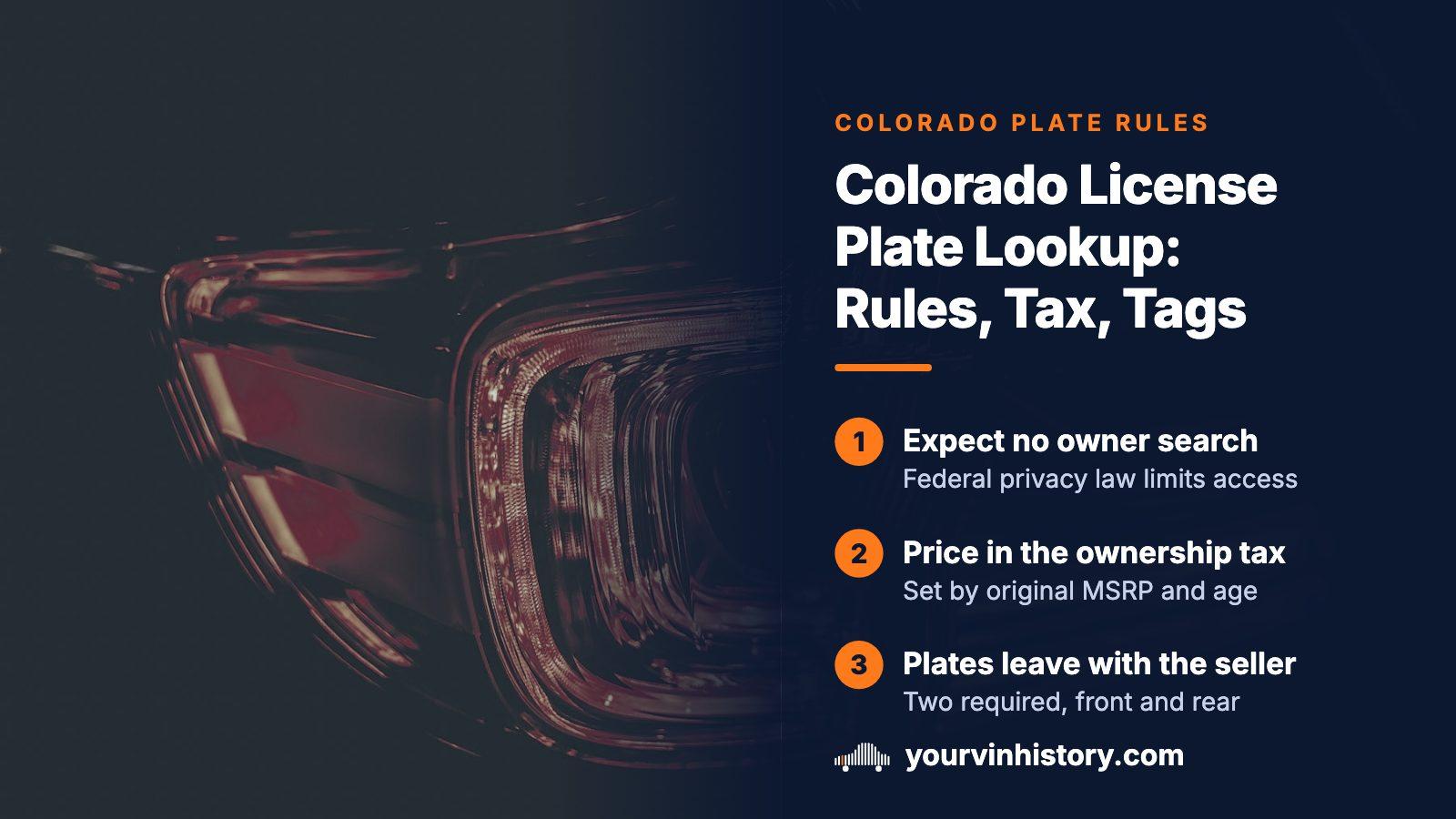
No public Colorado search turns a plate into an owner, since the federal Driver's Privacy Protection Act limits who may see that record. A buyer's practical lookup runs on the VIN: decode the build, check open recalls and pull the title history. The plate still teaches something. Two are required, the seller keeps them, and renewals are priced from the car's original MSRP and age.
- Owner search
- Closed to the public, permitted uses only
- Plates required
- 2, front and rear
- Renewal cost
- Specific ownership tax, set by original MSRP and age
- At a sale
- Plates stay with the seller
What a Colorado plate gives away, and what it keeps private
Read a plate on a car you are thinking of buying and you learn less than you might hope. The characters point to a registration record at the state, but an ordinary buyer cannot search that record by plate. Owner names and addresses sit behind the Driver's Privacy Protection Act, a federal law restricting how motor vehicle agencies share personal details from their files. Colorado follows it, so a plate number typed into a website does not produce a legitimate owner lookup.
What the plate does give you is circumstantial. The design shows whether the owner paid for a specialty or personalized plate. The tag's condition, or its absence, raises questions worth putting to the seller. The tax paid at the last renewal hints at how the car was priced when new. None of that replaces a record check, but it tells you which questions to ask first.
Who can lawfully get owner details from a plate
The federal law lists permitted uses, and a curious shopper is not on the list. Insurers handling a claim qualify. So do parties to a lawsuit, employers checking commercial drivers, and licensed investigators working within the statute. In practice the lawful private routes come down to three:
- Police, who can run a plate when they have a reason, which is also how a hit-and-run gets traced.
- An insurer, once a claim is open on the vehicle.
- A court case or a licensed investigator acting inside the statute.
Sites that promise an owner name for a fee mostly resell old scraped data, and a buyer gains nothing from it. The broader federal picture, including the scams, is covered in the general license plate lookup guide on this site.
Specific ownership tax: why renewals vary so much
Colorado counties are funded in part by the specific ownership tax, and every registration and renewal collects it. The amount is not a flat fee. It is worked out from the vehicle's original MSRP, meaning the manufacturer's suggested retail price when new, and from how old the vehicle is. It shrinks on a fixed schedule as the years pass.
The result is two cars with identical-looking plates and very different bills. A recently built pickup carries a heavy charge in its early registrations. A well-worn station wagon renews for little more than the basic fees. If a seller still has several years of renewal receipts, you can watch the tax step down from one year to the next, which turns a stack of paperwork into a rough sketch of the car's life.
Pricing the tax into a newer-car purchase
Listings rarely mention the ownership tax, yet on a late-model car it can be the biggest line on the registration bill. Two similar cars with the same asking price can cost very different amounts once you are standing at the county counter.
- Confirm the model year and the original MSRP, because those two inputs drive the calculation.
- Expect the heaviest charge on the newest vehicles and the lightest on older ones.
- Set the tax aside separately from the purchase price, next to the title and plate fees.
- Compare cars of different ages with the tax added in, not only by asking price.
Treat this as part of the negotiation. A seller who parked the car to dodge a renewal is not likely to have mentioned what the next registrant will face.
When a newer car's plates have lapsed
A late-model car with expired Colorado plates deserves a closer look. One plausible reason is simple: the owner faced an expensive renewal and let it go. Whoever registers the car next then has to catch up, late fees included, and if you are that person the bill is yours rather than the seller's.
Ask for the date of the last renewal and the reason for the gap. A car that sat in a garage and a car left behind after a wreck can look identical from the curb. A break in registration is a prompt to go and look for brands, accident entries and time spent out of state. If the seller expects you to absorb the catch-up cost, take it off the price.
County counters, state rules
The state DMV sets the rules, but registration happens at county motor vehicle offices. Denver, El Paso and Jefferson are among the counties, and each has its own windows, hours and wait times. Plates, the ownership tax and renewals are county transactions, while titles and the records behind them are handled at the state level.
For a buyer, the purchase becomes official at the county office where the car will be kept. Busy offices can book out, so plan the visit early enough that any temporary paperwork does not run short. If your county requires an emissions test, finish that before you go.
Registering a purchase when the plates leave with the seller
Colorado plates belong to the seller and come off at the sale. The buyer goes to the county motor vehicle office, settles the ownership tax together with the fees, and walks out with plates of their own. A sensible order of operations looks like this:
- Collect the title with the seller's signature and the odometer disclosure, and compare the names against photo ID.
- Estimate the ownership tax so the total at the counter holds no surprises.
- Complete an emissions test first if your county calls for one.
- Visit the county office for the title, taxes, fees and plates in a single trip.
- Mount two plates, and remove any paper tag that came with the deal.
Two plates, and what a missing one suggests
Colorado calls for a plate on the front and another on the rear. A Colorado-titled car with a bare nose is not always a deliberate violation, but it is worth a question. The missing plate can point to front-end repair work, a replaced bumper, or a stretch of life in a state that asks for only one plate.
A bumper with no mounting holes tells you the car probably spent time somewhere else, or was serviced in a way that left no mark. Either story shows up in records a buyer can pull, such as title transfers, accident entries and repair-related reports. Ask the seller where the car has lived and see whether the answer matches the history.
Plate designs you will see on Colorado roads
| Plate type | What it tells you |
|---|---|
| Standard mountain base | The everyday design, long in use and updated rather than replaced, so a departure from it stands out |
| Retro and blackout | Optional alternative bases that cost extra and fund state programs |
| Specialty and collegiate | Causes, universities and parks, each with its own series |
| Personalized | Characters picked by the owner, subject to state approval |
| Collector or horseless carriage | For qualifying older vehicles, with expectations about how they are used |
A specialty plate says something about the owner, never about the car. The one design that matters to a buyer is the collector plate: ask what use expectations come with it before assuming you can drive the car every day.
Hail and magnesium chloride: damage no plate will show
Colorado's signature damage comes from the sky and the road. Hail dimples roofs and hoods, and paintless dent repair can hide a storm from a quick look, so inspect the panels with the light at a low angle and ask about any dent work. Mountain counties treat their roads with magnesium chloride, which corrodes underbody parts much like coastal salt air does. Get under the car with a flashlight.
A VIN report fills in what eyes cannot: title brands, accident entries with a damage map, odometer readings and open recalls. The yourvinhistory report begins with a preview before you decide to buy, and NHTSA offers its own recall lookup by VIN at no cost.
Where this information comes from
- Colorado DMV: vehicle registration — State starting point for registration, plates and the county offices that handle the counter work.
- Driver's Privacy Protection Act, 18 U.S.C. 2721 — The federal statute that restricts release of personal information held in motor vehicle records.
- NMVTIS: National Motor Vehicle Title Information System — Federal program behind the national title and brand record tied to each VIN.
- NHTSA: recalls lookup — Government tool for checking a specific VIN against open safety recalls.
Sources and photos: Facts checked against the sources above in October 2026. Photo by A n v e s h on Unsplash; diagrams by YourVINHistory.
Keep reading
- License plate lookupThe national rules on permitted uses, scam sites and why the VIN is the better key.
- ColoradoHail, road-treatment corrosion and the other checks that matter for a Colorado car.
- Temporary tagHow long a paper tag lets you drive and what deadline follows.
- Colorado title checkHow Colorado brands a car and what the rebuilt steps look like on the title.
Frequently asked questions
Can I find out who owns a car from its Colorado plate?
Not as a private buyer. Under the Driver's Privacy Protection Act, owner information goes out only for defined permitted uses, and a Colorado record release has to fit one of them. If a car hit yours or damaged your property, give the plate number to police or your insurer, who can request the owner details through the proper channel.
How is the Colorado specific ownership tax calculated?
It starts with the vehicle's original MSRP and its age, and it is collected at registration and again at every renewal. The amount falls on a fixed schedule as the car ages. Because model year and original price drive it, two trims of the same model can land on different bills, so check the exact car you are buying.
Do Colorado plates stay on the car when it is sold?
No. The seller keeps the plates and takes them off at the sale. As the buyer you register the car through your county office, where the ownership tax is due on top of the fees. Bring the signed title and be ready for the tax to be the largest item on a newer car.
Does Colorado require a front license plate?
Colorado calls for two plates, one on the front and one on the rear. If a car you are viewing carries only a rear plate, ask where it has been registered and whether the bumper was ever replaced. A Colorado-titled car with no front mounting holes is worth a follow-up question.
Why do some Colorado cars still wear paper tags?
Backlogs at busy county offices stretched temporary tags well past their intended life, and the state later tightened the rules. A paper tag on a used car should match the title and bill of sale for issuer and dates. Expired paper means the registration is unresolved, so settle that before you hand over money.
Now check the car itself
The guide explains what to look for. The report shows what this VIN has on record.