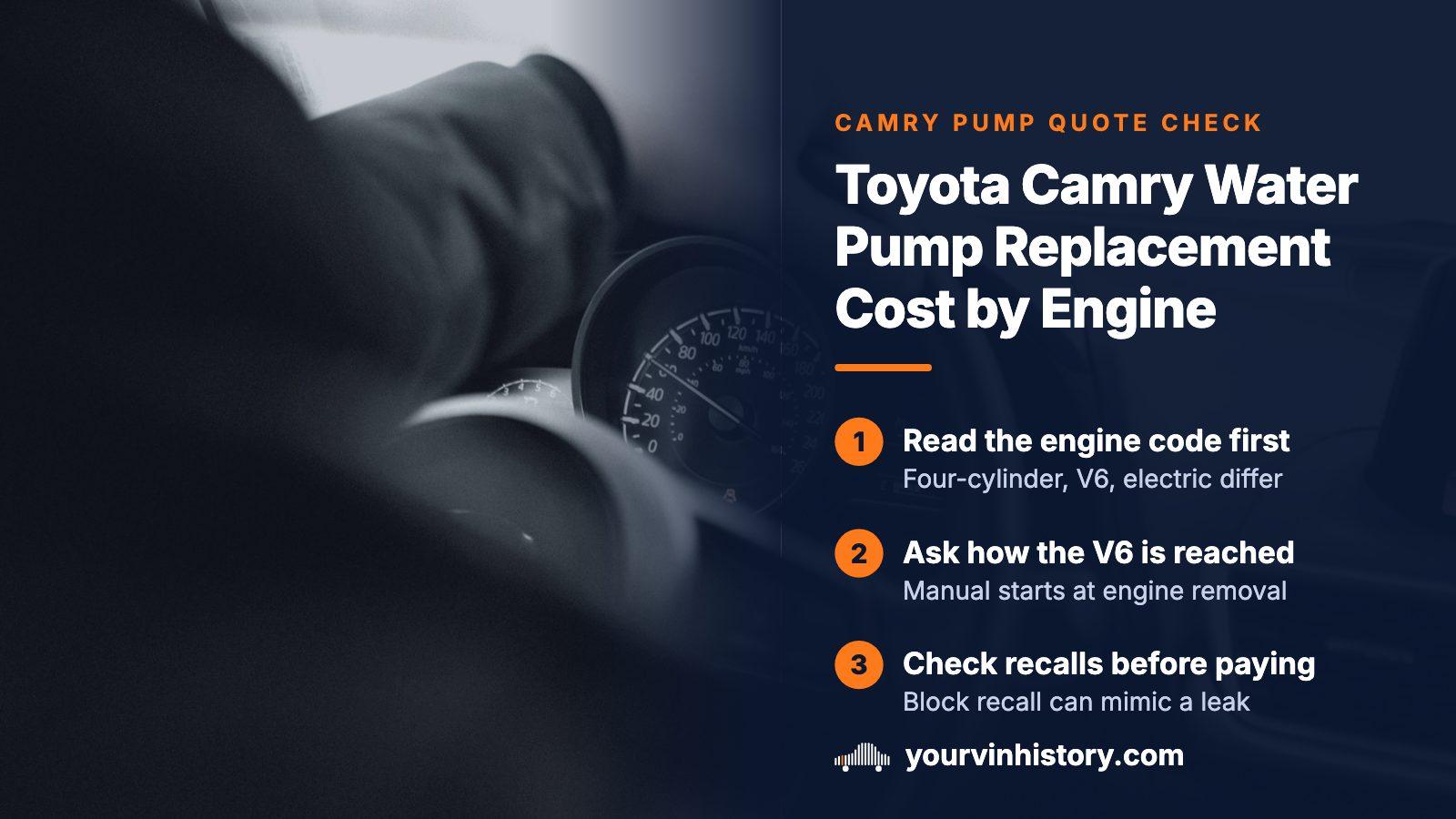
THE SHORT ANSWER
Published figures run from about $150 to $1,200, depending on who is counting and which engine they assume. RepairPal's Camry average is $625 to $807, and its pages for 2025 and 2026 cars show $836 to $1,052. The 3.5L V6 pump is buried deep enough to push a bill to the top of any range. NHTSA records show no recall for a Camry water pump.
- RepairPal Camry average
- $625 to $807
- Toyota V6 manual, step one
- Remove engine and transaxle
- 2018 four-cylinder bulletin
- T-SB-0323-17, code P26CB71
- Water pump recalls found
- None, 2007–2022 models
Four published ranges, and what each one measures
This site sets no repair prices. Every dollar figure here belongs to the publisher beside it, as displayed in October 2026, and none is a quote for your car.
| Publisher | Figure shown | What it stands for |
|---|---|---|
| RepairPal, Camry estimator | Average $625 to $807, with $313 to $460 in labor and $311 to $347 in parts | Model-wide average as of September 3, 2026 |
| RepairPal, year-specific pages | 2022 and 2023: $781 to $981. 2025 and 2026: $836 to $1,052 | Each sits above the model average |
| Kelley Blue Book | $375 to $787, parts and labor | Generic number shown without a ZIP code |
| Haynes, Camry pump guide | About $150 to $1,200; 1 hour 30 minutes to 12 hours | Spread across every Camry engine it covers |
KBB's own page says a local range needs a ZIP code, so its figure reads as a placeholder, not a Camry estimate. Haynes spans many eras, which puts its top end on the hardest engine in the set. RepairPal is the most specific, and its parts line shows labor carrying a large share of the total. Labor is what grows when a pump is hard to reach.
Pull the engine code before you collect quotes
From 2008 through 2022 the gas Camry carried four engines, and the water pump differs in location or design on three of them. The engine code in the VIN settles which applies.
| Engine | Model years | Where the pump sits and what drives it |
|---|---|---|
| 2.4L four, 2AZ-FE | 2008–2009 | Mounted at the front, spun by the accessory belt |
| 2.5L four, 2AR-FE | 2010–2017 | Same position and drive; belt and pulley come off first |
| 3.5L V6, 2GR-FE | 2008–2017 | Belt-driven but low and recessed, behind a bracket, two idlers and the tensioner |
| 2.5L four, A25A-FKS | 2018–2022 | Electric pump, controlled by the engine computer (Toyota bulletin) |
| 3.5L V6, 2GR-FKS | 2018–2022 | No Toyota document found; ask the shop to name the part |
An old habit says to replace the water pump whenever the timing belt is done. These engines do not have one. The 2AZ, 2AR and 2GR families all run timing chains, so a pump quote that includes a timing belt kit describes a different car.
The 2008–2017 four-cylinder is the baseline job
Most Camrys of these years came with a four-cylinder, so RepairPal's average fits them best. The pump sits low on the front of the block, driven by the serpentine belt. A technician removes the belt and pulley, undoes the mounting bolts and fits a new pump with a new gasket. Nothing major has to be pulled.
The cost questions are about what gets bundled in. Draining and refilling the coolant is part of the job, and Toyota fills new cars with a long-life pink coolant that a coolant type lookup by VIN can confirm. Because the belt has to come off anyway, a new one costs only the part. A thermostat suits a high-mileage engine, not a low-mileage one.
The 3.5L V6 is belt-driven but one of the deeper jobs
The 2GR-FE pump turns on the same ribbed belt as the alternator, which suggests an easy afternoon. It is not one. On this transverse V6 the pump sits low at one end, crowded by the tensioner, two idler pulleys and a mount bracket.
Toyota's 2008 Camry service manual for the 2GR-FE, posted on workshop-manuals.com, begins the water pump removal by taking out the engine assembly and transaxle. Owner write-ups describe a shorter route that props the engine and lifts it slightly, but that shortcut has not been checked against a Toyota procedure.
Find out how deep the shop plans to go
On a 2008–2017 V6, learn whether the labor estimate assumes lifting the engine or pulling it. High hours may reflect that. Very low hours call for a question about what will actually be taken apart.
2018 and newer: an electric pump, a software bulletin and the hybrid
The 2018 redesign brought the 2.5L A25A-FKS four-cylinder, whose water pump is driven by neither belt nor chain. The evidence is Toyota bulletin T-SB-0323-17 (December 8, 2017), posted in NHTSA's files. It applies to certain 2018 four-cylinder Camrys that set the engine warning light with code P26CB71, titled Electric Water Pump Speed Stuck in the bulletin.
The remedy is not a pump. Dealers are told to reprogram the engine computer, booked at 0.4 hour, and are warned not to replace the computer itself. The warranty clock is 96 months or 80,000 miles counted from the in-service date under Toyota's federal emission warranty, and only cars built before a listed production change qualify.
KBB's Camry page says a belt-driven pump is a modest repair and an electric one can cost noticeably more. No Toyota document found for this guide settles whether the later V6 kept a belt-driven pump, or which coolant pump each earlier Camry Hybrid uses. A quote for either should name the exact part.
What NHTSA's engine complaints say, and what they cannot
NHTSA has no category for a water pump. A pump complaint goes under the engine category beside oil burning, stalling, cracked blocks and every other engine fault, so the count is at most an upper bound on pump trouble.
The file for 2008–2022 Camrys holds 7,521 complaints. In 6 of the 15 model years, engine ranked among a year's five most-reported components. Those six are 2008, 2009, 2014, 2018, 2019 and 2020, and together they hold 689 reports. Engine takes 11.8% of the top-five tally, ranking 4 of 13 categories, behind vehicle speed control at 998. Years outside the top five are left out, so every total here is a minimum.
The pattern follows the engines, not the pumps. Two 2AZ-FE model years, 2008 and 2009, account for 362 reports (53%), and Toyota's ZE7 warranty program for excessive oil consumption on certain 2007–2009 Camrys reaches both. The long 2AR-FE stretch, 2010 through 2017, adds only 57, all in 2014. The A25A years add 270 (39%), and 191 of them fall in 2018 and 2020, which had the two 2.5L engine recalls. The highest single year is 2009, at 218 reports or 15% of that year's complaints.
In the nine years where engine misses the top five, it sits below that year's fifth-ranked component, which never exceeds 68 reports (2012). No Camry year shows an engine pattern pointing at the water pump.
Cooling-system recalls exist; none names the pump
A search of NHTSA's recall records for the Camry and Camry Hybrid, model years 2007 through 2022, run in late October 2026, found no campaign summary that mentions a water pump. The same sweep did return two engine and cooling campaigns, so it can see this area.
- 20V064000: affects some 2020 Camrys, gas and hybrid, fitted with the 2.5L engine. Porosity in the engine castings can crack the block and let coolant escape inside or outside the engine. Dealers inspect and replace the engine, including the block as needed.
- 18V200000: certain 2018 Camry 2.5L cars whose pistons may be oversized and cause a stall. Dealers check piston production date codes and replace the engine assembly where an affected piston turns up.
A 2020 owner tracing a coolant leak should read that first campaign twice. The leak may be the recalled block, and a dealer makes that repair at no charge within the limits of the federal rule on recall remedies. Run the VIN through NHTSA's recall lookup before paying for any pump, since campaigns are added over time.
Prove where the coolant is going before paying for a pump
A leaking hose, radiator, reservoir cap or, on 2020 cars, the recalled block can mimic a pump leak. Ask for these checks:
- Fresh coolant or crusty residue at the pump's weep area, not general dampness at the front of the engine
- A cooling-system pressure test, which shows where fluid escapes under load
- Belt-driven pumps: a check for bearing play or a growl at the pulley with the belt removed
- 2018 and newer four-cylinders: pull the stored code and compare it with bulletin T-SB-0323-17 before ordering parts
- 2020 cars with the 2.5L engine: look up campaign 20V064000 first
Some dried coolant crust at a seal shows up on many high-mileage engines and proves little alone. Wet, active leakage, a falling reservoir or a rough bearing proves more.
Comparing two quotes line by line
On this car the gap between two estimates usually sits in the extras, so make the same requests of both shops:
- Name the engine on the quote, with a matching part number
- State whether the pump is Toyota or Aisin original equipment or aftermarket, and its warranty
- Say whether Toyota-specification coolant is included, and how much
- Strike any timing belt line, since these engines use chains
- On a V6, ask for booked labor hours and whether the engine is staying put
Two quotes that answer all five are comparable. If one is still cheaper, the difference then has a visible reason.
Shopping for a used Camry with a pump in its past
At 100,000 miles and beyond, a receipt for a replaced pump is worth real money to the next buyer, more so on a V6 than on a four. Ask which engine the car has before weighing it.
Check a 2018 for the engine computer update and for the modification label dealers attach after it. Confirm on a 2020 that the block recall has been completed. A vehicle history report adds title, accident, odometer and open-recall records, but it cannot show whether a pump was replaced. Service records and a pre-purchase inspection answer that.
Where this information comes from
- Toyota service bulletin T-SB-0323-17 (NHTSA copy) — Source for code P26CB71, the 0.4-hour reprogramming remedy and the 96-month, 80,000-mile emission-warranty terms on 2018 four-cylinder Camrys.
- NHTSA recalls API: 2020 Toyota Camry — Lists campaign 20V064000, the engine casting porosity recall that can leak coolant.
- NHTSA recalls API: 2018 Toyota Camry — Lists campaign 18V200000, the oversized-piston recall filed under engine and engine cooling.
- Toyota Warranty Enhancement Program ZE7 memo (NHTSA copy) — Dealer memo extending coverage for 2AZ engine oil consumption on certain 2007–2009 Camrys.
- Toyota repair manual, 2008 Camry 2GR-FE water pump (workshop-manuals.com) — Shows the factory removal sequence for the V6 pump, starting with engine and transaxle removal.
- RepairPal: Toyota Camry water pump replacement estimate — Origin of the average, labor, parts and per-year ranges quoted in the cost table, as the publisher listed them.
Sources and photos: Facts checked against the sources above in October 2026. Photo by Miles Loewen on Unsplash; diagrams by YourVINHistory.
Keep reading
- Toyota Camry years to avoid: 2009, 2008 and 2018 draw the most complaintsEvery Camry model year scored on its full complaint record, well beyond the engine category.
- Engine size by VINReads the factory engine from the VIN, which decides the pump and the quote.
- Toyota recallsChecks a specific Camry for open campaigns such as the 2020 block recall.
- TSB vs recallExplains why the 2018 software fix depends on warranty terms while a recall does not.
Frequently asked questions
What does a Toyota Camry water pump replacement cost?
Published ranges run from about $150 to $1,200, but only RepairPal's Camry average of $625 to $807 is specific to the car. Treat it as a starting point and collect two itemized quotes that name the engine, because a V6 and a four-cylinder are different jobs.
Why is a V6 Camry pump job pricier than a four-cylinder?
The part is not the difference. A four-cylinder pump is easy to reach once the belt is off, while the 3.5L V6 pump hides behind a mount bracket, idler pulleys and the tensioner. Even a shorter shop method than Toyota's manual leaves labor well beyond a four-cylinder job.
Do Toyota Camrys use an electric water pump?
Gas Camrys from 2018 on with the 2.5L A25A-FKS four-cylinder do, per bulletin T-SB-0323-17, which corrects code P26CB71 with a computer update. Camrys from 2008 through 2017 use a belt-driven pump. No Toyota document found confirms the later V6, so ask the shop to name the part.
Has Toyota recalled or extended coverage on Camry water pumps?
Nothing turned up. NHTSA's records for 2007 through 2022 Camry and Camry Hybrid models show no campaign that mentions a water pump, though recalls arrive over time, so check the VIN. The nearest items are recall 20V064000 and the 2018 software bulletin, which carries 96 months or 80,000 miles of warranty cover.
What are the signs of a failing Camry water pump?
Watch for coolant residue around the pump, a reservoir that keeps dropping, a temperature gauge that climbs, or a noise from the pulley that rises and falls with engine speed. Ask for a pressure test before agreeing to a pump, because hoses and the radiator leak the same way.
Now check the car itself
The guide explains what to look for. The report shows what this VIN has on record.