THE SHORT ANSWER
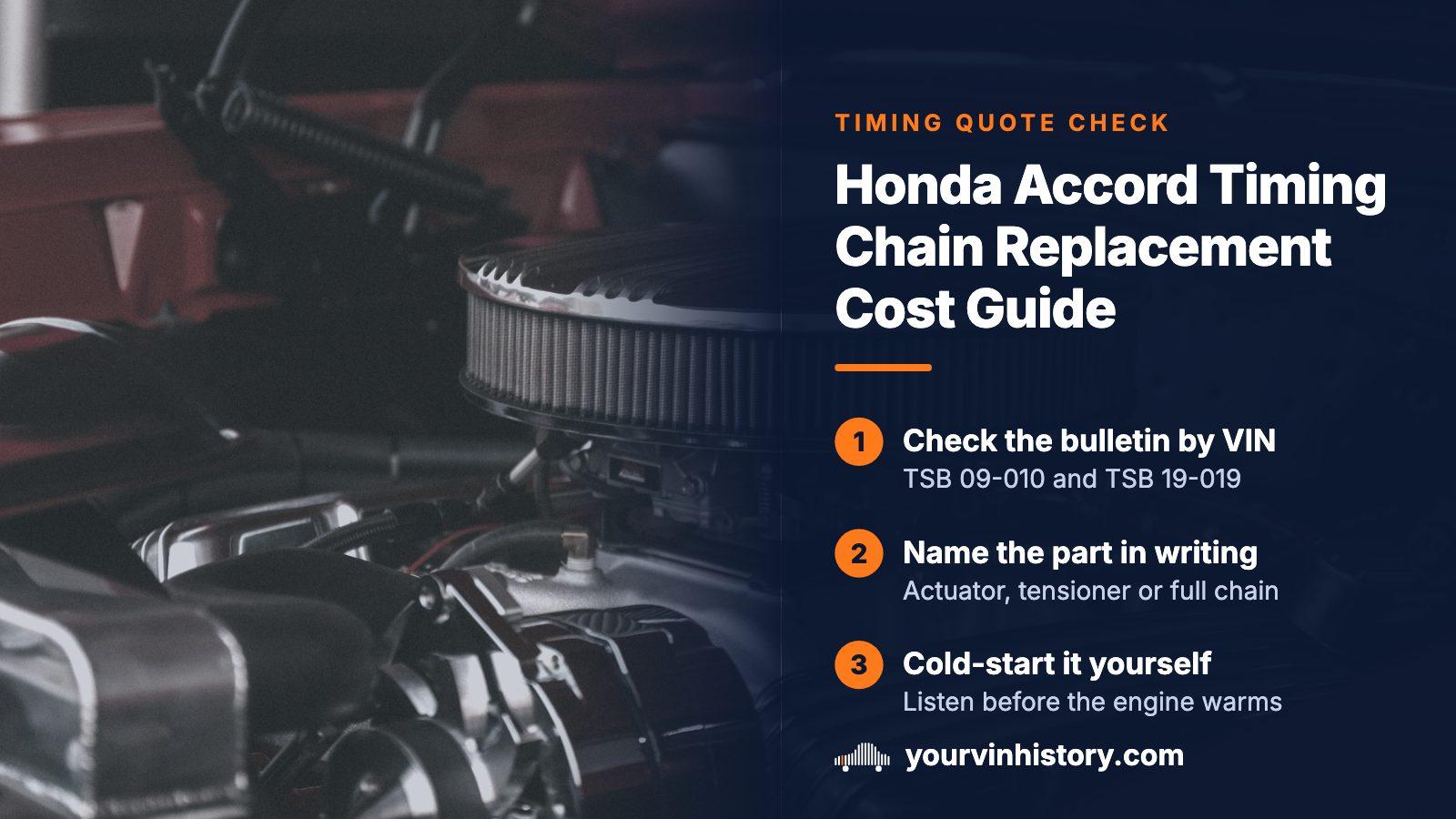
Read the quote for what it names. RepairPal lists the Accord tensioner job between $382 and $1,132 by model year, and a generic full chain replacement at labor of $1,334 to $1,957 plus parts of $786 to $807. Secondhand accounts of two Honda bulletins, TSB 09-010 for 2008–2012 cars and TSB 19-019 for 2014 and 2015–2017 four-cylinders, blame an actuator or a tensioner, not the chain.
- RepairPal tensioner range
- $382 to $1,132, by model year
- Generic full chain job
- $1,334–$1,957 labor, $786–$807 parts
- Honda bulletin spans
- 2008–2012 and 2014–2017
- Engine complaints in those spans
- 64% of the Accord's engine total
The price figures on file, and who published each
RepairPal does not publish one Accord number. Its tensioner estimator changes with the model year, and the break falls where the car was redesigned: $830 to $1,132 on the 2008–2011 body, then $382 to $494 on the 2013-and-later body. The figures gathered here skip 2012, so ask any shop to price that year fresh.
| Publisher and page | Job it prices | Range shown |
|---|---|---|
| RepairPal, Accord estimator, 2008–2011 body | Chain tensioner | $830 to $1,132 |
| RepairPal, Accord estimator, 2013 and later | Chain tensioner | $382 to $494 |
| RepairPal, generic page for any vehicle | Full chain replacement | $1,334 to $1,957 for labor and $786 to $807 for parts |
| Kelley Blue Book, Accord page for a 2010 | Labeled as a timing belt job | $1,099 to $1,651 |
| Kelley Blue Book, Accord page for a 2016 | Labeled as a timing belt job | $1,152 to $1,816 |
Each amount belongs to the publisher named beside it, as read in September 2026. This site sells vehicle history reports, not repairs, and prints no repair price of its own. Use the table to spot a quote far out of line.
A belt page for an engine that never had a belt
Kelley Blue Book's estimator answers an Accord search with a timing belt replacement page, and it does so for every model year checked, 1997 through 2025. Yet every Accord engine in the 2008–2022 span carries a chain, whether the 2.4-liter four, the 3.5-liter V6 or the turbo fours of 1.5 and 2.0 liters added in 2018. The page looks like a template keyed to the nameplate, with no test for belt versus chain.
A belt job and a chain job are different repairs, and a price for the wrong one tells you little. The schedule differs too. On a healthy engine a chain is meant to outlast normal service life, and Honda sets no replacement interval for it, so a quote that treats chain work as routine maintenance deserves a question. The timing belt or chain by VIN guide shows how to confirm a specific car.
Two bulletins, two parts, and neither one is the chain
Honda has put out two technical service bulletins for an Accord that rattles briefly on a cold start. Neither tells a dealer to install a new chain.
| Bulletin | Cars covered | Cause as described | Part replaced |
|---|---|---|---|
| TSB 09-010 | 2008–2012, every trim | Faulty VTC (variable valve timing control) actuator | The actuator |
| TSB 19-019 | 2014 (VIN ranges vary by trim); 2015–2017 four-cylinder cars, every trim | A worn check valve inside the tensioner that drains oil pressure after shutdown | The tensioner |
The 2019 bulletin describes a fault that fits the symptom: pressure leaks away while the car sits, so the noise lasts only until oil pressure rebuilds after the start.
How the bulletins were sourced
The bulletin documents themselves were not opened for this page, because connections to NHTSA's bulletin servers were refused during research. The part and year details come from four independent descriptions that agree: two owner forums (honda-tech.com and driveaccord.net) and two bulletin-tracking sites (truedelta.com and julieannacline.com). Ask a Honda dealer to confirm the bulletin against your VIN.
What the engine complaint record can and cannot prove
NHTSA's record holds 9,607 owner complaints against 2008–2022 Accords. Of those, 1,495 were filed under ENGINE, which ranks second among the nameplate's complaint categories, below ELECTRICAL SYSTEM and above brakes.
- Nine of the fifteen model years sit inside the two bulletin spans, 2008 through 2012 and 2014 through 2017. Together they hold 64% of all engine complaints on file.
- Within the first span, 86% of its engine complaints fall in 2008, 2009 and 2010.
- The other six model years, 2013 and 2018 through 2022, share what remains.
Read that with care. NHTSA has no complaint category for a single part, so ENGINE absorbs every engine fault an owner reports, not only timing trouble. The count is a ceiling on timing-related problems, not a tally of them, and complaints are unverified owner reports rather than a failure rate. The pattern does line up with the years Honda wrote bulletins for, which are the years to examine hardest.
Why a cold-start rattle is not proof of a worn chain
Unlike a belt, a chain is built to last as long as a healthy engine does. In both bulletin spans, Honda points to a part that supports the chain. On the 2008–2012 cars it is the valve timing actuator, and on the 2014–2017 cars it is the tensioner holding the chain taut. Either can mimic a stretched chain.
A complaint filed under ENGINE cannot say which of those the owner had in mind, which is why the bulletin numbers carry more weight than the category. It also explains the price spread. An actuator or tensioner swap and a full chain-and-guide job involve different amounts of labor, so a shop quoting the bigger job for a rattle Honda already has a bulletin for may be pricing more work than the car needs.
The reverse also happens. A bulletin applies only to its own span. A car outside those years, or one with stored timing codes, needs its own diagnosis, and chain stretch stays possible until someone rules it out.
Recall, bulletin, special coverage, goodwill: who pays
A bulletin is an instruction sheet for dealers, not a payment program, and the Accord's two are not recalls. Which program below applies decides who pays.
| Program | What it is | Who pays |
|---|---|---|
| Safety recall | A defect the maker must remedy because of a safety risk | The maker, at a dealer, within the federal rule's limits |
| Special coverage | Honda stretches warranty on a known problem | Honda, subject to year and mileage limits |
| Technical service bulletin | Repair steps Honda sends its dealers | The owner, unless factory warranty or special coverage applies |
| Goodwill or policy adjustment | A courtesy repair | At the dealer's discretion, usually on cars near warranty |
The research behind this page does not break Accord recall campaigns down by component, so nothing here says what any Accord recall fixes. NHTSA's recall lookup answers that for one VIN, and the TSB vs recall guide explains the difference.
Symptoms, from the first noise to the check-engine light
- A rattle or knock lasting a second or two on a cold start, fading once oil pressure builds. This is the symptom both bulletins describe.
- The same noise returning more reliably over several weeks instead of appearing all at once.
- A check-engine light with a camshaft and crankshaft correlation code stored, which indicates timing has drifted.
- A rough idle or a louder start, a later warning that deserves an inspection soon.
The order matters. An early rattle can be matched to a bulletin number by VIN, and a dealer can often confirm the repair in one visit. Once correlation codes appear, a shop must inspect more of the engine and rule out chain stretch before committing to a scope.
Reading a timing quote line by line
Start with the noun. 'Timing chain replacement' can mean an actuator, a tensioner or the whole chain-and-guide set. The wording matters because, in the generic full-chain figure, the labor range sits above the parts range, so a bigger quote is mostly a bigger labor scope.
Model year moves the price as well. RepairPal does not say why its tensioner figure falls so sharply after the redesign. A change in how much of the engine has to come apart is the obvious guess, which is one more reason to ask for the labor operation by name.
Shop type is the third variable, and no dealer-versus-independent split was available for the Accord. Collect two written quotes, each naming the part and saying whether the shop checked Honda's bulletin.
Shopping for an Accord from a bulletin span
A car from 2008–2012 or 2014–2017 should show the relevant repair already done, with service records to prove it, or pass a cold start you watch yourself before the asking price treats the engine as settled. Ask the seller not to start it beforehand and listen during the first seconds, since a warm engine can hide the noise Honda's bulletins describe.
Decode the VIN to confirm the exact year and engine, since the bulletin spans are narrow, and look up open recalls with NHTSA's free tool. A vehicle history report from this site adds odometer readings, accident and title records and open recalls for the VIN. It does not replace a cold start or a mechanic's inspection.
The six model years outside both spans hold the rest of the engine complaints, a shorter worry list and not a clean bill of health.
Where this information comes from
- NHTSA: Honda Accord vehicle page — The federal complaint record behind the engine counts, which can be browsed by model year.
- NHTSA: Recalls lookup by VIN — Where to check whether a particular Accord has an open safety campaign.
- RepairPal: Accord timing chain tensioner estimate — Source of the per-year tensioner range, read in September 2026.
- RepairPal: timing chain replacement estimate — Source of the full chain labor and parts ranges. It is a generic page, not specific to the Accord.
Sources and photos: Facts checked against the sources above in October 2026. Photo by Victor Hughes on Unsplash; diagrams by YourVINHistory.
Keep reading
- Honda Accord years to avoid: 2008, 2013 and 2014 lead the complaintsSee every Accord model year ranked by complaint count against its own median.
- Timing belt or chain by VINConfirm which timing system a specific VIN carries before you price work.
- TSB vs recallLearn why a service bulletin pays for nothing while a recall repair is made at no charge.
- Honda Accord head gasket replacement cost, and who pays on 2018–2022 carsAnother large Accord engine repair, with its own price ranges and warning signs.
Frequently asked questions
How much does a Honda Accord timing chain replacement cost?
RepairPal's Accord tensioner figure runs $382 to $494 on the 2013-and-later body and $830 to $1,132 on the 2008–2011 body. Its generic full chain page lists $1,334 to $1,957 in labor and $786 to $807 in parts. An estimator is not a quote, so only a written estimate from a shop that has your VIN applies to your car.
Is the Honda Accord timing system a belt or a chain?
A chain, on every engine in the 2008–2022 span, including the 2.4-liter four and the 3.5-liter V6. Honda sets no scheduled replacement interval for it. Kelley Blue Book still shows a timing belt page for the Accord, so disregard that label when you read its price, and use a VIN decode to confirm the engine.
Which Honda Accord years have the most engine complaints?
Two stretches stand out: 2008 through 2012 and 2014 through 2017, nine of the fifteen model years between them. They account for 64% of the engine complaints on file, and 86% of the first stretch sits in 2008–2010. These are owner reports under a catch-all ENGINE category, a pointer for inspection and not a failure rate.
What does a failing Accord timing tensioner sound like?
Expect a short rattle or knock for a second or two right after a cold start, quieting as oil pressure rises. Owners describe it growing more regular over weeks. A check-engine light with a camshaft and crankshaft correlation code means timing has drifted, and the repair becomes urgent.
Will Honda pay for an Accord timing chain repair?
Only through a program that actually pays. A technical service bulletin gives dealers repair steps but pays for nothing itself, and neither Accord bulletin is a recall. Coverage depends on whether your car is still under factory warranty or special coverage, and goodwill help is at the dealer's discretion. Run the VIN through NHTSA's recall lookup first.
Now check the car itself
The guide explains what to look for. The report shows what this VIN has on record.