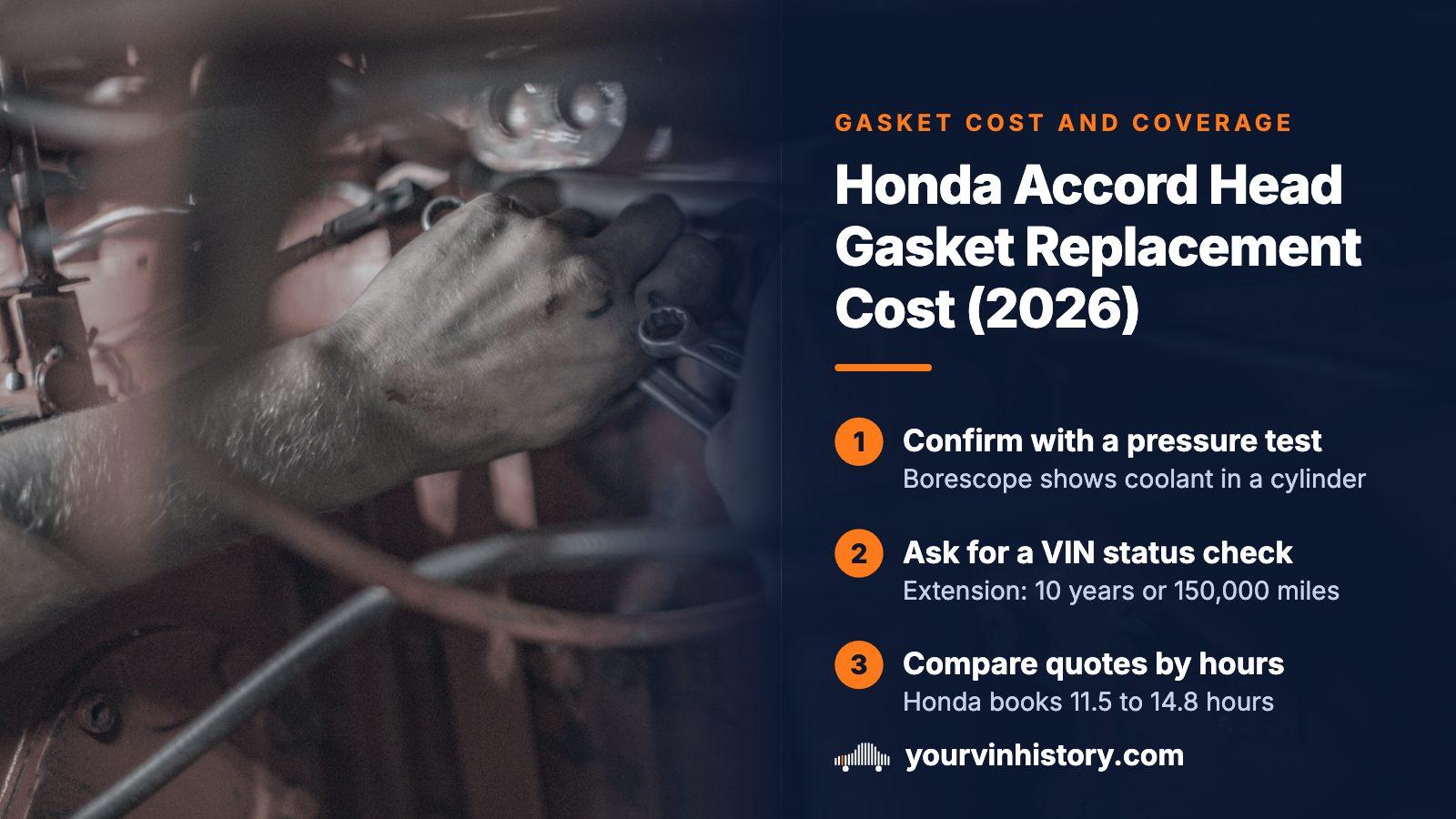
THE SHORT ANSWER
An Accord head gasket averages $2,294 to $2,971 on RepairPal's estimator, with $1,277 to $1,874 of that in labor. Honda's bulletins 26-003, 26-004 and 26-006 stretch gasket coverage on 2018–2022 Accords (2018–2020 for manual cars) to 10 years or 150,000 miles, so Honda may foot the bill. Earlier Accords have no such extension, and no recall names the gasket.
- RepairPal average
- $2,294 to $2,971, before taxes and fees
- Honda extension
- 10 years or 150,000 miles on listed 2018–2022 cars
- Honda labor hours
- 11.5 to 14.8 on gasoline cars
- Recalls naming the gasket
- None found for 2008–2022 Accords
The price range, and whose number it is
No official price exists for this job, so every figure you see is someone's estimate. The one most shoppers meet first belongs to RepairPal. As its Accord head gasket listing read on October 25, 2026, the average job costs $2,294 to $2,971: labor accounts for $1,277 to $1,874 and parts for $1,017 to $1,098.
RepairPal excludes taxes and fees and does not adjust for location, so treat the range as a starting point, not a quote. Hourly rates differ between dealers, independent garages and chains, and no average predicts what a technician finds once the head comes off.
Rule out the cheaper look-alikes first
A falling coolant level does not automatically mean a failed gasket. Match what you see against likelier causes before agreeing to a teardown.
| Symptom | Possible cause |
|---|---|
| Reservoir level keeps dropping, yet the driveway stays dry | Coolant leaking into a cylinder |
| Rough running right after a cold start that clears up | Coolant wetting a cylinder overnight |
| Temperature needle climbing while the heater blows cold | Exhaust gas in the coolant, or a plain leak |
| Oil disappearing with no drips on a 2008–2011 four-cylinder | Oil-ring trouble, not the gasket |
Before opening the engine, many independent shops run a chemical block test that sniffs the coolant for combustion gas. A positive test together with coolant seen inside a cylinder makes a convincing case. A reservoir that drains slowly without either points more often to a hose, a radiator seam or the water pump, and those repairs cost a small fraction of a gasket job.
How Honda's own test proves a failed gasket
Honda's bulletin sets out a test that makes a fair yardstick for any shop's diagnosis:
- Begin with the engine cold and print a complete trouble-code check.
- Install a cooling-system pressure tester, then run the engine until it reaches normal temperature; Honda cites 194°F.
- Shut the engine off and top the system up to 18 psi if it reads lower.
- Remove all four spark plugs.
- Sweep a borescope around each cylinder, watching for coolant where head meets block.
No coolant, and the bulletin stops applying; normal troubleshooting resumes. For a warranty claim the dealer must attach the code printout, with or without P0300 through P0304, and a borescope photo showing the VIN, repair order number, date and engine number next to coolant on the cylinder wall. A shop that cannot produce comparable evidence is guessing.
Who pays: Honda's August 2026 extension
Honda issued a batch of cylinder head gasket warranty extensions on August 26, 2026. Three apply to Accords from 2018: bulletin 26-003 (2018–2022, CVT), bulletin 26-004 (2018–2020, manual) and bulletin 26-006 (2018–2022 Hybrid). Under certain conditions the gasket's sealing may degrade, leading to overheating, coolant loss or misfire, and Honda lengthens the gasket warranty to 10 years from original purchase or 150,000 miles, whichever limit arrives first.
A September 25, 2026 revision, version 3, changed two things: trouble codes are no longer needed, and the extension holds even if the car was ever totaled, sold for salvage or branded. Honda says owners will get a mailing, but the bulletins direct dealers to check VIN status, so an absent letter proves nothing.
A warranty extension is not a recall
It pays for the gasket condition the bulletins describe, on cars that clear the dealer's eligibility check, until the age or mileage limit passes. A safety recall search will not list it, and the year-by-year recall search done for this guide found no campaign that names a head gasket on any 2008–2022 Accord.
Your Accord's year, engine and gearbox decide the answer
| Model years and equipment | Honda gasket coverage | What to do |
|---|---|---|
| 2008–2012, every engine | None for the gasket; 2008–11 four-cylinders got a separate piston-ring program | Check for oil burning before blaming the gasket |
| 2013–2017, every engine | No bulletin or recall naming the gasket turned up | Investigate the cooling-system history |
| 2018–2022, 1.5T with CVT | Bulletin 26-003, good for 10 years or 150,000 miles | Request a VIN status inquiry |
| 2018–2020, manual | Bulletin 26-004, identical terms | Request a VIN status inquiry |
| 2018–2022 Hybrid | Bulletin 26-006, identical terms | Request a VIN status inquiry |
| 2018–2022, 2.0T automatic | Neither gasoline bulletin lists it | Ask for the status check regardless |
| 2023–2026, Accord and Hybrid | Bulletins 26-005 and 26-007, listed with the same terms | Not covered here; ask the dealer |
The 2.0-liter turbo is the gray area. It was sold with a 10-speed automatic, and with a six-speed manual through 2020, so the automatic sits outside the CVT bulletin, and both gasoline bulletins build their repair steps around the 1.5-liter engine. Neither document lists or rules out a 2.0T explicitly, and NHTSA's complaint database holds at least one owner narrative in which a dealer turned a 2.0T claim down. Only a VIN status inquiry settles it.
Why shop quotes land thousands of dollars apart
Honda measures the repair in flat-rate hours, and those hours explain the spread. With the head removed, the technician measures both the head and the engine block for warpage, and the job branches from there.
| Parts replaced | Honda hours, gasoline Accord |
|---|---|
| Gasket only | 11.5 |
| Gasket and cylinder head | 12.0 |
| Gasket and short block | 14.7 |
| Gasket, head and short block | 14.8 |
The Hybrid bulletin starts at 10.8 hours when only the gasket is replaced, and tops out at 15.5. One shop may price the gasket and assume flat surfaces; another may price the worst case. Engines that kept running after overheating are the likeliest to need the pricey tiers, so pull over at the first warning light.
What NHTSA complaints can and cannot say
NHTSA files nothing under head gasket. The closest bucket is ENGINE, which gathers misfires, failed starters, oil burning and every other engine complaint, so its count caps gasket trouble from above and can never measure it. In the tally behind this guide, 9,607 complaints cover 2008–2022 Accords, and 1,495 sit in ENGINE, a category that makes the top five components in all 15 model years.
| Accord generation | ENGINE reports | Slice of all ENGINE reports | ENGINE within its own complaints |
|---|---|---|---|
| 2008–2012 | 538 | 36% | 15% |
| 2013–2017 | 594 | 40% | 14% |
| 2018–2022 | 363 | at least 24% | 20% |
Raw counts favor older cars, so shares tell the fairer story: the newest generation runs highest, and the 2019 model has the top engine share of any single year, 26%, backed by 194 ENGINE reports. In the narratives, the phrase “head gasket” barely appears from 2008 through 2017, then recurs from 2018, often beside the 1.5-liter turbo and coolant loss.
One caution: the 2018 row is incomplete. The row lists just 22 ENGINE reports among 113 complaints, yet NHTSA's live database, checked October 25, 2026, returned many times that, with gasket failures the leading engine theme among the added reports. Other model years agreed with the tally to within about a tenth. Treat 2018, and the 24% share for 2018–2022, as minimums. Filings that mention a gasket on these Accords mostly date from 2025 and 2026, long after the cars were new.
Why older Accords rarely need this job
The 2008–2011 four-cylinders logged 494 ENGINE reports, mostly about oil use. Honda's Service Bulletin 12-087 addresses sticking rings and high oil consumption: after an oil consumption test, the fix is new pistons and rings, and the parts list includes a cylinder head gasket since the head must come off. So an old invoice for a 2010 four-cylinder can list a gasket on a car that never leaked one. Honda lengthened piston and ring coverage to 8 years or 125,000 miles, per an April 2015 dealer notice, a window every eligible car has now passed.
On 2013–2017 cars, engine reports peak at 183 for the 2014 model, but 2013 through 2015 narratives mostly name the starter, then oil use. No bulletin or recall naming a head gasket turned up for those years. When a gasket does fail on these cars, heat is the usual route: a coolant leak, a dead water pump or a sticking thermostat. Cooling history outranks model year.
Before you pay a shop, or buy a used Accord
- Dealer first: on a 2018–2022 car, ask for the VIN status inquiry before approving any work.
- Pin down what you own: the VIN settles whether it is a 1.5T with CVT, a manual, a 2.0T automatic or a Hybrid.
- Find out if the quote assumes true surfaces on the head and block, and the price if either is warped.
- For a 2008–2011 four-cylinder losing oil, ask whether anyone ran an oil consumption test.
The bulletins say nothing on reimbursement, so ask Honda directly about a bill already settled on an eligible car, and keep the repair order, code printout and shop photos.
Shopping for a used 2018–2022 Accord, the extension is part of the car's value. A 2018 Accord bought new that year keeps its coverage until 2028 if the odometer stays under 150,000 miles. Ask whether a gasket was already replaced under a bulletin, check that cold coolant sits at the full mark, and listen for a rough idle just after a cold start. This extension survives a branded title, though such a title can cancel other coverage and lowers value. A vehicle history report from this site lists title brands, accident records, odometer readings and open recalls, but extension eligibility comes only from a Honda dealer's VIN inquiry.
Where this information comes from
- Honda Service Bulletin 26-003 v3 (NHTSA copy) — The CVT extension: coverage terms, branded-title wording, flat-rate hours and the borescope inspection steps.
- Honda Service Bulletin 26-006 v3 (NHTSA copy) — The Hybrid version of the extension, with its own range of labor hours.
- Honda Service Bulletin 12-087 v6 (NHTSA copy) — The oil-consumption bulletin for 2008–2011 four-cylinder Accords, where the gasket appears only as a parts-list item.
- NHTSA: recalls — Where to run a VIN for open safety recalls, which do not include Honda's warranty extension.
- NHTSA: report a safety problem — The federal complaint system behind the ENGINE counts discussed above.
- RepairPal: Honda Accord head gasket replacement estimate — Source of the average price and its labor and parts split, as listed in October 2026.
Sources and photos: Facts checked against the sources above in October 2026. Photo by Nina Mercado on Unsplash; diagrams by YourVINHistory.
Keep reading
- Honda Accord years to avoid: 2008, 2013 and 2014 lead the complaintsThe complaint record for every Accord model year, well beyond the engine.
- Honda Accord timing chain replacement cost: check Honda's two bulletins firstA second engine repair Accord owners price, with bulletins of its own.
- Honda warranty by VINEstimate how much factory coverage a specific Accord still has.
- TSB vs recallExplains why a warranty extension never appears in a recall search.
Frequently asked questions
What should an Accord head gasket job cost at a shop?
RepairPal's listing averages $2,294 to $2,971. To judge a specific quote, ask for the labor hours and the hourly rate. Honda's bulletin allows 11.5 hours when only the gasket is replaced on a gasoline 2018–2022 Accord, so rate times hours shows the labor charge for the cheapest tier.
Did Honda recall the Accord for head gasket trouble?
No campaign naming the gasket turned up in a year-by-year search of NHTSA recall data for 2008 through 2022. Honda's answer, dated August 26, 2026, was a group of warranty extensions, which a recall lookup will not display. Use NHTSA's lookup for open safety recalls and a Honda dealer's VIN status inquiry for the extension.
Are some Accord model years worse for head gaskets?
The documented trouble starts with 2018, the first year Honda's extensions reach. Earlier complaint narratives seldom mention a gasket, and the fault Honda documented on 2008–2011 four-cylinders was sticking oil rings. Despite the incomplete 2018 row, 2018–2022 Accords account for at least 24% of ENGINE complaints in the tally used here.
How can I tell if my 1.5T Accord has a blown head gasket?
Honda's bulletin names overheating, coolant loss and misfire, with codes P0300 through P0304 stored in some cases but no longer required. Owners report a reservoir that keeps emptying without any visible leak and shaking after cold starts. A dealer confirms it with a pressure test, a warm-up and a borescope look for coolant in each cylinder.
Will Honda cover a rebuilt or salvage title Accord?
Per the September 2026 revisions, yes: the bulletins state the extension applies even when a car was totaled, went to salvage or has a branded title. Eligibility still runs through the dealer's VIN status inquiry, and the claim still needs the code printout and borescope photo.
Now check the car itself
The guide explains what to look for. The report shows what this VIN has on record.