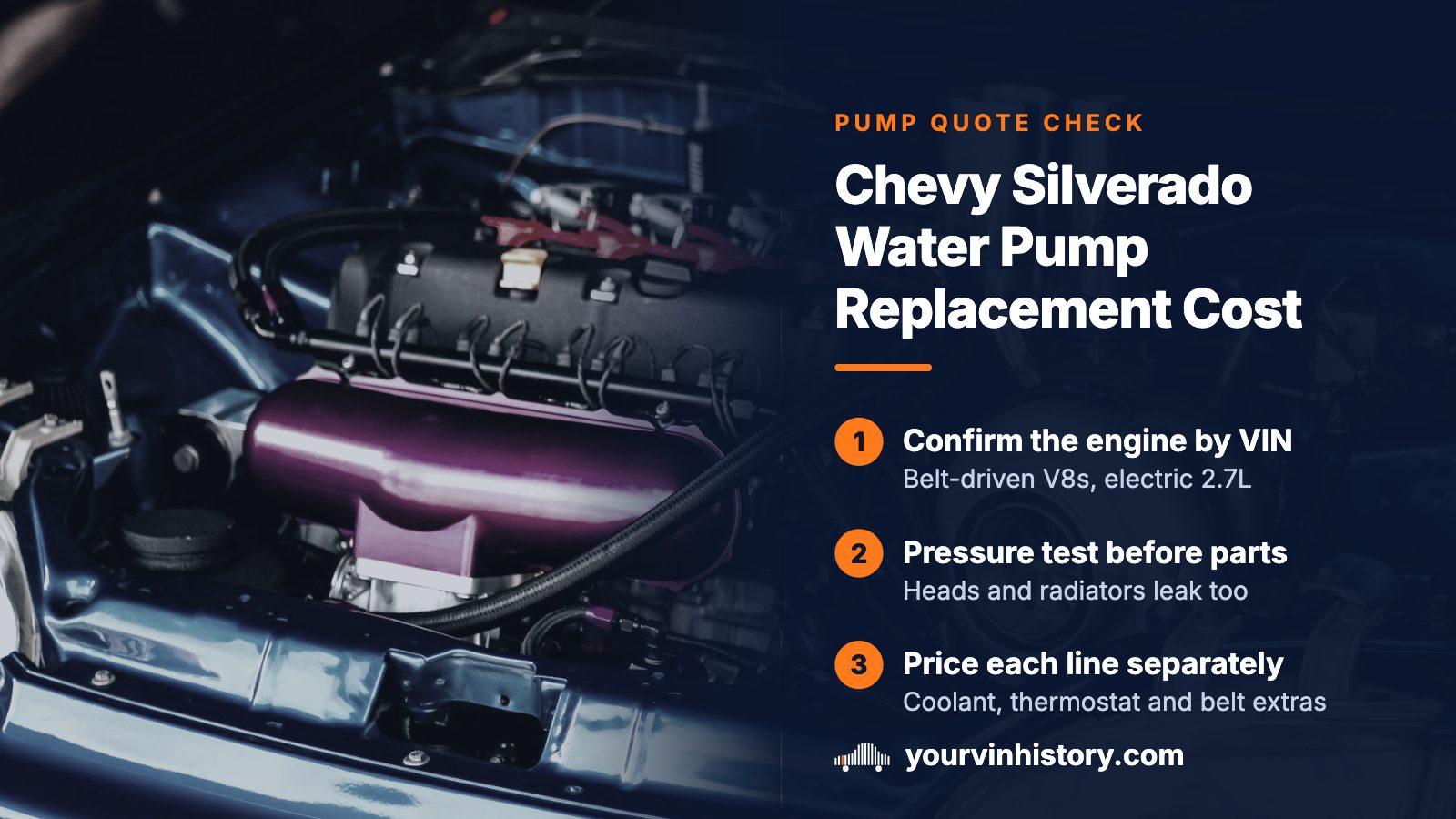
THE SHORT ANSWER
RepairPal estimates a Silverado 1500 pump job at $1,082 to $1,442, with parts at $783 to $1,004 and labor at $299 to $439, before taxes and fees. Its 2020 to 2023 rows run higher. GM documents belt-driven pumps on the V8s and an electric pump on the 2.7L turbo four. Have the shop pressure test the system first, since GM also ties coolant loss to cylinder heads and radiators.
- RepairPal range
- $1,082 to $1,442, Silverado 1500
- Parts and labor
- $783 to $1,004 parts, $299 to $439 labor
- 2.7L turbo four
- Electric pump, no drive belt
- Pump recalls found
- None, model years 2008 to 2022
What RepairPal and Kelley Blue Book publish
Only one source here gives a Silverado-specific range. RepairPal's estimator for the 1500 puts the national price of a pump replacement between $1,082 and $1,442, and its page, dated September 3, 2026, leaves out taxes, fees and where you live.
| Piece of the bill | Low end | High end |
|---|---|---|
| Parts | $783 | $1,004 |
| Labor | $299 | $439 |
| Total, Silverado 1500 | $1,082 | $1,442 |
| Total, 2020 to 2023 rows | $1,375 | $1,793 |
Kelley Blue Book was no help: its 2019 Silverado 1500 Double Cab page showed no pricing data without a ZIP code, and the lone figure on it, $375 to $787, is a generic Chevrolet number. Every dollar figure here is the named publisher's estimate.
What pushes a real quote away from the middle
Parts outweigh labor in RepairPal's split, so the pump itself sets the floor. A real quote drifts from the midpoint for four reasons:
- Engine: belt-driven pumps and the 2.7L's electric pump are different parts with different diagnosis.
- Model year: RepairPal prices 2020 to 2023 trucks above its all-years range.
- Extras: new coolant, a thermostat or a belt often join the bill, each its own decision.
- Location and shop: taxes, fees and local rates fall outside the published range.
The largest swing is a wrong diagnosis: a pump bought for a leak elsewhere is money spent before the real repair begins.
Which Silverado pumps turn on a belt, and which are electric
For the V8s, the evidence is GM's parts catalog. Part 12724894, the current Silverado V8 pump, is listed with a serpentine-belt drive type and arrives with its pulley and gasket. Dealer bulletins agree, since they have technicians pull the belt to test a noise, a check that only fits a belt-driven pump.
One engine departs from this. GM's TechLink magazine, in July 2019, described the 2.7L turbo four's pump as electric, commanded by the engine computer over a data link and kept running after shutdown. With no belt to remove, diagnosis there leans on electrical testing.
Where the paper trail ends
No GM document found for this guide states the pump drive on the 2008 to 2010 V8s, the V6 before 2014, the 3.0L Duramax diesel from 2020, the two-mode hybrid or the eAssist 5.3L. For those, ask the shop which drive its labor estimate assumes.
Which engines were offered in which years
Quotes only compare when the engines match. The table follows EPA's fuel economy listings, which show what GM offered, not what sits under your hood, so decode the VIN first. Pricing a 2.7L truck like a V8 means quoting the wrong pump.
| Engine | Model years listed |
|---|---|
| 4.3L V6 | 2008 to 2021 |
| 4.8L V8 | 2008 to 2013 |
| 5.3L V8 | 2008 to 2022 |
| 6.0L V8 | 2008 and 2009 |
| 6.2L V8 | 2009 to 2022 |
| 6.0L two-mode hybrid | 2009 to 2013 |
| 5.3L eAssist hybrid | 2016 to 2018 |
| 2.7L turbo four | 2019 to 2022 |
| 3.0L diesel | 2020 to 2022 |
Coolant loss that GM traces to the cylinder heads
The costliest look-alike is in GM service information PIP5330D, dated November 22, 2019. It addresses Silverados from 2014 through 2019 fitted with a 4.3L, 5.3L or 6.2L (codes LV3, L83, L86) that lose coolant or smell of it after driving. Technicians pressure test a low system, check the outer head bolts, and replace any head that leaks.
A March 2022 bulletin, 22-NA-047, widens that to the 2019 to 2021 new-generation 1500 and the 2019 Silverado LD, adding the L82, L84 and L87 engines. The cause, GM says, can be porosity in either cylinder head around the outer bolt boss; coolant streaks may show along the head's side.
If coolant vanishes but nothing drips near the pump, a cylinder head could be the source, and a new pump would change nothing. Head work costs far more, so check warranty first: the bulletin's labor operations are for repairs under powertrain coverage, and a Chevrolet warranty check by VIN shows whether a truck still has it. A bulletin guides dealers; it is not a repair promise.
A cracked radiator that starts with the thermostat
Bulletin PI1513G (January 2021 revision) applies to model year 2015, early 2016 builds and certain 2014 Silverados, depending on plant and towing package, with a 4.3L, 5.3L or 6.2L engine. Drivers notice a coolant smell or a front leak. GM blames a thermostat that cycles too often, fatiguing the radiator tubes until they crack at the headers.
The repair is a new radiator together with a redesigned thermostat housing. In the bulletin the thermostat is the causal part, and both pieces fall under the powertrain limited warranty. GM books 1.4 hours when the truck has a 5.3L or 6.2L and 5.2 hours when it has the V6.
One 2014 owner's NHTSA complaint fits the pattern: pump and thermostat already replaced, radiator still cracking about every two years. A front leak on a 2014 to 2016 truck earns a radiator inspection before a pump order.
A whine or scrape near the pump is not a verdict
Two separate GM bulletins tell dealers to rule out other causes before blaming a pump. PIP5108A, dated June 2013, covers 2011 to 2013 trucks with a 5.3L or 6.2L V8 and a whine between 1,500 and 1,800 rpm, heard mostly by the right side of the dash. Its order of work:
- Verify the coolant level.
- Take off the serpentine belt and see whether the noise stops.
- Turn the thermostat a quarter turn and listen again.
- Swap in a new thermostat and listen once more.
- If the noise persists, replace the water pump.
The other, 22-NA-216 (November 2022), spans Silverado 1500 trucks from 2014 through 2023 that run hot or tick near the thermostat. GM's cause is a head gasket installed incorrectly during a head job; locating tabs sitting nearer cylinders 5 or 6 give it away. On the L82, L84 and L87, it can also sound like a scraping bearing by the pump that stops with the belt off.
What NHTSA engine complaints can and cannot say about pumps
NHTSA has no heading for a single part. The nearest fit is ENGINE, which gathers every fault on every engine GM fitted. For 2008 to 2022 Silverado 1500 trucks, a tally of NHTSA's public complaints totals 12,743 reports, and ENGINE holds at least 2,155 of those, roughly 17%. The floor is deliberate: only each year's five largest categories were counted, and 2016's ENGINE fell below its fifth, which held 91 reports. That year is a gap, not a zero.
The share rises with each body generation: 8% of complaints for 2008 to 2013 (297 reports over six years), at least 12% for 2014 to 2018 (640 counted) and 34% for 2019 to 2022, roughly 4 times the oldest share. Those last four years hold 57% of the engine reports counted, and the 2019 model peaks at 377, or 33% of its complaints. Treat all of it as context and a ceiling, not a tally of failed pumps.
Owner narratives for the 2019, 2021 and 2022 models point mostly at valve lifters, with camshafts, misfires or ticking alongside. Pumps rarely appear: one 2021 owner described grinding at 31,000 miles and a dealer quote over $1,400, inside RepairPal's range for that year.
Recalls: none for the pump, two nearby engine campaigns
NHTSA's recall database was searched for each Silverado 1500 model year from 2008 to 2022 under both names GM uses for the truck. The 2014 results include transmission cooler line recall 14V-152, which shows the query works. No campaign names the pump, radiator, thermostat or coolant.
Two engine campaigns sit nearby, and neither is about the pump. Recall 14V-007 applies to model year 2014 trucks equipped with a 4.3L or 5.3L whose exhaust components can overheat and melt neighboring plastic; dealers reprogram the engine computer at no charge. Recall 25V-274 reaches 2021 through 2024 Silverado 1500s carrying the 6.2L V8, for defective connecting rods or crankshafts; dealers inspect, then repair or replace the engine at no charge. A VIN search at NHTSA's lookup shows what is open on a given truck.
If you are buying a Silverado instead of repairing one
The record suggests the cooling system is not where this truck's engine complaints cluster. Still, with the engine cold, check the coolant level, look for dried residue along the cylinder heads and the radiator tube ends, and listen for whining or scraping from the belt area. On a 2019 or newer V8, lifter reports outweigh pump worries. For a 6.2L truck from model year 2021 or later, find out if recall 25V-274 was performed.
A shop inspection before you buy, including a cooling-system pressure test, is cheap beside any repair above. A vehicle history report cannot see inside the cooling system, but it does list open recalls, title brands and accident records.
Where this information comes from
- RepairPal: Chevrolet Silverado 1500 water pump replacement cost — Source of the national range, the parts and labor split and the 2020 to 2023 rows.
- GM TechLink: New Turbocharged 2.7L 4-Cylinder Engine Powers Full-Size Trucks — GM's technician magazine, July 2019, on the 2.7L's electric water pump.
- NHTSA: recalls by VIN — The official lookup for open campaigns, including 14V-007 and 25V-274.
- GM PIP5330D (NHTSA copy) — Dealer instruction to pressure test for outer head bolt leaks on 2014 to 2019 Silverados.
- GM PI1513G (NHTSA copy) — Radiator and thermostat bulletin with GM's labor times by engine.
- GM PIP5108A (NHTSA copy) — The step order for a whine between 1,500 and 1,800 rpm, with the pump last.
Sources and photos: Facts checked against the sources above in October 2026. Photo by Willian Cittadin on Unsplash; diagrams by YourVINHistory.
Keep reading
- Chevrolet Silverado 1500 years to avoid: 2014, 2015 and 2019 stand outThe complaint record by model year, well beyond the engine.
- Chevy Silverado transmission replacement cost: match the quote to the symptomThe other big powertrain repair on this truck, with its own bulletins and price ranges.
- TSB vs recallWhy the dealer bulletins cited here are guidance, not recalls.
- Chevrolet warranty by VINCheck whether powertrain coverage still applies before paying for a head or radiator.
Frequently asked questions
What is a fair price to replace the water pump on a Silverado?
RepairPal's Silverado 1500 estimator runs $1,082 to $1,442 nationally, before taxes and fees. Ask for an itemized quote that lists the pump, coolant, thermostat and belt separately. A quote far above RepairPal's $1,375 to $1,793 rows for 2020 to 2023 trucks needs an explanation.
Is the Silverado water pump belt-driven or electric?
GM's catalog shows current V8 pumps on the serpentine belt, and TechLink describes an electric pump, run by the engine computer, on the 2.7L turbo four. Nothing turned up for the pre-2014 V6 or the 3.0L diesel, so ask which drive the labor estimate assumes.
Can a Silverado lose coolant even when the water pump is fine?
Yes. GM bulletins name porosity near the outer head bolts on 2014 to 2021 trucks and radiator tube cracks on 2014 to 2016 trucks. Dried coolant streaking down a cylinder head is what dealers are told to look for, and a pressure test shows where fluid escapes.
Has GM ever recalled the Silverado water pump?
None showed up in NHTSA's database for 2008 through 2022 Silverado 1500 trucks, and none names the radiator, thermostat or coolant. Status changes over time, so enter the VIN at NHTSA's recall lookup before buying or repairing. Nearby engine campaigns cover exhaust heat and connecting rods.
Should a coolant leak stop me from buying a used Silverado?
Not by itself, but it changes the price conversation. A leak with a known source and a repair invoice beats an unexplained one. Ask where it leaks, who tested it and which part was replaced, then check powertrain warranty status by VIN.
Now check the car itself
The guide explains what to look for. The report shows what this VIN has on record.