THE SHORT ANSWER
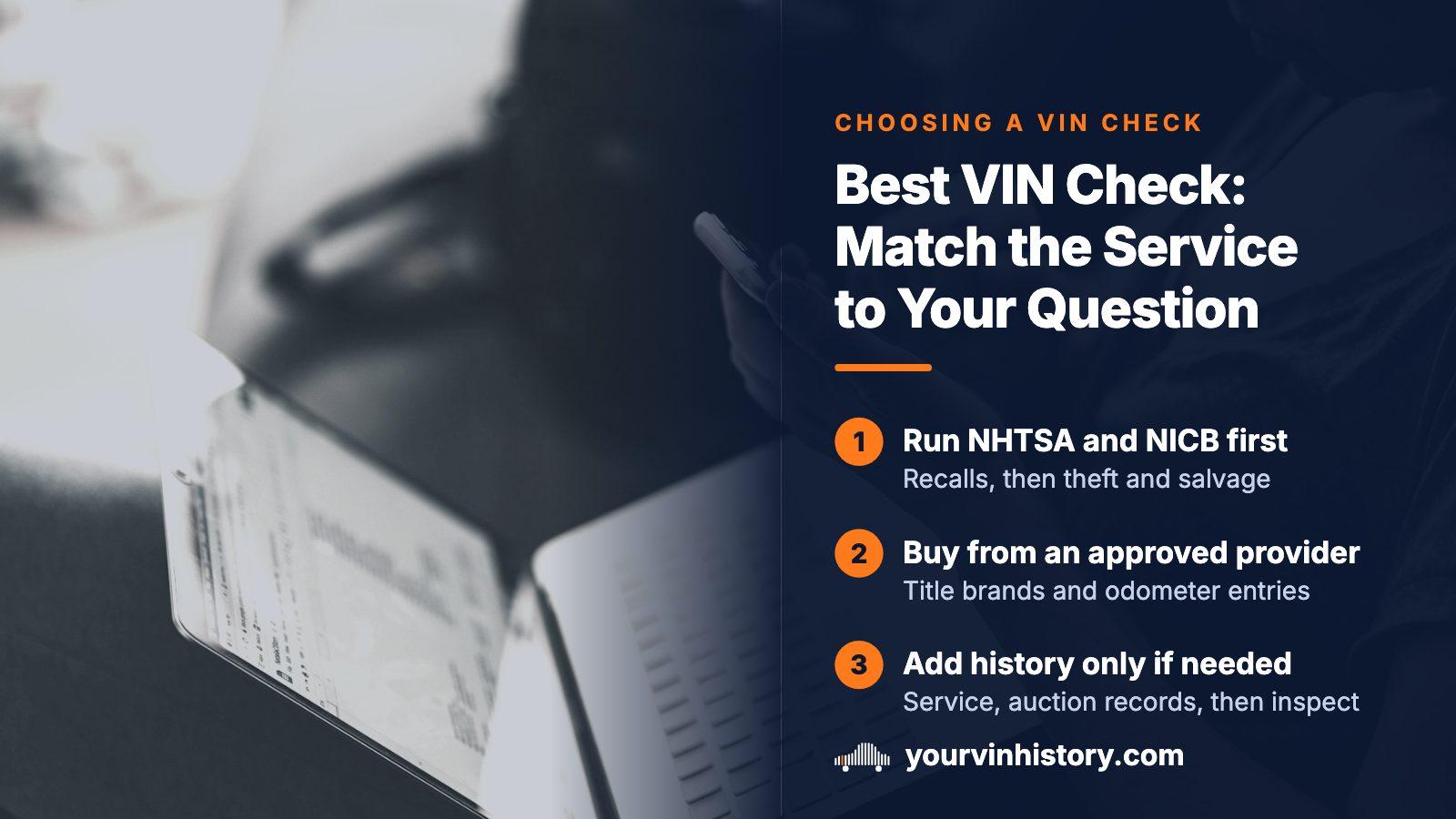
The best VIN check is the one whose records match your question. Run the free NHTSA recall lookup and the free NICB theft and salvage screen first. For title brands and odometer entries, buy a report from a provider on the Justice Department's approved NMVTIS list. Add a commercial history report only if service or auction records matter, and finish with a mechanic's inspection.
- Official roster
- The Justice Department lists approved NMVTIS data providers
- Public group
- Twelve providers sell to consumers as of this update
- Commercial-only group
- Six providers, with a California note beside CARFAX
- Free layer
- NHTSA decoder and recalls, plus the NICB theft and salvage screen
Why a single winner is the wrong target
A VIN check is not one product. It is a handful of separate record sets sold under many brand names, and each set answers a different question. A free federal lookup can tell you what the factory built. Only a title record can tell you whether a state ever branded the car. Brand-versus-brand rankings blur that difference, which is why they rarely help a buyer decide.
A better method runs in three moves. Decide what you need to find out, find the record set that holds it, then choose among the services that carry that set. For the title record, the Department of Justice publishes a roster that anyone can inspect, which sets it apart from a ranking that rests on one writer's taste.
Start with the question, then find where the answer lives
Write down what worries you about the car. Then look up which source actually holds that fact.
| What you need to know | Where the fact is kept | What it costs you |
|---|---|---|
| Trim, engine and factory specifications | NHTSA vPIC decoder | Nothing |
| Open safety recalls | NHTSA recall lookup by VIN | Nothing |
| Theft or salvage entries reported to NICB | NICB VINCheck | Nothing |
| Title brands, odometer readings, total-loss records | NMVTIS data, sold by approved providers | A fee set by the provider |
| Service visits, auction and dealer entries | A company's own commercial report | A fee set by the company |
| How the car drives and wears today | A mechanic's inspection | The shop's fee |
The free checks to run before paying anyone
- NHTSA recall lookup: enter the VIN and see which safety recalls are still open on that car.
- NHTSA vPIC decoder: returns build and specification details, drawn from what manufacturers submitted to the agency.
- NICB VINCheck: screens a VIN against theft and salvage records reported to the bureau.
None of these is a stripped-down trial of a paid product. For build details and open recalls, the free tools are the source itself, so paying gets you no better version of either.
Recall repairs are usually done at no charge, because federal law makes the manufacturer fix a safety defect without billing the owner. That duty has a limit. It does not apply when the first purchaser bought the vehicle more than 15 calendar years before the recall notice went out. On a much older car, ask the manufacturer what it will do before assuming the repair costs nothing.
What the free tools leave out
Not one of those three tells you how the car has been treated on paper. Title brands, odometer readings recorded at each transfer and total-loss declarations sit in a separate federal system, the National Motor Vehicle Title Information System, or NMVTIS. States, insurers and salvage yards report into it.
As a private buyer you do not query it directly. The Justice Department approves businesses to resell the data, and you buy through one of them.
This is where a paid check starts to make sense. A branded title, or odometer entries that fail to line up, can change the price you should accept or whether you should buy at all.
The approved roster for public buyers
The Justice Department's Research Vehicle History page sorts approved NMVTIS providers into two groups. The first sells to everyone, consumers included. At the time of this update it held twelve businesses: Bumper, Carsforsale, CarVertical, CheckThatVIN, ClearVIN, EpicVIN, GoodCar, TitleCheck, VinAudit, VINdata, VinReport and VINsmart.
The page lists them alphabetically and states that the order signals no preference. Treat it the same way. A listing means the NMVTIS data in that company's report is the genuine federal record. It is not a grade for customer service, refund handling or how much extra data a company layers on top.
Open the page itself
Approvals change over time, and a copy of the roster on a review site can go stale. Check the Justice Department page directly before you pay. The count of twelve reflects that page on the date this guide was updated.
The commercial-only group and the CARFAX note
The second group on that page is approved for business customers such as dealerships. It names six companies: OneAIB, add123, CARFAX, Vitu, Experian and Yassi.
Beside the CARFAX entry the page adds a note: its NMVTIS offering reaches only commercial customers, and only in California. A separate line on the page says consumers cannot receive NMVTIS vehicle history reports from CARFAX, DMVDesk or Experian, since those companies serve car dealerships alone.
Read it narrowly
These lines concern one dataset, the federal title record, and who may buy it from each company. They say nothing about the quality of any other records those companies keep, and this guide passes no judgment on them. If the federal title record is your question, buy it from the public group.
Vetting any service in a few minutes
- Open the Justice Department page directly instead of relying on a copy.
- Look for the company's name and note which group holds it: public or commercial-only.
- Read the extra-sites lines to see whether it shares an owner with another service you are weighing.
- If it is missing, ask which product it sells: NMVTIS data through an approved provider, its own records, or a repackaged copy of the free decoder and recall data.
- Read the price and refund terms on its own checkout page before you enter payment details.
A missing listing tells you which record set is on offer, and it does not grade the company. Many tools hold records of their own or present the free federal data neatly. What matters is which kind of product your money is buying.
When a company's own report earns its fee
Some questions sit outside every government system. Where the car was serviced, whether a dealer or an auction handled it, and what a company's private data shows about the VIN come only from a commercial history report, and coverage depends on what that company has gathered. If one of those facts drives your decision, the purchase is justified. If none does, it adds cost without answering anything you asked.
For transparency, the reports on this site take their NMVTIS title records from ClearVin LLC, which appears in the public group. The preview is free, the report is a one-time purchase, and the vetting steps above apply to it as to any other.
An order that avoids paying twice for the same facts
- Decode the VIN and read the recall result before you drive out to see the car.
- Run the NICB screen for theft and salvage entries.
- Buy a title report from one approved provider. A second provider's NMVTIS data will mostly repeat the first.
- Add a commercial report only if service, auction or dealer history is a live question.
- Pay a mechanic to inspect the car. Records describe the past, while an inspection describes what is in front of you.
Stop at whichever step answers your question. Later steps exist for questions the earlier ones leave open. The two free steps come first because they cost nothing and can end the search early: an unresolved recall or a theft or salvage hit changes what you offer, or whether you keep looking at that car.
Where this information comes from
- U.S. Department of Justice: Approved NMVTIS Data Providers — The two groups of providers, the extra sites each owns, the CARFAX note and the line on who can receive reports.
- NHTSA: Recalls — Where to look up open safety recalls on a specific vehicle by VIN.
- NHTSA: vPIC VIN decoding API — The decoder behind the free build and specification layer, filled from manufacturer submissions.
- NICB: VINCheck — The no-cost theft and salvage screen run against records reported to NICB.
Sources and photos: Facts checked against the sources above in October 2026. Photo by Michal Biernat on Unsplash; diagrams by YourVINHistory.
Keep reading
- NMVTIS reportWhat the federal title record holds, once you have decided to buy one.
- Carfax alternativesA closer look at matching a free, cheap or paid option to your question.
- NICB VINCheck explainedHow the free theft and salvage screen works, and where it stops.
- Pre-purchase inspectionThe check that examines the car itself rather than its paperwork.
Frequently asked questions
What is the best VIN check for a used car?
No single service wins every time, because each one holds different records. For recalls and factory build, the free NHTSA tools are the source. For title brands and odometer entries, any provider in the Justice Department's public group carries the federal record, so compare fees and refund terms. If money is tight, spend it on an inspection once the free checks pass.
Is there an official list of approved VIN check services?
Yes, for one kind of data. The Justice Department publishes the approved NMVTIS data providers, split into a public group and a commercial-only group. The list does not rate quality or endorse anyone, and it does not cover services that sell other kinds of records. It simply confirms who may sell the federal title record.
Is a free VIN check enough before buying?
It is enough to rule out open recalls and to screen for theft or salvage entries, which are real red flags. It cannot confirm a clean title. A clean result from a free tool says nothing about brands or odometer entries, because those live in NMVTIS. Treat a free pass as the start of your checking, not the finish.
Do all VIN check sites show the same information?
No. Sites that belong to the same approved provider share an NMVTIS source, so they differ mainly in layout, packaging and price. Sites from different companies can differ in what extra records they add, such as service or auction entries. Compare the sample report each one offers against the question you actually need answered.
Should I avoid a VIN check that is not on the Justice Department list?
Not automatically. The list covers only NMVTIS data providers, so a tool that does not appear is simply not selling that record under its own name. It may decode the free federal data or hold records of its own. Ask the seller to state which one it is, and decide whether that matches the question you are trying to answer.
Now check the car itself
The guide explains what to look for. The report shows what this VIN has on record.