THE SHORT ANSWER
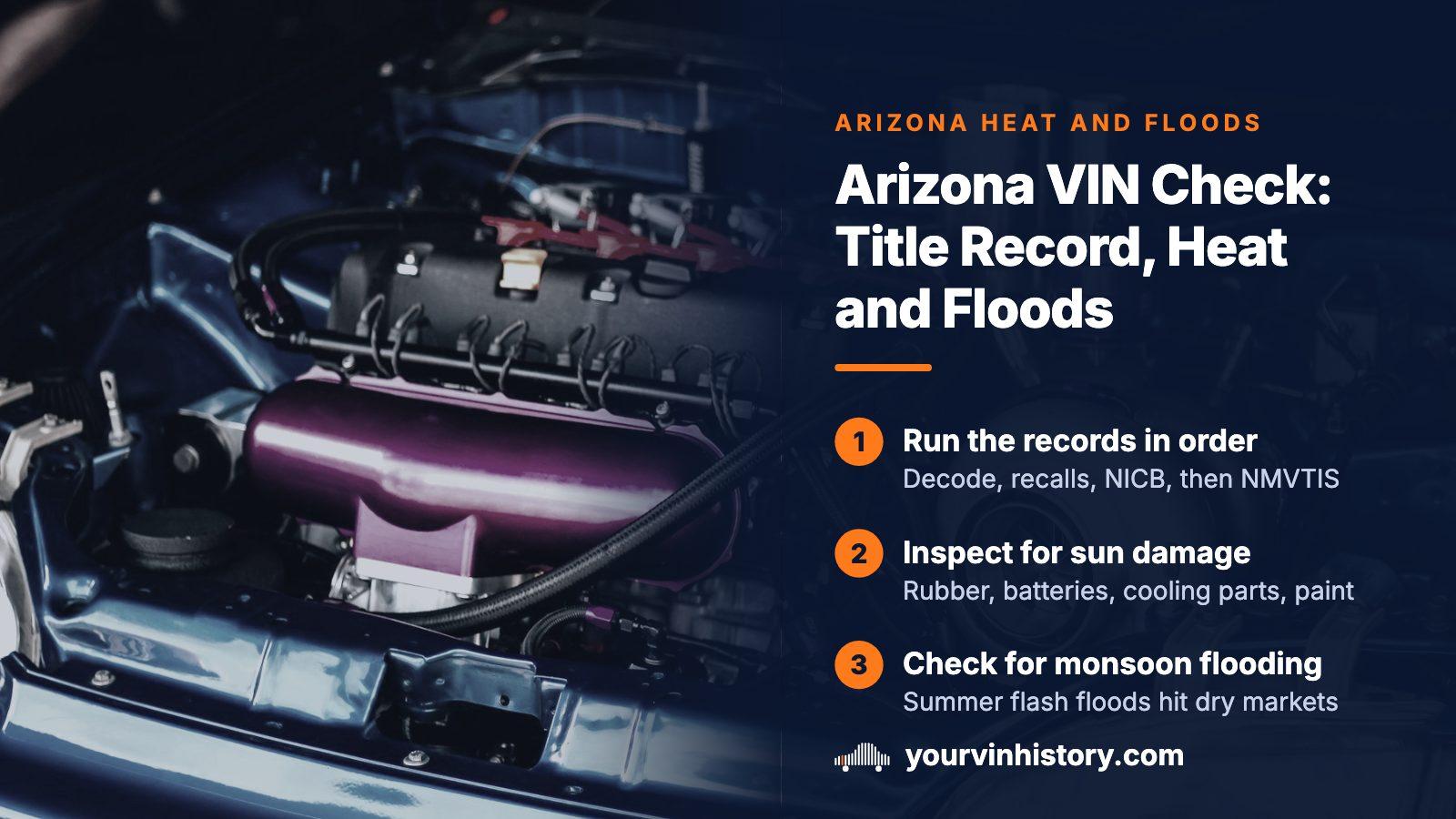
Decode the VIN, search the NHTSA recall lookup and NICB VINCheck, then pull the national NMVTIS title record from an approved provider. Arizona titles and registers vehicles through the Motor Vehicle Division, which handles the paperwork but does not vouch for the car. After the records, inspect for what this climate does: sun-aged rubber, batteries, cooling parts and paint, and flood damage from monsoon storms.
- Title agency
- Motor Vehicle Division, inside the state transportation department
- Main wear
- Heat and UV, not rust
- Water risk
- Summer monsoon flash floods
- Plate lookups
- Limited by a federal privacy law
The order to run an Arizona VIN check
Everything useful starts with the VIN, not the plate. Before you spend anything, compare the number on the dash plate and the door-jamb label with the number on the title the seller is holding, character against character.
- Decode the VIN and compare the build with the listing: engine, body style, drivetrain and model year.
- Search the NHTSA recall lookup. The search costs nothing, but ask a dealer what repair terms apply, because the federal remedy rule does not reach every vehicle and very old ones can fall outside it.
- Search NICB VINCheck for theft and salvage reports from participating insurers.
- Pull the national title record from an NMVTIS approved provider.
- Inspect the car for heat wear, then for water damage.
- Work out the emissions requirement for the area where you will register it.
- Finish the transfer through the Motor Vehicle Division or an authorized office.
Who handles Arizona titles: the MVD and its partner offices
Arizona has no department called the DMV. Titles, registration and plates run through the Motor Vehicle Division, a unit inside the Arizona Department of Transportation.
The state also uses authorized third-party providers, private businesses that do some of the front-desk work for the state. What that means for a buyer is limited. The Division and those offices process paperwork. They do not inspect the car or promise that its past is clean, so verification is your job and it belongs before the transfer, not after.
Think of the counter as the finish line. A transferred title is still a title for the same car with the same history.
What the national title record adds to an Arizona search
A car on an Arizona lot may have spent its earlier years somewhere else. The NMVTIS record is where brands applied by other reporting states show up in a single search.
The Justice Department describes the consumer report as intentionally concise. It covers the brand history on the current title (junk, salvage or flood, for example), the latest reported odometer reading, insurer total-loss determinations, transfers to recyclers or salvage yards, and in some cases theft data. A yourvinhistory report builds on NMVTIS title records supplied by ClearVin LLC, an approved NMVTIS data provider.
A clean report is not a clean bill of health
States define brands differently, and a car can be handled as salvage without ever being branded. The Justice Department advises buyers to review the actual state title record instead of trusting any one history report.
Why a clean frame says little about an Arizona car
Shoppers in salt states learn to inspect from underneath, because winter road treatment eats metal. Dry desert air works the other way. Arizona underbodies often look decades younger than the rest of the car, which is exactly why out-of-state buyers go looking for them.
That sets a trap. Clean metal flatters the whole car, so the odometer and the body can look better than the parts that did the work. Price the vehicle on what the heat has used up, in hoses, belts, battery, cooling parts, air conditioning and interior, instead of how good the undercarriage looks.
What sun and heat age first
Rubber, plastic and anything that holds fluid take the beating here. Use this as a walk-around checklist.
| Part | What the desert does | What to check |
|---|---|---|
| Hoses, belts and seals | Dry out, harden and crack well ahead of schedule | Squeeze the hoses, look for cracks or swelling, ask for proof of a recent hose-and-belt service |
| Battery | Heat shortens its life more than cold does | Read the date code instead of trusting a quick tester result |
| Cooling system | Radiator, water pump and fans have worked at full load every summer | Watch the temperature gauge on a climb |
| Air conditioning | Runs hard for most of the year | The cabin should cool fast on a hot afternoon |
| Interior | Cracked dashboards, split leather, brittle plastic | Inspect the dash top and the seat bolsters |
| Paint and lenses | Clear coat chalks and headlight lenses yellow | Compare panels in daylight and look at lens clarity |
A test drive built around the heat
Book the drive for a warm part of the day. A cool engine on a cool morning hides most cooling and air conditioning faults.
- With the engine off, check the battery date code and press on the radiator hoses.
- Start the car and listen for belt squeal or a rough idle.
- Climb a grade with the air conditioning running and keep an eye on the temperature gauge, since cooling weakness shows up under load.
- Run the air conditioning on its coldest setting. Slow cooling points to a compressor or refrigerant charge problem.
- Sit still and study the interior. A cracked dash and split seats say the car lived outdoors, and a garage-kept example is a better purchase.
Fresh paint: sun damage or crash repair?
Ultraviolet light chalks the clear coat, so fresh paint on a desert car is frequently an honest fix for sun damage. It can also cover collision repair, and the finish alone cannot tell you which.
Look for uneven panel gaps, overspray on rubber trim and inside the door jambs, a mismatched texture from one panel to the next, and paint on bolts nobody should have touched. Then compare the story with the records. A yourvinhistory report lists accident records with a damage map, plus salvage and auction records with photos, and a damaged-car photo contradicts a story about sun.
Ask the seller why the car was repainted and ask to see the shop receipt. If the story and the records disagree, the records win.
Monsoon flooding in a market everyone thinks is dry
Summer monsoon storms drop heavy rain on hard, dry ground that sheds it fast. Washes run, underpasses fill, and vehicles get caught in minutes. Arizona produces flooded cars every season in a state buyers associate with dust.
The assumption helps sellers, because nobody is looking for water. Run the same inspection you would give a Gulf coast car:
- Silt or dried mud in the spare-tire well and under the seat rails
- Corrosion on electrical connectors and behind the dash
- Water lines or fogging inside headlight and taillight housings
- Electrical faults that come and go, such as windows, gauges or warning lights
- A musty smell covered by a fresh air freshener
A missing flood brand proves little
If an Arizona title carries a flood brand, believe it. If it carries none, that proves less, because a car that never produced an insurance claim never produced a record.
Emissions rules follow the registration address
Arizona requires emissions testing where its air-quality obligations apply, broadly the Phoenix and Tucson metropolitan areas. In those areas, registering most vehicles after their early model years means passing a test. Registrations out in the rural counties mostly fall outside the program.
So one car can be easy to register in one county and a headache in another. If you will register in a metro area, treat a lit check-engine light as a repair bill to negotiate, not a quirk of age. The state sets the boundaries and exemptions, so confirm the current terms for your address with the Motor Vehicle Division before you agree on a price.
Buying an Arizona car from out of state, or selling one
Arizona ships clean-bodied used cars to places where salt wrecked the local supply, and a rust-free frame on an older truck can carry a real premium in a snowbelt city.
If you are the distant buyer, run the VIN records first, then pay for an independent inspection near the car. Photos will not show a brittle hose or a weak air conditioner.
If you are selling, document the Arizona history: underbody photos, service receipts, and a title in your own name. Buyers will price in heat wear, so showing recent hose, belt and battery work answers the objection before it comes up. Either way, read the name on the title and match it to the seller's ID before any payment.
Where this information comes from
- Arizona Department of Transportation: Motor Vehicle Division — The state agency behind Arizona titles, registration, plates and transfers, including the authorized third-party offices.
- Bureau of Justice Assistance: NMVTIS — Federal home of the national title database, with consumer guidance on what a report covers and where it falls short.
- NICB: VINCheck — A no-cost theft and salvage search fed by participating insurers.
- NHTSA: Recalls — Where you enter a VIN to see whether a safety recall is still open on the car.
Sources and photos: Facts checked against the sources above in October 2026. Photo by Willian Cittadin on Unsplash; diagrams by YourVINHistory.
Keep reading
- Flood-damaged carsThe full water-damage inspection that monsoon cars need as much as coastal ones.
- Buying a car out of stateWhich records follow a car over a state line and which stop at the border.
- Arizona platesWhat happens to the plate and its credit when an Arizona car is sold.
- MichiganThe salt-state inspection that Arizona buyers get to skip.
Frequently asked questions
Can I look up the owner of an Arizona license plate?
No, private individuals cannot. The federal Driver's Privacy Protection Act limits who can obtain personal details from motor vehicle records, and curiosity is not a permitted use. For a purchase you do not need the owner anyway. Ask the seller for the VIN, then confirm that the name on the title matches the person selling.
Do Arizona cars flood even though the climate is dry?
Yes. Monsoon storms send flash floods through washes and low crossings, and cars get stalled or swept along. Because many buyers expect a dry car, the water check gets skipped. Look for silt, corroded connectors and water lines in the light housings, and treat a clean title as unproven rather than as an answer.
Does an Arizona car need an emissions test before I buy it?
The testing duty attaches to registration, not to the sale. It applies broadly in the Phoenix and Tucson metro areas, and mainly to vehicles beyond their early model years. Ask the seller for the most recent test result, and check the rule for the address where the car will actually be registered.
How old can the battery be on a used Arizona car?
Heat wears batteries out faster than cold does, so the date code tells you more than a passing test. A battery past three or four Arizona summers is on borrowed time even if it starts the car today. Build a replacement into your offer instead of hoping it lasts.
Should I still run a VIN check if the car looks spotless?
Yes. A spotless body is exactly what dry air produces, and it says nothing about brands from earlier states, a theft report or a salvage record. Appearance and paperwork answer different questions. Run both, and let any gap between them become a negotiating point or a reason to walk away.
Now check the car itself
The guide explains what to look for. The report shows what this VIN has on record.