THE SHORT ANSWER
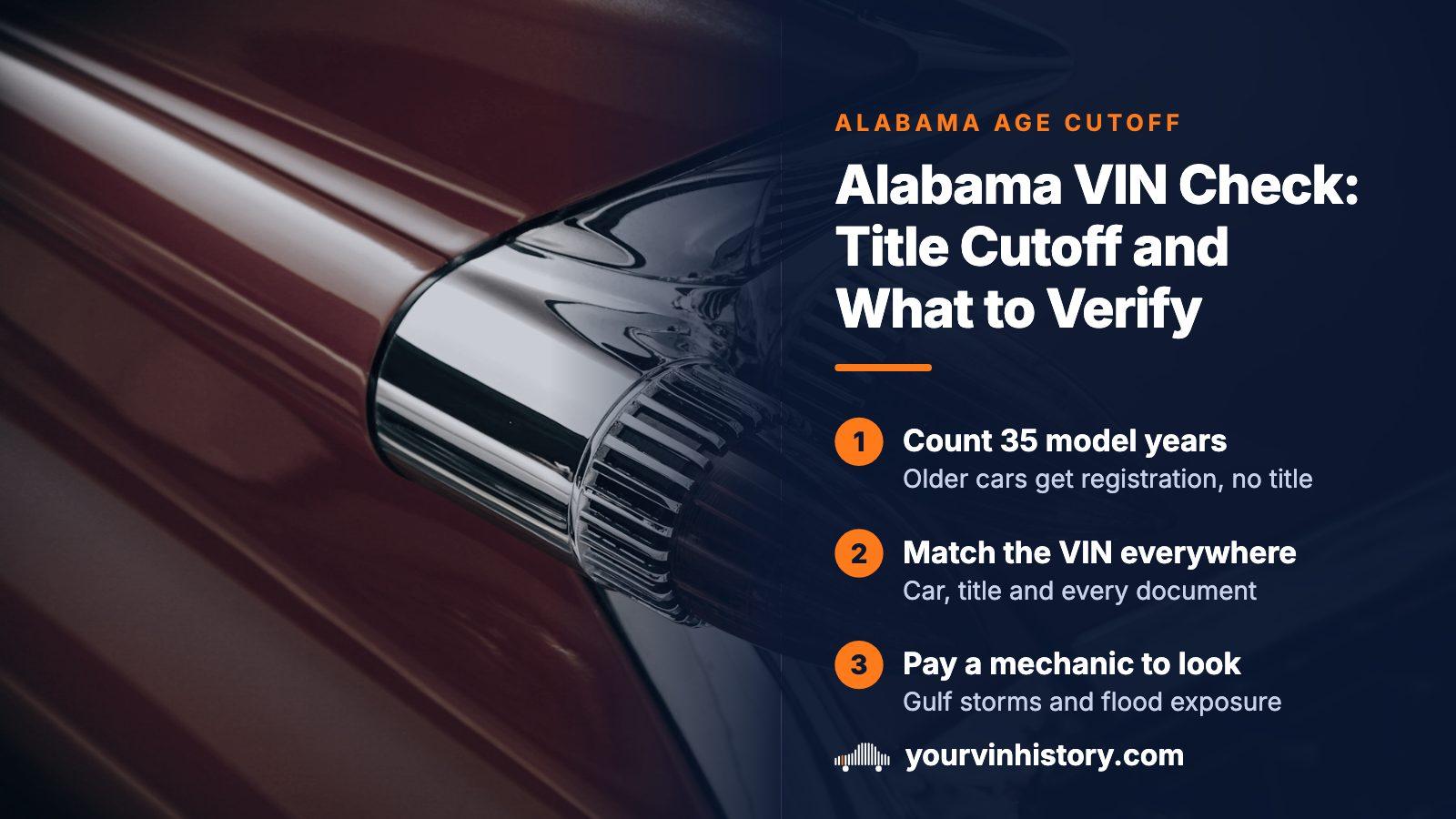
Alabama titles a motor vehicle only while it is 35 model years old or newer. Older ones get a registration, backed by a bill of sale or similar proof of ownership. Because the rule counts an age rather than a year, the cutoff creeps forward every year. Match the VIN on the car to every document, run the free recall and theft lookups, and pay a mechanic to go over the vehicle.
- Title line
- Motor vehicles 35 model years old or newer
- Past the line
- Registration and ownership paperwork, no title
- Cutoff year
- None fixed: the line advances annually
- Travel and camping trailers
- Titled when not more than 20 model years old
An age test, not a calendar year
The Alabama Department of Revenue builds its title rule around age. A motor vehicle that is domiciled in Alabama, has to be registered there and is not more than 35 model years old needs an Alabama certificate of title. Once a vehicle passes 35 model years, the same department says no title is to be obtained for it.
Picture a conveyor belt. Each year another model year slides past the line, and a car that was titled for decades can stop needing one without a single change to the car itself. Articles that quote one specific year as the Alabama cutoff are freezing a number that keeps moving, so treat any such year as stale and count back from the present model year on your own.
For a shopper, that means a vehicle's title status depends on the date you look as well as on the vehicle. A classified ad written two years ago may describe a car that is now on the other side of the line.
Trailers and equipment run on different clocks
The 35-year figure belongs to motor vehicles. The Department of Revenue sets other thresholds for the trailers and machinery that tend to be bought alongside a truck.
- Travel trailers and folding camping trailers need a title while they are not more than 20 model years old.
- Trailers past 20 model years are exempt from titling.
- Utility trailers, meaning vehicles without motive power that a car or pickup is meant to tow, need no title, and neither do boat trailers or bumper-pull trailers.
- Farm equipment, special mobile equipment and implements of husbandry need neither a title nor a registration.
If you are shopping for a camper or a work trailer, work out which category it falls into before assuming a title exists. The county license office can tell you where a particular trailer lands.
What changes hands when there is no title
A vehicle past the line is not left unregistered. Instead the buyer receives a registration, and ownership is shown through the paperwork filed with the application. Acceptable papers include a bill of sale, a court order, or a manufacturer's certificate of origin that has been correctly assigned to the buyer, along with anything else the Department of Revenue specifies.
| Vehicle age | What the state issues | What to ask the seller for |
|---|---|---|
| Not more than 35 model years old | Certificate of title, plus registration | The signed title, with a VIN that matches the car |
| More than 35 model years old | Registration only | A bill of sale, plus any earlier bills of sale the seller kept |
| Once titled, now past the line | Registration only | The last title the car held, because it records earlier owners and brands |
County offices apply these rules at the counter, and the details can differ from one office to the next. Call the license office in the buyer's home county before money changes hands, and ask exactly what it will want to see.
The in-person look at the vehicle
Where no title is required, the state's rules send the licensing official, or a deputy named by that official, to look the vehicle over before registering it, and again at every sale. County offices describe this as a VIN inspection that may be required at registration, so plan on bringing the vehicle in rather than just a stack of paper.
It deserves some credit. Someone looks at the VIN plate in person, and the plate is where fraud on older vehicles tends to live: a number that was restamped, a frame borrowed from another car, an identity moved from one vehicle to a different one.
Identity, not condition
The inspection answers one question: is this the vehicle the paperwork describes? It says nothing about whether the brakes work, the frame is straight or the carpet spent a week underwater.
How a wrong digit travels through the state system
Alabama processes title applications in a system called ALVIN, and the system includes a VIN decoder that fills in vehicle details from the number. The Department of Revenue says some fields, weight among them, do not always fill themselves and can appear only after a trim level is chosen.
Two lessons follow. First, a description on Alabama paperwork may have been produced by software from the VIN, not typed from what a clerk saw, so one wrong character can yield a tidy, official-looking description of a different car. Second, a decoded field is a starting point rather than a verification.
Read the VIN off the vehicle itself, then read it off each document, comparing character by character instead of glancing at the first few. Any mismatch is a stop sign until the seller produces a corrected document or a plausible explanation.
Gulf storms, floodwater and cars that age out
Alabama has a Gulf coastline, and tropical systems push storm water well inland from it. Like any coastal state, it ends up with vehicles that sat in floodwater, and those vehicles get sold on, sometimes across state lines.
Age-based titling adds a wrinkle. Brands live on titles, and a vehicle that has aged out may have lost its old title, with nothing new issued to carry the history forward. A water-damaged car past the line can then be sold using only a registration and a receipt. The inspection at the county office confirms what the vehicle is, not what it went through.
So the evidence has to come from the vehicle: a water line on door panels, silt in seat tracks and under carpet, corrosion in places that stay dry on a normal car, and a musty smell that air freshener does not quite cover.
Why the federal title record thins out with age
NMVTIS, the national title database overseen by the U.S. Department of Justice, is fed in large part by state title systems. A vehicle that no longer has a title adds less to that pipeline, so the older the vehicle, the less a national report may have to say.
Inside the 35-year window the report earns its cost, because there is a title record to read. The Department of Justice lists the approved providers, and a buyer should stay within that list. A yourvinhistory report carries NMVTIS title records supplied by ClearVin LLC, an approved provider, alongside accident, salvage and auction records, odometer readings, liens and open recalls, and a free preview comes first.
A blank NMVTIS result on an older car is not a clean bill of health. It can simply mean that nothing was ever recorded.
Lookups from other organizations that ignore the title
Two searches run off the VIN rather than the state's paperwork, so they work on a car of any age and cost nothing to run.
- NHTSA recall lookup: reports whether the VIN has an open safety recall. The search itself costs nothing, but the repair is a separate matter, because the federal rule that makes a manufacturer pay does not extend to very old vehicles. Ask the maker or a dealer what the work would cost before you assume it is covered.
- NICB VINCheck: a National Insurance Crime Bureau search that flags theft and salvage indicators for a VIN.
A clean answer from either one narrows the risk without ending it. Neither can see a wreck that was repaired out of pocket and never reached an insurer.
What a license plate search will not tell you
A plate search will not hand over an owner's name or address. Federal privacy law limits the personal details that motor vehicle records may release, and consumer lookup services stay within that boundary.
What a plate can do is tie the car on the lot to the listing on your screen. It leads to a VIN, and the VIN can be compared with the one on the vehicle. A seller who offers a plate number but hesitates on the VIN has handed you extra work, so ask for the VIN itself and check it against the car in person.
A buying order for both sides of the line
Adjust the order to the vehicle's model year, and do the cheap steps before the expensive ones.
- Decode the model year from the VIN itself, since the tenth character carries it, and ignore the year in the listing.
- Run the NHTSA recall lookup and NICB VINCheck. Neither needs a state record.
- If the vehicle sits inside the title window, get the title in hand and add an NMVTIS report from an approved provider.
- If it sits past the line, collect every bill of sale the seller has, then call the county license office to learn what it will require at registration.
- Match the VIN on the car to each document, then pay an independent mechanic to inspect it before you sign.
On a vehicle past the line, the documents carry less weight, so the vehicle has to carry more. Spend your effort accordingly.
Where this information comes from
- Alabama Department of Revenue: What vehicles are required to be titled — Supports the 35-model-year title rule, the exemption for older motor vehicles, and the separate 20-model-year line for camping and travel trailers.
- NHTSA: Recalls — The federal recall lookup that checks a VIN for open safety recalls regardless of how the state titles the vehicle.
- Bureau of Justice Assistance: Approved NMVTIS data providers — The Department of Justice list of businesses approved to sell national title records to the public.
Sources and photos: Facts checked against the sources above in October 2026. Photo by Clem Onojeghuo on Unsplash; diagrams by YourVINHistory.
Keep reading
- Alabama title checkThe next question for a titled Alabama car: reading the salvage, rebuilt and flood legends printed on it.
- Classic car VIN decoderVehicles past the title line are often classics with unusual serial numbers, and this guide covers reading and checking them.
- Flood-damaged carsGulf-state buyers should know how to spot water damage when no brand is on the paperwork.
- NMVTIS reportExplains what the federal title record contains and where it runs out.
Frequently asked questions
Do I need a title to register an old car in Alabama?
Not if the car is more than 35 model years old. Alabama titles only motor vehicles that are not more than 35 model years old and registers older ones without a title. Expect to show a bill of sale or similar proof of ownership, and possibly bring the car in for a VIN inspection. Counties apply the details, so confirm with the license office before you buy.
What is the Alabama title cutoff year?
There is no fixed year. The rule counts model years back from the present, so a vehicle that needed a title last year can be exempt this year. To find the current line, count back 35 model years from the present one and compare the result with the year decoded from the VIN, not the year printed in the advertisement.
Can I still get a title for a car that is past the line?
Plan on not getting one. The Department of Revenue's wording says no title is to be obtained for motor vehicles more than 35 model years old, so a registration and your paperwork are what you will hold. A title the car already carries from earlier years is different, and worth asking for. If a seller promises a title anyway, see it before paying.
Will a VIN check work on an Alabama car that has no title?
A decode and a recall search run from the VIN alone, so they work fine. What shrinks is title history: with no title, fewer state records reach the federal database, and a national report may come back sparse. Treat a thin report as missing information, and lean on the physical inspection and the chain of bills of sale instead.
Does the county inspection replace a pre-purchase inspection?
No. The official's check targets identity, matching the VIN plate to the paperwork. It does not test the engine, brakes, frame or interior for water damage. A mechanic you choose, working for you, is the only person whose job is finding faults. Schedule that visit before you sign anything, and pay for it yourself.
Now check the car itself
The guide explains what to look for. The report shows what this VIN has on record.