THE SHORT ANSWER
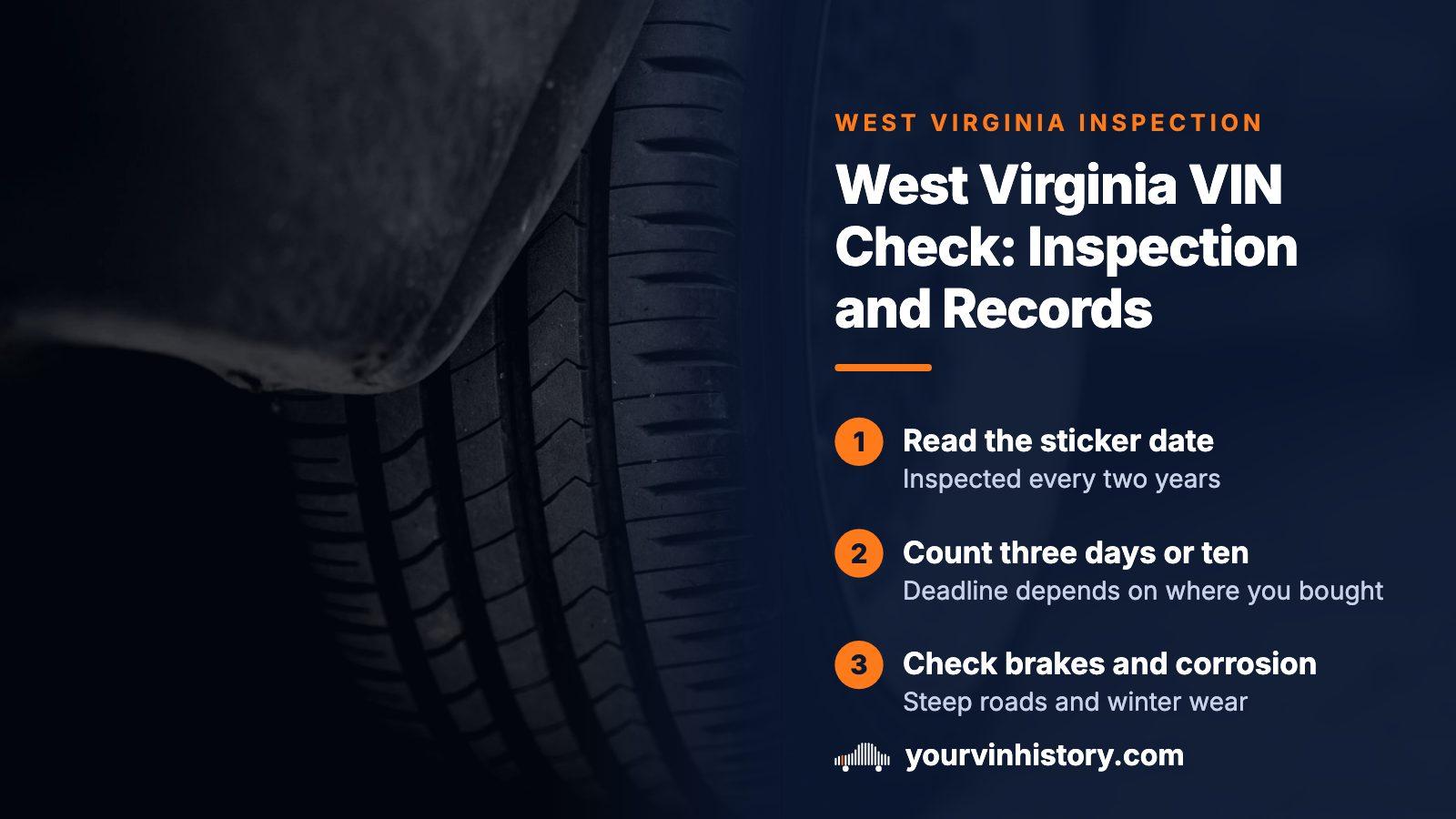
Run the VIN through the free federal tools for open recalls and theft or salvage flags, then buy the national NMVTIS title history through an approved data provider. Separately, read the windshield sticker. West Virginia inspects vehicles every twenty-four months, and a car without a valid sticker must be inspected within three days of an in-state purchase, or within ten days of titling when it was bought out of state.
- Bought in West Virginia
- Three days to inspect if no valid sticker
- Bought out of state
- Ten days, counted from titling
- Sticker life
- Twenty-four months
- Maximum sticker fee
- $19 for the full two years
What the VIN tells you and what the sticker tells you
These are separate questions, and a careful West Virginia buyer needs an answer to both. The VIN is the vehicle's identity. It leads to the factory build, open safety recalls, the title record and any theft or salvage flags. The inspection sticker says something different: a licensed station looked at the car on one particular day.
The state describes the inspection as a check that mechanisms, brakes and equipment work properly. That is useful, but nothing in that description reaches title brands, odometer history, past insurance claims or liens. A car can pass on the lift and still carry a brand written in another state.
So treat the two as halves of one purchase. Use the VIN for the paper record, use the inspection for present mechanical condition, and do not let a fresh sticker talk you out of the first half.
Three days or ten: the deadline that follows a purchase
West Virginia runs two different clocks for a vehicle that changes hands without a valid sticker. Which one applies depends on where the sale took place.
| Where you bought it | Time to get it inspected | Counted from |
|---|---|---|
| Inside West Virginia, no valid sticker | Three days | The day you acquire the car |
| Another state, then titled in West Virginia | Ten days | The date of titling |
Three days is tight. Buy from a private seller on a Saturday and the inspection has to fit into Monday or Tuesday, before you even know whether the car will pass. The ten-day window gives more room, and because it runs from titling rather than handover, the date on your title paperwork is the one to watch.
Make the sticker part of the deal
If the windshield shows no valid sticker, ask for a passing inspection as a condition of sale, or agree in writing who pays for whatever it turns up. Doing it afterward means you take on the deadline and the unknown result at the same moment.
How the two-year sticker works
The requirement is not limited to cars and trucks. Trailers, semi-trailers and pole trailers on a West Virginia registration are covered as well, and driving without a valid sticker is illegal. A vehicle that passes gets a sticker good for twenty-four months, placed on the inside of the windshield. The maximum sticker fee is $19 for the whole two-year period.
The two-year cycle is recent. House Bill 2310 moved the state off annual inspections starting January 1, 2024, so an older sticker may reflect the previous annual schedule. A truck last inspected in 2023 sits on a different timetable from one inspected afterward.
Inspections are done at stations licensed by the West Virginia State Police. Bring a valid registration card and a current certificate of insurance, because a station can turn you away without them.
Reading the sticker date like a buyer
A two-year sticker is a weaker signal than an annual one. A car with twenty-three months behind it is still entirely legal, yet nobody has looked at its brakes through almost two winters and two summers of wear. The date tells you how recently a person examined the car. It says nothing about how the car has been driven since.
- Read the month and year on the sticker before you talk about price.
- A sticker close to expiring means an inspection is due soon, so ask who will handle it.
- No sticker, or an expired one, puts you on the three-day or ten-day clock after the sale.
- Do not accept 'it will pass' from a seller in place of a passing result on paper.
Stickers from other states that West Virginia accepts
The state honors valid, unexpired inspection stickers from nine other states: Texas, Oklahoma, Louisiana, Mississippi, Missouri, Utah, Wyoming, New York and New Hampshire. A car that shows up with a live sticker from one of them is in a better position than one that shows up with nothing.
Now look at who is missing. Ohio, Pennsylvania, Maryland and Virginia all border West Virginia, and none of them is on the list. Kentucky, the fifth neighbor, is not either. A buyer who crosses the line to a dealer in any of those states and drives home is looking at the ten-day clock from titling.
Check both the issuing state and the expiry date on any out-of-state sticker before you assume it covers you.
Registration renewal and the property tax receipt
Before a West Virginia plate can be renewed, the DMV requires proof that the personal property tax on the vehicle has been paid, or an affidavit from the county assessor. Insurance information and the correct fee are part of renewal too, and the paperwork can go by mail or to a regional office. State law requires every registered vehicle to be insured.
For a buyer, that links a seller's county tax position to the car's registration status. Lapsed plates may mean an unpaid tax bill rather than simple forgetfulness. Ask the seller directly, and ask to see the receipt. A tax problem is far easier for the seller to clear before the sale than for you to chase once your name is on the paperwork.
Why a West Virginia car often has history elsewhere
The state is ringed by five others, and for plenty of residents the nearest dealer sits across a state line. A used car on a West Virginia lot may well have been titled in Ohio, Pennsylvania, Maryland, Virginia or Kentucky first, and each of those states keeps its own files.
That is the job of NMVTIS, the national title database, which draws separate state records together. A yourvinhistory report is built on NMVTIS title records supplied by ClearVin LLC, an approved NMVTIS data provider, and adds accidents, odometer readings, salvage and auction records, liens and theft entries. The preview is free, and the full report is a one-time purchase.
State paperwork describes what that state knew. A national record describes the vehicle.
Steep roads, worn brakes and winter corrosion
Much of West Virginia is steep country, and used vehicles from hilly regions often show it in the brakes, transmission and cooling system. Long descents load brake parts harder than flat highway miles do, and a tow-rated truck may have worked much harder than its odometer suggests.
Winter road treatment adds corrosion on top. Wherever crews spread salt or brine, the underbody, brake lines and fasteners pay for it. A sticker issued up to two years ago is no guarantee about any of that. Put the car on a lift, or at least slide underneath with a flashlight, before you pay. Then test the brakes on a real downhill, not a flat parking lot.
Free checks to run before you drive out
Two free tools from outside this site cover ground the state inspection does not. The NHTSA recall lookup returns open safety recalls for a VIN, and the NICB VINCheck screens a VIN for theft and salvage records. Each takes a minute, and both are worth running before a price turns into a deposit.
The recall lookup is separate from the state inspection, so a passing sticker tells you nothing about whether recall work has been done.
A license plate is not a substitute. Federal privacy law limits who may obtain personal details held in motor vehicle files, so a plate search will not lawfully hand you an owner's identity. Work from the VIN on the dashboard and the title.
A buying sequence for a West Virginia car
- Ask for the VIN before the visit and decode it, so the year, build and engine can be matched against the listing.
- Run the NHTSA recall lookup and the NICB VINCheck on that same VIN.
- At the car, match the VIN on the dash to the paperwork, then read the sticker's month, year and issuing state.
- Inspect the brakes and underbody, and drive a stretch that includes a descent.
- Pull the NMVTIS title record before any money moves, since out-of-state history is common here.
- Settle the inspection in writing: a passing result as a condition of sale, or a clear note on who owes the repair. After the sale, put the three-day or ten-day deadline on your calendar.
Where this information comes from
- West Virginia DMV: Vehicle inspection — Backs the twenty-four month cycle, the three-day and ten-day deadlines, the $19 sticker cap, the nine honored states and the HB 2310 change.
- West Virginia DMV: Registrations — Backs the property tax proof or assessor affidavit needed to renew a plate, plus the insurance requirement and renewal channels.
- NHTSA: Recalls — The federal lookup for open safety recalls by VIN, which runs separately from any state inspection.
Sources and photos: Facts checked against the sources above in October 2026. Photo by engin akyurt on Unsplash; diagrams by YourVINHistory.
Keep reading
- Buying a car out of stateShows which records follow a car across a state line and which stop at the border.
- NMVTIS reportExplains the national title record that covers a car with history in a neighboring state.
- PennsylvaniaA neighboring state with its own sticker rules, useful if the car comes from there.
- Vehicle registration lookupMaps the status checks and official tools for a registration question.
Frequently asked questions
How long do I have to get a car inspected after buying it in West Virginia?
Three days if you bought it inside the state and it has no valid sticker. A car bought in another state and then titled here gets ten days, counted from the titling date. Because the short deadline can land on a weekend, line up a station before you hand over payment and bring the registration card and an insurance certificate.
Will West Virginia accept an Ohio or Pennsylvania inspection sticker?
Neither state is among the nine whose valid, unexpired stickers West Virginia honors, and the same is true of Maryland and Virginia. A car coming from any of them counts as an out-of-state purchase on the ten-day clock, so plan on a West Virginia inspection soon after the car is titled in your name.
How much is a West Virginia inspection sticker?
The maximum sticker fee is $19, and that covers the full twenty-four months. The sticker is the cheap part. The real expense is whatever the station finds wrong with the brakes or equipment, so a seller who says the car just needs a sticker deserves a follow-up question about why it does not already have one.
Does passing a West Virginia inspection mean the car has a clean history?
No. The inspection confirms that mechanisms, brakes and equipment work properly on the day of the test. Nothing in that scope covers salvage or rebuilt brands, odometer comparisons, liens or theft flags. Those come from records tied to the VIN, which is why both checks belong in the same purchase.
Can I check a West Virginia car using only the license plate?
Not reliably. A plate will not lawfully reveal the owner, since federal privacy law limits access to personal data in motor vehicle files. Ask the seller for the VIN, or read it off the dashboard or the paperwork yourself, then run the free recall and theft screens before buying the national title record.
Now check the car itself
The guide explains what to look for. The report shows what this VIN has on record.