THE SHORT ANSWER
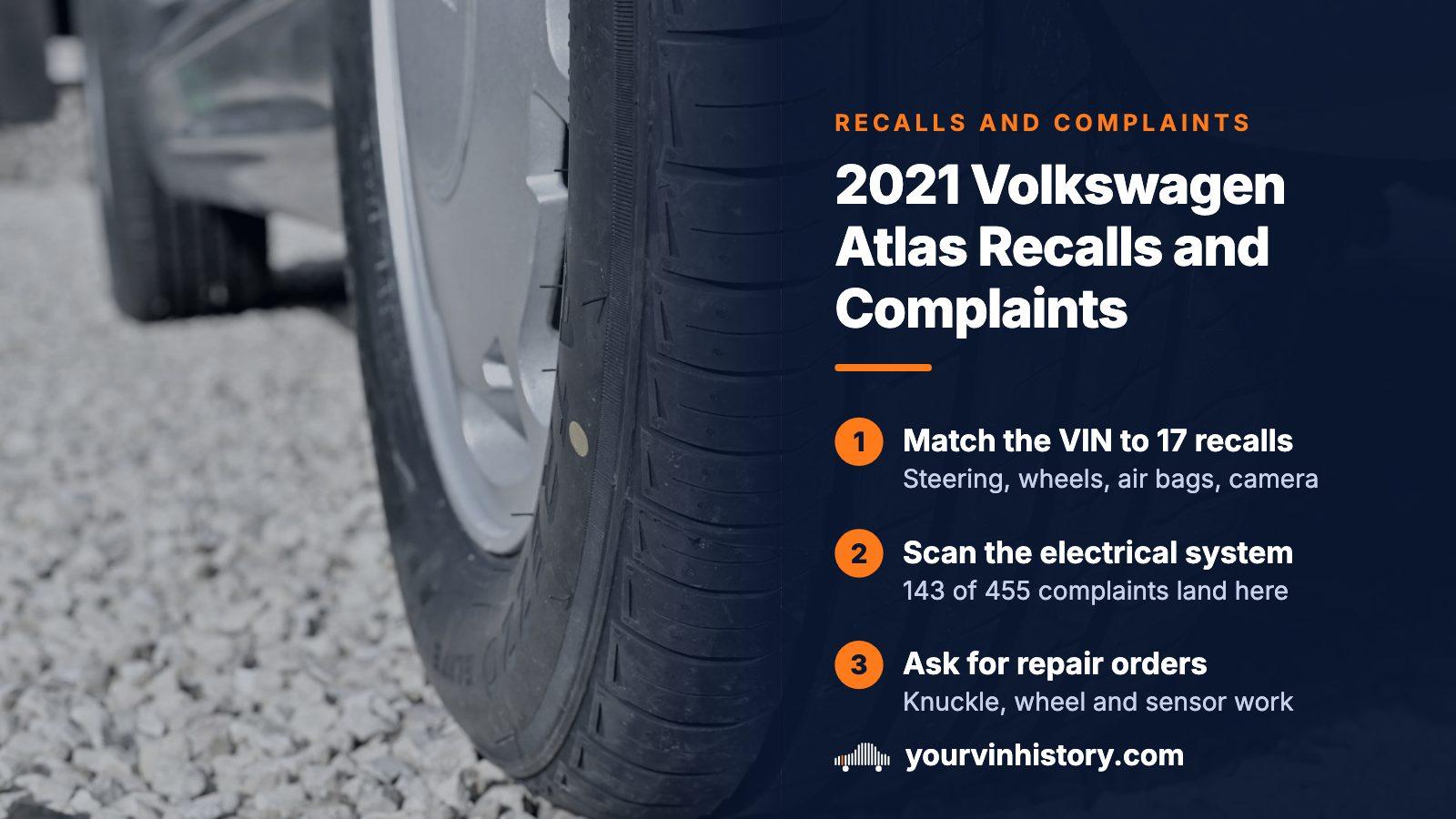
The 2021 Volkswagen Atlas has 17 recall campaigns on file with NHTSA, covering steering knuckles, wheel bolts, air bag parts, a rear camera, tires and more, plus 455 owner complaints led by the electrical system at 143. NHTSA rated it 5 of 5 stars overall. Run the VIN through NHTSA's recall lookup to learn which campaigns remain unrepaired on one car.
- Recall campaigns
- 17 on file with NHTSA
- Owner complaints
- 455, with 143 about the electrical system
- NHTSA overall rating
- 5 of 5 stars, 4 of 5 for rollover
- Complaint filing peak
- 2022
What the 17 and the 455 each stand for
NHTSA keeps two files on every model year, and they carry different weight. A recall campaign is a defect Volkswagen has accepted responsibility for; the 2021 Atlas has 17. A complaint is one owner's unverified account; this model year has 455. Treat campaigns as repairs to confirm and complaints as leads for a mechanic.
Some complaints carry flags drawn from the owner's wording: 8 describe a crash, 1 a fire and 11 an injury. One incident can produce several filings, so these are not event counts. NHTSA also lists 1 investigation touching this model year, which can end in a recall or in nothing. Read it as a reason to ask questions, not a finding.
Steering, wheels and tires: five notices about holding the road
Five campaigns concern the parts that keep the car on the road. Two cover steering knuckles under separate numbers, so ask for proof of both.
- 20V712000: a steering knuckle may have been damaged in production. Volkswagen told owners not to drive until the car was inspected. Dealers replace knuckles as needed. It began in November 2020.
- 21V026000: a front knuckle may crack near the strut mount. Dealers inspect and replace one or both. It began in February 2021.
- 21V132000: lug bolt holes in the wheels may have been machined wrongly, so a wheel could separate from the car. Dealers inspect all four wheels and replace wheels, bolts and bearings as needed.
- 21V812000: front wheel bearing bolts may have been tightened wrongly and could loosen. Dealers check them and replace as needed.
- 20V702000: one Continental Cross Contact LX Sport fitment in the 20-inch size may have been over-cured. Dealers check each tire's date code and mold number and replace affected tires.
Volkswagen's own codes for the first four are 40Q6, 40Q7, 44Q9 and 40R7. A repair order that quotes the NHTSA number or the Volkswagen code is the paperwork to ask for.
Air bags, relays and a drain tube
Five campaigns involve air bag hardware or nearby wiring. Several repairs are conditional, with a part replaced only when it fails a check, so a repair order and a clean scan together make the best evidence.
| Campaign | Part | Fault | Repair |
|---|---|---|---|
| 21V892000 | A/C drain tube | A blocked tube can leak water near the air bag control module | Repair tube, replace module if needed |
| 22V152000 | Door wiring, side air bags | Corroded contacts may delay deployment in a side impact | Secure harnesses, replace any with a fault code |
| 23V215000 | Passenger sensor | A wiring fault may switch off the front passenger air bag when the seat is occupied | Replace sensor mat and harness |
| 24V464000 | Passenger sensor | Same fault, with a wider model-year range | Same replacement |
| 21V616000 | Engine bay relays | Damaged relays could set off the horn or starter | Replace relays if needed |
Two notices describe one passenger sensor fault, so ask which campaign number the repair order closes.
Rear camera, tire pressure, headlight, seat, fuel and label notices
The remaining seven campaigns are narrower, and several are software jobs.
- 20V716000 and 22V514000: the rear view image can go black or freeze, breaking the federal rear visibility rule. The first blamed the ignition cycle, the second a flaw in the infotainment memory module. Both get a software update.
- 22V815000: the tire pressure monitor may be slow to warn when all four tires lose air together. Software update.
- 20V504000: the driver's side headlight may be aimed too low. Dealers adjust it.
- 20V505000: front seat frame and backrest adjuster welds may be faulty. Dealers replace seatback frames as needed.
- 22V245000: long fuel injectors may lack filters. Dealers replace them.
- 22V086000: cars with accessory side steps lacked a reduced weight-rating label. Dealers add it.
Some notices name the Atlas FL instead of the plain Atlas, a tag they never explain. If a list looks as if it skips your car, trust the VIN lookup over your own reading.
How the 455 complaints divide by component
Raw totals follow sales, so the split says more than the sum. NHTSA files each report under the component the owner blamed.
| Share of the 455 | Component group | Reports |
|---|---|---|
| 31% | Electrical system | 143 |
| 21% | Service brakes | 95 |
| 18% | Engine | 82 |
| 16% | Unknown or other | 73 |
| 15% | Forward collision avoidance | 68 |
| 14% | Air bags | 63 |
| 13% | Exterior lighting | 61 |
| 9% | Fuel and propulsion system | 39 |
| 5% | Structure | 21 |
| 3% | Power train | 15 |
| 3% | Speed control | 12 |
| 2% | Steering | 10 |
The groups add up to more than 455 because one report can name several components. Electrical stands clear of the rest.
Complaint areas that have no recall behind them
Lay the campaign list over the complaint table and a gap shows. Service brakes draw 95 complaints and forward collision avoidance 68, yet neither has a campaign. The engine's 82 reports sit beside one injector notice, and the 143 electrical reports beside notices for relays and for camera and tire pressure software.
What the gap means
No campaign means no standard repair and nothing for the recall lookup to flag. The file does not tie each complaint to a campaign either, so nobody can say how many of the 143 electrical reports trace to the relay or camera notices. For brakes, collision avoidance and the engine, the evidence comes from service records and a test drive.
When owners filed and how old the car was
Filings for the 2021 Atlas peaked in 2022. A peak that early tends to mean a build or design fault surfacing while the car was new, rather than wear that builds with mileage.
| System | Typical age at failure | Filed within three years |
|---|---|---|
| Electrical system | 1.2 years | 71% |
| Service brakes | 1.2 years | 91% |
| Engine | 3.3 years | 43% |
| Unknown or other | 3.3 years | 44% |
| Forward collision avoidance | 1.2 years | 84% |
| Air bags | 2.2 years | 62% |
| Exterior lighting | 4.5 years | 10% |
| Fuel and propulsion system | 3.5 years | 26% |
Electrical, brake and collision avoidance reports mostly arrived within the first three years, so a well-maintained car may have had those repairs made already. Ask to see the paperwork. Exterior lighting is the late arrival, around the age a 2021 car has reached today. These are medians of unverified reports, not failure rates.
Crash-test stars and the driver aids on the sheet
| NHTSA test | Result |
|---|---|
| Overall | 5 of 5 stars |
| Frontal crash | 4 of 5 stars |
| Side crash | 5 of 5 stars |
| Rollover | 4 of 5 stars |
| Rollover probability | 15.9% |
NHTSA rated two configurations, all-wheel drive and front-wheel drive, and both earned 5 overall and 4 for rollover. The stars describe a new vehicle in a laboratory; structural repair, aftermarket parts and old damage change how a body behaves in a crash and never appear in the rating.
On driver aids, the sheet lists forward collision warning as not offered and lane departure warning as an option. That sits awkwardly beside 68 complaints filed under forward collision avoidance, so confirm the car's equipment from its window sticker or a dealer build sheet.
Running the VIN, and the limits on a no-charge recall repair
Enter the 17-character VIN in NHTSA's recall lookup. It lists the campaigns that apply to that exact car and whether a repair is still open. A model-year list like this one only says which could apply.
Federal law, 49 U.S.C. §30120, requires the manufacturer to repair a recalled vehicle without charge when it is presented for remedy. The duty ends for a vehicle bought by its first purchaser more than 15 calendar years before the notice or order, and tires get a shorter window of 5 calendar years. A 2021 Atlas sits well inside the vehicle window, but the limits are why a no-charge repair is never guaranteed whatever the age.
What to put in front of a mechanic
Start where owners filed the most, then add checks that match the campaigns.
- Electrical: have fault codes scanned, then work the lights, windows, screen and rear camera image.
- Brakes: 95 complaints and no recall. Make several firm stops and have pads, rotors and fluid examined.
- Engine: 82 reports. Start it cold, look for leaks and ask whether the injectors were replaced under the campaign.
- Wheels and steering: look for signs of knuckle, bearing or wheel work and ask for invoices.
- Air bags: with an adult in the front passenger seat, confirm the dash shows no air bag warning.
- Engine bay: one complaint describes a fire, so look for heat damage, melted insulation and amateur wiring.
- All-wheel drive: engagement trouble hides on a short drive, and the transfer case and couplings are costly.
- Body: check tailgate seals and the spare well for damp, plus the third-row mechanism, the floor beneath it and the roof rail mounts.
Questions for the seller, and what this file leaves out
- Did a dealer complete all 17 campaigns, and do you hold the invoices?
- Has anyone repaired or replaced parts of the electrical system?
- Which shop maintained the car, and are the service records available?
- Has it ever been in a collision that an insurer paid to repair?
- Will you let my own mechanic look it over before we talk price?
- Is the title clean, in your name, with no lien on it?
A safety file stops at safety. It carries no title brands, accident repair, odometer readings or liens, which come from title and insurance records such as the federal NMVTIS database. A yourvinhistory report pulls those together, and a free preview comes before any purchase.
Where this information comes from
- NHTSA: recalls by vehicle — The lookup that matches a VIN to open campaigns, and the record behind each of the 17 campaign summaries here.
- NHTSA: vehicle safety and consumer complaints — Entry point to the owner complaint database behind the 455 reports, their component groups and the crash, fire and injury flags.
- 49 U.S.C. §30120: remedy without charge — The statute requiring manufacturers to repair recalled vehicles at no charge, with the 15 calendar year limit for vehicles and the shorter one for tires.
- NHTSA: New Car Assessment Program ratings — The federal crash-test program that produces the star ratings and the rollover figure.
- NMVTIS: national title record — The federal title database covering brands and history, which a safety record does not include.
Sources and photos: Facts checked against the sources above in October 2026. Photo by Andres Siimon on Unsplash; diagrams by YourVINHistory.
Keep reading
- Volkswagen recallsShows how to check any Volkswagen by VIN, handy when the Atlas is one of several cars on your list.
- Buying a car with an open recallCovers what to do when the lookup turns up an Atlas campaign that was never repaired.
- Volkswagen warranty by VINExplains how to see what Volkswagen coverage remains, which matters because many Atlas reports arrived early.
- NMVTIS reportDescribes the national title record that fills in what this safety file cannot.
Frequently asked questions
How many recall campaigns cover the 2021 Volkswagen Atlas?
NHTSA lists 17 recall campaigns. The earliest began in September 2020, for headlight aim and seat frame welds, and the newest concerns the front passenger occupant sensor, with letters mailed in phases from 2024. Campaigns follow production ranges, so the VIN decides which ones a given car carries.
Which problems do 2021 Atlas owners report most often?
Electrical system leads with 143 of the 455 complaints, then service brakes at 95 and the engine at 82. Electrical and brake reports tend to come early, at a typical age of 1.2 years, so a car repaired early may come with records. These are owner accounts, not confirmed defects.
Is the 2021 Volkswagen Atlas safe in crash tests?
NHTSA gave it 5 of 5 stars overall, 5 in the side test and 4 each in the frontal and rollover tests, for both drivetrain versions. A star rating describes a new test vehicle, so on a used one the completed recall repairs and any past collision damage matter just as much.
How do I check a specific 2021 Atlas for open recalls?
Type its 17-character VIN into NHTSA's recall lookup. The VIN is printed on the dashboard at the base of the windshield and on the driver's door jamb label. For work already done, ask the seller for dealer repair orders that quote the campaign numbers.
Does a clean recall lookup mean a 2021 Atlas has a clean history?
No. The lookup covers safety campaigns only. A car can pass it and still carry a salvage or rebuilt brand, accident repair, an odometer discrepancy or a lien. Those come from title and insurance records, including the federal NMVTIS database, so read both before agreeing on a price.
Now check the car itself
The guide explains what to look for. The report shows what this VIN has on record.