THE SHORT ANSWER
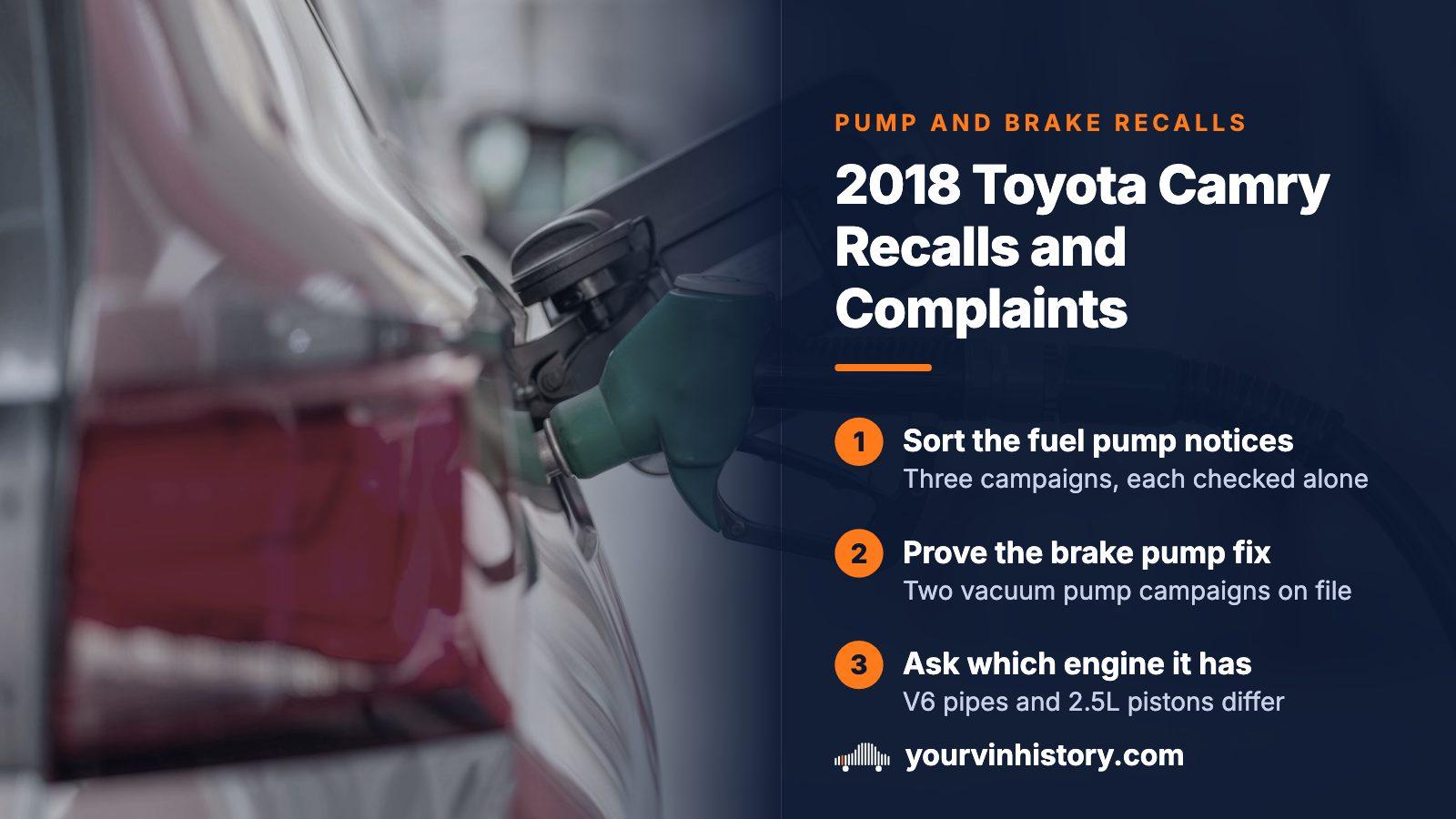
The 2018 Toyota Camry has 8 recall campaigns on file with NHTSA: three for the fuel pump, two for brake vacuum pumps, one for 2.5L engine pistons, one for V6 fuel pipes and one for a load label. Owners filed 759 complaints, 25% of them about the power train. NHTSA's crash tests gave the sedan 5 of 5 stars overall. Recalls follow VIN ranges, so each car needs its own lookup.
- Recall campaigns
- 8 on file with NHTSA
- Owner complaints
- 759, led by power train at 25%
- NHTSA overall rating
- 5 of 5 stars
- Among Camry years
- Third heaviest of 15, at 1.9 times the median
Three federal records, and what each can tell a buyer
NHTSA keeps separate records for a model year, and each answers a different question. A recall campaign is a defect the manufacturer has acknowledged and promised to repair. A complaint is an owner's unverified account. A crash rating comes from a laboratory test of a new car.
For the 2018 Camry that means 8 campaigns, 759 complaints and 5 stars, and none of the three is a score. Together they show a mechanic where to look, not whether to walk away. Owner wording flagged 48 complaints as involving a crash, 4 a fire and 45 an injury. Those are the filer's words, not investigators' findings, and one event can produce several filings, but they deserve a full read. NHTSA's ratings record lists no investigations for this model year.
All eight campaigns, sorted by the part involved
Copy the campaign numbers before you phone a dealer.
| Part | Campaign | Models named | Risk in plain terms |
|---|---|---|---|
| Fuel pump | 20V012000 | Camry among many Toyota and Lexus models | In-tank pump fails; engine can stall while driving |
| Fuel pump | 20V682000 | 2018 to 2020 Camry among many others; expands 20V012000 | Same pump fault, same stall risk |
| Fuel pump | 25V028000 | 2018 Camry and two 2019 Lexus models | Same in-tank pump; owner letters mailed in 2025 |
| Brake assist | 18V211000 | 2018 Camry and Highlander, plus three 2017 models | Badly machined pump rotor can end brake assist suddenly |
| Brake assist | 21V890000 | 2018 and 2019 Camry | Vane cap inside the vacuum pump can break |
| Engine | 18V200000 | 2018 Camry with the 2.5L four-cylinder | Oversized pistons can stall the engine |
| Fuel pipes | 18V108000 | 2018 Camry with the V6 | Pipes may sit loose on the hoses, so fuel can leak and burn |
| Label | 19V503000 | 2017 to 2019 Camry and others with factory floor mats | Wrong load-capacity label invites overloading |
Each campaign covers a production range narrower than the model year, so being listed here does not put a given Camry inside one.
Which engine the car has decides two of the campaigns
Only a V6 Camry can fall under 18V108000. A fuel delivery pipe may not be fully seated on its hose in the engine compartment, which could leak fuel near an ignition source. Dealers inspect the connection and correct it.
Only the 2.5L four-cylinder can fall under 18V200000. Pistons larger than specified could stall the engine. Dealers read the production date codes on the pistons and, if one comes from the affected period, replace the whole engine assembly.
Toyota expected the pipe campaign to start in March 2018 and the piston campaign in May 2018. Decode the VIN to confirm the engine before matching the car to either number.
The fuel pump: three notices between 2020 and 2025
The low-pressure pump inside the tank has the longest paper trail. 20V012000 came first, with repairs starting in May 2020. 20V682000 followed in late 2020 as an expansion, naming 2018 to 2020 Camrys; remedy parts were available for some models from January 2021, with the rest due by late March 2021.
25V028000 is the late arrival. It names the 2018 Camry with just two Lexus models, and Toyota mailed owner letters in March 2025.
All three describe one consequence, a pump failure that stalls the engine while driving, and all three end with a replacement pump at no charge. Each campaign has its own completion status, so check them one at a time rather than assuming one repair closed all three.
Brake assist was recalled twice, and brakes draw 23% of complaints
18V211000 began in May 2018 and concerns the vacuum pump that helps the brake booster. NHTSA's summary says the oil passage in the pump rotor may have been machined badly, so brake assist could vanish suddenly. The fix is a new vacuum pump.
21V890000 arrived in 2021 for 2018 and 2019 Camrys. A vane cap inside the vacuum pump can break and stop the pump, with the same risk of sudden lost assist. Dealers repair or replace the pump, and owner letters were mailed in May 2022. The two campaigns describe different faults in one part, so verify each number on its own.
On the complaint side, service brakes hold 178 filings, 23% of the total. The federal file cannot link a filing to a campaign, so nobody can say how many trace to the pump. They report brake defects, not routine pad wear.
Where the 759 complaints land by component
Owners choose the failed component when they file, and one filing may name several, so the twelve lines below add up to more than 759.
| Reports | Share of 759 | Component label |
|---|---|---|
| 192 | 25% | Power train |
| 178 | 23% | Service brakes |
| 133 | 18% | Engine |
| 100 | 13% | Unknown or other |
| 75 | 10% | Vehicle speed control |
| 73 | 10% | Fuel / propulsion system |
| 69 | 9% | Electrical system |
| 63 | 8% | Steering |
| 44 | 6% | Forward collision avoidance |
| 39 | 5% | Hydraulic |
| 30 | 4% | Fuel system |
| 29 | 4% | Gasoline |
Power train leads at 25%, yet no area dominates, which reads as a spread of ordinary complaint areas rather than one systemic fault. NHTSA splits fuel complaints across three labels, with 73, 30 and 29 filings.
When owners filed, and how 2018 ranks among Camry years
Each complaint carries the failure date the owner gives. Subtract the model year for a rough age at the time of the problem. Filings for this Camry peaked in 2018 itself.
| Component label | Reports | Median age | Filed by year three |
|---|---|---|---|
| Vehicle speed control | 75 | 0.8 years | 79% |
| Unknown or other | 100 | 2.1 years | 59% |
| Power train | 190 | 2.2 years | 55% |
| Engine | 133 | 2.4 years | 59% |
| Fuel / propulsion system | 72 | 2.7 years | 61% |
| Electrical system | 69 | 3.6 years | 39% |
| Service brakes | 178 | 3.8 years | 31% |
| Steering | 63 | 3.8 years | 38% |
Power train and engine reports mostly landed inside the first three years, so a well-kept car may have had that work done already; ask to see it. Brakes and steering come latest. Treat the medians as timing hints from unverified filings. They do not measure how often anything breaks.
Against the Camry's own history, 2018 ranks third from the top for complaint volume among 15 model years (2008 to 2022), at 1.9 times the median year. The heaviest, 2009, runs at 3.53 times the median, and the lightest settled year, 2022, at 0.15 times.
Crash ratings and the safety equipment NHTSA lists
NHTSA tested a 2018 Camry four-door, front-wheel-drive sedan and gave it 5 of 5 stars overall, with 5 each in the frontal, side and rollover tests. Its rollover probability is 9.9%. Those results describe a new car in a lab. Structural repairs, aftermarket parts or earlier damage can change how a used one behaves in a crash, and the stars cannot show that.
NHTSA's equipment listing for that configuration marks lane departure warning and electronic stability control as standard and forward collision warning as not offered. That is NHTSA's record for one tested car, so confirm a specific Camry's equipment from its window sticker or VIN decode.
Who pays for recall work, and where the limit sits
A manufacturer must provide a recall remedy at no charge, and 49 U.S.C. 30120 sets the cutoff: the duty lapses when the first purchaser bought the vehicle more than 15 calendar years before the recall notice. Every campaign above fell well inside that limit for a car first sold in 2018, so a Toyota dealer should repair an open item without a bill.
To see what is open, enter the full VIN in NHTSA's recall lookup. It costs nothing, and the answer is specific to that car. For any item a seller says was done, ask for the dealer's repair order.
The lookup covers safety campaigns only. Title brands, which come from NMVTIS-reporting sources, sit in a different record altogether.
What to put in front of a mechanic
Start where the owner filings point, then add the usual sedan checks.
- Power train: 192 filings, the largest group. Have the shop look here first.
- Service brakes: 178 filings plus two vacuum pump campaigns. Ask for the repair orders.
- Engine: 133 filings. Confirm whether the car has the V6 or the 2.5L four, then match it to its campaign.
- Engine bay wiring: 4 filings mention a fire, so look for heat damage and amateur electrical work.
- Subframe and control-arm bushings: worn rubber makes a sedan loud and loose.
- Trunk floor and spare well: look for pooled water and signs of a past repair.
- Suspension corners, since uneven ride height can reveal a collision the paperwork skips.
- Water paths: check the cabin filter housing and firewall seals, then press the carpet in the footwells.
Questions for the seller, and the record the lookup misses
- Which of the 8 campaigns were done, and can you show the dealer's repair orders?
- Has anything in the power train been rebuilt or replaced?
- Who serviced the car, and where are the records?
- Has this car been in a collision, and was an insurance claim paid?
- Will you let my own mechanic inspect it before we agree on a price?
- Does the title carry your name alone, and is any lender still listed on it?
Some answers sit outside the safety file. A vehicle history report by VIN adds title brands, accident and odometer records; on this site the preview is free and the full report is a one-time purchase.
Where this information comes from
- NHTSA: recalls lookup — Where a VIN is entered to see open campaigns; the campaign summaries here were checked against NHTSA's recall records.
- NHTSA: vehicle safety and consumer complaints — Entry point to the owner filings behind the 759 total, the component counts and the crash, fire and injury flags.
- 49 U.S.C. §30120: remedy without charge — Statute text for the no-charge remedy and the 15 calendar year cutoff counted from the first purchase.
- NHTSA: 5-Star Safety Ratings — The federal crash-test program behind the star ratings and the equipment listing described above.
- NMVTIS: national title information system — Federal source for title brands and history, which a safety record does not include.
Sources and photos: Facts checked against the sources above in October 2026. Photo by engin akyurt on Unsplash; diagrams by YourVINHistory.
Keep reading
- Toyota Camry years to avoid: 2009, 2008 and 2018 draw the most complaintsRanks every Camry model year by complaint volume, with 2018 near the top.
- Toyota recallsShows how to check any Toyota by VIN for open campaigns.
- Toyota Camry brake pad replacement cost, and which years need a recall checkPrices Camry brake work and separates it from the years with real brake defects.
- Buying a car with an open recallCovers what to do when the lookup shows a repair was never made.
Frequently asked questions
How many recall campaigns apply to a 2018 Camry?
Per NHTSA, 8 campaigns name the model year, from a V6 fuel pipe check in early 2018 to a fuel pump campaign whose owner letters went out in March 2025. None covers every car. Each follows a production range, and the V6 and 2.5L engine campaigns apply only to cars with that engine.
What do owners complain about most on a 2018 Camry?
Power train, with 192 of 759 filings, then service brakes with 178 and engine with 133. Speed control reports arrive earliest, at a median of 0.8 years, while brake and steering reports arrive latest, near 3.8 years. Unverified testimony helps aim an inspection, not rank reliability.
How did the 2018 Camry do in crash tests?
NHTSA's tests gave the sedan it tested 5 of 5 stars overall, with 5 in the frontal, side and rollover tests and a 9.9% rollover probability. Stars describe the design when new. They say nothing about collision repairs, aftermarket changes or whether recall work was done on one particular used car.
Will a dealer still repair a 2018 Camry recall at no charge?
As a rule, yes. Federal law ends the no-charge duty only when the first purchaser bought the vehicle more than 15 calendar years before the recall notice, and a 2018 Camry is nowhere near that line for the campaigns listed. A VIN lookup shows which campaigns are still open on the car.
Where do the numbers on this page come from?
From NHTSA's public databases on recalls, complaints and crash testing. Complaint totals drift as owners keep filing, and this count dates from August 2026, so a fresh lookup may differ by a few reports. Title brands live in NMVTIS, a separate system.
Now check the car itself
The guide explains what to look for. The report shows what this VIN has on record.