THE SHORT ANSWER
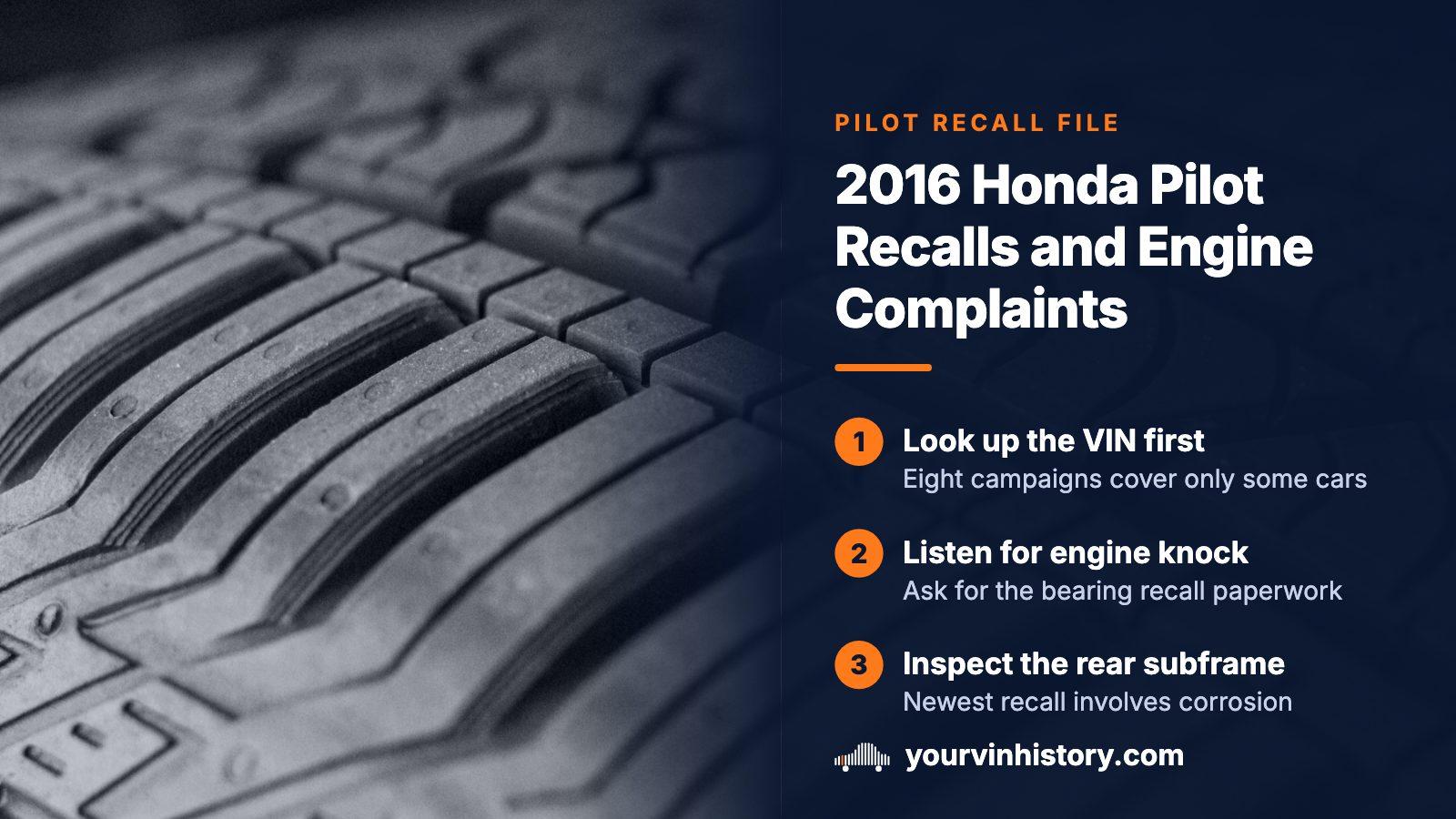
The 2016 Honda Pilot has 8 recall campaigns on file with NHTSA, among them fuel tank, fuel pump, engine bearing and rear subframe actions. Owners filed 1,679 complaints, and 756 name the engine. NHTSA gave the SUV 5 stars overall and 4 in the frontal test. Recalls follow VIN ranges, so run the exact car through NHTSA's lookup before you pay, then have a mechanic listen to the engine.
- Recall campaigns
- 8 on file with NHTSA
- Owner complaints
- 1,679, with 45% naming the engine
- NHTSA overall rating
- 5 stars, 4 in the frontal test
- Against other Pilot years
- Heaviest of 15, at 6.22 times the median
What the 2016 Pilot's federal file does and does not say
NHTSA keeps two ledgers for every model year. A recall campaign is a defect the manufacturer has accepted and promised to repair. A complaint is one owner's account, filed with no check on the diagnosis. The 2016 Pilot has 8 of the first and 1,679 of the second, and neither count is a grade, only a guide to what to inspect.
In the August 2026 pull, the narratives flagged 23 crashes, 9 fires and 20 injuries. The filer's wording, not an investigator's, sets those flags, and one event can produce several filings, but read those entries in full. NHTSA also lists 4 investigations for this model year, which are early signals, not findings.
All eight campaigns, sorted by the part they repair
Keep this table beside NHTSA's lookup for the car in question. The last column paraphrases each notice, but the VIN range decides.
| Part involved | NHTSA number | Honda code | Who is in scope |
|---|---|---|---|
| Fuel tank, leak risk | 17V219000 | KE8 | Certain 2016 Pilots |
| Fuel tank, weak welds | 16V417000 | KA9 | Pilot, Odyssey and Acura MDX |
| Third-row seat belt | 15V424000 | JS7 | Built May 4 to June 5, 2015 |
| Dash warning lamps | 15V668000 | JV7 | Built May to September 2015 |
| Hood latch striker | 21V932000 | PBV | 2016 through 2019 Pilots and other models |
| Engine bearing | 23V751000 | XG1 and GG0 | Certain 2016 Pilots and some later years |
| Fuel pump module | 23V858000 | KGC and KGD | 2015 through 2020 Pilots and many others |
| Rear subframe | 26V365000 | AOU and AOT | 2016 through 2022 Pilots sold in listed states |
Fuel tank and fuel pump: three campaigns
Two campaigns concern the tank. Number 17V219000 covers 2016 Pilots whose tanks may leak, raising fire risk near an ignition source. Number 16V417000 also takes in the 2015 and 2016 Odyssey and the Acura MDX. Those tanks had welds too weak to hold, so a seam can separate and let fuel out. Dealers replace the tank in both, and the second action began on July 29, 2016.
The third, 23V858000, concerns the in-tank fuel pump, which may fail and stall the engine while the vehicle is moving. The remedy is a new pump module. The notice names a long list of Honda and Acura models and widens two earlier actions, so only the VIN settles it.
The engine campaign and the knocking in owner reports
Number 23V751000 deserves a second read. Honda says a manufacturing error can let a connecting rod bearing wear and seize, damaging the engine, which may then run badly or stall while driving. NHTSA lists fire, crash and injury as the risks. Dealers inspect, then repair or replace the engine as needed.
Set that beside the complaint file. Among the engine narratives, many describe a metallic knock from low in the engine, dozens cite this campaign by number, and some say a shop traced the damage to a rod. Several owners write that their VIN was not on the list.
756 is not a count of failed bearings
NHTSA's ENGINE category takes any engine complaint, from a rough idle to a thrown rod, and owners choose it themselves. This recall's component sits under Engine and engine cooling, a separate label with 45 filings. Let a mechanic's ear and the repair records decide.
Rear subframe corrosion, the newest campaign
Number 26V365000 is the newest entry, logged in 2026. Honda says the rear subframe can corrode where the suspension attaches, and a failed part such as the control arm could cost the driver handling and control. It applies to 2016 through 2022 Pilots sold in a named list of jurisdictions, among them New York, Ohio, Michigan, Illinois and Virginia. The repair is an inspection, a reinforcement kit and new subframe parts where needed.
Interim letters have gone out, and the final remedy was expected in fall 2026, so ask a dealer what it can do today and get the answer in writing. Where the car was first sold decides scope, so trust the VIN result over the seller's home state.
Seat belt, warning lamp and hood campaigns
- 15V424000, third-row belt: an assembly slip could pinch the belt behind the seat, leaving a rear passenger poorly restrained. The campaign opened August 6, 2015.
- 15V668000, warning lamps: on early cars, a failing tire pressure, anti-lock or stability control system might not light its dash warning until the ignition was cycled, which left the cars out of line with federal standards 126, 135 and 138. The fix is a cluster software update, begun December 11, 2015.
- 21V932000, hood latch: a damaged striker can let go, so the hood may swing up in motion and block the driver's view. It spans 2016 through 2019 Pilots, the 2019 Passport and 2017 through 2020 Ridgeline. Letters went out January 18, 2022.
An attentive owner would have closed all three long ago, so an open one says something about the car's care.
Where the 1,679 complaints land, and when
Owners pick the component when they file, and one filing can name several, so shares add up past 100%. The right-hand columns show the median age of the Pilot when the owner says the problem happened.
| NHTSA component | Filings | Share | Median age at failure | Within first three years |
|---|---|---|---|---|
| Engine | 756 | 45% | 7.4 years | 8% |
| Electrical system | 578 | 34% | 4.8 years | 17% |
| Unknown or other | 289 | 17% | 4.8 years | 20% |
| Power train | 198 | 12% | 4.4 years | 31% |
| Fuel and propulsion | 165 | 10% | 6 years | 12% |
| Structure | 53 | 3% | 3.4 years | 43% |
| Engine and engine cooling | 45 | 3% | 8.8 years | 2% |
| Vehicle speed control | 39 | 2% | 3.4 years | 44% |
Smaller groups include stability control, brakes and steering. The electrical narratives keep returning to a car that will not start or shuts off, a dash lit with warnings and a drained battery. The electrical label also covers wiring, lighting and modules, so it never counts one part.
Age at failure, and where 2016 ranks among Pilot years
Engine reports sit at a median of 7.4 years, only 8% of them inside three years, and engine and cooling comes later at 8.8. Speed control and structure arrive earliest, at 3.4 years, yet fewer than half of even those fall inside three years. Most of what owners describe surfaced after a typical new-car warranty would have ended, and filings peaked in 2022, six years on, which fits mileage wear better than a launch defect. These medians say when filers placed the trouble, not how likely your Pilot is to suffer it.
Measured against the Pilot's own median year, which strips out most of the sales-volume effect, the 2016 ranks first for complaints among 15 Pilot years from 2008 through 2022, at 6.22 times the median. The lightest settled year is 2015, at 0.4 times. That ranks owner reports, not reliability, and the newest years look light because young cars have had little time to collect filings.
Crash ratings and the driver aids that were optional
| NHTSA result | Test |
|---|---|
| 5 of 5 | Overall |
| 4 of 5 | Frontal crash |
| 5 of 5 | Side crash |
| 4 of 5 | Rollover |
| 16.4% | Rollover probability, all-wheel drive |
NHTSA scored the all-wheel-drive and front-drive versions separately, and both earned 5 overall and 4 for rollover. The frontal 4 comes from the passenger side, since the driver side scored 5. Stability control was standard, though campaign 15V668000 shows its warning lamp could stay dark on early cars. Forward collision warning and lane departure warning were optional. The stars describe a new example in a laboratory, so earlier damage or structural repair changes the picture.
What to check on a used 2016 Pilot
- Engine: cold start and warm idle with the radio off, listening for a metallic knock from low in the engine. Ask for oil-change records and any paperwork on campaign 23V751000.
- Electrical: start it several times, confirm each dash warning lamp lights at start-up and then goes out, and ask whether it ever needed a jump.
- Underbody: check the rear subframe and suspension mounts for flaking or swollen rust, and learn where the car was first sold.
- Engine bay: fire narratives exist for this model year, so look for heat damage, melted insulation and amateur wiring.
- Hood and third row: a firm latch with an undamaged striker, working rear belts and seat mechanisms, and a dry floor beneath them.
- Drivetrain and body: all-wheel drive engages, and the tailgate seals and spare well show no water.
Recall repairs, the seller and the VIN
Enter the 17-character VIN at NHTSA's recall lookup before any money moves, and again before signing, because new campaigns appear. Dealers do recall repairs at no charge only within the federal rule's limits: under 49 U.S.C. section 30120, the requirement lapses when the first purchaser bought the vehicle more than 15 calendar years before the manufacturer's notice. A 2016 Pilot is inside that window for these campaigns, but it is a limit, not a promise.
Ask the seller for repair orders showing each campaign was completed, since a mailed notice is not a repair. Ask whether the engine was ever opened or replaced, who serviced the car, whether an insurer paid for a collision, and whether the title carries a lien. Then book your own mechanic's inspection.
NHTSA covers safety defects only. A yourvinhistory report gathers title brands, accidents and odometer readings by VIN, starting with a free preview.
Where this information comes from
- NHTSA: recalls by vehicle — Where a VIN is entered to see open campaigns; the eight campaign summaries here follow the agency's own notices.
- NHTSA: vehicle safety and consumer complaints — Entry point to the owner filings behind the 1,679 total, the component counts and the crash, fire and injury flags.
- 49 U.S.C. §30120: remedy without charge — Statute text for the no-charge remedy and the 15 calendar year limit that ends it.
- NHTSA: 5-Star Safety Ratings — The crash-test program behind the stars, the rollover probability and the two tested configurations.
- NMVTIS: national title information system — Federal source for title brands and history, which a safety record leaves out.
Sources and photos: Facts checked against the sources above in October 2026. Photo by Joan on Unsplash; diagrams by YourVINHistory.
Keep reading
- Honda Pilot years to avoid: 2016, 2017 and 2019 lead NHTSA complaintsRanks every Pilot model year by complaints, so you can see how 2016 compares.
- Honda recallsExplains how to check any Honda by VIN for open campaigns.
- Buying a car with an open recallCovers what to do when the lookup shows a repair was never made.
- Honda Pilot transmission fluid change cost: quote the trim, not the yearCovers the Pilot's fluid service, where one model year can carry two different transmissions.
Frequently asked questions
Which recalls are on file for the 2016 Honda Pilot?
NHTSA lists 8 campaigns, numbered from 15V424000 in 2015 to 26V365000 in 2026. Some are narrow, such as the third-row belt action for about a month of production, and others span several model years. Ranges are set by VIN, so only that car's lookup shows which are open.
Is the 2016 Honda Pilot a reliable used SUV?
The federal record cannot grade reliability. It shows a heavy complaint year, 6.22 times the Pilot median, led by the engine and electrical system. That points you to service records, the engine campaign paperwork and a pre-purchase inspection. Documented maintenance and finished recalls make a different purchase from a car with gaps.
Does the engine recall cover every 2016 Pilot?
No. Campaign 23V751000 names certain 2016 Pilots plus some from later years, and the VIN decides membership. Several owners in NHTSA's filings report a rod failure on a Pilot that was not on the list. If a car knocks and shows no open campaign, ask a Honda dealer for a written inspection and consider filing your own NHTSA complaint.
Does a dealer fix Pilot recalls at no charge on a used one?
Within the federal limit, yes. Dealers repair a covered recall without billing the owner, and the statute's cutoff is 15 calendar years from the first retail sale to the manufacturer's notice. Bring the VIN and campaign number when you book, and expect a wait if parts are not yet available.
Where do these numbers come from, and how current are they?
They come from NHTSA's public recall, complaint and ratings databases, pulled in August 2026, with the engine and subframe wording rechecked against NHTSA's recall records afterward. Complaint totals keep rising as owners file, so a lookup today may show more than 1,679.
Now check the car itself
The guide explains what to look for. The report shows what this VIN has on record.