THE SHORT ANSWER
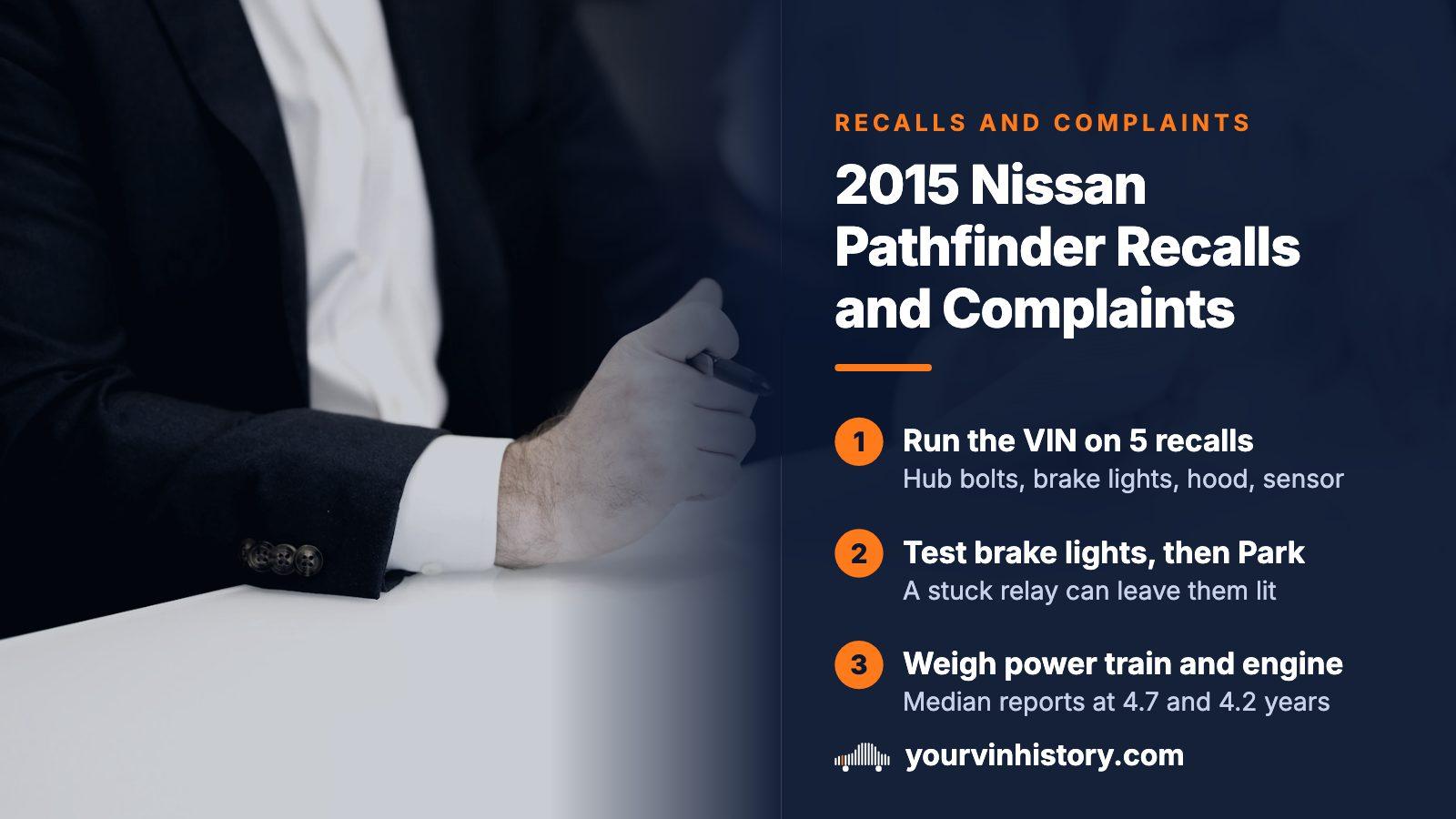
The 2015 Nissan Pathfinder has 5 recall campaigns with NHTSA: wheel hub fasteners, the brake light switch, the hood latch, and two on the front passenger seat sensor. Owners filed 319 complaints, led by unknown or other (79), power train (76) and engine (74). NHTSA gave it 5 of 5 stars overall and 4 for frontal and rollover. Run the VIN to see which recalls apply.
- Recall campaigns
- 5 on file with NHTSA
- Owner complaints
- 319, led by unknown or other at 79
- Crash rating
- 5 of 5 overall; 4 frontal, 4 rollover
- Against other Pathfinder years
- 3.47 times the median year
Three grades of federal record, and what each one proves
NHTSA's file on this model year mixes records of very different weight. A recall campaign is the heaviest: the manufacturer has accepted a defect and owes the owner a repair at no charge, and this Pathfinder has 5. A complaint is the lightest, one owner's unverified account, and NHTSA held 319 when this page was compiled in August 2026. An investigation sits between them, an agency probe of a possible pattern. One is listed, open or closed.
Filers can flag what happened: 11 of the 319 describe a crash, 1 a fire and 7 an injury. Those flags rest on the owner's own account, and one incident can produce several reports, so treat them as entries worth opening in full, not as findings. Counts drift upward as late reports and new campaigns arrive.
The five campaigns, oldest first
Campaign numbers are the handle for dealers and for NHTSA's search. Two name only the Pathfinder; the other three share notices with sister models.
| Campaign | Problem area | Pathfinder years named | Dealer repair |
|---|---|---|---|
| 15V012000 | Front wheel hub fasteners | 2014-2015, built August 14 to November 5, 2014 | Inspect and tighten loose bolts |
| 15V681000 | Wrong passenger-seat sensor unit fitted during a repair | 2013-2015 | Software update |
| 16V244000 | Passenger-seat sensor misjudging the occupant | 2013-2016 | Replace the sensor control unit |
| 21V020000 | Brake light switch and relay | 2013-2015 | Re-seat or swap the switch, new relay |
| 22V420000 | Secondary hood latch | 2013-2016 | Replace the bell crank assembly |
Wheel hub bolts, a brake light relay and the hood latch
Campaign 15V012000 began on the assembly line: front wheel hub fasteners may not have been tightened to specification. Loose ones could let a brake caliper separate from the wheel assembly, reducing braking or steering control. It covers Pathfinders built from August 14 to November 5, 2014, so a car outside that window is not in it. Dealers inspect and tighten; the remedy began February 2, 2015.
Campaign 21V020000 is a switch placement problem. The brake light relay can open and close repeatedly until it sticks on, leaving the lights lit with the pedal up, and the same fault can let the lever leave Park without the brake pressed. Lights stuck on hide braking from the driver behind, and an unbraked shift out of Park invites rollaway. Dealers re-seat or swap the switch and fit a new relay, work that began March 1, 2021 under Nissan's number PC786.
Campaign 22V420000 is the newest. On some 2013 to 2016 Pathfinders the secondary latch can stay unlatched after the hood is shut, and a hood that lifts at speed blocks the driver's view. Nissan mailed owner letters on March 26, 2025, so a previous owner who sold earlier may never have heard of it.
Two campaigns on the front passenger seat sensor
Both air bag campaigns involve the occupant classification system, which decides whether the passenger air bag should be ready for whoever sits there. In 15V681000, some cars received the wrong control unit during an earlier repair, and it could read an adult as an empty seat; dealers update its software. In 16V244000, which spans many Nissan and Infiniti models, the system may rate an adult as a child or the seat as empty; Pathfinder dealers replace the control unit.
Air bag complaints number 55, or 17%, and they arrived early: a median of 1.4 years after the model year, 75% within three years. NHTSA's category does not name the sensor, so any match is a lead, not a finding. Check that the warning lamp clears at start-up, and ask for paperwork on both.
Sorting the 319 complaints by the system owners blamed
NHTSA files each complaint under the system the owner named; all twelve categories follow, largest first.
| Reports | NHTSA category | Share |
|---|---|---|
| 79 | Unknown or other | 25% |
| 76 | Power train | 24% |
| 74 | Engine | 23% |
| 55 | Air bags | 17% |
| 27 | Vehicle speed control | 8% |
| 26 | Electrical system | 8% |
| 25 | Service brakes | 8% |
| 12 | Structure | 4% |
| 11 | Fuel / propulsion system | 3% |
| 10 | Visibility / wiper | 3% |
| 8 | Exterior lighting | 3% |
| 7 | Electronic stability control | 2% |
The top three sit close together at 79, 76 and 74, a scatter of ordinary gripes more than one systemic fault. Keep the buckets in proportion: power train takes in more than the transmission, engine covers any engine fault, and unknown or other is a catch-all.
Where 2015 falls among Pathfinder model years
A raw complaint total mostly tracks sales, so this page leans on a comparison: each year's count set against the median year for the same nameplate. By that yardstick the 2015 Pathfinder runs at 3.47 times the median, the fourth heaviest of 14 model years on record.
| Marker | Model year | Multiple of the median |
|---|---|---|
| This page | 2015 | 3.47 |
| Heaviest year | 2013 | 9.67 |
| Lightest settled year, not a recent one | 2012 | 0.25 |
Filings for the 2015 peaked in 2019, years after the car was new. A late peak fits wear that comes with age and mileage better than a launch defect. The multiple is not a failure rate: it shows how loudly owners spoke up, not how often cars broke.
How old the car was when each problem was reported
Each complaint carries the date the owner gives, which set against the model year yields the car's age then. The table shows the median age per system and the reports behind it.
| System | Median age in years | Reports | Within three years |
|---|---|---|---|
| Air bags | 1.4 | 55 | 75% |
| Structure | 3.1 | 12 | 50% |
| Unknown or other | 4.2 | 79 | 15% |
| Engine | 4.2 | 74 | 8% |
| Vehicle speed control | 4.3 | 27 | 15% |
| Service brakes | 4.3 | 25 | 24% |
| Electrical system | 4.6 | 26 | 12% |
| Power train | 4.7 | 76 | 26% |
Air bags and structure surfaced early, while many cars were still under factory warranty, so a well-kept example may have had that work done; ask for paperwork. Power train arrives latest, and engine reports came late too, with only 8% in the first three years. Those two are the systems to budget around.
Medians are not predictions
These figures time unverified filings; they are not odds. A well-documented car can outlast every age in the table, and a neglected one can fail sooner.
Crash-test stars: what the lab measured and what it skipped
NHTSA tested two configurations, all-wheel drive and front-wheel drive; both earned 5 stars overall and 4 for rollover. The table is the all-wheel-drive result.
| Test | NHTSA stars |
|---|---|
| Overall score | 5 stars |
| Side impact | 5 stars |
| Frontal impact | 4 stars |
| Rollover resistance | 4 stars |
| Chance of rollover | 17.9% |
The frontal 4 comes from the driver side, which earned 4 while the passenger side earned 5. Electronic stability control is standard, but NHTSA lists neither forward collision warning nor lane departure warning as offered. Stars describe a new vehicle in a laboratory; a structural repair can change how a body behaves in a crash, and no rating captures that.
How long a recall repair stays at no charge
Federal law, 49 U.S.C. §30120, requires a recall remedy at no charge, with a limit. It does not apply when the first purchaser bought the vehicle more than 15 calendar years before the manufacturer's notice, or before an NHTSA order, whichever came first. The clock is read on the date of that notice, not the day you reach the dealership.
So a campaign announced while the car was inside the window keeps the no-charge requirement, while one announced after the window has shut need not be free. Model years do collect campaigns late; this one's hood latch recall dates from 2022. Dealers do the work, and the remedy follows the vehicle, not the owner who got the first letter.
What to put in front of a mechanic
Only the car answers what the data raises.
- Power train and engine: take a long drive with a cold start, a hot restart and shifts under load.
- Brake lights and Park: have a helper watch the lights as you press and release the pedal, and confirm the lever will not leave Park without the brake.
- Front wheels: if the door-jamb build date falls between August 14 and November 5, 2014, ask for the hub fastener repair record.
- Passenger seat: the air bag lamp should go out after start-up, and both sensor campaigns should have paperwork.
- Hood: close it, press down, and ask for proof of the latch repair.
- Engine bay: one fire report exists for this model year, so look for heat marks, melted insulation and amateur wiring.
- SUV wear points: all-wheel-drive engagement, tailgate seals and the spare well for damp, third-row mechanisms, and roof rail mounts.
Questions for the seller, then the VIN
- Which of the 5 campaigns were done, and where are the repair orders?
- Which shop has maintained it, and may I read the service file?
- Has an insurer ever paid for collision damage on this car?
- Will you let my own mechanic look it over before a price is discussed?
- Is the title in your name, and does any lender still hold a lien?
NHTSA's recall lookup, which costs nothing, shows the campaigns still open on one VIN, but nothing about title, accidents or mileage. A yourvinhistory report on the same VIN covers title brands, accident and damage records, odometer readings, salvage and auction history, liens, theft and open recalls. The preview comes first; the full report is a one-time purchase.
Where this information comes from
- NHTSA: recalls lookup by VIN — Where a VIN is entered to see unrepaired campaigns; the five campaign summaries above come from the same records.
- NHTSA: vehicle safety and owner complaints — Entry point to the complaint filings behind the 319 total, the category shares and the investigation count.
- NHTSA: 5-Star Safety Ratings — The crash-test program behind the overall, frontal, side and rollover results for both configurations.
- 49 U.S.C. §30120: remedies for defects — Statute text for the no-charge remedy and the limit counted in calendar years from the first purchase.
- NMVTIS: national title information system — Federal source for title brands and history, which a safety record never covers.
Sources and photos: Facts checked against the sources above in October 2026. Photo by Carrie Allen www.carrieallen.com on Unsplash; diagrams by YourVINHistory.
Keep reading
- Nissan Pathfinder years to avoid: 2013 and 2014 lead the complaintsRanks every Pathfinder year against its own median, which puts the 3.47 multiple in context.
- Nissan recallsShows how to check any Nissan by VIN for open campaigns.
- Buying a car with an open recallCovers what to do when the lookup shows one of these repairs was never made.
- Nissan Pathfinder transmission replacement cost: which years Nissan paid forPrices a transmission job, relevant because power train is the second largest complaint group here.
Frequently asked questions
Does the 2015 Nissan Pathfinder have open recalls?
NHTSA lists 5 campaigns, from wheel hub fasteners in early 2015 to a hood latch campaign with owner letters in 2025. Whether any is still open depends on the VIN, because each applies by range and a car may have been repaired already. The list can also grow, so the lookup for one VIN is the count that matters.
Is the 2015 Nissan Pathfinder a safe SUV?
In NHTSA's lab tests it did well: 5 of 5 stars overall and for side impact, 4 in the frontal and rollover tests. For a used one, the open question is repairs rather than stars. The recall fixes only help if a dealer completed them, and a past collision can change how the body performs.
What are the most common problems on a 2015 Pathfinder?
No single system dominates the 319 complaints. Unknown or other leads with 79, then power train with 76 and engine with 74, with air bags fourth at 55. Power train and engine reports carry median ages of 4.7 and 4.2 years. They are owner accounts, not confirmed defects.
Will a Nissan dealer fix an open recall on a used 2015 Pathfinder?
Recall remedies attach to the VIN, so a second or third owner can claim them as the first could. The repair is at no charge while the federal rule applies, and that rule stops covering a campaign announced more than 15 calendar years after the first retail purchase.
How can I tell whether a specific Pathfinder had its recalls repaired?
Enter the VIN in NHTSA's recall lookup; it lists campaigns still waiting for a repair on that exact car. A clean result says nothing about accidents, title brands or odometer history. Ask the seller for repair orders that carry the campaign numbers, then compare them with the table on this page.
Now check the car itself
The guide explains what to look for. The report shows what this VIN has on record.