THE SHORT ANSWER
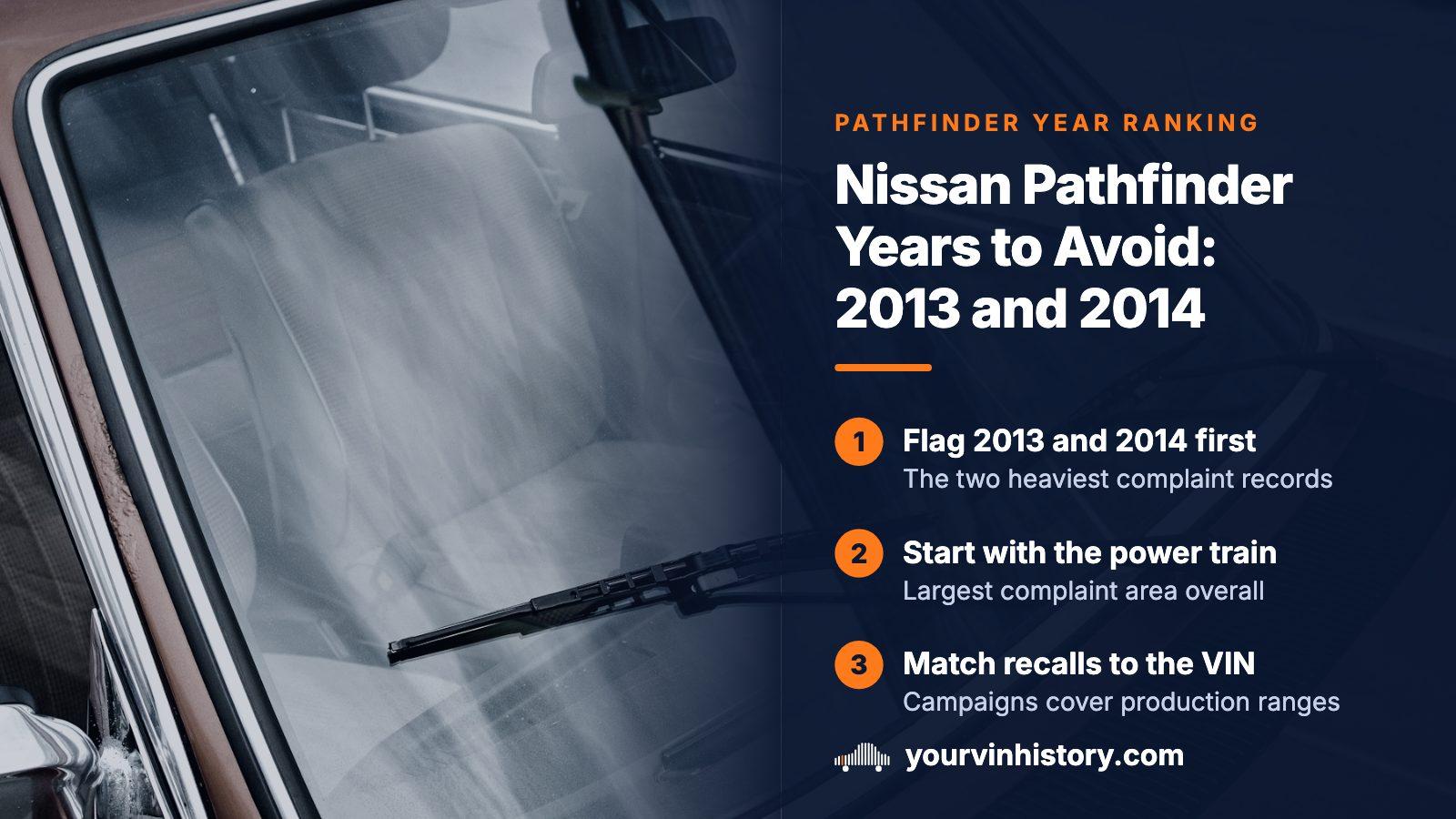
By NHTSA complaint volume, the 2013 and 2014 Nissan Pathfinder stand out most, at 890 and 583 reports against a median year of 92. The 2008, 2015 and 2017 years also run high. The lightest older records belong to 2012, 2009, 2010 and 2011. Power train is the largest complaint area, with 916 reports across all years. Complaints are unverified owner accounts, not failure rates, so a flagged year means inspect harder and price accordingly.
- Complaints on record
- 2,893 across 2008 to 2022
- Median year
- 92 complaints
- Heaviest year
- 2013, with 890 complaints
- Top complaint area
- Power train, 916 reports
Two model years dwarf the rest of the Pathfinder record
Most Pathfinder years sit in a modest band. The 2013 year does not: NHTSA holds 890 complaints against it, which is 9.67 times the yearly median of 92, and the 2014 year follows with 583. Nothing else comes near that pair.
The edges make the pattern stranger. The 2012 year has just 23 complaints, the lowest count in the set, and the very next model year leaps to 890. After that the counts fall year by year, 583 and then 319, down to 107 by 2016, with a bump at 2017. A jump that sharp often lines up with a change in how the vehicle was built, though complaint data cannot say what changed here.
Every Pathfinder year measured against its own median
Raw totals follow sales, so a popular SUV out-complains a scarce one even when every car is sound. To damp that, each year is scored against the Pathfinder's own median year instead of against other models. The median is 92, the midpoint between the 2018 count of 77 and the 2016 count of 107, and a reading of 1× means an ordinary year for this SUV.
The span runs 2008 through 2022 but holds 14 model years, because 2021 has no row in the data. Duplicates were removed by ODI complaint number, and the pull is dated 2026-08-15, so later filings are not counted.
| Model year | Reading | Multiple of median | Complaints | Recalls |
|---|---|---|---|---|
| 2008 | High | 3.57× | 328 | 5 |
| 2009 | Light | 0.4× | 37 | 4 |
| 2010 | Light | 0.43× | 40 | 5 |
| 2011 | Light | 0.49× | 45 | 2 |
| 2012 | Light | 0.25× | 23 | 2 |
| 2013 | Extreme | 9.67× | 890 | 11 |
| 2014 | Extreme | 6.34× | 583 | 11 |
| 2015 | High | 3.47× | 319 | 5 |
| 2016 | Typical | 1.16× | 107 | 2 |
| 2017 | High | 2.01× | 185 | 2 |
| 2018 | Typical | 0.84× | 77 | 3 |
| 2019 | Typical | 0.8× | 74 | 2 |
| 2020 | Typical | 0.57× | 52 | 0 |
| 2022 | Moderate | 1.45× | 133 | 5 |
| Median year | Benchmark | 1× | 92 | n/a |
The reading column uses plain words. Light means under half the median, Typical runs from just over half to a little above it, Moderate is clearly above it, High is double the median or more, and Extreme marks the two years far past everything else.
The five years that run high, one by one
Five model years sit at double the median or higher. Each line gives the area owners name most often for that year.
- 2013: 890 complaints, 9.67× the median, 11 recalls. Power train and air bags both stand out.
- 2014: 583 complaints, 6.34×, 11 recalls. Power train is the most reported area.
- 2008: 328 complaints, 3.57×, 5 recalls. Power train leads again.
- 2015: 319 complaints, 3.47×, 5 recalls. The top label is unknown or other, so owner reports give no tidy story for this year.
- 2017: 185 complaints, 2.01×, 2 recalls. Engine is the area owners report most.
The 2017 count is the odd one out. It sits between a 2016 year at 1.16× and a 2018 year at 0.84×, so it reads as a local bump, not part of the 2013 and 2014 block. The data does not say why.
The quiet records, and the footnote on each
Four model years sit well under the median: 2012 with 23 complaints, 2009 with 37, 2010 with 40 and 2011 with 45. In multiples, that is 0.25× to 0.49×.
Three cautions go with them. A light record is not a recall-free record: the 2010 year carries 5 recalls, the same as the 2008 year that draws 328 complaints. Next, 2012 sits directly before the 890-complaint year, and a thin record there is no promise about its neighbor. Last, the newest model years stay out of this list on purpose, because a young SUV has had little time to collect owner reports.
The newest years: a 2022 step and a missing 2021
Between the 2020 count of 52 and the 2022 count of 133, the table has a hole: 2021 has no row. The step up cannot be pinned on a single transition, and the data offers no reason for it. What it shows is that the 2022 year, the newest in the set, already holds more complaints than 2016, 2018, 2019 or 2020, at 1.45× the median.
It also carries 5 recalls, where the 2020 year has none. A young model with 133 complaints and 5 recalls is still building its record, so treat both figures as early readings and look up the exact VIN.
Where owners say the trouble sits
NHTSA files every complaint under a broad component heading. Across all years, the biggest pile on the Pathfinder sits under power train. That heading covers more than one part, so it shows where owners filed, not which component failed.
| Complaint area | Reports, 2008 to 2022 | What stands out |
|---|---|---|
| Power train | 916 | Largest area overall, and prominent in the 2013 peak year |
| Engine | 503 | Second-largest, and the leading area for 2017 |
| Air bags | 423 | Third-largest, and also prominent in 2013 |
| Unknown or other | 418 | A catch-all label that leads the 2015 year |
| Service brakes | 111 | Owners reporting brake defects, not routine pad wear |
| Electrical system | 95 | Battery, wiring and modules share this heading |
Power train and air bags both show up in 2013, so the heaviest year and the heaviest area point the same way. A mechanic looking at any Pathfinder, whatever its year, can treat this list as a map of where to look first.
Why the recall column does not mirror the complaints
A recall is a defect campaign the maker has acknowledged. A complaint is one owner's unverified account. They measure different things, so they can disagree. The 2013 and 2014 years carry 11 recalls each, the most in the table, and also the most complaints. Yet 2009, 2010 and 2011 show 4, 5 and 2 recalls beside light complaint counts, and the 2020 year has no recalls at all.
The repair has a time limit, too. Under 49 U.S.C. §30120(g), a maker's duty to fix a recalled vehicle at no charge lapses 15 years after the first sale. On the oldest Pathfinders in this range that window may already be closed, so ask a dealer whether an open campaign is still covered before you count on the repair.
Campaigns are also written for production ranges, not whole model years. A year's recall count cannot tell you whether the car you are viewing is affected. Only a VIN lookup answers that.
What a complaint count cannot tell you
- Sales volume: a popular year collects more filings than a scarce one of identical quality, which is why the table scores against the Pathfinder's own median.
- Age: an older year has had longer to gather reports, so the newest years are left out of the cleanest list instead of being ranked best.
- Accuracy: a complaint records what the owner believed happened. That is useful in aggregate and shaky for any single car.
- Meaning: a count is not a failure rate or a reliability score, and nothing here says how many Pathfinders of any year had a problem.
- Scope: no figure describes the SUV in front of you, whose history is its own.
Use a flag to price the risk
Every year in this table includes cars that were looked after and cars that were not. A high count is a reason to inspect harder and to bargain, not a reason to rule out a Pathfinder you have not yet seen. A low count is not a pass.
Inspecting a 2013, 2014 or 2008 Pathfinder before you pay
Start from the complaint map above and work down it.
- Ask for the service records and read them before the test drive. On an SUV this old, a documented maintenance history says more than any model-year statistic.
- Put the power train first. On the drive, notice how it pulls away from a stop, how it responds under throttle, and any noise or hesitation, both cold and warm.
- Have the engine checked on a lift and with a scan tool, looking for leaks, warning lights and stored fault codes.
- Watch the dash at start-up. The air bag light should glow briefly and go out. One that stays on, or never lights at all, needs an explanation from the seller.
- Run the VIN through NHTSA's recall lookup, note every open campaign, and ask whether the repair will still be done at no charge given the car's age.
- Book an independent pre-purchase inspection and tell the shop where the complaints cluster.
From a model year to one particular Pathfinder
A model year describes a crowd. The VIN describes one SUV: which recall campaigns cover its production range and whether the work was done, what its title record says, whether the odometer readings climb in a believable sequence, and whether it carries a theft or total-loss flag. No ranking of years can answer those.
Two public tools help. NMVTIS is the federal title record system, and NICB's VINCheck screens a VIN for theft and total-loss reports at no cost. A yourvinhistory report begins with a free preview, then the paid report puts title brands, accidents, odometer readings and open recalls for that VIN in one place.
Where this information comes from
- NHTSA: Vehicle safety — The federal complaint filings behind every owner count in the table, including the 2,893 total.
- NHTSA: Recalls — Where the recall counts per model year come from, and where a VIN is checked for open campaigns.
- Bureau of Justice Assistance: NMVTIS — Federal overview of national title records, which describe one car's title history instead of a model year.
- NICB: VINCheck — A no-cost screen for theft and total-loss reports tied to a single VIN.
Sources and photos: Facts checked against the sources above in October 2026. Photo by Tigran Shishmanyan on Unsplash; diagrams by YourVINHistory.
Keep reading
- 2015 Nissan Pathfinder recalls, complaints and what to inspectOne model year in full: its open recall campaigns and its complaints split by component.
- Nissan recallsHow to find open Nissan recalls by VIN, the first lookup on any Pathfinder.
- Nissan Pathfinder transmission replacement cost: which years Nissan paid forPower train leads the complaint areas; this post covers transmission replacement cost and the years Nissan covered.
- Nissan Pathfinder timing chain replacement cost by engine and yearEngine is the second-largest complaint area; this post covers a timing chain job and what each engine's record says.
Frequently asked questions
Which Nissan Pathfinder years should I avoid?
Look hardest at 2013 and 2014, which carry 890 and 583 NHTSA complaints against a median of 92, with 2008, 2015 and 2017 also running high. None is automatically off the table. If one is priced right, ask for service records, run the VIN for open recalls, and pay an independent shop to examine the power train and engine before you commit.
Which Pathfinder years have the cleanest record?
A complaint count is not a reliability score, so no year can be crowned from this data. It does show that 2012, 2009, 2010 and 2011 have the lightest records among the older years, at 23 to 45 reports. The newest years are left out of that comparison, since young cars have had little time to collect complaints and a low count there says little.
What do Pathfinder owners complain about most?
By NHTSA category, power train leads with 916 reports across 2008 to 2022, then engine at 503, air bags at 423 and a catch-all unknown or other label at 418. Service brakes and electrical system follow at 111 and 95. The headings are broad, so they point a mechanic toward systems to check, not toward one named failed part.
Does a high complaint count mean a Pathfinder is a bad car?
Not by itself. Counts rise with sales and with age, and each complaint is an unverified owner account. That is why this ranking uses the Pathfinder's own median instead of comparing it with other SUVs. A high count is a prompt to look closer and negotiate. It says nothing definite about the particular car you are standing next to.
How do I check a specific Nissan Pathfinder?
Start with the VIN. Run it through NHTSA's recall lookup for open campaigns, since those follow production ranges instead of model years. Then pull the title record through NMVTIS and screen for theft and total loss with NICB VINCheck. Finish with a pre-purchase inspection, since no database shows what a mechanic sees on a lift.
Now check the car itself
The guide explains what to look for. The report shows what this VIN has on record.